Interesting upcoming conference:
Exploring Human Host-Microbiome Interactions in Health and Disease.
8-10 May 2012 Wellcome Trust Conference Centre
Wellcome Trust Genome Campus
Hinxton, Cambridge, UK
See WT Scientific conferences for more detail.

Interesting upcoming conference:
Exploring Human Host-Microbiome Interactions in Health and Disease.
8-10 May 2012 Wellcome Trust Conference Centre
Wellcome Trust Genome Campus
Hinxton, Cambridge, UK
See WT Scientific conferences for more detail.
Well, how perfect is this. Today Wired ran a follow up “Birds, Poop and Roadkill: A field guide to Field Guides” to an article that came out last week about my drive for a full field guide to the microbes. Last weeks article was “Book of Germs: The Quest for a Field Guide to Microbes.” It is by Daniela Hernandez and was a follow up on my talk at AAAS on “A Field Guide to the Microbes” which you can see on YouTube here. I wrote a blog post with more detail on my obsession with field guides and microbes here.
While Daniela was writing the article I told her about how I collected field guides. And I sent her a link to a private album I had made of me and my field guides which I am now making public:
https://picasaweb.google.com/s/c/bin/slideshow.swf
For the follow up Daniela and a photographer from Wired Jon Snyder came to my office and lab and took some pictures of me and my field guides (with assistance from Russell Neches in my lab to help set up some of the “scenes).
Here are some pics from their visit.
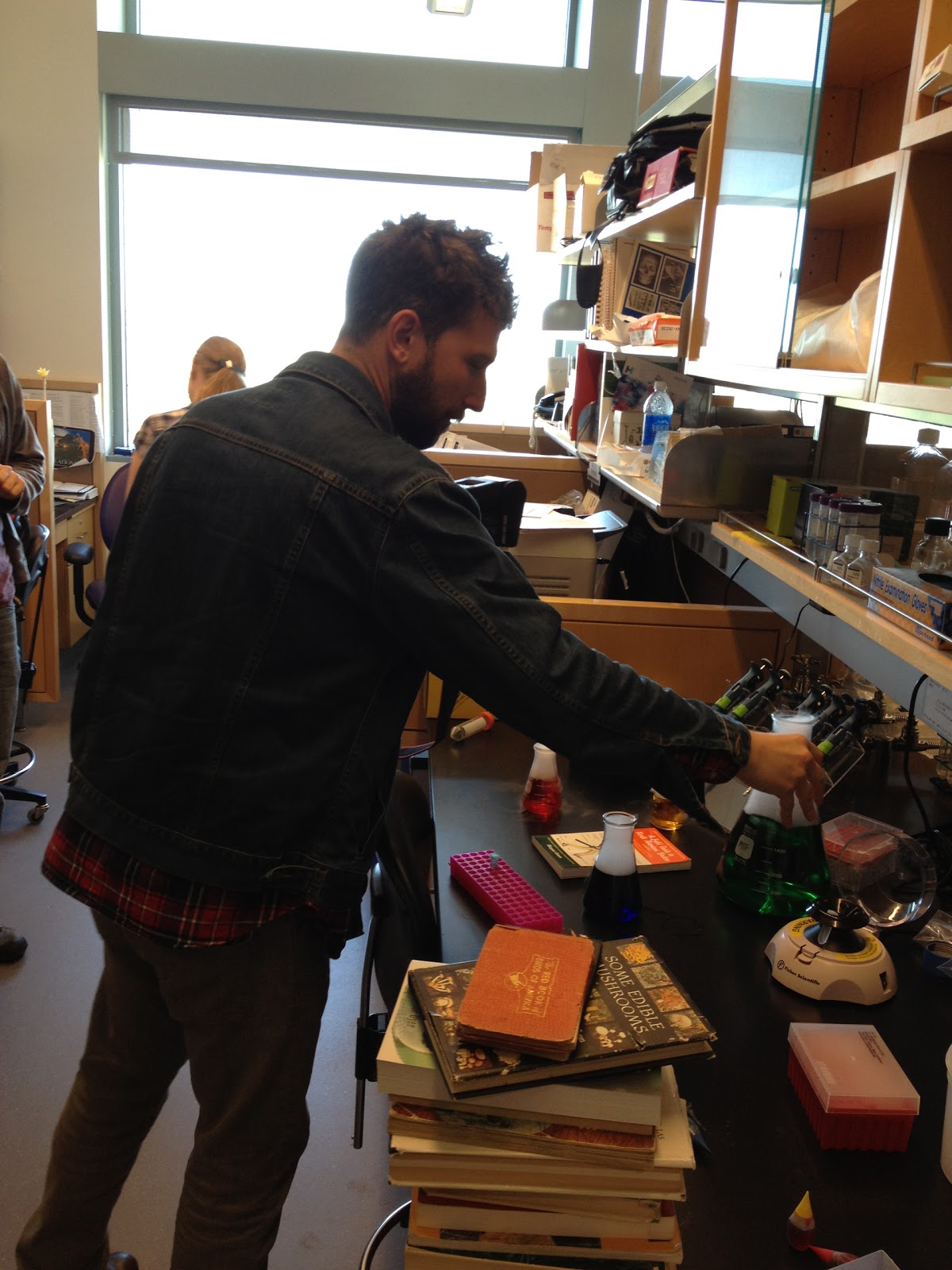

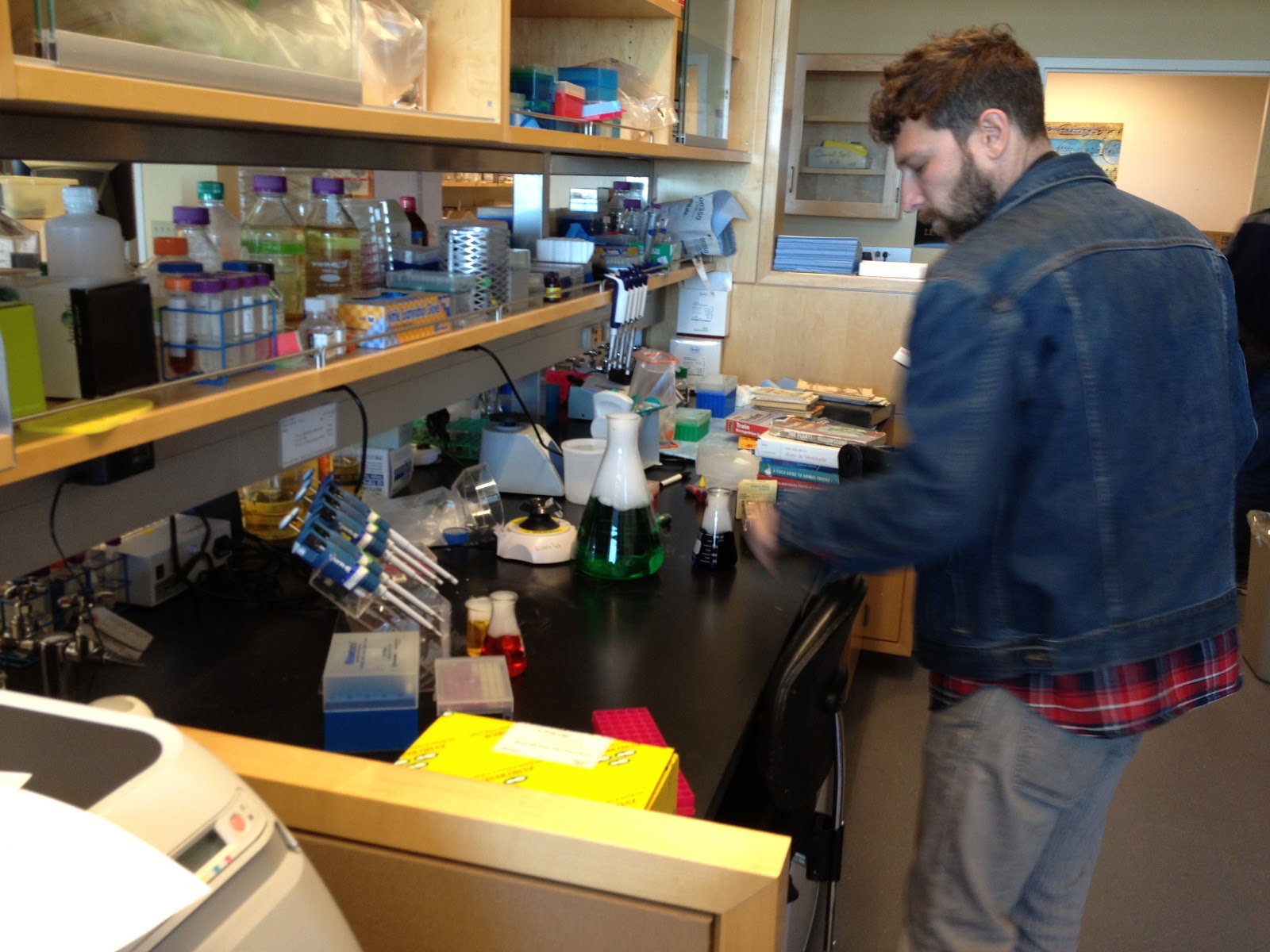
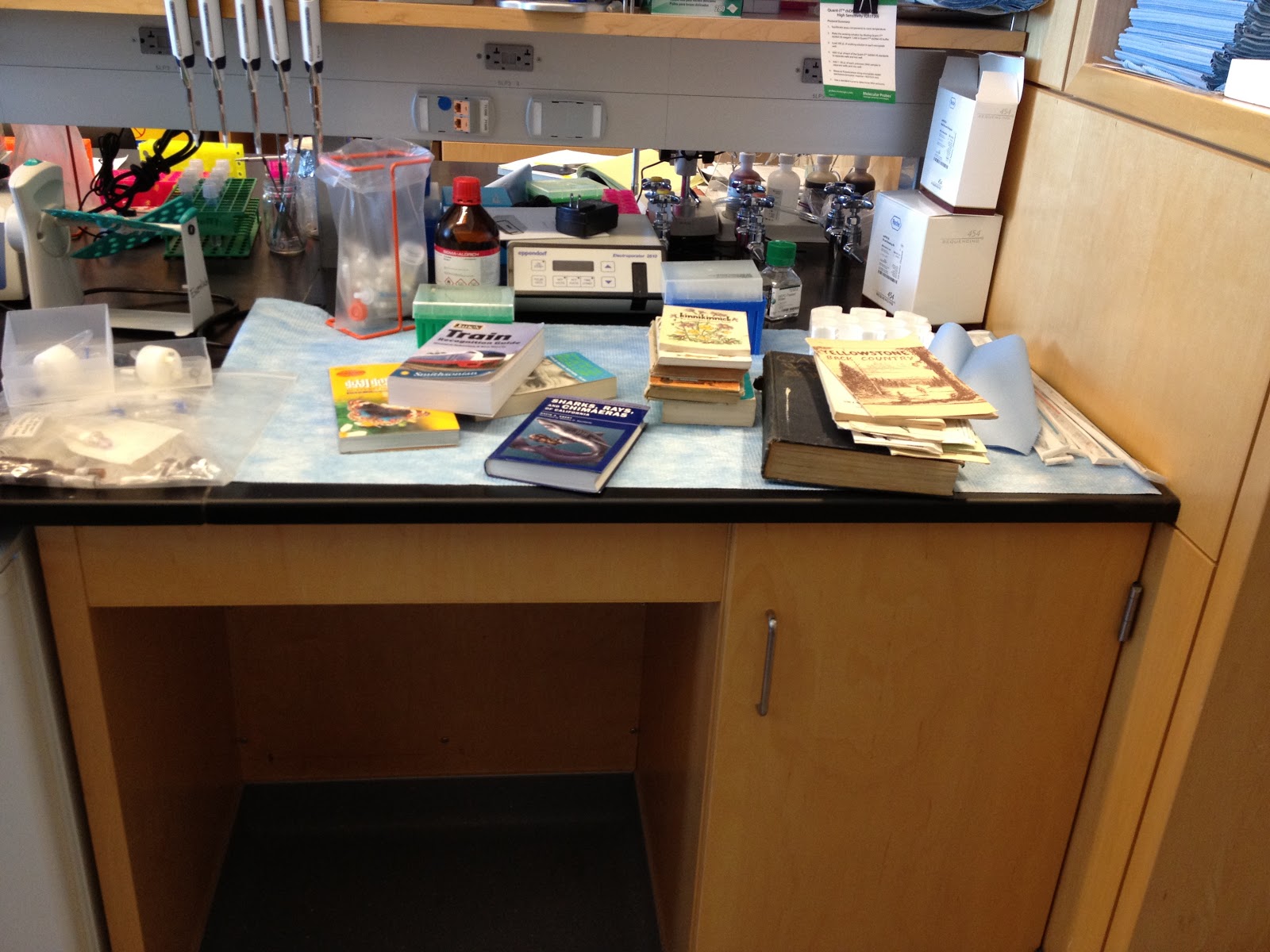

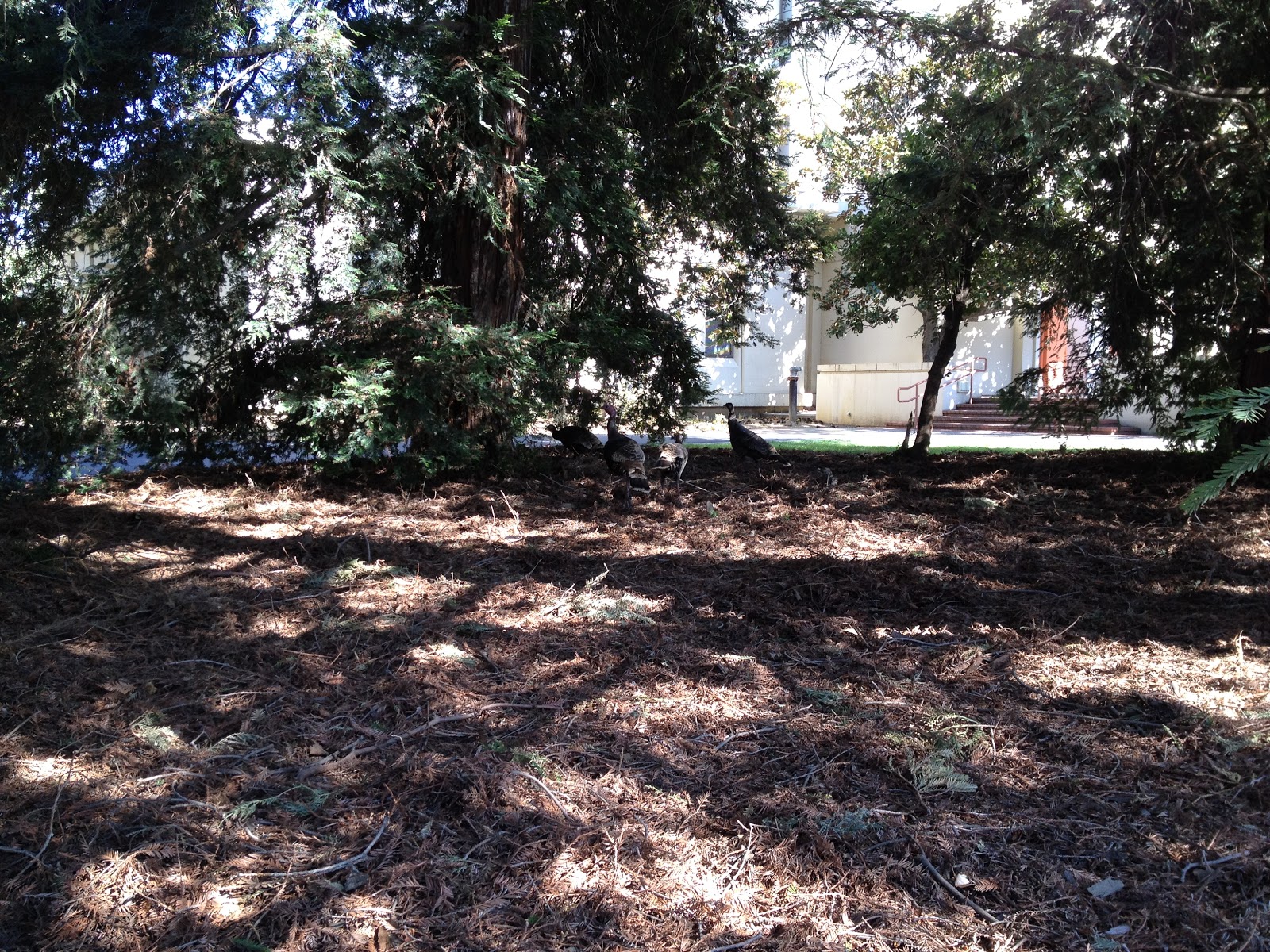
And now today, the Wired article came out and and amazing coincidence happened. I was taking a walk around campus with Misha Angrist who is giving a talk at UC Davis today. And on the walk first we saw a collection of turkeys wandering around campus:

I note – I love the Wired photo spread of my field guides and my lab. I particularly am happy that they includes some of the funnier field guides out there like “Flattened Fauna.” And I am glad they got in Betsy Dyer’s Field Guide to Bacteria because it is one of my favorite field guides of all time. Thanks to Russell Neches for helping out with it and Daniela Hernandez and Jon Snyder for their work.
Been playing around with Google Scholar‘s Citations system that allows anyone to create a mini page with their publications. Here is a link to mine: Jonathan Eisen. I recommend that everyone out there who has any publications create a Scholar Citations page for themselves. Instructions can be found here.
I quite like the simplicity yet informativeness of the Scholar Citations front page:

Yet there are many other things I wish were there. For example, I really wish the “Institution” part was an active link and led to other people at UC Davis. Alas, not so. So I had to use the search function to pull out other people from UC Davis (searching for UC Davis in the search for Authors in the box in the upper right from my home page).

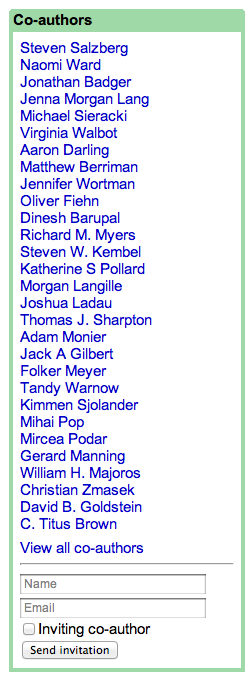
The list comes out in order of numbers of citations, which is good and bad. Here are some of the top people from the list:


The Genome Center
Network Focus
Group Presents
Dana Pe`er
Assistant Professor, Department of Biology
Columbia University
"On the road to personalized therapy, a systems approach“
Abstract: Systematic characterization of cancer genomes has revealed a staggering complexity of aberrations among individuals, such that the functional importance and physiological impact of most tumor genetic alterations remains poorly defined. A major challenge involves the development of analysis methods to integrate the flood of genome-wide data on tumors towards patient-specific tumor network models. We will elaborate on two computational approaches: (1) Integration of genetic and genomic data to identify genetic determinants of cancer and model how these alter the regulatory network, as well as drug response. (2) Single cell models of cancer signaling based on mass cytometry, a novel technology that can accurately measure more than forty signaling molecules simultaneously single cells. We will demonstrate the utility of these applications of these approaches across a broad range of different cancers.
Monday, March 5, 2012
10:00 a.m., 1005 GBSF Auditorium
Just got this email and well, I thought I would share. I would share even if I was not on the list since, well, I love microbes and microbiology. Note the list is also available on the AAM Web site here.
Recently I gave a talk at the AAAS Meeting in Vancouver on my dream of having “A Field Guide to the Microbes”. The talk was part of a session on the “Earth Microbiome Project” organized by Jack Gilbert and others.
You can see a slideshow with audio of my talk below:
It seems that my talk has sparked a lot of interest as I have been interviewed by various people and publications about this concept.
For example, Holly Menninger recently interviewed me for a blog post for the “Your Wild Life” blog:
Is a Field Guide for Microbes in Our Future? Q & A with Microbiologist Jonathan Eisen.
And today a wonderfully illustrated piece came out at Wired.Com by Daniela Hernandez titled “Book of Germs: A Quest for a Field Guide to Microbes.”
If you are interested in some more background on what I have been thinking about a Field Guide to the Microbes here are some previous things I have written or said or commented on relating to this topic:
Just got an email from UC Communications
“Former California Supreme Court Associate Justice Cruz Reynoso, chair of the task force investigating the pepper-spray incident on November 18, 2011, said today the task force is working toward public release of findings and recommendations on Tuesday, March 6, at a time and location on the UC Davis campus to be determined.
Additional information will be provided as soon as it is available.”
 |
|
Figure 1 from 10.1007/s00253-011-3819-9. Sediment cross section
exposing the characteristic Y-shaped burrow dug by S. velum.
Positioning itself at the triple junction of the Y, the bivalve alternates
between actively pumping oxygenated water from the upper arms of
the burrow through the mantle cavity and across the gills and
accessing reduced sulfur compounds diffusing up from the anoxic
zones below and pumped through a ventral incurrent opening in the
mantle. Scale bar equals 2.5 cm
|
 Roeselers, G., & Newton, I. (2012). On the evolutionary ecology of symbioses between chemosynthetic bacteria and bivalves Applied Microbiology and Biotechnology, 94 (1), 1-10 DOI: 10.1007/s00253-011-3819-9


