Tom Bruns talk on fungal dispersal at #UCDavis 11/10/11 #ecology #fungi

http://storify.com/phylogenomics/tom-bruns-talk-on-fungal-dispersal-at-uc-davis-11-10-11.js<a href=”http://storify.com/phylogenomics/tom-bruns-talk-on-fungal-dispersal-at-uc-davis-11-10-11″ target=”_blank”>View the story “Tom Bruns talk on fungal dispersal at UC Davis 11/10/11” on Storify</a>]

Love that Klout says I am influential about Mars http://www.klout.com/#/phylogenomics/topics

Image

Love that Klout says I am influential about Mars http://www.klout.com/#/phylogenomics/topics

Image

What you need to know about infectious disease?

New video from Institute of Medicine on “What you need to know about infectious disease” which is useful and fortunately includes some information about things other than infectious diseases.

It is based on this booklet.

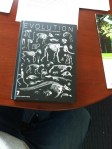
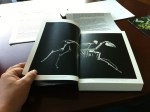
Gorgeous new book on Evolution

Just got a review copy of Evolution by Jean-Baptiste de Panafieu and Patrick Gries

Haven’t read it yet but it looks gorgeous

This is a smaller edition of an oversized hardcover published in 2007

Gorgeous new book on Evolution

Just got a review copy of Evolution by Jean-Baptiste de Panafieu and Patrick Gries
Haven’t read it yet but it looks gorgeous
This is a smaller edition of an oversized hardcover published in 2007

Yes I like mixing science and art – but "DNA2Art" seems a bit, well, non artsy #visualiztion≠art

Just got this email

I am representing DNA2Art – a start-up working with creating DNA art. DNA2Art just launched a few new products that I would be glad to share as I think they might be of interest. 
DNA2Art takes human uniqueness to a whole new level by enabling visualization of one’s personal DNA. DNA based art is a great way to show the beauty of your genes.
DNA art is extraordinary because:  

  • As an innovation launched just recently, DNA2Art enables creating DNA art from already existing DNA test results by reverse engineering real-life laboratory testing to deliver authentic DNA art. More information on reverse engineering. Besides being a convenient and faster way for receiving personal DNA art (sample taking and analysis steps are skipped), it also grants clients a discount. More information with instructions for inserting data can be found on Already have DNA data? page. 

The technological platform developed by our bioinformatics team allows clients to use data from industry leading consumer DNA testing companies such as 23andMe, or the use of customer genetic markers. DNA2Art is working with other genetic testing service providers to add them to the platform, as offering DNA art is a great value adding opportunity for customers and companies working with genetics. 

  • As an introductory offer, DNA2Art has a special price for high-quality print ready digital file when sending in already existing DNA data (just 99 EUR). Click on the Already have DNA data? page for the offer. 
  • The latest product addition is DNA2Info – providing insights to what the genetic stripes really mean and which genes are displayed on the DNA art masterpiece. It can be ordered as an entertaining add-on to DNA Art. 

Ordering DNA Art is easy with the following steps: place an order on the website, receive a DNA collection kit for taking the DNA sample, DNA2Art’s secure and certified lab performs the DNA test. Based on the results, an art piece is created by our designer and delivered to you. 
DNA2Art is an innovative team coming up with new ways for visualizing DNA and also trying to have an educational value to it. If the above information is of interest to you we would be thankful if you could share it. In case of additional questions, please contact me.

Best wishes,
Madli

The whole thing seems a bit off to me.  Yes, you can “visualize” your genomic data.  Visualization and art are not necessarily the same thing.  And this does not sound or smell like art to me.  

I am phylogeny obsessed but this is too much to me: phylogeny of cancer subtypes

Just because you have data that could be plugged into a phylogenetic analysis does not mean it makes sense to do so. Case in point – the following paper:

A Differentiation-Based Phylogeny of Cancer Subtypes by Riester M, Stephan-Otto Attolini C, Downey RJ, Singer S, Michor F.

In this paper the authors take gene expression data from various cancer samples/cell lines and then they build phylogenetic trees from the data.  See example below:
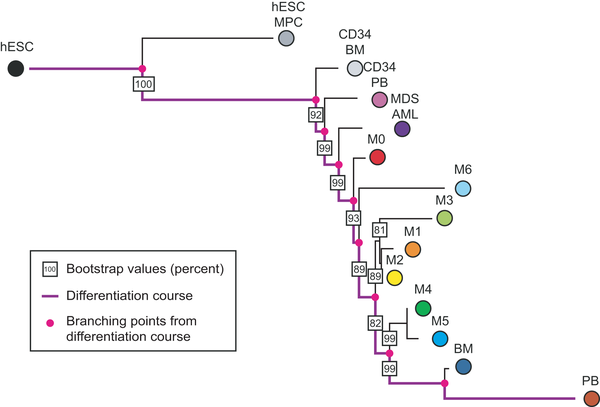
Figure 2. A phylogeny of acute myeloid leukemia (AML) subtypes. According to the French-American-British (FAB) classification, AML samples are classified into seven different types according to their level of differentiation (see Table 1). Expression data from 362 AML patients and 7 Myelodysplastic Syndrome (MDS-AML) patients is used to construct a phylogeny of these leukemias. We include expression data of human embryonic stem cells (hESCs), CD34+ cells from bone marrow (CD34 BM) and peripheral blood (CD34 PB), and mononuclear cells from bone marrow (BM) and peripheral blood (PB). The differentiation pathway from hESCs to mononuclear cells from peripheral blood is represented in purple, and the common ancestors of subtypes are shown as pink dots. The bootstrap values of branches are indicated by boxed numbers, representing the percentage of bootstrapping trees containing this branch. The ranking of AML subtypes identified by the phylogenetic algorithm corresponds with the differentiation status indicated by the FAB classification. The M6 subtype, represented by only 10 samples in our dataset, has the least stable branch, leading to lower bootstrap values for those branches where it can alternatively be located.

The pictures are pretty.  They make some sense biologically.  The paper has some very interesting parts and I do not want to suggest that the paper is not useful.  But it makes no sense to me to use a phylogenetic approach to analyze this data.  Phylogenetic methods are about reconstructing history of evolutionary lineages.  They should not be doing that here as far as I can tell since the cancers are from different people with different histories and what they make be looking at is convergent / developmental similarities in the cancer samples.  But they are not looking at history per se.  And thus it is not appropriate to use algorithms that use phylogenetic methods:
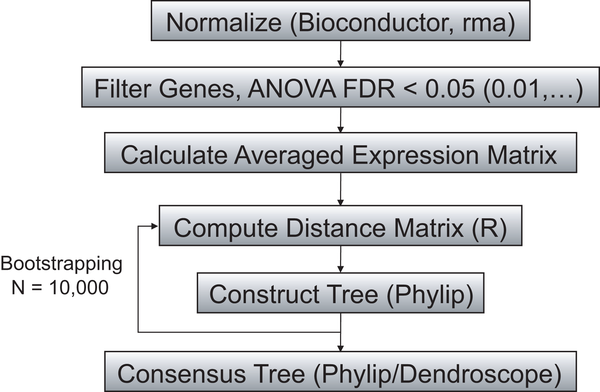
It just makes no sense to me to use a phylogenetic method instead of some sort of clustering method in the step where it says “construct tree” in their flow diagram.  Sure phylogenetic methods can make nice pictures.  But they should only be used when the underlying data has a history that is reflected in the model/assumptions of the phylogenetic method.  I could, for example build a phylogeny of cities based on various metrics.  But would that make sense?  Most likely not.  Don’t get confused by the fact that similar things group together in the same part of a phylogenetic tree to thinking that that means that a phylogenetic model is right for your data.

I may be obsessed with phylogeny but that obsession applies to applying phylogenetic methods to data with histories that are approximated by the methods being used …  and this paper seems to not be doing that …

Hat tip to Eric Lowe, an undergrad in my lab for showing me this paper.

I note – this does not mean that phylogenetic methods cannot be applied to cancer studies.  Case in point – this paper:

Estimation of rearrangement phylogeny for cancer genomes by Greenman CD, Pleasance ED, Newman S, Yang F, Fu B, Nik-Zainal S, Jones D, Lau KW, Carter N, Edwards PA, Futreal PA, Stratton MR, Campbell PJ.

In this paper the authors focus on mutations in cancer cells and they use phylogenetic methods to determine the order in which genomic changes happen in these cancer cells.  This seems to be an excellent use of phylogenetic / phylogenomic methods.

So – lesson of the day – phylogenetic methods should be used on data with a phylogenetic history.  Not so complicated.  But pretty important.

Monica Medina from UC Merced coming to #UCDavis Wed 4 PM "Coral holobiont genomics"

This one should be fun:

Dr. Monica Medina (UC Merced)

 “Coral holobiont genomics: Insights into the interplay of a host and its diverse microbial assemblage”

Wednesday, November 9, 2011

4:10pm

1022 Life Sciences


See a little about Monica below:


See a recent PLoS One paper from her here:

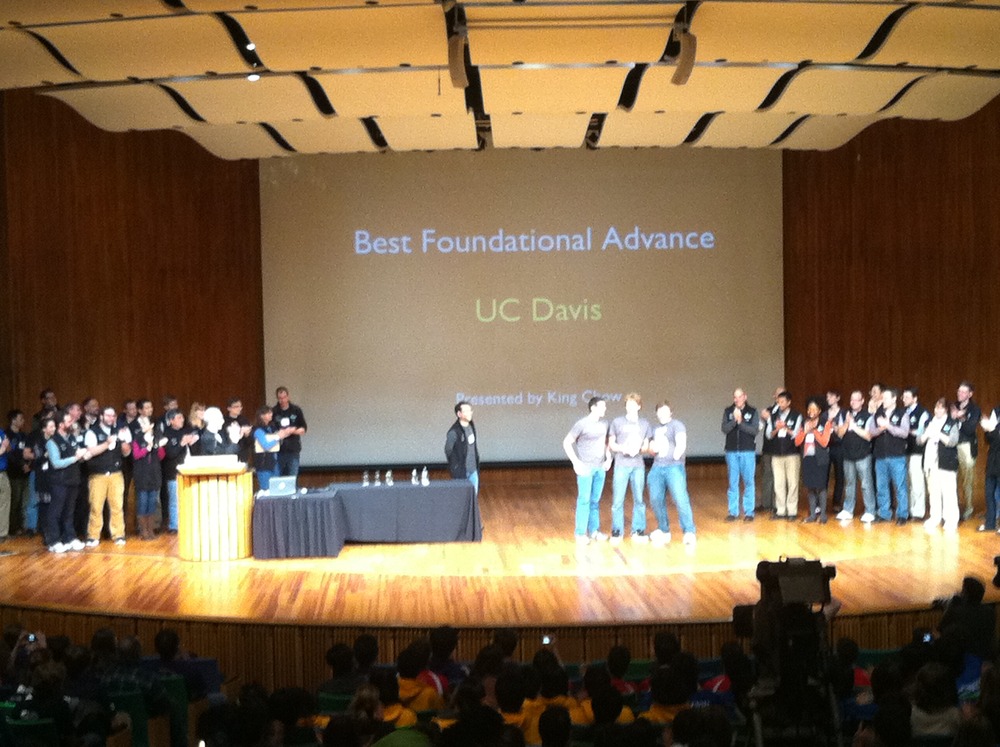
Congrats to #UCDavis #Igem team for making Sweet16 & “Best Foundational Advance” via @saltyprof

Image