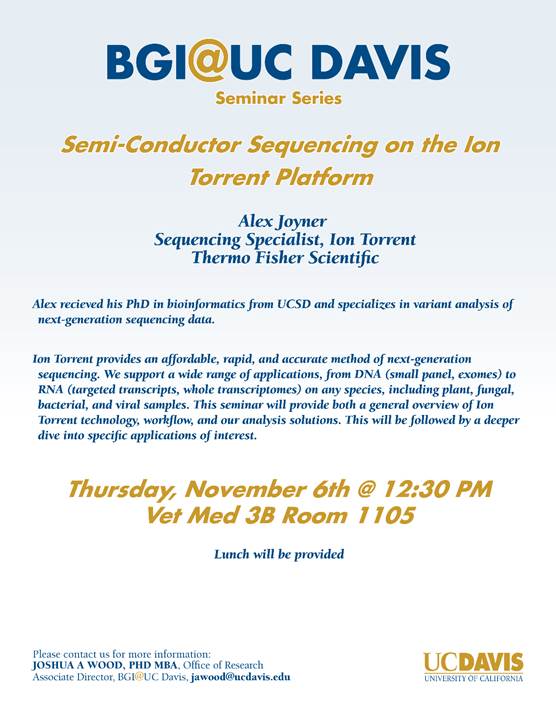
At #UCDavis today: Semi-Conductor Sequencing on the Ion Torrent Platform – 12:30 Vet Med 3B room 1105

Crossposting this from the microBEnet blog where I originally posted it 10/31/14:
It seems that any time a holiday comes around in the US, the press starts to ramp up the writing of stories about evil microbes that are lurking all around us. And Halloween appears to be no exception. I am now planning on referring to this attitude as “microbophobia” rather than “germophobia” because to some “germ” implies pathogen and many of these stories fan the flames of fear about any kind of microbe not just pathogens. I note – the term microbophobia comes from some searches I did recently of Google books.
I was thinking of writing up yet another post trying to counter this excessive microbophobia but decided instead to just provide a collection of links to stories over the last month that have a distinctive microbophobia flavor. Mind you – there are real reasons to be afraid of some of the microbes circulating around these days. But the links below seem to me to be serious overkill.
These are but a few of the many examples of microbophobia being pushed by the press. Again, there are certainly things to worry about in terms of pathogens in our immediate environment. Flu season is coming. Enterovirus might be on the upswing. Antibiotic resistance is a massive and troubling problem. And so on. But please let us not go completely over the top because the more we promote the idea that we should be killing all microbes, the more trouble we are likely to cause, rather than prevent.
OK. It is Halloween night and I am tired and need to get my kids to sleep. But someone on Twitter just pointed me to an opinion piece just out in the New York Times: Academic Science Isn’t Sexist – NYTimes.com and after reading it I felt I had to write a quick post.
The opinion piece is by Wendy M. Williams and Stephen J. Ceci and discusses work by them (and coauthors). In particular they discuss findings in a massive report “Women in Academic Science: A Changing Landscape” by Stephen J. Ceci, Donna K. Ginther, Shulamit Kahn, and Wendy M. Williams in Psychological Science in the Public Interest. I note – kudos to the authors for making this available freely and under what may be an open license and also apparently for making much of their data available behind their analyses.
The opinion piece and the associated article have a ton of things to discuss and ponder and analyze for anyone interested in the general issue of women in academic science. I am not in any position at this time to comment on any of the specific claims made by the authors on this topic. But certainly I have a ton of reading to do and am looking forward to it.
However, I do want to write about one thing – really just one single thing – that really bothers me about their New York Times article. I do not know if this was intentional on their part, but regardless I think there is a major flaw in their piece.
First, to set the stage — their article starts off with the following sentences:
Academic science has a gender problem: specifically, the almost daily reports about hostile workplaces, low pay, delayed promotion and even physical aggression against women. Particularly in math-intensive fields like the physical sciences, computer science and engineering, women make up only 25 to 30 percent of junior faculty, and 7 to 15 percent of senior faculty, leading many to claim that the inhospitable work environment is to blame.
This then sets the stage for the authors to discuss their analyses which leads them to conclude that in recent times, there are not biases against women in hiring, publishing, tenure, and other areas. Again, I am not in any position to examine or dispute their claims about these analyses – to either support them or refute them.
But the piece makes what to me appears to be a dangerous and unsupported connection. They lump together what one could call “career progression” topics (such as pay, promotion, publishing, citation, etc) with workplace topics (hostility and physical aggression against women). And yet, they only present or discuss data on the career progression issues. Yet once they claim to find that career progression for women in math heavy fields seems to be going well recently, they imply that the other workplace issues must not be a problem. This is seen in statements like “While no career is without setbacks and challenges” and “As we found, when the evidence of mistreatment goes beyond the anecdotal” and “leading many to claim that the inhospitable work environment is to blame.”
Whether one agrees with any or all of their analyses (which again, I am not addressing here) I see no justification for their inclusion of any mention of hostile workplaces and physical agression against women. So – does this mean that a woman who does well in her career cannot experience physical aggression of any kind? Also – I note – I am unclear I guess in some of their terminology usage – is their use of the term “physical aggression” here meant to discount reports of sexual violence? This reminds me of the “Why I stayed” stories of domestic violence. Just because a women’s career is doing OK does not mean that she did not experience workplace hostility or physical or sexual violence. I hope – I truly hope – that the authors did not intend to imply this. But whether they did or not, their logic appears to be both flawed and offensive.
UPDATE 1. November 1, 8:30 AM
Building a Storify about this.
UPDATE 2: Nov 3, 2014. Some other posts also criticizing the NY Times piece


 Jonathan Eisen's Lab