Postdoc on HGT & genome evolution – Jeff Palmer & Claude dePamphilis

POSTDOC ON HORIZONTAL GENE TRANSFER AND GENOME EVOLUTION

An NSF-funded

postdoctoral position is available to work on a collaborative project between the labs of Dr. Jeff Palmer (Department of Biology, Indiana University, Bloomington) and Dr. Claude dePamphilis (Department of Biology, Penn State University, University Park). This project is a follow-up to papers on the mitochondrial and nuclear genomes of the basal angiosperm Amborella that were led by our labs and published in the Dec. 20, 2013 issue of Science. The project focuses on evolutionary gene transfer, including transfer of mitochondrial and plastid sequences to the nucleus of Amborella, and the extensive horizontal transfer of foreign mitochondrial sequences to the mitochondrion of Amborella.

This

is a strictly bioinformatic/comparative genomic project involving extensive analysis of genome-scale sequence data. A Ph.D. in computational biology, evolutionary genetics, or a related field is required, and proficiency in computer programming is expected. Competitive candidates will have a strong record of prior publication in genome-scale data analysis, including bioinformatic pipeline construction, phylogenomics, and/or genome evolution. This position is funded for two years, with continued appointment dependent upon availability of funding. Salary will be commensurate with experience, and full benefits are included.

To apply,

please submit, as a single unified PDF, a cover letter detailing research interests and experience, a C.V., and contact information for three professional references to jpalmer) or Claude dePamphilis (cwd3).

Indiana University

is an equal employment and affirmative action employer and a provider of ADA services. All

qualified applicants will receive consideration for employment without regard to age, ethnicity, color, race, religion, sex, sexual orientation or identity, national origin, disability status, or protected veteran status.

Postdoc on HGT & genome evolution in plants – Jeff Palmer & Claude dePamphilis.docx

Repeated, extremely biased ratio of M:F at meetings from SFB 680 "Evolutionary Innovations" group #YAMMM

Well, this is disappointing, to say the least – there is a conference coming up in July 2015 on “Forecasting Evolution”:  SFB 680 | Molecular Basis of Evolutionary Innovations at the Gulbenkian Foundation in Lisbon.

Here is the listed lineup of invited speakers:

  1. Andersson (Uppsala University), (NOTE I AM ASSUMING THIS IS DAN ANDERSSON)
  2. Trevor Bedford (Hutchinson Cancer Research Center), 
  3. Jesse Bloom (Fred Hutchinson Cancer Research Center), 
  4. Arup Chakraborty (MIT)
  5. Michael Desai (Harvard University), 
  6. Michael Doebeli (University of British Columbia), 
  7. Marco Gerlinger (Institute of Cancer Research, London, 
  8. Michael Hochberg (CRNS, Montpellier), 
  9. Christopher Illingworth (Cambridge University), 
  10. Roy Kishoni (Harvard University), 
  11. Richard Lenski (Michigan State University), 
  12. Stanislas Leibler (Rockefeller University), 
  13. Marta Luksza (IAS Princeton), 
  14. Luke Mahler (University of California, Davis), 
  15. Leonid Mirny (MIT), 
  16. Richard Neher (MPI Tuebingen), 
  17. Julian Parkhill (Sanger Institute), 
  18. Colin Russell (University of Cambridge), 
  19. Sohrab Shah (University of British Columbia), 
  20. Boris Shraiman (UCSB), 
  21. Olivier Tenaillon (Inserm Paris).

For a whopping 20:1 ratio of men to women or 4.8% women. And this in a field that is just overflowing with excellent female researchers.

So I dug around a little bit.  Here is another meeting from the same group at the University of Cologne – a group known as SFB 680. SFB 680: Molecular Ecology and Evolution: Cologne Spring Meeting 2012.

Speakers:

  1. Ian Thomas Baldwin, MPI Jena
  2. Nitin Baliga, ISB Seattle 
  3. Andrew Beckerman, University of Sheffield 
  4. Joy Bergelson, University of Chicago
  5. Michael Boots, University of Sheffield 
  6. John Colbourne, Indiana University 
  7. David Conway, LSHTM London
  8. Santiago Elena, IBMCP Valencia
  9. Duncan Greig, MPI Plön 
  10. Bryan Grenfell, Princeton University 
  11. Eddie Holmes, Pennsylvania State University 
  12. Peter Keightley, University of Edinburgh
  13. Britt Koskella, University of Oxford
  14. Juliette de Meaux, University of Münster 
  15. Thomas Mitchell-Olds, Duke University
  16. Hélène Morlon, Ecole Polytechnique Paris 
  17. Wayne Potts, University of Utah 
  18. Michael Purugganan, New York University
  19. Andrew Rambaut, University of Edinburgh 
  20. Walter Salzburger, University of Basel 
  21. Johanna Schmitt, Brown University
  22. Ralf Sommer, MPI Tübingen
  23. Miltos Tsiantis, University of Oxford 
  24. Diethardt Tautz, MPI Plön 
  25. Daniel Weinreich, Brown University

Session and Meeting Chairs:

  1. Michael Lassig
  2. Maarten Koornneef
  3. Eric von Elert
  4. Thomas Wiehe
  5. Jonathan Howard

That would be 25:5 or 16.6% female.

And then there was this: Perspectives in Biophysics in October 2014

  1. Konstantin Doubrovinski
  2. Tobias Bollenbach
  3. Stefano Pagliara
  4. Damien Faivre
  5. Ingmar Schön
  6. Kurt Schmoller
  7. Max Ulbrich
  8. Florian Rehfeld
  9. Steffen Sahl
  10. Timo Betz
  11. Alexandre Persat
  1. Rubén Alcázar (MPI for Plant Breeding Research, Cologne)
  2. John Baines (Christian-Albrechts-University, Kiel)
  3. Thomas Bataillon (University of Aarhus)
  4. Frank Chan (MPI for Evolutionary Biology, Plön)
  5. George Coupland (MPI for Plant Breeding Research, Cologne)
  6. Susanne Foitzik (Johannes Gutenberg-University, Mainz)
  7. Isabel Gordo (Instituto Gulbenkian, Lisbon)
  8. Oskar Hallatschek (MPI for Dynamics and Self-Organization, Göttingen
  9. Jonathan Howard (University of Cologne)
  10. JinYong Hu (MPI for Plant Breeding Research, Cologne)
  11. Jeffrey Jensen (University of Massachusetts, Medical School, Worchester)
  12. Michael Lässig (University of Cologne)
  13. Dirk Metzler (Ludwig-Maximilians-University, Munich)
  14. Ville Mustonen (Welcome Trust Sanger Institute)
  15. John Parsch (Ludwig-Maximilians-University, Munich)
  16. Frank Rosenzweig (University of Montana, Missoula)
  17. Christian Schlötterer (University of Veterinary Medicine, Vienna)
  18. Shamil Sunyaev (Brigham & Women’s Hospital and Harvard Medical School) 
  19. Karl Schmid (University of Hohenheim)
  20. Ana Sousa (Instituto Gulbenkian, Lisbon)
  21. Diethard Tautz (MPI for Evolutionary Biology, Plön)
  22. Xavier Vekemans (University of Lille)
Session and Meeting Chairs
  • Wolfgang Stephan
  • Michael Lässig
  • Berenike Maier
  • Wolfgang Stephan
  • Peter Pfaffelhuber
  • Juliette de Meaux

For a 19:3 ratio or 13.6 % women for the speakers and if you include session chairs it comes to 23:5 or 18 % female total.

And Evolutionary Innovations in 2010. 

Invited speakers:

  1. R. Bundschuh (Ohio State University), 
  2. C. Callan (Princeton University),
  3. A. Clark (Cornell University), 
  4. J. Colbourne (Indiana University),
  5. E. Dekel (Weizmann Institute),
  6. L. Hurst (University of Bath), 
  7. S. Elena (Universidad Polytecnica de Valencia), 
  8. E. Koonin (National Center for Biotechnology Information), 
  9. M. Kreitman (University of Chicago),
  10. S. Leibler (Rockefeller University, New York and Institute for Advanced Study, Princeton),
  11. T. Lengauer (Max Planck Institute for Informatics), 
  12. S. Maerkl (Ecole Polytechnique de Lausanne), 
  13. C. Marx (Harvard University), 
  14. L. Mirny (Massachusetts Intitute of Technology), 
  15. V. Mustonen (Sanger Institute), 
  16. C. Pal (Biological Research Center, Szeged),
  17. D. Petrov (Stanford University), 
  18. B. Shraiman (Kavli Institute for Theoretical Physics, Santa Barbara),
  19. S. Sunyaev (Harvard University), 
  20. D. Tautz (Max-Planck-Institute for Evolutionary Biology)
Plus session chairs 
  1. Johannes Berg
  2. Siegfried Roth
  3. Wolfgang Werr
  4. Martin Lercher
And addition speakers not listed on their invited speakers page:
  1. Michael Lassig
  2. Ruben Alcazar
  3. Juliette de Meaux
  4. Joachim Krug

For a whopping ratio of 27:1 or 3.6 %

The only meeting from them I could find with a decent / non massively skewed ratio was the following very small one: Evolution of Development

  1. Cassandra Extavour
  2. Angela Hay
  3. Felicity Jones
  4. Nicolas Gompe
  5. Kristen Panfillio
  6. Christiane Kiefer
This is a nice case.  But it really seems like an exception in a long list of meetings with a much smaller representation of female speakers than one would expect based on the researchers in the fields.   I think the SFB680 seriously need to consider what is causing these biases and they should do something about it.

———————————————
See this page for other posts of mine on this and related topics.

Skin microbiota biogeography

Over at Nothing In Biology Makes Sense! I wrote about a recent paper that analyzed the biogeography of skin microbiota. If you’re interested in your body as a conglomerate of unique ecosystems and want to know more – go check out “What’s lurking on your glabella“.

Oh et al. (2014) showed that individual microbial species showed different patterns across body sites and individuals.


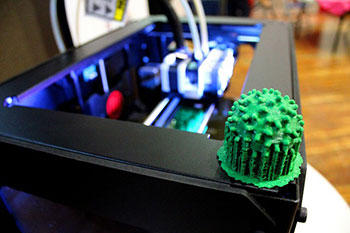
Really cool: 3D printed microbes for the visually impaired

Image from Nanowerk story.

This is one of the most interesting things I have seen relating to microbiology recently:  3D printed giant germs help visually impaired see the world of microorganisms reported by Nanowork News on October 31.  This work has done by researchers from the BBSRC (the Biotechnology and Biological Sciences Research Council in the UK) who hosted an event called “Giant Germs” for the blind and visually impaired.  In discussing various microbes (alas, the story implies that all they discussed were pathogens), they had accompanying tactile sessions to feel the structures of the microbes.  Just a really brilliant, important idea.

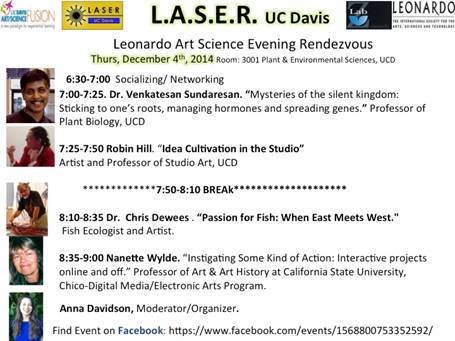
Dec 4 at #UCDavis: Leonardo Art Science Evening Rendezvous (L.A.S.E.R.)

Got this by email:

Please join us for the UC Davis Leonardo Art Science Evening Rendezvous where four speakers will present on their interdisciplinary work in the sciences and in the arts.

L.A.S.E.R.-UC DAVIS Continue reading “Dec 4 at #UCDavis: Leonardo Art Science Evening Rendezvous (L.A.S.E.R.)”

Registration Open for Data Rights & Data Wrongs workshop, 12/10 at #UCDavis

Data Rights & Data Wrongs

A workshop organized by
Innovating Communication in Scholarship (ICIS)

University of California, Davis

Date & Time: December 10, 2014 from 9:00 am – 5:00 pm

Location: MPR, Student Community Center, UC Davis

Register: https://www.eventbrite.com/e/data-rights-data-wrongs-tickets-14079810091

Full Agenda: http://icis.ucdavis.edu/?page_id=329

Keynote talks:
Dr. Christine Borgman, Professor & Presidential Chair, iSchool, UCLA
John Wilbanks, Chief Commons Officer, Sage Bionetworks

Scholars are increasingly subject to pressures from funding bodies, disciplinary norms, professional and personal ethics, and institutional directives to share their research data and make it available for reuse. There is, however, a great deal of heterogeneity across the research enterprise with respect to what is meant by ‘data’ and ‘data sharing,’ why data sharing is deemed important, and what data management strategies are considered most effective. Moreover, data are often difficult and costly to produce and share. Therefore, many scholars view these as a significant product of their intellectual labor for which they should receive some sort of credit towards tenure and promotion, authorial recognition through citation, or financial compensation. While balancing all of these considerations is desirable to promote increased access to data, it is difficult to guarantee that the concerns of all research stakeholders will be met given (1) the diverse forms that data can take, as well as the mobility and malleability of data given widespread access to new information technologies, (2) the complex and variable legal status of data as not-quite/not-always property, and (3) the ethical considerations and legal restrictions implicated in the sharing and reuse of data related to sensitive topics such as personal health information, national security, and vulnerable populations. This workshop will address theoretical concerns and pragmatic solutions that can be harnessed to help researchers comply with requirements or desires to share their data in ways they deem appropriate for their goals.

11_07 Data Rights flyer.pdf

Wanted: Program Directors in the Division of Mathematical Sciences (DMS)

Got this by email:
Dear Colleagues,

The Division of Mathematical Sciences (DMS), within the Directorate for Mathematical and Physical Sciences, National Science Foundation (NSF), announces a nationwide search for mathematical sciences professionals to fill Program Director positions. Formal consideration of interested applications will begin on November 18, 2014 and will continue until selections are made.

NSF Program Directors bear the primary responsibility for carrying out the Agency’s overall mission. To discharge this responsibility requires not only knowledge in the appropriate disciplines, but also a commitment to high standards, a considerable breadth of interest and receptivity to new ideas, a strong sense of fairness, good judgment, and a high degree of personal integrity.

Continue reading “Wanted: Program Directors in the Division of Mathematical Sciences (DMS)”

Today’s Open Science Reading: the Open Science Reviewer’s Oath

Well this certainly is interesting: The Open Science Peer Review Oath – F1000Research.  This emerged apparently from the AllBio: Open Science & Reproducibility Best Practice Workshop.  The “Oath” is summarized in the following text from a box in their paper:

Box 1. While reviewing this manuscript:

  1. I will sign my review in order to be able to have an open dialogue with you
  2. I will be honest at all times
  3. I will state my limits
  4. I will turn down reviews I am not qualified to provide
  5. I will not unduly delay the review process
  6. I will not scoop research that I had not planned to do before reading the manuscript
  7. I will be constructive in my criticism
  8. I will treat reviews as scientific discourses
  9. I will encourage discussion, and respond to your and/or editors’ questions
  10. I will try to assist in every way I ethically can to provide criticism and praise that is valid, relevant and cognisant of community norms
  11. I will encourage the application of any other open science best practices relevant to my field that would support transparency, reproducibility, re-use and integrity of your research
  12. If your results contradict earlier findings, I will allow them to stand, provided the methodology is sound and you have discussed them in context
  13. I will check that the data, software code and digital object identifiers are correct, and the models presented are archived, referenced, and accessible
  14. I will comment on how well you have achieved transparency, in terms of materials and methodology, data and code access, versioning, algorithms, software parameters and standards, such that your experiments can be repeated independently
  15. I will encourage deposition with long-term unrestricted access to the data that underpin the published concept, towards transparency and re-use
  16. I will encourage central long-term unrestricted access to any software code and support documentation that underpin the published concept, both for reproducibility of results and software availability
  17. I will remind myself to adhere to this oath by providing a clear statement and link to it in each review I write, hence helping to perpetuate good practice to the authors whose work I review.

I note – I reformatted the presentation a tiny bit here.   The Roman numerals in the paper annoyed me.  Regardless of the formatting, this is a pretty long oath.  I think it is probably too long.  Some of this could be reduced.  I am reposting the Oath below with some comments:

  1. I will sign my review in order to be able to have an open dialogue with you.  I think this is OK to have in the oath. 
  2. I will be honest at all times. Seems unnecessary.
  3. I will state my limits. Not sure what this means or how it differs from #4.  I would suggest deleting or merging with #4.
  4. I will turn down reviews I am not qualified to provide.  This is good though not sure how it differs from #3. 
  5. I will not unduly delay the review process. Good. 
  6. I will not scoop research that I had not planned to do before reading the manuscript. Good. 
  7. I will be constructive in my criticism. Good. 
  8. I will treat reviews as scientific discourses.  Not sure what this means or how it is diffeent from #9. 
  9. I will encourage discussion, and respond to your and/or editors’ questions.  Good though not sure how it differs from #8. 
  10. I will try to assist in every way I ethically can to provide criticism and praise that is valid, relevant and cognisant of community norms. OK though this seems to cancel the need for #7. 
  11. I will encourage the application of any other open science best practices relevant to my field that would support transparency, reproducibility, re-use and integrity of your research.  Good.  Seems to cancel the need for #13, #14, #15, #16. 
  12. If your results contradict earlier findings, I will allow them to stand, provided the methodology is sound and you have discussed them in context. OK though I am not sure why this raises to the level of a part of the oath over other things that should be part of a review. 
  13. I will check that the data, software code and digital object identifiers are correct, and the models presented are archived, referenced, and accessible.  Seems to be covered in #11. 
  14. I will comment on how well you have achieved transparency, in terms of materials and methodology, data and code access, versioning, algorithms, software parameters and standards, such that your experiments can be repeated independently. Seems to be covered in #11. 
  15. I will encourage deposition with long-term unrestricted access to the data that underpin the published concept, towards transparency and re-use. Seems to be covered in #11. 
  16. I will encourage central long-term unrestricted access to any software code and support documentation that underpin the published concept, both for reproducibility of results and software availability. Seems to be covered in #11. 
  17. I will remind myself to adhere to this oath by providing a clear statement and link to it in each review I write, hence helping to perpetuate good practice to the authors whose work I review.  Not sure this is needed.

The paper then goes on to provide what they call a manifesto.  I very much prefer the items in the manifesto over those in the oath:

  • Principle 1: I will sign my name to my review – I will write under my own name
  • Principle 2: I will review with integrity
  • Principle 3: I will treat the review as a discourse with you; in particular, I will provide constructive criticism
  • Principle 4: I will be an ambassador for good science practice
  • Principle 5: Support other reviewers

In fact I propose here that the authors considering reversing the Oath and the Manifesto.  What they call the Manifesto shoud be the Oath.  It is short.  And works as an Oath.  The longer, somewhat repetitive list of specific details would work better as the basis for a Manifesto.

Anyway – the paper is worth taking a look at.  I support the push for more consideration of Open Science in review though I am not sure if this Oath is done right at this point.

Job Announcement: Moore Foundation Program Associate

This seems like a potentially interesting job.  I note – I love the Moore Foundation – and just about everything they are doing in science.  Below is the email I recieved from the Project Lead Jon Kaye:

We have opened a search for a Program Associate. Details at the link below and attached. Please share with Bachelor’s and Master’s level individuals who may be interested. http://www.moore.org/about/careers?gnk=job&gni=8a8725d0494f97e601495deb88ba30cb We will also be opening a search for a PhD-level Program Officer position soonstay tuned for details.


Full text of the announcement is below:

Program Associate, Marine Microbiology Initiative
 
Marine Microbiology Initiative
The Marine Microbiology Initiative (MMI) seeks to gain a comprehensive understanding of marine microbial communities, including their genetic diversity, composition and function; their ecological role in the oceans; and their contribution to ocean health and productivity.
 
 
The Position
The Program Associate will provide programmatic support to the Marine Microbiology Initiative. The primary responsibility is to ensure that the systems to manage grants and strategic workflows are implemented efficiently by the MMI team through effective coordination of team processes and activities.
 
Key Responsibilities
  • Facilitate coordination of overall Initiative grantmaking processes and strategic planning efforts.
  • Employ project and grant management tools to manage information on the grant pipeline, including grant requirements, preparing reporting templates for grantees and tracking payments.
  • Support timely programmatic decisions through tracking and analyzing the Initiative budget allocation, including funding and grantmaking projections.
  • Assist with analysis of current and prospective grantees’ legal and financial status.
  • Analyze grantee financial reports.
  • Develop, solicit and manage website content.
  • Analyze and report on media, news outlets, and scientific journals and share relevant information with the team.
  • Collect and organize scientific publications, including compiling citations using bibliographic software.
  • Help organize and schedule conferences, workshops and meetings with members of the MMI community, including arranging travel (meals, lodging, etc.) for meeting participants as needed, managing event expenses and participant reimbursements, etc.
  • Develop and give presentations for internal and external audiences regarding the Initiative’s activities.
  • Apply knowledge of MMI and the Science Program when addressing inquiries from the MMI community.
  • Actively participate in Science Program and Foundation meetings, trainings, and other activities.
  • Communicate directly with grantees and prospective grantees regarding grantmaking procedures.
  • Support team by helping manage review process for grant proposals, as needed.
  • Coordinate MMI team activities, organize team meetings and calendars, manage documents, and carry out other administrative duties as requested.
  • Maintain meeting agendas, create and distribute meeting notes and synthesis documents, maintain action items for the team.
 
Experience and Education
The ideal candidate will have:
  • Bachelor’s or Master’s degree in a relevant field.
  • Demonstrated work experience in administration and/or project management.
  • Interest in scientific research (such as biology, environmental microbiology, oceanography, ecology, earth sciences, chemistry, physics, etc.) demonstrated through work, extracurricular activities, and/or volunteer programs.
 
Competencies and Attributes
The ideal candidate will also have:
  • Strong attention to detail and organizational skills.
  • Excellent project management and analytical skills.
  • A strong team orientation, positive attitude, integrity, self-motivation, discipline, and reliability.
  • Ability to work independently, self-manage priorities and goals for projects, meet deadlines, and multi-task while working well under pressure.
  • Work proactively and take initiative while consulting with Program Director and Program Officers as appropriate.
  • Ability to think critically and exercise judgment within defined procedures and practices to determine appropriate courses of action.
  • Interest and ability to synthesize knowledge in a variety of scientific fields.
  • Willingness to ask for help and identify appropriate resources to accomplish tasks, when necessary.
  • Strong written, oral, graphic, and inter-personal communication skills (e.g. phone inquiries, webpages, PowerPoint presentations, correspondence, and research summaries).
  • Proficiency with office productivity software (e.g. Outlook, Word, Excel, PowerPoint, etc.).
 
Desired Behavioral Characteristics
The ideal candidate will also demonstrate the following behaviors, which are the hallmarks of our culture and characterize how we strive to do our work with each other and our partners: 
  • Practice courageous conversations 
  • Build trusted relationships 
  • Move with speed 
  • Build high-performing teams 
  • Focus on what matters 
  • Take smart risks 
  • Plan outcomes, learn and adapt      
Compensation and Benefits
Compensation includes a competitive base salary and an excellent package of health, retirement savings and other benefits.
 
Application Process
Applicants must be legally authorized to work in the United States.  Pursuant to the San Francisco Fair Chance Ordinance, we will consider for employment qualified applicants with criminal histories in a manner consistent with the requirements of the ordinance.
 
The Gordon and Betty Moore Foundation is an equal opportunity employer. All correspondence will remain confidential. 


The future of Google Scholar

There is an interesting interview out in Nature where Richard van Noorden interviewed Anurag Acharya from Google Scholar: Google Scholar pioneer on search engine’s future : Nature News & Comment.  Definitley worth a look.  It has tidbits on the past, present and future of Google Scholar.

There are also some follow ups to this.  For example on Twitter I saw the following exchange:

//platform.twitter.com/widgets.js

I am in general agreement here that the cmmnity needs to start thinking about an open alternative.  Yes, I like Google Scholar (e.g., see my post on the Google Scholar blog: Using Google Scholar in Scholarly Workflows that I wrote in honor of the 10th Anniversary og GS.  But the lack of an API interface and the givng in to publishers demands seems lame.  So I do think we need to start to build up new strategies.  //platform.twitter.com/widgets.js