Volkswagen: Diesel Transplants Reveal Likely Culprit Behind Deiselgate: Car Microbiomes

Screen-Shot-2015-10-06-at-9.30.41-AM-1038x576.png

By Morten Blaser

WOLFSBURG (AP) – Volkswagen held a press conference earlier today to present the results of their preliminary investigation into the “dieselgate” controversy.

Volkswagen’s CEO to be Hans Dieter Poetsch himself oversaw the press conference in Wolsfburg where the company presented the results of this investigation .

“We are determined to get to the core of the problems with the vehicle testing anomalies. We have begun testing many theories, including what we thought was the most likely explanation – that a rogue engineer in secret without the knowledge of anyone else wrote millions of lines of code to rig the smog tests” reported Poetsch. “Although this still seems plausible we have found another possible explanation, which has led us to hold this press conference today.”

Poetsch then turned over the lectern to Volkwagen’s Chief Scientist Josephine Candelsman.  She gave a six hour PowerPoint presentation on the investigation.  The key came right at the end:

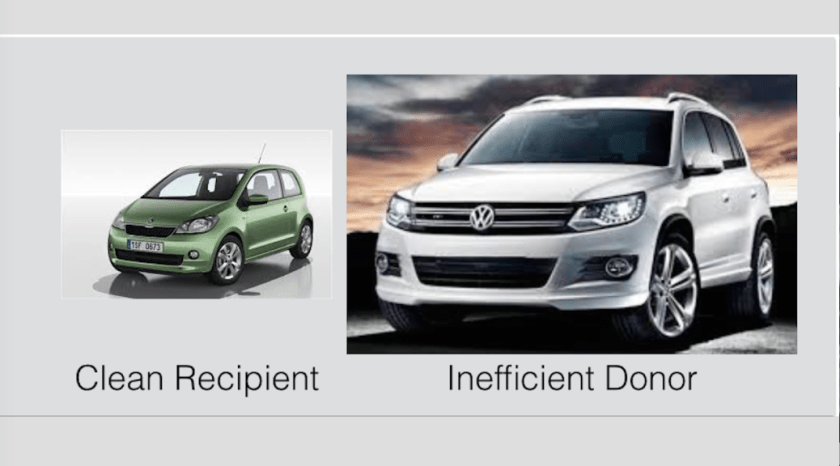
“To test one possible explanation – we carried out a diesel transplant where we took the diesel from one vehicle that had failed the test and removed it and transferred it to another vehicle that had passed the test.”
460x.jpg
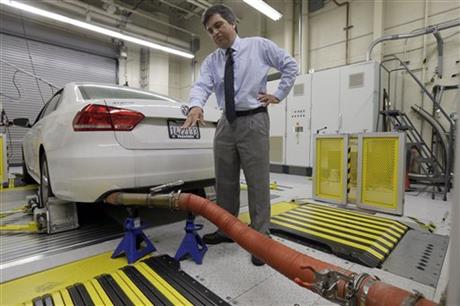
Diesel transplant being carried out

The crowd was hushed when she reported the key finding:

“Amazingly, the recipient vehicle went from being lean, green and energy efficient to being an incredibly inefficient, pollution pumping vehicle. In other words, something in the diesel transferred the inefficiency from one vehicle to another.”

Screenshot-2015-10-05-00.29.47-300x136.png

Gordon then turned over the presentation to Volkswagen’s Chief Microbiologist Jeferina Gordon:

We ran the diesel from the donor and recipient vehicles through a series of tests – especially an array of genomic analyses.  And what we found was that the microbes in the donor diesel were very different from those in the recipient.  This “dieselome” analysis also showed that after a diesel transplant from a sick vehicle, the microbes in the previously healthy, efficient vehicle become more like those from the sick donor.

Screenshot 2015-10-05 00.12.03

Screenshot-2015-10-05-00.12.03.png

Gordon concluded by saying:

“It is clear to us that the problem is not actually in software but it is in the microbes in the vehicles.  Somehow the microbes in the vehicles that were failing the test were different than in the healthy vehicles.”

This reporter then asked Gordon if they had any explanation for what could have caused the difference.  She responded:

We are unsure of the causes.  But we believe the most likely explanation is excessive use of antimicrobial cleansers in the cleaning of vehicles, or possible the choice of air filtration systems that may have eliminated beneficial microbes from the vehicles. We are investigating.

At #UCDavis 10/8: MicroRNAs and the diabetic beta cell

Dr. Anath Shaleve

Professor of Medicine

Nancy R. and Eugene C. Gwaltney Family Endowed Chair in Juvenile Diabetes Research

Director, Comprehensive Diabetes Center

University of Alabama at Birmingham

“MicroRNAs and the diabetic beta cell”

Thursday, October 8, 2015

4:10 p.m.

1022 Life Sciences

Host: Mark Huising

(mhuising)

(If you wish an appointment with the invited speaker, please contact the host.)

Shalev_Mtg Notice.pdf

Faculty position: Plant Evolutionary Biologist at CSUN

Dear Colleagues:

Cal State Northridge is hiring a Plant Evolutionary Biologist and I’m seeking your help to identify any qualified candidates. Ideally, we’re looking for somebody with expertise in molecular systematics, but we’ll consider anybody that works on evolutionary questions associated with plants and has a strong record.

Although Cal States don’t have the reputation of most R-1 schools, CSUN is an exception in that our President and Provost are pushing research more than most Cal States and putting their money where their mouth is. Despite having to teach slightly more than some places, I’ve found enough time and resources to do what I want here (well, at least as much time as any of us have to do what we want). I’d appreciate your forwarding this along to people that you think might be appropriate.

Qualifications:

California State University, Northridge, seeks a Plant Evolutionary Biologist to become a tenure-track Assistant Professor of Biology. Applicants’ research should address evolutionary questions in plant biology, with a preferable focus on molecular systematics. Applicants must have a Ph.D. and postdoctoral experience. Teaching will include Evolutionary Biology, Flowering Plants, and/or an upper division course developed by the applicant. The successful candidate is expected to develop a vigorous research program involving undergraduate and M.S. students, aggressively seek extramural funding, demonstrate teaching excellence, and provide effective instruction to students of diverse backgrounds in a multicultural setting.

The successful candidate is expected to establish a productive research lab, preferably involving research on plants in their natural habitat and to collaborate with others in the department using molecular tools, including next-generation sequencing technologies. The Department of Biology has a fully functional Molecular Core Facility with an in-house Illumina Sequencer. Faculty in the department’s Ecology and Evolution area have a strong commitment to teaching courses in field biology and to offering students research experiences testing evolutionary ideas. We seek applicants who share this vision and have a strong interest in field research/teaching. The successful applicant will be expected to teach Evolutionary Biology (upper division majors course) and Flowering Plants (an upper division field and laboratory course), as well as specialty upper division majors and/or graduate level course(s) in their area of expertise.

At time of appointment, the successful candidate, if not a U.S. citizen, must have authorization from the Bureau of Citizenship and Immigration Services to work in the United States.

Responsibilities:

• Develop a vigorous research program involving undergraduate and M.S. students and seek extramural research funds. • Demonstrate teaching excellence in coursework at multiple levels.
• Participate in department, college, and university service.

Application Deadline:

Screening will begin on November 1, 2015. Priority will be given to applicants who meet the screening deadline. However, the position will remain open until filled. Applicants should submit (1) a cover letter, (2) CV, (3) summary of research experience, (4) summary of teaching philosophy and experience, including how his/her teaching reaches a diverse student body, and (5) PDFs of three publications to: Applicants should also arrange for three letters of recommendation to be sent to plantevosearch. Although electronic applications are strongly encouraged, materials may also be sent to: Plant Evolutionary Biologist Search Committee, Department of Biology, California State University, 18111 Nordhoff Street, Northridge, California 91330-8303, USA. In later phases of the search process, applicants may be requested to provide verification of terminal degrees, licenses and certificates.

In later phases of the search process, applicants may be requested to provide verification of terminal degrees, licenses and certificates.

The full job ad can be found here: http://www.csun.edu/biosphere/PlantEvoSearch_aa1.pdf