Evolution of DNA sequencing talk 2015 version

Crossposted from microBEnet

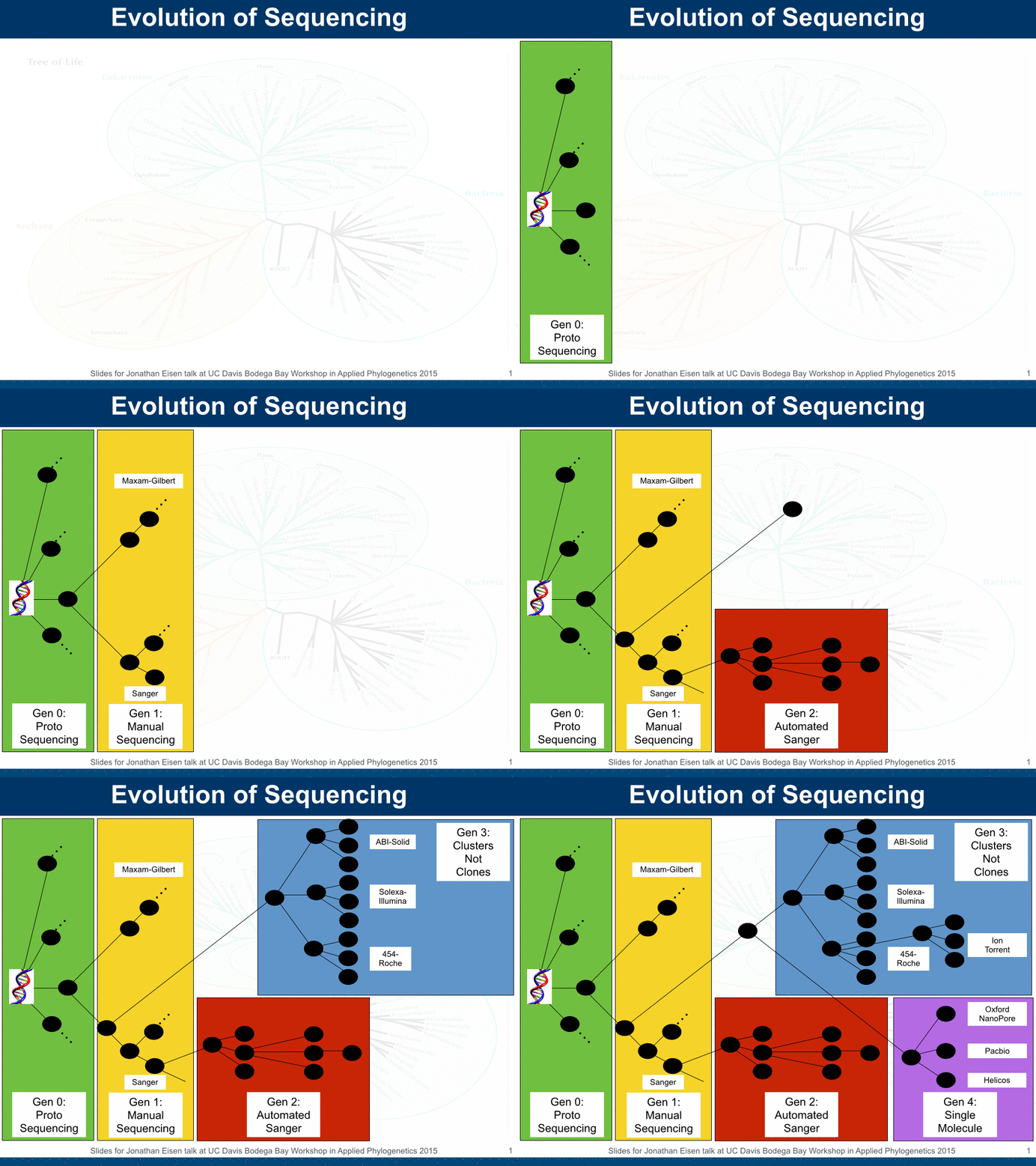
Every year for the last few years I have given a talk on the “Evolution of DNA Sequencing” at the “Workshop in Applied Phylogenetics” at Bodega Bay Marine Lab. I just did the talk and thought I would post the slides here. I note – I also added an evolutionary tree of sequencing methods which I include here as a separate animated gif too.

I note I posted a request to Twitter the day before the talk pointing to last years slides and I got lots of helpful suggestions from people about what to add or change. I included links to Tweets in the talk and thanked those people on the slides. But I would like to thank everyone here too. Published originally on March 10, 2015.  Updated  10/20/15 with information below and republished. Finally posted the video of the talk (recorded using Camtasia) to Youtube.  It is imperfect (there are a few things I said that came out wrong .. it was late at night).  But since it may be helpful to people I am posting it.

Storify of Software for Science: Getting Credit for Code #SoftCiteUCD

At #UCDavis today: “Protein interaction networks and complexes in bacteria”

Medical Microbiology and ImmunologyFaculty Recruitment Seminar

Peter Uetz, Ph.D.

Associate Professor

Center for the Study of Biological Complexity

Virginia Commonwealth University

Richmond, Virginia

Protein interaction networks and complexes in bacteria”

Friday, October 30, 2015

MedSci Building 180C (across from Tupper Hall)

12:10 – 1:00 pm

Please contact Karryn Doyle for additional information at kddoyle: 530.752.9401

PUetz Seminar Announcement.pdf

Today at #UCDavis: Megan Frederickson on “Mutualism ecology and evolution: moving beyond cheating”

Just got this announcement:

This Thursday’s EVE seminar speaker will be Megan Frederickson from the University of Toronto. Megan studies the evolution of cooperation and cheating in mutualisms, and the consequences of diversity for cooperation. To tackle these topics, Megan uses interactions between insects, ants, and microbes. See her website for more info.

Megan’s talk is titled "Mutualism ecology and evolution: moving beyond cheating," and will be at 4:10 in Everson 176.

If you would like to meet with Megan, please email me (amobrien) to coordinate a time.

There will also be a graduate student lunch at 12:10 in 1017 Wickson Hall, please RSVP (amobrien) if you plan to attend.

Also, as a "trailer" for the talk, check out Megan’s work on Devil’s Gardens featured in BBC’a Life in the Undergrowth, narrated by David Attenborough (first segment of: Intimate Relations).

Storify of the IFAL Roundtable on Microbiomes in Food and Agriculture

Here is a quick roundup of the Roundtable discussion I was involved in on Microbiomes in Food and Agriculture run by the IFAL at UC Davis.

Extraterrestrials, or Space Pirates?

A landmark study has illuminated the presence of specific microbes on the ISS strongly suggesting that humans might be on board the spacecraft.  In a routine survey of one air filter and more than one (two) of the vacuum bags used to clean the station, the researchers arrived at unexpected results – the amount and type of microbes found on the ISS are in stark contrast to those found on the meticulously scrubbed and disinfected NASA clean rooms* back on Earth.  Furthermore, these microbes on the ISS seem to resemble those found in association with humans.

NASA-Clean-room-from-Wikimedia-Commons-300x200.jpg

NASA Clean room, image from Wikimedia Commons https://commons.wikimedia.org/wiki/File:327160main_SICDH_FS_img1_lg.jpg

Experts say that if these microbes came from a human, it is entirely possible that they could live on another human.  A major worry is that the astronauts and cosmonauts expected to continue living and working now on the ISS might be living with bacteria, which have been known to cause disease in the past.  It is therefore now the topmost priority to figure out which pathogens are there and how on (from?) Earth they arrived.

Astronaut_Karen_Nyberg_With_Cosmonaut_Fyodor_Yurchikhin_and_Astronaut_Luca_Parmitano-from-Wikidmedia-Commons-300x199.jpg

Astronaut Karen Nyberg with fellow Cosmonaut Fyodor Yurchikhin and Astronaut Luca Parmitano, image from Wikimedia Commons https://commons.wikimedia.org/wiki/File:Astronaut_Karen_Nyberg_With_Cosmonaut_Fyodor_Yurchikhin_and_Astronaut_Luca_Parmitano.jpg

Microbial forensic experts are being called in to analyze the unique “fingerprint” signatures of the microbes left behind, in the hope of identifying the suspects these potential pathogens came from.  Preliminary findings have urged officials to focus their search on anyone who has recently eaten space-grown lettuce.  Next steps to understanding what is influencing the microbes on the ISS include analyzing the effect of a human breathing, eating, washing hair, sneezing, farting, playing the guitar or performing any other act as might be expected of these hypothesized ISS inhabitants.  Due to the limited knowledge of the on-goings of the station, the public is being asked for any information they might know of regarding such activities.

*Designed to eliminate the spread and survival of microorganisms.

Google Trends on Microbiomes and Microbiota

//www.google.com/trends/embed.js?hl=en-US&q=microbiome&tz=Etc/GMT%2B7&content=1&cid=TIMESERIES_GRAPH_0&export=5&w=500&h=330 //www.google.com/trends/embed.js?hl=en-US&q=microbiome,+microbiota&cmpt=q&tz=Etc/GMT%2B7&tz=Etc/GMT%2B7&content=1&cid=TIMESERIES_GRAPH_0&export=5&w=500&h=330
UPDATE: Added a zoomed in version
//www.google.com/trends/embed.js?hl=en-US&q=microbiome&date=1/2011+49m&cmpt=q&tz=Etc/GMT%2B7&tz=Etc/GMT%2B7&content=1&cid=TIMESERIES_GRAPH_0&export=5&w=500&h=330

Assistant Professor in Evolutionary Biology at UMass Boston

Assistant Professor in Evolutionary Biology

Job Description:

The Biology Department at the University of Massachusetts, Boston seeks applicants for a full-time tenure track Assistant Professor in Evolutionary Biology starting September 1, 2016. This individual should be well versed in evolutionary and ecological theory, and special preference will be given to investigators conducting research in the area of global change evolution. Applications are particularly welcome from candidates who use creative molecular, experimental, comparative, paleontological, or theoretical approaches to study the evolutionary responses of living organisms to global changes, but candidates working in any area of evolutionary biology are welcome to apply. The successful applicant is expected to establish an externally funded research program, direct the research of students at the undergraduate, masters and doctoral levels, and interact with a dynamic group of ecologists and environmental biologists. Excellence in teaching at the undergraduate and graduate levels is expected.

Requirements:

A Ph.D. and postdoctoral training (or equivalent professional experience) in evolution, ecology, or population genetics is required.

Additional Information:

UMass Boston has a strong faculty with substantial research programs in environmental areas, and doctoral programs in Environmental Biology; Molecular, Cellular and Organismal Biology; and Environmental Sciences. Excellent opportunities exist to collaborate and engage in multidisciplinary research in the new Integrated Science Complex on campus, across the five UMass campuses and at our Nantucket Field Station.

Application Instructions:

Application materials must be submitted online via the following link: https://umb.interviewexchange.com/jobofferdetails.jsp?JOBID=65133&CNTRNO=7&TSTMP=1445528235220

Applications should include a cover letter addressed to the search committee, a current curriculum vitae, 3-5 representative publications, a statement describing research interests and goals, a teaching statement documenting teaching experience and philosophy, and contact information for three letters of recommendation.

For further information, visit the Biology Department website at liam.revell or ron.etter, search committee co-chairs. Target date for receipt of applications is Dec. 1, 2015, but applications will be reviewed until the position is filled.

The University of Massachusetts Boston provides equal employment opportunities to all employees and applicants for employment without regard race, color, religion, gender, gender identity or expression, age, sexual orientation, national origin, ancestry, disability, military status, or genetic information. In addition to federal law requirements, the University of Massachusetts Boston complies with applicable state and local laws governing nondiscrimination in employment in every location in which the university operates. This policy applies to all terms and conditions of employment.

advisor-mmi291 REMINDER: MMI Faculty Recruitment Seminar on Friday, 10/23 at 12:10 PM in GBSF 1005

Medical Microbiology and Immunology

Faculty Recruitment Seminar

Laura Hertel, Ph.D.

Associate Scientist

Center of Immunobiology and Vaccine Development

Children’s Hospital Oakland Research Institute

Oakland, California

Friday, October 23, 2015

Genome and Biomedical Sciences Facility, Auditorium Room 1005

12:10 – 1:00 pm

“Watch your mouth: human cytomegalovirus infection and reactivation in Langerhans-type dendritic cells

Dr. Hertel will be presenting some new, unpublished data on the effects of different maturation stimuli on Langerhans cells’ susceptibility to direct CMV infection and on their ability to support viral reactivation from latency.

Please contact Karryn Doyle for additional information at kddoyle: 530.752.9401

LHertel Seminar Announcement.pdf

The story behind the paper by @JeremyJBarr on phage using mucus to hunt prey

This is a guest post by Jeremy Barr about a new paper of his. Also see his previous post from 2013: Story behind the paper: from Jeremy Barr on “Bacteriophage and mucus. Two unlikely entities, or an exceptional symbiosis? “

———————————————————
The story behind the paper “Subdiffusive motion of bacteriophage in mucosal surfaces increases the frequency of bacterial encounters
Here’s the story behind our recent publication on the subdiffusive motion of bacteriophage in mucus published in PNAS – a manuscript that builds on our Bacteriophage Adherence to Mucus (BAM) model of phage-derived immunity. You can also find a recent write up on the work by San Diego State University (SDSU) News Center here.
Inception
In early 2013, I attended my first Keystone Symposia conference on “Emerging Topics in Immune System Plasticity” in Santa Fe, New Mexico. Apart from the excellent snow conditions, I was beginning to question my decision to attend an immunity conference as an experimental microbiologist, but one of the last presentations at the conference, given by Christopher Hunter from UPenn, stuck with me. The Hunter lab was investigating the ability of CD8+ T cells to control the parasite Toxoplasma gondii in the brains of mice. Using a powerful microscopy system, they were able to watch T cell movement in real time while they were searching the brain for the sparsely distributed parasites. They found the T cells moved in a specific pattern, characterized by many short-distance movements interspersed with occasional longer-distance flight to a new area. This search strategy is known as a Lévy flight, and it allowed the T cells to more effectively search an area of the brain for hiding Toxoplasma than if they searched by directed or random motion (see paper here). Once I saw this talk, the idea behind our paper was planted. I knew that by adhering to mucus, bacteriophage could also use this strategy to hunt bacteria, but it wasn’t until a couple of years later that I was able to test this hypothesis.
The makings of a microfluidic mucus layer.
During this time, I had been reading a number of papers that were reconstituting organ-level functions on microfluidic devices, making simulated lung or gut environments.

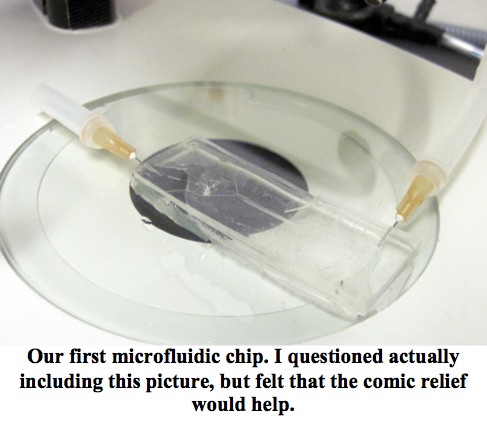
Recognizing the potential of these systems, I began working with Samuel Kassegne and his Masters student Nicholas Sam-Soon in the Department of Mechanical Engineering at San Diego State University (SDSU) to develop our own microfluidic ‘chip’ aimed to simulate a mucus layer with fluid flow and secretion dynamics. I had no idea how difficult this endeavor would be. Our first chip was as close to a complete failure as one could get. The device leaked, it was dirty, and I had the bright idea that we could simple poke a syringe into the chip to set up fluid flow.

But we persevered. We continually solved problem after problem, with every solution leading to new problems, be it leaks, growths, or cracks in the chip. Two years and a Masters thesis later, the system was finally working at a useful throughput for us to experimentally test. We could now run up to nine chips simultaneously and immediately set out to recapitulate our prior results – that mucus-adherent phage protected mucosal epithelium from bacterial infections.
What we found from these experiments was quite surprising. Firstly, I should explain that the model system we were using was phage T4, a strictly lytic phage that infects and kills Escherichia coli that we previously showed was capable of adhering to mucus, and a T4∆hoc phage that is equally capable of killing E. coli but lacks the capsid proteins required to adhere to mucus. When we infected the chips with E. coli bacterium and the non-mucus adherent T4∆hoc phage, we found that these phage-treated chips were no better at reducing bacterial abundance in the mucus layer compared to control chips where no phage had been added at all. Meanwhile, the mucus-adherent T4 phage was capable of reducing bacterial colonization in the mucus by over 4000-fold. We next investigated whether differences in phage accumulation or persistence in the mucus could explain this stark difference, but we found no effect. The question remained, why were the mucus-adherent phage better suited at finding and reducing bacteria in mucus than the same phage that could not stick?

Weekly math meetings to the rescue
For the last four and a half years I have been extremely fortunate to have the opportunity to work as both a post-doc and now an adjunct faculty in Forest Rohwer’s lab at SDSU. During that time, one of Forest’s many punishments for me was compulsory, weekly Bio-Math meetings, which are still being run here at SDSU. These meetings were something that I initially rebelled against – what good could math do me? But as I unwillingly persisted, I came to realize the value in using math to describe biological systems. This is especially true for phages that play the game of life at a speed and scale that is at times incomprehensible.
Over time, I came to have my own weekly math meetings with a group of SDSU mathematicians, statisticians, and physicists. I owe a big thanks to Peter Salamon, Arlette Baljon, Jim Nulton, and Ben Felts, who all took countless hours out of their days to meet with me and discuss the complexities of diffusion. During these meetings we analyzed hundreds of thousands of data points detailing phage diffusivity in mucus, and eventually we answered the question as to why mucus-adherent phage were better at reducing bacterial numbers – the phage were employing a search strategy to hunt bacteria in mucus. But this search strategy was not the same as the Lévy flights I had seen the T cells use at the conference talk years earlier. This was something different, something that no predator had been shown to utilize before. Our phage were using a type of motion know as subdiffusion.
Phage are like ticks in a grass field
We found that phage that adhere weakly to mucus, through reversible binding interactions to one or more mucin strand, exhibit subdiffusive motion, not normal diffusion, in mucosal surfaces. The question now was what that means for the phages. What benefit could subdiffusive motion provide?
Subdiffusion is a very abstract concept that is difficult to explain without mathematical formula, and we spent many hours discussing the possible biological implications. Subdiffusive particles move slower and slower over time, remaining in their original positions longer, and in certain models the chance of finding a nearby target is significantly increased. Using similar logic, we hypothesized that mucus-adherent phage moved slower in specific regions of the mucus layer, remained nearby sites of productive bacterial infections, and concentrated in regions of the mucus that overlapped the niche of their bacterial host – all resulting in a greater chance for the phage to encounter a bacterium. Now we just had to prove it.

One of the beautiful things about phage biology is the detailed and expansive literature published over the last 100 years. Going back through these papers, we found a classical phage experiment that was first published in 1932 by Martin Schlesinger. This experiment measured the adsorption rate of a specific phage to its bacterial host. Using this assay, we showed that phage adsorption rate was increased in mucin solutions at low, but not high, bacterial concentrations. The logic here is that when bacterial hosts are abundant, the chance of a random phage-host encounter is high, and any improvement in the search strategy employed doesn’t provide a noticeable benefit. But when bacterial abundance is low and chance phage-host encounters are comparatively low, performing a more efficient search can greatly improve the chances of a successful infection.
The implications here become apparent when we consider that phages are typically quite specific and that mucosal surfaces harbor a large diversity of bacterial hosts – dynamics that reduce the chance of any successful phage-host encounter. From the perspective of the phage subdiffusing within a mucus layer, the world is a three-dimensional web, and like ticks in a grass field, the phage are holding onto the mucus network, awaiting a bacterial host.
The publication process
I presented this work at another Keystone Symposia on “Gut Microbiota Modulation of Host Physiology” earlier this year. During one of the conference dinners, an editor for Science happened to join the table where I was seated. We started speaking and they suggested that I submit the work for review at Science. At the time, I was reading Steven Pinker’s The Sense of Style and wanted to write the paper in ‘Classic Style’ to simply explain phage subdiffusion and appeal to a broader audience. I was very fortunate to be able to work once again with Merry Youle. We wrote a very stylized paper for Science, but after a two-week internal review we were told that although the work would likely be of great interest to the field, it was not broad enough for their general readershipSo we quickly edited the paper and sent it to PNAS for review.
Our reviewers from PNAS were very helpful and suggested a number of experiments that strengthened the work, but they all hated the writing style and asked us to cut out many of the phage anthropomorphisms we had used (e.g., phage hunting bacteria). We spent another three months collecting and analyzing additional data and rewriting the paper, now with a more serious tone (e.g., search strategies instead of hunting). Overall, I felt our resubmitted paper was much stronger scientifically, even though it lost some readability. But the paper was still not accepted, and we had to go through a third revision. The final reviewer insisted on us including in vivo experiments (not something we could easily do for this paper, but we’re working on it) and continued to argue that the use of ‘search strategy’ obfuscated phage subdiffusion in mucus. Although we disagreed with this final point, the thought of going through another review was enough for us to concede, and we removed the use of this term from the paper. The rest of the editorial process was handled extremely well and we were in press at PNAS just three weeks later.