Connotea is closing

Just got this email … not sure what the full story is behind it but Connotea is closing ….

Connotea is closing

Connotea, nature.com’s social bookmarking site, is closing on March 12th, 2013. We would like to thank you for your patience with and support for the site.

To enable you to export your bookmarks to an alternative service, we are providing a tool to make the process as easy as possible. Connotea will be available until March 12th, 2013 and you are strongly encouraged to download your bookmarks before this date as your library will not be accessible afterwards.

The Connotea Export Tool will convert your bookmarks into two formats that should be compatible with most common browsers or reference management systems:

  • HTML – compatible with most browsers
  • RIS – compatible with most reference management systems.

You will be able to log in to the Connotea Export Tool by using your Connotea username and password and following the instructions on screen. Once you have downloaded your HTML and/or RIS file, please refer to the instructions for your browser and/or reference management system to import your bookmarks.

Access the Connotea Export Tool.

As Connotea stores a large amount of data, in some cases it may take over an hour for your bookmarks file to be generated. If you experience any problems with exporting your bookmarks, or have any other questions or queries, please contact Marta Rolak

Science music video of the week: Some budding yeast I used to grow

Hat tip to Gian Baucom and Susan Perkins

#UCDavis Ecology & Evolution Seminar 1/24: Dawn Sumner #Awesome

Forwarding this:

Dear Colleagues,

The Ecology and Evolution Seminar speaker this week will be our own Dawn Sumner from Geology. Her talk on Thursday January 24th is entitled

The Modern Ecology of Ice-Covered Lakes in Antarctica: A Journey Back to Precambrian Time

and takes place at 4:10pm in 1003 Giedt Hall.

Dawn is one of the principle scientists on Curiosity, NASA’s Mars Science Laboratory. You can read about this work on her blog at

http://dawnonmars.blogspot.com/

which links to some marvelous footage/photos of their Mars explorations.

Dawn has done also extensive work on the (nearly) other-wordly ecology of microbial communities in Antarctic lakes to "develop a predictive understanding of how microbial communities produce complex microbialite morphologies." You can find out more about this at

http://mygeologypage.ucdavis.edu/sumner/Dawns_Research/Antarctica.html

and her Antarctic blog http://dawninantarctica.blogspot.com/

From iSEEM project: Phylogenetic Diversity Theory Sheds Light on the Structure of Microbial Communities

Quick post.  Another paper is out based on the Gordon and Betty Moore Foundation funded iSEEM project I co-ran with Jessica Green and Katie Pollard.

PLOS Computational Biology: Phylogenetic Diversity Theory Sheds Light on the Structure of Microbial Communities.

O’Dwyer JP, Kembel SW, Green JL (2012) Phylogenetic Diversity Theory Sheds Light on the Structure of Microbial Communities. PLoS Comput Biol 8(12): e1002832. doi:10.1371/journal.pcbi.1002832.

It has one of my favorite paper figures ever.

Figure 1. The local community and metacommunity framework casts local biodiversity of coexisting species in terms of a sampling process from a larger reference pool, or metacommunity. 

And the paper is definitely worth checking out.

Halophiles 2013 Conference June 23-27 U Conn.

Just got this from Thane Papke

It is my pleasure to invite everyone to the tri-annual Halophiles conference on microorganisms. This year’s event will take place from June 23-27th on the Storrs Campus of the University of Connecticut.

The conference will highlight the diverse research of over 30 invited speakers on topics of biodiversity, evolution, proteins, biochemistry, physiology, genetics, applied biotechnology, astrobiology, ecology and biogeochemistry, and there will be a joint meeting of the ICSP-Subcommittees on the taxonomy of the Halobacteriaceae and Halomonadaceae.

If you are interested in participating, please go to the following website for registration, and more information. http://www.regonline.com/halophiles2013

This announcement was made from an incomplete email list and cannot reach everyone. If you are aware of any names who should receive this and future announcements, please forward this notice to them, and let me know their address and I will add them to the list. If you are on the list and wish to be removed, please let me know.

Sincerely,
Thane

http://www.papkelab.uconn.edu

Halophiles_Conference_Poster.pdf

Overselling the microbiome: University Bern press release uses slight of hand to make mouse study seem to be about people

Interesting new paper came out recently on “Sex Differences in the Gut Microbiome Drive Hormone-Dependent Regulation of Autoimmunity.”  It is alas in Science so it is not available openly.

Anyway there are some news stories about the article where you can get the gist of it.  Best one is probably the blog post by Christine Gorman: Transplanted Bacteria Turn Up Testosterone to Protect Mice against Diabetes.  The story is pretty interesting.

For those who do not know I have been a bit obsessed about the connection between diabetes and the microbiome for a while.  See my Ted talk for example where I discuss my own personal connection to this issue.

http://embed.ted.com/talks/jonathan_eisen_meet_your_microbes.html

But the science is not what I want to talk about here.  What I want to talk about is how science press releases can just be awful.  The one for this paper is like some sort of con artist’s scheme.  Here it is on Science Daily: Good bacteria in the intestine prevent diabetes, study suggests.  First, they lure you in with a headline that, well, fails to mention that the study was in mice.  And then they keep trying to lure you with some lines about humans and their microbes.  In fact, the first two and half paragraphs I think are pretty deceptive.

All humans have enormous numbers of bacteria and other micro-organisms in the lower intestine. In fact our bodies contain about ten times more bacteria than the number of our own cells and these tiny passengers are extremely important for our health. They help us digest our food and provide us with energy and vitamins. These ‘friendly’ commensal bacteria in the intestine help to stop the ‘bad guys’ such as Salmonella that cause infections, taking hold. Even the biochemical reactions that build up and maintain our bodies come from our intestinal bacteria as well as our own cells.  

Pretty important that we get along with these little bacterial friends… definitely. But as in all beautiful relationships, things can sometimes turn sour. If the bacteria in the intestine become unbalanced, inflammation and damage can occur at many different locations in the body. The best known of these is the intestine itself: the wrong intestinal bacteria can trigger Crohn’s disease and ulcerative colitis. The liver also becomes damaged when intestinal bacteria are unbalanced. 

Research groups led by Professor Jayne Danska at the Sick Children’s Hospital of the University of Toronto and Professor Andrew Macpherson in the Clinic for Visceral Surgery and Medicine at the Inselspital and the University of Bern have now shown that the influence of the intestinal bacteria extends even deeper inside the body to influence the likelihood of getting diabetes. In children and young people, diabetes is caused by the immune cells of the body damaging the special cells in the pancreas that produce the hormone insulin.

Yup – lots and lots of stuff about people.  Which is fine.  I like people.  But the thing is. The paper is about mice.  So lines like “have now shown that the influence of the intestinal bacteria extends even deeper inside the body to influence the likelihood of getting diabetes” are kind of misleading because so far there has been no mention of mice and that line is they only true for mice, not people.  And then they wrap up this section with another line about people, clearly trying to imply that the “have now shown …” part is relevant to people.

And then, finally, they turn to mice.

By chance, 30 years ago, before the development of genetic engineering techniques, Japanese investigators noticed that a strain of NOD laboratory mice tended to get diabetes. These mice (also by chance) have many of the same genes that make some humans susceptible to the disease. With the help of the special facilities of the University of Bern and in Canada, these teams have been able to show that the intestinal bacteria, especially in male mice, can produce biochemicals and hormones that stop diabetes developing.

And then they go back to people.

Diabetes in young people is becoming more and more frequent, and doctors even talk about a diabetes epidemic. This increase in diabetic disease has happened over the last 40 years as our homes and environment have become cleaner and more hygienic. At the moment, once a child has diabetes, he or she requires life-long treatment. 

“We hope that our new understanding of how intestinal bacteria may protect susceptible children from developing diabetes, will allow us to start to develop new treatments to stop children getting the disease,” says Andrew Macpherson of the University Bern.

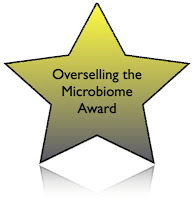
Wow.  So in a press release about a paper that is about mice, there are three sentences about mice and the rest are about people.  The thing is, in case you don’t know – mice are not the same as people.  Just saying.  And for trying to overplay the connection of their work to humans, I am giving the writer’s of this press release my coveted Overselling the Microbiome Award.

Past posts about this award include:

Crosspost from PLOS Biologue: Working to increase diversity of PLOS Biology Academic Editors and Advisory Board members

On the PLOS Biologue (the blog for PLOS Biology) I have a post that may be of interest.  I discuss our efforts to increase the diversity of the people involved in the various Boards of PLOS Biology.  This is my first task I have taken as the Chair of the PLOS Biology Advisory Board.  See the post: Working to increase diversity of PLOS Biology Academic Editors and Advisory Board members.

Evolutionary Biology of the Built Environment Working Group: Call for Participants

Call for participants: Evolutionary Biology of the Built Environment Working Group.  Details copied from the announcement pasted below:

The Basics: We need your help. We are organizing the first working group aimed at understanding the evolutionary biology of the built environment—our bedrooms, our houses, our backyards and our cities. This working group will occur June 10 – 14, 2013, in Durham, North Carolina. We are now inviting applications for participants in the working group.
Why: As recently as one hundred thousand years ago the indoor environment did not exist. Yet, this is now where most humans spend the majority of their life. One might imagine that in its relatively short history the built environment might have had time to accumulate very few species. Far from the case, an emerging body of literature shows that hundreds of multicellular species and thousands of unicellular species can be found in houses and buildings more generally. Among the species found in homes are those whose presence (or absence) is likely to have a large impact on human health and well-being, species including beneficial microbiota on the body but also pathogens and potential pathogens or toxic species such as extremophilic fungi. Yet, with the exception of a few deadly pathogens (such as MRSA), the evolutionary history of most of the species with which we most intimately interact in our homes remains unknown. To remedy our lack of knowledge and take advantage of recent advances in disparate fields we will bring together scientists studying both the fauna (microbiologists, entomologists, mammalogists, and any other -ologists you can convince us have some bearing on house biomes) and environment (engineers, architects) along with social scientists (anthropologists) and evolutionary biologists (e.g. theoreticians, bioinformaticians, geneticists) to begin to build a framework for the evolution of the indoor and more generally built biome. Our goal is to develop a framework for a comprehensive understanding of the evolution of the species we most intimately interact with, particularly in the context of considering how to build and design our environments so as to favor beneficial (rather than dangerous) evolutionary trajectories. We aim to understand both how to prevent the extinction of beneficial species and to favor the evolution of lineages and species with beneficial attributes, whether those be ecological functions, health benefits or simply aesthetic value.
Who: We’d like to convene a diverse group of scientists and practitioners at various stages in their careers, from graduate students and post-docs to senior scientists, representing an array of disciplines including the organismal -ologies (e.g. microbiology, entomology, etc.), engineering, architecture, anthropology, evolution, genetics, bioinformatics, art and design. We want to be inclusive of any field that you can convince us has something to bear on studying evolution in the built environment.
How: We are currently accepting applications to be part of this working group. If you are interested, you can apply online apply online here, but do so soon. We will select a group of 30 scholars and practitioners from the applicant pool who will meet in Durham with the goal of producing a series of general audience and peer-reviewed publications about the evolutionary biology of the built environment.
Sponsored by a partnership between the Sloan Foundation and the National Evolutionary Synthesis Center.
Have questions? Drop us a note at yourwildlife@gmail.com.

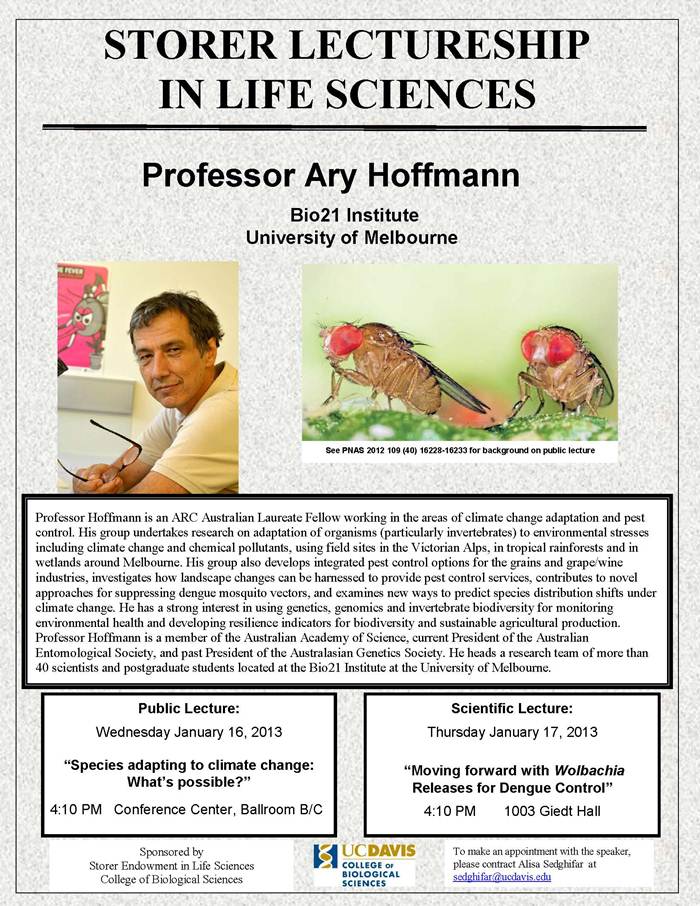
At #UCDavis: Ary Hoffmann-1/16-17th Climate change, Dengue, Wolbachia and more

Ary Hoffman flyer FN.PDF

Phyloseminar: ""Language phylogenies and cultural evolution" Online 1/16 2 PM PST

From phyloseminar.org home

“Language phylogenies and cultural evolution”

Simon Greenhill (Australian National University)

“Charles Darwin famously noted that there were many curious parallels between the evolution of species and languages. Since then evolutionary biology and historical linguistics have used trees to conceptualise evolution. However, whilst evolutionary biology developed the vast discipline of phylogenetic methods, linguistics dabbled with computational methods before rejecting them. The last decade or so has seen the introduction of phylogenetic methods into linguistics, often with some startling results. In this talk I will present some of these studies, and discuss how phylogenetics can help us grapple with the problems of linguistic and cultural evolution. These problems range from testing population dispersal hypotheses, to investigating the shape of cultural evolution, to inferring the rates at which languages change.

West Coast USA:14:00 (02:00 PM) on Wednesday, January 16
East Coast USA:17:00 (05:00 PM) on Wednesday, January 16
UK:22:00 (10:00 PM) on Wednesday, January 16
France:23:00 (11:00 PM) on Wednesday, January 16
Japan:07:00 (07:00 AM) on Thursday, January 17
New Zealand:11:00 (11:00 AM) on Thursday, January 17