People not Projects: the Moore Foundation continues to revolutionize marine microbiology w/ its Investigator program

People not Projects.

It is such a simple concept.  But it is so powerful.  I first became aware of this idea as it relates to funding scientific research in regard to the Howard Hughes Medical Institute’s Investigator program.  Their approach (along with a decent chunk of money) has helped revolutionize biomedical science.  And thus I was personally thrilled to see the introduction of this concept in the area of Marine Microbiology a few years back with the Gordon and Betty Moore Foundation’s “Marine Microbiology Initiative Investigator” program.  Launched in 2004 it helped revolutionize marine microbiology studies in the same way HHMI’s investigator program revolutionized biomedical studies.

The first GBMF MMI Investigator program ran from 2004 -2012. And the people supported were pretty darn special:

Now I am I suppose a little biased in this because at the same time GBMF launched this program they also put a bunch of money into the general area of Marine Microbiology and I have been the recipient of some of that money.  For example, I got a small amount of money as part of the GBMF Funded work at the J. Craig Venter Institute on the Sargasso Sea and Global Ocean Sampling metagenomic sequencing projects and also had a subcontract from UCSD/JCVI to do some work as part of the “CAMERA” metagenomic database project.  I ended up being a coauthor on a diverse collection of papers associated with these projects including Sargasso metagenome and this review, and GOS1GOS2 and my stalking the 4th domain paper.

I am also a bit biased in that I have worked with many of the people on the initial MMI Investigator list some before, some after the awards including papers with Jen Martiny, Ed Delong, Alex Worden and Ginger Armbrust, and Mary Ann Moran.

But perhaps most relevant in terms of possible bias towards the Gordon and Betty Moore Foundation is that in 2007 my lab received funds through the MMI program for a collaborative project with Jessica Green and Katie Pollard for our “iSEEM” project on “Integrating Statistical, Ecological and Evolutionary analyses of Metagenomic Data” (see http://iseem.org) which was one of the most successful collaborations in which I have ever been involved.  This project produced something like a dozen papers and many major new developments in analyses of metagenomic data including 16S copy correction, sifting families, microbeDB, PD of metagenomes, WATERs, BioTorrents, AMPHORA. and STAP.  This project just ended but Katie Pollard and I just got additional funds from GBMF to continue related work.

So sure – I am biased.  But the program is simply great.  In the eight years since the initial grants the Gordon and Betty Moore Foundation has helped revolutionize marine microbiology.  And a lot of this came from the Investigator program and it’s emphasis on people not projects.  I note – the Moore Foundation has clearly decided that this “people not projects” concept is a good one.  A few years ago they partnered with HHMI to launch a Plant Sciences Investigator Program  which I wrote about here.

It was thus with great excitement that I saw the call for applications for the second round of the MMI Investigator program.  I certainly pondered applying.  But for many reasons I decided not to.  And today the winners of this competition have been announced and, well, it is an very impressive crew:

Some of the same crowd as the previous round.  Some new people.  Some people not there from the previous round.  All of them are rock stars in their areas especially if one takes into account how senior they are (the more junior people are stars in development).  And all have done groundbreaking work in various areas relating to marine microbiology.  The organisms covered here run the gamut including viruses, bacteria, archaea, and microbial eukaryotes.  The areas of focus covered range from biogeochemistry to ecosystem modeling with everything in between.  It really is an impressive group. Delong pioneered metagenomics and helped launch studies of uncultured microbes in the oceans.  Karl has led the Hawaii Ocean Time series and done other brilliant work.  Sullivan and Rohwer and pushing the frontiers of viral studies in the oceans.  Allen, Armbrust, and Worden are among the leaders in genomic studies of microbial eukaryotes in the marine environment.   Dubilier, Bidle, Fuhrman and Follows Stocker (double listed Follows in original post …) – though they focus on very different aspects of marine microbes – are helping lead the charge in understanding interactions across the domains of life in the marine environment.  Orphan, Saito, Deutsch, Follows and Pearson are on the cutting edge of biogeochemical studies and trying to link experimental studies of microbes to biogeochemistry of oceans.

The great thing about the “people not projects” concept is that the people funded here get to follow their own path.  They are not going to be constrained by the complications and sometime idiocy of the grant review process.  They in essence get to do whatever they want.  Freedom to follow their noses.  Or their guts.  Or whatever.  It is a refreshing concept and as mentioned above has been revolutionary in various areas of science.  There has been a slow but steady spread of the “people not projects” concept to various federal agencies too but it seems to be more of a private foundation type of strategy.  Federal Agencies are so risk averse in funding that this type of concept does not work well there.  I wish there was more.  But I am at least thankful for what HHMI and GBMF and Wellcome and Sloan and other private groups are doing in this regard.  Now – sure – all of these private foundations do not do everything perfectly.  They have blunders here and there like everyone else.  But without a doubt I think we need more of the People not Projects concept.
Oh – and another good thing.  GBMF is quite a big supporter of Open Science in it’s various guises.  So one can expect much of the data, software, and papers from their funding to be widely and openly available.   
It is a grand time to be doing microbiology largely due to revolutions in technology and also to changes in the way we view microbes on the planet.  It is an even grander time to be doing marine microbiology due to the dedication of the Gordon and Betty Moore Foundation to this important topic.  

Twisted tree of life award #14: @nytimes and Nathaniel Rich on Immortal Jellyfish

Well, this article by Nathaniel Rich in today’s New York Times Magazine certainly has gotten people talking: Can a Jellyfish Unlock the Secret of Immortality? – .  Alas, from a scientific point of view there are numerous problems with it.  So many that Paul Raeburn at the Knight Science Journalism Tracker at MIT has published a major takedown: First we get proof of heaven; now the secret of immortality. 
Now, the science about immortality in the article is certainly bad.  But that is not what I am here to discuss.  I am here to discuss the parts of the article about evolution.  I suppose if I had read the article online instead of in print I might have been attuned already to potential evolution problems from the correction on the first page

This article has been revised to reflect the following correction:
Correction: November 29, 2012
An earlier version of this article misstated the title of Charles Darwin’s classic book on the subject of evolution. It is “On The Origin of Species,” not “On the Origin of the Species.”

Oops.  Not a good start.  The article has a lot of background about jellyfish and in particular on person who is studying them and claiming this one species is immortal (which it is not).  It is the higher vs. lower organism meme that drives me crazy in the article:

Today the outermost twigs and buds of the Tree of Life are occupied by mammals and birds, while at the base of the trunk lie the most primitive phyla — Porifera (sponges), Platyhelminthes (flatworms), Cnidaria (jellyfish).

And then 

The mystery of life is not concealed in the higher animals,” Kubota told me. “It is concealed in the root. And at the root of the Tree of Life is the jellyfish. 

Seriously?  The root of the tree of life is the jellyfish?  And higher vs. lower organisms?  What exactly is a higher organism?  Does this mean that jellyfish have not evolved since their branch separate from the trunk of the animal tree?  Oh – and – what about the rest of the Tree of Life – you know – outside of animals for example?  Aaargh.  
The higher vs. lower meme continues with this quote:

Hydrozoans, he suggests, may have made a devil’s bargain. In exchange for simplicity — no head or tail, no vision, eating out of its own anus — they gained immortality.

Really?  So there is a tradeoff between complexity and immortality?  So does this mean all simple organisms are more immortal?  And all complex ones are doomed?  Where does this notion even come from?
For helping perpetuate the higher vs. lower organism meme (which drives me batty) I am awarding the author and the editor and the NY Times my coveted “Twisted Tree of Life” award.


As an aside, the article is littered with painful other statements like

It is possible to imagine a distant future in which most other species of life are extinct but the ocean will consist overwhelmingly of immortal jellyfish, a great gelatin consciousness everlasting.

So – this jellyfish operates in the absence of an ecosystem?  Suppose individual organisms are “immortal” as claimed in the article.  What exactly will they eat when everything else is gone?
Plus there is a conspiracy part that is lame.

You might expect that biotech multinationals would vie to copyright its genome; that a vast coalition of research scientists would seek to determine the mechanisms by which its cells aged in reverse; that pharmaceutical firms would try to appropriate its lessons for the purposes of human medicine; that governments would broker international accords to govern the future use of rejuvenating technology. But none of this happened.

Really?  So all the scientists and companies of the world have ignored this amazing finding?  Maybe, just maybe you might think that is because this is BOGUS?
And then there is the bogus “small bodied organism” problem.

He cited this as an example of a phenomenon he calls the Small’s Rule: small-bodied organisms are poorly studied relative to larger-bodied organisms. There are significantly more crab experts, for instance, than hydroid experts.

What?  Is this even remotely serious?  So ignore Drosophila as a model for animals.  Or mice for that matter.  Ignore Arabidopsis as a model for plants.  Ignore yeast too.  And E. coli.  Uggh.  Completely inane. 

Drexel Executive Leadership in Academic Technology and Engineering program fellowships

Just a quick post here.  I just got an email about the ICELA | International Center for Executive Leadership in Academics program in “Leadership Development for Senior Academic Women”.

The full email I received about this program is below:

Dear Colleague

As a recent recipient of an NSF institutional- level grant and a leader in your field, I would like to alert you to our (NSF-supported) leadership development program for mid-career women faculty in science and engineering.

The Executive Leadership in Academic Technology and Engineering program (ELATE at Drexel(r)) is a program for the enhancement of the professional and leadership skills of women faculty in mid-career (associate or full professor) in science and engineering fields. It is designed for faculty who are in a developmental phase of their institutional leadership, or who are already holding such positions.

We are now accepting applications for its 2013-2014 class through our online application<https://www.icela.net/apply/>.

The ELATE at Drexel program launched in 2012, and is currently hosting its inaugural class of Fellows from some of the nation’s leading universities in science and engineering. Over the past year, the program has been recognized with awards from the National Science Foundation, the Sloan Foundation, and the Henry Luce Foundation.  Our greatest honor has been to work with the accomplished Fellows and faculty in the program. More information about the current fellows and faculty is available at http://www.drexel.edu/engineering/programs/special_opp/ELATE/

ELATE advances knowledge and skills in strategic finance and management, personal and professional leadership effectiveness, and academic organizational dynamics. Upon graduation, each ELATE fellow becomes part of a community of leaders in higher education that provides continuing support for each member and her organization while serving as role models for the next generation of men and women scientists and engineers.

We would appreciate it if you could distribute this information to your colleagues, and encourage women in current or potential leadership roles to apply. Information provided in the attached brochure.

Applications are due by January 3, 2013.

Questions? Please contact us at ELATE@Drexel.edu or 215-991-8240.

Convoluted title, cool paper in #PLoSGenetics on relative of insect mutualists causing a human infection

Saw this tweet a few minutes ago:

//platform.twitter.com/widgets.js
The title of the paper took me a reread or two to understand.  But once I got what they were trying to say I was intrigued.  And so I went to the paper:  PLOS Genetics: A Novel Human-Infection-Derived Bacterium Provides Insights into the Evolutionary Origins of Mutualistic Insect–Bacterial Symbioses.  And it is loaded with interesting tidbits.  First, the first section of the results details the history of the infection in a 71 year old male and his recovery and the isolation and characterization of a new bacterial strain.  Phylogenetic analysis revealed this was a close relative of the Sodalis endosymbionts of insects.

And then comparative genomics revealed a bit more detail about the history of this strain, it’s relatives, and some of the insect endosymbionts.  And plus, it allowed the authors to make some jazzy figures such as

And this and other comparative analyses revealed some interesting findings.  As summarize by the authors

Our results indicate that ancestral relatives of strain HS have served as progenitors for the independent descent of Sodalis-allied endosymbionts found in several insect hosts. Comparative analyses indicate that the gene inventories of the insect endosymbionts were independently derived from a common ancestral template through a combination of irreversible degenerative changes. Our results provide compelling support for the notion that mutualists evolve from pathogenic progenitors. They also elucidate the role of degenerative evolutionary processes in shaping the gene inventories of symbiotic bacteria at a very early stage in these mutualistic associations.

The paper is definitely worth a look.

Playing with Impact Story to look at Alt Metrics for my papers, data, etc

The future of science will include in part better evaluations of the impact of individual scientists, individual papers and individual other units such as data sets, software, presentations, etc.

 There are many efforts in this area of “Alt Metrics” and one I have been playing around with recently is Impact Story. It used to be called Total Impact but they changed their name and some of their focus. It is pretty easy to use.

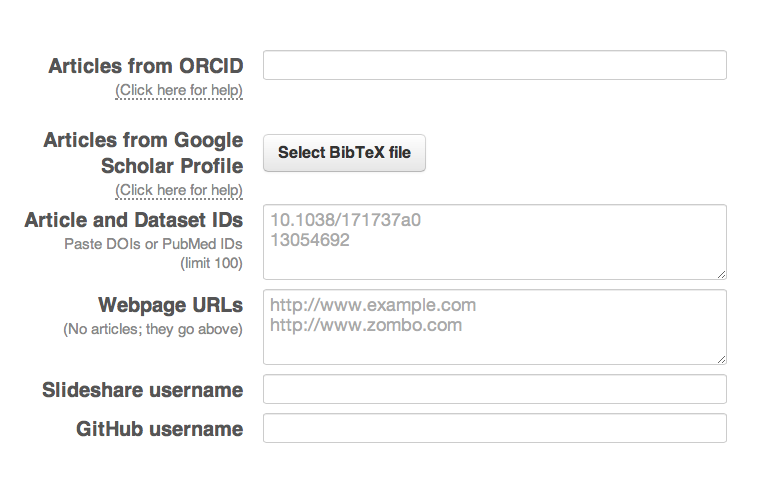
 One thing you can do is to create “A Collection.” To do this you go to their site, you register, and then you select “Create Collection“. And you add some information there

Among the information you can include: 
  • ORCID ID: ORCID is a new system for unique author IDs.  Once you get your unique ID you can curate / update your papers at the site (the site needs some work … some issues there with duplication).  I have gotten my ORCID ID and updating my publications there.
  • Articles from Google Scholar profile.  This allows one to upload a Bibtext fuile of one’s publication list from Google Scholar.  To get this, you need a Google Scholar page.  I have one here.  I have been playing a lot with Google Scholar recently: The Tree of Life: Wow – Google Scholar “Updates” a big step forward … and The Tree of Life: Thank you Google Scholar Updates for finding me … but did not realize it had a Bibtex export function until now.  From the drop down menu one selects “Export” and then can export ones publications (in the screen capture below the default option is Actions).  Once you get a Bibtex file you can upload it to ImpactStory.
  • Article and Dataset IDs.  Here one can Pubmed IDs or DOIs for other publications or datasets. Since most / all of my papers are in my Bibtext export and Orcid ID what I imagine using this for is data from places like Figshare and DataDryad
  • Webpage URLs.  One can include URLs here.  But so far my experience has been that they do not have a good system of assessing webpages.
  • Slideshare username.  If you are not posting slides and other materials on Slideshare, get with the program.  I post all my talks there.  And other things.  
  • Github Username.  A good place to post code/software.  We are doing this more and more in my lab.  I have a username though I don’t do much there myself.  
And then give your collection a name and click go.  It takes a bit of time to finish the initial collection creation with my list of materials.  But it is fascinating and very useful once done.  Here is a link to a collection “Jonathan Eisen try #3” I recently made.  I have not added everything to it but it is still a good record of how many of my contributions are being used.
My favorite thing to do so far is to click “expand all” from the menu which then shows the detailed Alt Metrics for everything.  

  • PDF views.
  • HTML Views. 
  • Facebook shares.  
  • Twitter shares.  
  • And much more. 
It does not seem perfect – not sure how the metrics are quantified for things like Twitter and Facebook.  But it gives a decent indication of how much chatter and use there is of various materials.
And you can export all the information for your own private use.  I can imagine this being VERY useful for promotion/tenure/other review actions.
I also sniffed around the site and found some nice features from their api page.  I especially like the embed function for specific DOIs.  You copy their text and change the DOI and you get a nice graphical summary of Alt Metrics for that DOI.  See an example at the bottom of the post.  Am probably going to add this to my publication lists on the web.

It is important to realize this is a BETA version. Still needs some work. But LOTS of cool things to play with. The future is here and I like it. Time to end reliance on indirect measures of the impact of papers and data (e.g., Journal Impact Factor). Time to measure actual impact. And this is a good tool to help do that.

http://impactstory.org/static/js/total-impact-item.jsdoi:10.1371/journal.pone.0018011


“How many species exist?” Seminar, Mark Costello. Dec 7,Fri. 3:10 2342 Storer”

Just got this in email:

Mark Costello will be giving a seminar on Friday, December 7th, at 3:10pm in Storer Hall room 2342. His talk will focus on several of his recent papers on “Can we discover Earth’s species before they go extinct?” If you have any questions, please contact Eliot Crafton (recrafton).

Mark is an Associate Professor as the University of Auckland Leigh Marine Laboratory. His work focuses on biodiversity, ecology, biogeography, and ectoparasites with an interest in conservation. He has done extensive work looking at biogeography of marine species, including invasive species, and examining the biodiversity of the world’s oceans. This work has relied on both taxonomic records and statistical modeling of these systems. In addition, Mark has been an active participant in developing and proliferating access to biodiversity data, including positions as the founding chair of the World Register of Marine Species (www.marinespecies.org), President of the International Association for Biological Oceanography (www.iabo.org), and Vice-Chair of the Global Biodiversity Information Facility Science Committee (www.gbif.org), among several other positions. More information regarding Mark’s activities can be found on his university webpage, http://www.marine.auckland.ac.nz/uoa/home/about/our-people/dr-mark-costello/

Seminar Topic: ‘Can we discover Earth’s species before they go extinct?’

Mark will be presenting findings from several of his 2012 papers. Poor estimates of how many species exist on Earth and extinction rates, coupled with a perception of declining taxonomic expertise, have led to concerns that many or most species may be extinct before they are discovered. In contrast to widespread beliefs, we find that hyper-estimates of species richness cannot be supported, that there have never been so many taxonomists, and that extinction rates are not yet out of control. Thus most species are likely to be described within this century, especially if taxonomic productivity increases.

Predicting Total Global Species Richness Using Rates of Species Description and Estimates of Taxonomic Effort

Mark J Costello, Simon Wilson, and Brett Houlding

http://sysbio.oxfordjournals.org/content/61/5/871.short

The Magnitude of Global Marine Species Diversity

Appeltans et al.

http://www.cell.com/current-biology/retrieve/pii/S0960982212011384

Seminar “DNA repair in bacteria: from genomes to single cells”

MIC 291: Selected Topics in Microbiology

Work-in-Progress Seminars

Dr. Meriem El Karoui
(Lactic Acid Bacteria and Opportunistic Pathogens Unit, INRA)

"DNA repair in bacteria: from genomes to single cells"

Wednesday November 28, 2012

4:10 pm

1022 Life Sciences

El Karoui 11-28-12.doc

Returning to Walt Whitman High School, home of supposed overachievers

And now for something completely different … But I thought this might have some connection to the theme of this blog here since this was a bit about education …

Yesterday I was a member of panel of alumni from my high school Walt Whitman High School in Bethesda, MD discussing the book “The Overachievers”.

Why on Earth was there a panel of alumni from my high school discussing a book?  Well, there is a course at UC Davis “Integrated Studies Honors Seminar” which was for this quarter discussing the book The Overachievers. The book is by a WWHS alum (Alexandra Robbins) about WWHS students.  Anyway, Sharon Knox, a WWHS alum heard about this course and suggested to the instructor Jim Shackleford the idea of a panel of WWHS alumni to discuss WWHS with the students.  And thus the WWHS panel was born.

I got an email from Sharon a month or so ago inviting me to participate and found out there would be three other WWHS alums who are in the area involved.  Sue Greenwald (ex mayor of Davis and husband of one of my faculty colleagues Michael Syvannen.  Max Chertok – a UC Davis physics professor.  And Kim Addonizio a poet/artist living in Oakland.

Anyway .. the panel discussion was at 4 PM yesterday on campus at UCD.  I showed up a few minutes early, and eventually went into the room where I was the first of the WWHS alumni to arrive.  Eventually the others showed up as did the ~ 100 students and we had a somewhat interesting discussion of Whitman (we covered the 60s, 70s and 80s pretty well with the different people on the panel).  Most of what we discussed was whether we thought WWHS was somehow different in producing overachievers in some way.  Most of the panel felt that it was not really about the school – that it was really more about the demographic (in general this apparently agrees with the message of the book which also said WWHS was no unique in any special way).

Anyway – I don’t want to bore people with discussions of WWHS.  But one thing came up in the discussion with the students that was quite interesting and disturbing.  This relates to the excessive march towards having everything in K-12 be about preparing for college and about getting in to college.  Students are clearly more stressed these days about their futures.  They (on average — not everyone obviously) get tested and prodded and tested some more.  They have coaches and counselors and parents and others all telling them what they need to do.  And it seems they are less and less doing things they are passionate about and more and more doing things they think they should do.  This sounds bad.  Amazingly and sadly I even see this in my kids school.  And my kids are five and seven years old.  In Davis, there is, for example a “GATE” program for the supposedly gifted and talented students.  And kids get tested for this and if they score highly they can move into a completely separate “GATE” program – segregated from the other kids.  This program is very controversially right now in our town (e.g., see here)  and I personally think it should be dumped.  I must say I am pretty shocked by all of this.  Don’t we want kids to be able to just be kids.  To have fun?  To play a little bit?  Do they really have to have second graders getting stressed out about how they will do on a test to determine if they are gifted?  Uggh.  I mean – I am all for doing well in school and for education for educations sake.  But to plot out your kids lives when they are seven seems wacky beyond recognition.

Anyway – going to probably expand more into K-12 education issues here on the blog as my kids get more into the school system …

CPB Tuesday Seminar: James Mallet – November 27, 2012 – 1022 Life Science

CPB Seminar Series: Fall 2012

When: Tuesdays, 4:10 – 5:30PM

Where: 1022 Life Sciences Building

November 27: James Mallet, Distinguished Lecturer

Department of Organismic and Evolutionary Biology, Harvard University


Title: “
Hybridization and speciation in Amazonian butterflies: rainforest genomics”


Host:
Rick Grosberg

Abstract:
It is a seductive idea that species are independent evolutionary units. Natural hybridization is rare in nature on a per-individual basis, but it may affect many species. Brightly-coloured Heliconius butterflies engage in Müllerian mimicry of other species. Although most of this mimicry is due to adaptive reconstruction of similar patterns, we’ve long suspected that colour patterns are exchanged among some closely related species that hybridize occasionally in nature. We have recently shown that genomic regions that determine mimicry have been exchanged repeatedly among species to form new, adaptive combinations. Through their joint effects on mating behaviour and signalling to predators, these novel colour patterns are also involved in triggering evolution of new species.

A badomics word for good purposes: new paper on the "ridiculome"

Quick post here.  There is a new paper in BMC Biology which uses a bad omics word in the paper and in the title: BMC Biology | Full text | Logic modeling and the ridiculome under the rug.  Fortunately they are using the term to poke a bit of fun at people who think genomics will solve all of their research problems.