Why is the paper behind "The Pill Led to Increased Women’s Wages" story free to .GOV but not others?

There is an interesting story going around the web.  An example of the coverage is here at the Huffington Post: Birth-Control Pill Helped Boost Women’s Wages, New Study Shows.  As for all stories I read about new scientific findings, for this one I looked for the research paper or report behind the story.  The Huff. Post story seemed a bit strange in this regard reporting “Bailey and her colleagues report in a National Bureau of Economic Research working paper due to be published in July in the American Economic Journal: Applied Economics.”  Weird – to be published in July.  Why report on it now?  So I sniffed around at other news stories about this topic and found one that said the working paper was published online.  So a little more sniffing (i.e., Googling) led me to the National Bureau of Economic Research (a private non profit entity).  And there, eventually, I found

The Opt-In Revolution? Contraception and the Gender Gap in Wages 

Martha J. Bailey, Brad Hershbein, Amalia R. Miller
NBER Working Paper No. 17922
Issued in March 2012

When I tried to get the paper I discovered it was $5.  Not so bad.  I prefer of course, free and open publication.  Especially if the research and salaries of the authors were paid for by Government grants.  But I did not have the zeal to dig into the funding behind the work.  And 5$ really is not much money.  So I decided WTF – let’s buy it. Alas, then I discovered that I could not just buy the paper but that I had to create a user account of some kind, and I stopped at that point.  Too complicated for a bit of a whim.  So much for buying the paper.

Then I saw further down on the page

Information about Free Papers 

You should expect a free download if you are a subscriber, a corporate associate of the NBER, a journalist, an employee of the U.S. federal government with a “.GOV” domain name, or a resident of nearly any developing country or transition economy.

Most of this makes sense to me except the .GOV part.  Why exactly do they make articles available for free to those who work for the US Federal Government but not for others, like, say, the taxpayers who pay for the US Federal Government?  Again, I get that publishers have to make a living somehow and I was even ready to pay for this article because the fee was low and it seemed interesting.  But I am a bit perplexed and annoyed that people that have a .GOV domain address get stuff for free.  This smells funny to me.  You can’t even give pencils to some people working for the US Federal Government due to gift rules.  But apparently you can give away research papers that are not available to others.  What is the logic behind this?  Aargh.  Well.  Maybe I will download the paper when I within a .GOV domain.  But it will feel icky in some way.

Quick post: nice review on de novo genome assembly

Just a quick post here.  There is a nice review by Monya Baker on de novo genome assembly in Nature Methods: De novo genome assembly: what every biologist should know : Nature Methods : Nature Publishing Group.  It is currently freely available though not sure if that is permanent or not …

Love the start which quotes my colleague Ian Korf

Asked how mature the field of genome assembly is, Ian Korf at the University of California, Davis, compares it to a teenager with great capabilities. “It’s got bold assertions about what it can do, but at the same time it’s making embarrassing mistakes,” he says

The paper is definitely worth a look …

Elsevier: bringing us conference SPAM and also empty privacy policies (literally and figuratively)

Just got an announcement for a meeting from Elsevier that I have absolutely no potential connection too.  It is yet another example of Science Conference Spam.  Not really shocking to get it from Elsevier to be honest.  But one part of the email struck me.  This was the end of the message which I post below:

DATA PROTECTION NOTICE

This email has been sent to xxxxxxx from Elsevier B.V., Radarweg 29, 1043 NX Amsterdam, The Netherlands, using 22 Times B.V. technology and platform. This is a one-off email sent to you in the belief that it will be of interest. We will not add your name and email address to our database unless you request further information. If you wish to ensure that you will not receive a future marketing message from us about these products or services, please send a reply message to exclusionlist@elsevier.com. We respect your privacy and do not rent or sell your personal information to any non-affiliated third parties without your consent, except as may be stated in our privacy policy at: Elsevier privacy policy.

For the 22 Times privacy policy, please visit: 22 Times B.V. privacy policy.

We obtained your name and email address from ISI Thomson Scientific, 3501 Market street, Philadelphia, PA 19104 USA. If you wish to be removed from the ISI Thomson Scientific mailing lists, please click here ISI Thomson Scientific.
Copyright © 2012 Elsevier B.V. http://www.elsevier.com. registered office: Radarweg 29, 1043 NX Amsterdam, The Netherlands, under number 33156677, VAT number 002967455B65. All rights reserved.

This is a typical SPAMMY system where you get added to a list without requesting it.  So – want to know what the “22 Times” privacy policy is?  Well if you click the link you get

I can guess what it says but fortunately for those like me that don’t read Dutch, Google offers to translate. So I clicked on that offer just to be sure: “Page not found.”  Great policy.  Maybe I am supposed to pay to access it?  I note – I have not posted the actual original link in the email because it has what appears to be some tracking information embedded in it.  This I guess is what one could call an empty promise of privacy?

Anyway, next I clicked on the link for the Elsevier Privacy Policy.  This time there is an actual policy there.  Not surprisingly it is not very focused on the people at the other end.  Here it is below, with some highlighting by me

Elsevier Website Privacy Policy

Elsevier is committed to maintaining your confidence and trust with respect to the privacy of the personally identifiable information we collect from you. This privacy policy sets forth our practices regarding collection, use and disclosure of information collected through or in connection with the Elsevier corporate website and all other Elsevier websites that post a link to this privacy policy (each a “Site”).

Collection and Registration of Personal Information

We may request users of this Site to provide personal information. The information collected directly from a user may include contact information such as the user’s name, e-mail address, and postal address.

In order to access certain content and to make use of the full functionality and advanced personalization features of the Site we ask you to register by completing and submitting a registration form, which may request additional information, such as work setting or principal professional field.

Automatic Collection of Information

This Site automatically collects certain information from your web browser regarding your use of the Site. Examples of information collected automatically from all users include the Internet Protocol (“IP”) address used to connect your computer to the Internet; computer and connection information such as browser type and version, operating system, and platform; and full Uniform Resource Locator (“URL”) click stream data, including date and time, and content you viewed or searched for on the Site.

This Site also collects information through the use of “cookies” or similar technologies. Cookies are anonymous, unique alphanumeric identifiers sent to your browser from a website’s computers and stored on your computer’s hard drive. The type of information collected as a result of a cookie being stored on your computer is specific to your computer. “Session” cookies collect information about your use of the Site (e.g., whether you are logged in) and to give you a more personalized browsing experience and help you navigate the Site more efficiently from page to page. These cookies are temporary and are deleted when you close your browser. “Persistent” cookies gather statistical information about repeat usage from your computer or workstation.  In general, cookies do not contain personally identifiable information, but when you furnish your personal information through the Site, this information may be linked to the non-personally identifiable data stored in cookies sent to your browser from the Site.

We and our affiliated group companies and service providers may use cookies, “web beacons” or clear .gifs, or similar technologies to collect and use this information for the purposes of usage analysis (including for the purposes of reporting and paying royalties and license fees to third-party providers, such as authors, societies and other copyright holders and content distributors as well as tracking and analyzing user preferences and trends), delivery and management of our advertising, promotions and surveys, quality control and administering, customizing and improving the Site.

You can prevent your browser from accepting certain cookies, have the browser require your consent before a new cookie is placed in your browser, or block cookies altogether by accessing your browser’s privacy preferences menu. However, if you block cookies altogether, you may not be able to register, login to the Site, or make use of the full features and functionality of the Site.

How Personal Information Is Used

We use the personal information that you provide for such purposes as:

Completion and support of the activity for which the information was provided, such as allowing access to or delivery of our products or services, processing or fulfilling an order, or responding to your requests or inquiries;
Website and system administration, such as for the technical support of the Site and its computer system, including processing computer account information, information used in the course of securing and maintaining the Site, and verification of Site activity by the Site or its agents;
Tailoring or customizing content or design of the Site during a single visit to the Site and individualized personalization of the Site on repeat visits;
Research and development to enhance, evaluate and improve the Site and our products and services;
Pseudonymous analysis to create a profile used to determine the habits, interests or other characteristics of users for purposes of research, analysis and anonymous reporting; and
Communicating with you about changes or updates to the Site and our products and services and special offers, promotions or market research surveys.
We may on occasion also match or combine the personal information that you provide with information that we obtain from other sources or that is already in our records, whether collected online or offline or by predecessor or affiliated group companies, for such purposes.

Disclosure of Personal Information to Third Parties

Access to your personal information is restricted to our employees, agents, representatives, service providers, and entities for which we are acting as an agent, licensee or publisher, such as societies, for the purposes set forth above. Your personal information may be used by all of our trading names and affiliated group companies and transferred to other countries for processing. These countries may not have similar data privacy laws, but if we transfer your information in this way, we will take steps to ensure that your information continues to be protected.

We also may share your personal information with our affiliated group companies worldwide and/or with non-affiliated third parties that wish to send you information about their products and services that may be of interest to you. We will not pass your personal information to such third parties if you indicate that you do not wish us to do so.

If this site offers an online content database or learning service (“Service”) and you access the Service through an institution-sponsored subscription, your personal information and certain usage data gathered through the Service, such as the number of items you downloaded, any non-subscribed items you accessed, and test scores, may be shared with your institution for the purposes of usage analysis, subscription management, course management, and testing and remediation.  If your institution is a corporation or other business entity, additional usage data, such as the types of records you viewed and the number of searches you ran, also may be shared for the purposes of cost attribution and departmental budgeting.

We will not otherwise disclose any personal information without your consent except under the following circumstances:

in response to subpoenas, court orders, or legal process, or to establish or exercise our rights to defend against legal claims;
if we believe it is necessary to investigate, prevent, or take action regarding illegal activities, suspected fraud, safety of person or property, violation of our policies, or as otherwise required by law; and
if Elsevier, this Site, or a related asset or line of business is acquired by, transferred to or merged with another company.

Access and Changes to Your Registration Information and Preferences

Registered users may access their identified contact information and other registration information and correct any discrepancies or update information upon log in at any time. The accuracy of such information is solely the responsibility of the user. No access is given to other data that may have been collected about users.

If you wish to receive alerts, newsletters, special offers or promotions from us, please indicate your preferences when you register or amend your preferences upon log in at any time. If you wish to cease receiving any of this information, amend your preferences either upon log in or by using the “opt-out” or unsubscribe option or other means provided within the communications you receive. We reserve the right to notify you of changes or updates to the Site whenever necessary.

Third-Party Advertisers

We may contract with third-party advertisers or their agents or service providers that post on the Site banner advertisements, which may link to other websites not under our control. or that use cookies, “web beacons” or clear .gifs, or similar technologies to collect and use user data to measure the effectiveness of their ads or deliver relevant marketing messages and advertisements.  Use of these technologies by these third parties is subject to their own privacy policies, which may differ from this privacy policy.  We are not responsible or liable for any content, advertising, products or other materials offered from such third parties.

Retention of Personal Information

We retain the personal information we collect from you for as long as the information is relevant to our business purposes or until you request that we remove the data.

Our Commitment to Data Security

We endeavor to keep your personal information confidential and protected against unauthorized access, loss, misuse or alteration through the use of appropriate administrative, physical and technical safeguards. The personal and demographic information about each user is stored on systems that are subject to appropriate physical and electronic security measures, and we limit employee access to and use of such information.

About This Privacy Policy

The foregoing is the current privacy policy of the Site. We reserve the right to change this policy at any time without notice. Any changes to this policy will be posted on this web page.

This Site may contain links to other websites that are beyond our control.  Other websites to which you link may contain privacy policies that are different from this privacy policy. This privacy policy will not apply to data collected by or provided to other websites.

The websites of certain divisions or business units within the Elsevier group of companies may have privacy policies that are different from this privacy policy.  In such cases, the privacy policy of that website will be posted and will supersede the terms of this policy in the event of a conflict.

Questions, Complaints, and Dispute Resolution

If you have any questions or comments regarding this privacy policy, please contact:

Elsevier Data Protection Officer
Elsevier Limited
The Boulevard
Langford Lane
Kidlington
Oxford OX5 1GB
United Kingdom
Email: DPO@elsevier.com

If at any time you believe that we have not adhered to this privacy policy or you have a complaint regarding the way your personal information is being handled, please contact the Elsevier Data Protection Officer. Disputes under this privacy policy will be resolved by the Elsevier Data Protection Officer, who will use commercially reasonable efforts to promptly investigate and, if necessary, to correct any problem.

Last revised: 28 May 2010

I don’t know about you but I am not feeling too comforted by this policy. For comparison here are some links to privacy policies of other science publishers:

I leave it to others to judge these policies for themselves … 

Calling on Nature Publishing Group to return all money received for genome papers and article corrections

Well, let’s see if Nature Publishing Group actually does the right thing here.  A few days ago I showed that they were charging for access to “genome sequencing” papers that were supposed to be freely available (see Hey Nature Publishing Group – When are you going to live up to your promises about “free” genome papers? #opengate #aaaaaarrgh).  And in researching this I then discovered that Nature Publishing Group has been charging for access to corrections of articles (see Nature’s access absurdity: Human Genome Paper free but access to corrections will costs $64 and Corrections Scamming at Nature: Tantalizing clues, to see errors just pay more money #Seriously?).  

Multiple people from NPG have posted on my blog and twitter that they are working on “fixing” these issues.  By which I think they mean “We will make these freely available again.”  But this is not a full fix.  NPG really needs to do a self audit and return ALL money that anyone has paid for access to these articles.  Charging for something that is supposed to be free is not a good thing … and if they want to really fix the issue they need to give any money they got for these papers back.  Note – I already called for them to do this last year when I wrote about the genome papers not being free.  But I never heard back.  Please help put the pressure on them to do the right thing this time.

Corrections Scamming at Nature: Tantalizing clues, to see errors just pay more money #Seriously?

So – after finding out that “corrections” for freely available papers at Nature cost money to get access to I decided to snoop around at Nature Publishing Group’s archives to see how they have handled corrections.

If you search for “Corrections” in Nature Publishing Group’s journals, you see that many / most are labelled as “free” and in fact, they do seem to be free.  That is until about 5 years ago.  As far as I can tell, most “Corrections” published prior to September 2007 are not freely available.

For example see this correction where we are told

“In the News & Views article “Chemical biology: Ions illuminated” by Christopher J. Chang (Nature 448, 654–655; 2007) an error crept into part a of the accompanying figure.”

Tantalizing.  To find out more you need just pay $18.

Or in this correction:

“In the News & Views article “Organic chemistry:A tuxedo for iodine atoms” by Phil S. Baran and Thomas J.”.  

Not so tantalizing.  But nevertheless the full correction can be yours for just $18.

Or this one:

The story ”That’s no laser, it’s a particle accelerator” (Nature 443, 256; 2006) incorrectly stated that the device described could accelerate electrons to 0.15% of their initial speed.

This is one of my favorites:

“A misleading statement appeared in the News and Views article “Cardiology: Solace for the broken-hearted?” by Christine L.”

Want to know what was misleading?  $18.

How about this one:

In Karim Nader’s News and Views article “Neuroscience: Re-recording human memories” (Nature 425, 571–572; 2003) the citation of reference 6 was unclear. The reference concerned — Siegel, J.

How about this one

“On page 875 of this Article, there are some typographical errors in the equations used in the computer model. The errors are in the third and fourth full paragraphs on this page.” 

Some don’t even have any clues.  For example in this one we just know the problem is in an article on Transatlantic robot-assisted telesurgery.  Or in this one the issue is with ancient homes for hard-up hermit crabs.

I could go on and on and on.

The corrections one needs to pay to see go back to the 1800s.  For example in 1893 J. J. Walker wrote:

“The next two paragraphs will require slight modifications accordingly; and the last will, of course, be unnecessary. I owe this correction to a correspondence with which Prof. W.”.  Alas, we can’t know the rest without – wait for it – without paying $32. 

I think we should have a context.  Find the correction for which the free part is the most absurd or tantalizing.  I don’t know if other closed access journals do the same thing but it would be great to know …

UPDATE: Some more fun stuff from Nature.  There is a paper from Nature in 2005 “Making sure corrections don’t vanish online“.  It is, of course, available for just $18.

Nature’s access absurdity: Human Genome Paper free but access to corrections will costs $64

Ahh – the saga continues.  Though I peripherally noted this in a previous post this deserves a post of it’s own.  Nature Publishing Group has a policy of making genome sequencing papers freely available.  Alas, not all such papers have in fact been made freely available (see Hey Nature Publishing Group – When are you going to live up to your promises about “free” genome papers?  and A Solution to Nature Publishing Group’s Inability to Keep Free Papers Free: Deposit them in Pubmed Central for more on this).

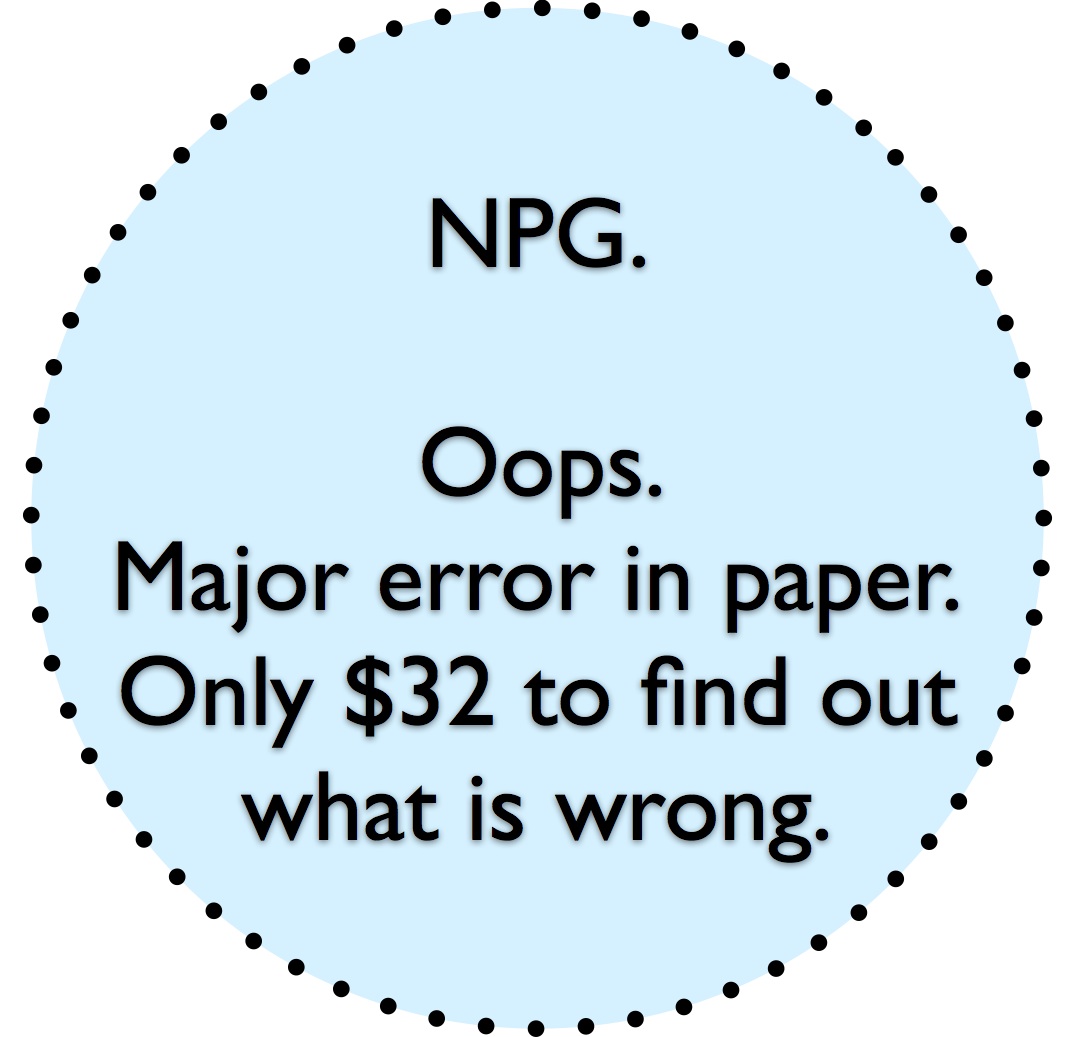
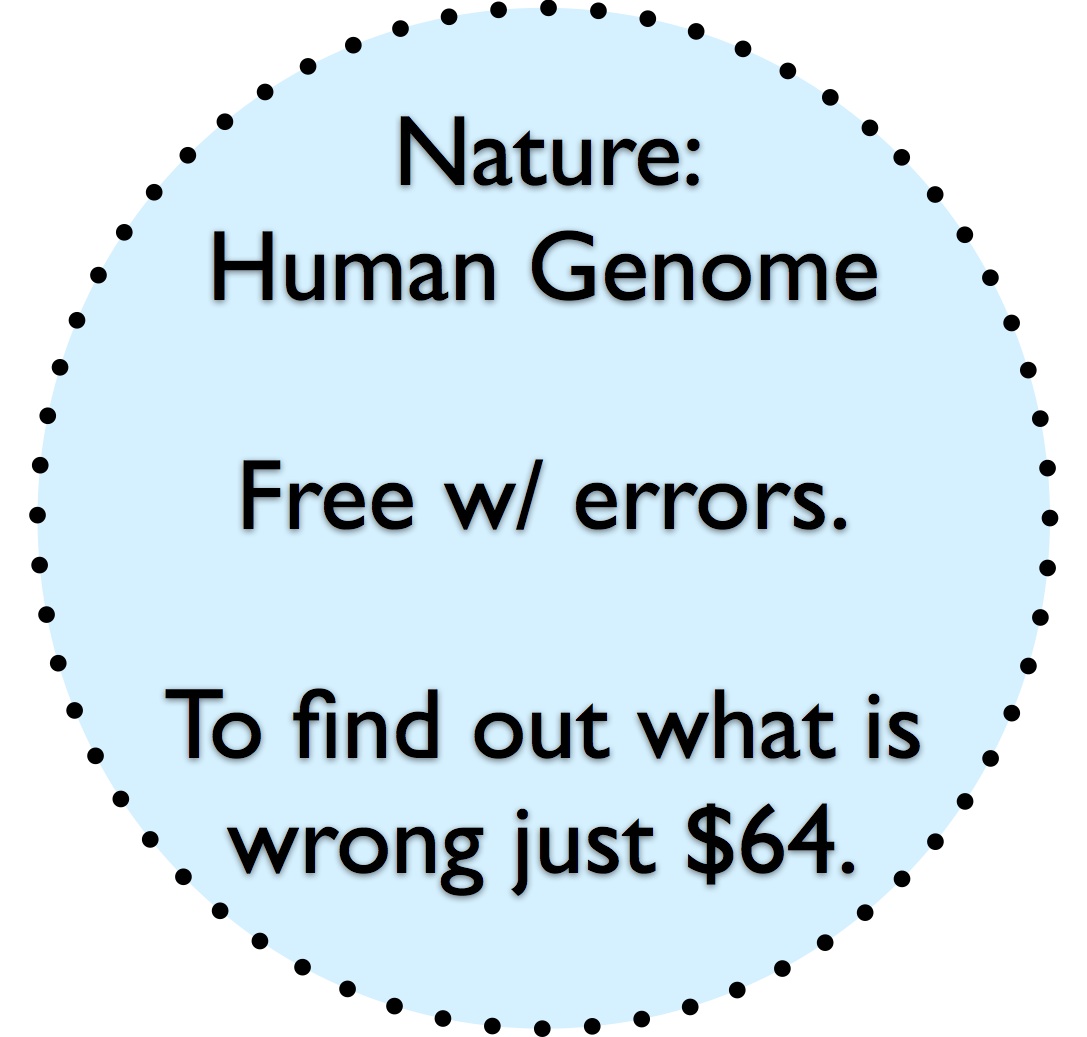
But I have discovered a just painful though funny absurdity with NPG’s money making machine.  They have in fact made the Lander et al. Human genome paper from 2001 freely available.  But there is an Erratum to this paper.  And if you want to get it (and without getting it there is no way to know what is being corrected), you have to pay $32: Access : erratum: Initial sequencing and analysis of the human genome : Nature.  Oh, and in addition a Correction “We have identified several items requiring correction or clarification in our paper on the sequencing of the human genome” for this paper also costs $32.  So the incorrect version of the paper is free but the corrections will cost you $64.

I wonder, for papers for which people pay $$, if there are corrections do they get them for free?

A Solution to Nature Publishing Group’s Inability to Keep Free Papers Free: Deposit them in Pubmed Central

Well, tick tock tick tock.  I am still awaiting some explanation for Nature Publishing Group once again charging for access to genome papers that they promised would be available for free.  See my last post for more details: The Tree of Life: Hey Nature Publishing Group – When are you going to live up to your promises about “free” genome papers? #opengate #aaaaaarrgh

In the meantime I have come up with a solution even if NPG folks cannot figure one out.  It is very simple.  How about Nature Publishing just deposit’s all genome papers in Pubmed Central and thus even when the money making machine of Nature switches some setting and makes the papers not freely available at the Nature web site(s) for some time, the papers will  still be officially free in Pubmed Central.  I think this is probably the only solution I would trust given that this is at least the third time this has happened.

Well, Annapurna has decided laps are for losers; now she curls up on my chest

Hey Nature Publishing Group – When are you going to live up to your promises about "free" genome papers? #opengate #aaaaaarrgh

This is just ridiculous.  Nature Publishing Group in 2007 announced that they were making all papers in their journals that reported genome sequences would be made freely available and would be given a Creative Commons license: Shared genomes : Article : Nature.

About a year ago I posted to twitter (using the hashtag #opengate) and my blog about how Nature Publishing Group was not following through on their promises.  See for example

and more including some from others
Amazingly, and pleasantly, I note, in my complaining I exacted some responses from people from Nature Publishing Group who swore that these were just oversights and they would fix them.  Well, alas, the money collecting machine of Nature Publishing Group is back.
For example, currently the following papers are not freely available even though at one point they were or they clearly fit in the “Shared genomes” definition Nature Publishing Group so happily promotes:
These above are all papers of mine, so I noticed them first (I noticed this when trying to create a Pintarest Baord for all my papers and not being able to get to a free page for these papers meant I couldn’t add them to the Board.  Could it be that Nature Publishing Group is just trying to get my goat?  Let’s see.  A brief search found these papers by others – all also not freely available even though all clearly fit Nature’s own definition of genome sequencing papers:
Here are some others

I think the funniest (and scariest) part may be the corrections and errata that are not freely available. And these are just the articles I found in a 15 minute search. I am sure there are more.  Yes, Nature Publishing Group has made many genome papers freely available.  That is great.  Much better than many other publishers.  But the cracks in your system are large and suggest that nobody there is actually dedicated to seeing through on the promises.  Promises are meaningless.  Follow through is the key.  Come on Nature Publishing Group – how about assigning a “Free access ombudsman” or something like that who will make sure that free means free.  I am sick of writing these posts.  You should do your own QC …

UPDATE: see some more recent blog posts of mine about this topic:

UPDATE 3-28-12 1 PM PST:
Well, if you look at the comments, Nature is apparently trying to fix this and most of the articles I listed above are now freely available (the corrections are still not free but they claim to be working on it).  But a simple search of Nature finds there are still some papers that are closed off that shouldn’t be:

It’s not that hard to find these.  It baffles me a bit how people at Nature don’t seem to be able to find them.  But maybe I am just really good at searching …

Costa’s Hummingbirds in #DavisCA

Got some new friends

https://picasaweb.google.com/s/c/bin/slideshow.swf