Taking a much needed blogging/twitter/etc break for a few weeks

Well, am on Winter Break here at Davis and am going to be taking at least a few weeks off of blogging/twitter/etc.  And trying to ignore email too.  I know – probably some irony in posting about taking a break, but whatever … am really taking a break.

Best wishes to all out there and see you next year ….

NASA arsenic story – let’s lay off the personal attacks on all sides

I have many thoughts about the recent NASA – arsenic – microbe story.

Quick summary

  1. NASA announced a major press conference
  2. at the conference they discussed a new Science paper claiming to show the discovery of a microbe that could replace much/some of its phosphate with arsenic
  3. initial press coverage of the paper was very positive and discussed the work as having profound implications for understanding of life in the universe – though some scientists in some of the stories expressed skepticism of the findings
  4. subsequently many science bloggers further critiqued the paper and/or the press coverage
  5. NASA and the scientists have now refused to discuss the criticisms of their work and press interactions
  6. News stories have now come out summarizing the blogger criticisms and also discussing the unwillingness of NASA / the authors to discuss their work
As I said above I have some strong opinions about the published paper and about the actions of many of the people involved.  For example I think NASA handled this whole thing very poorly.  And I think the unwillingness of the authors and NASA to discuss the work by saying such discussion should be done only in the “peer reviewed literature” is really unwise.  
But that is not what I am here to write about today.  I am here to beg for people to calm down on the personal criticisms and attacks of any of the players involved.  I have seen so much out there about the failings of the paper reviewers, about the intelligence of the authors and the bloggers critiquing the authors, and a whole lot of uneducated guesswork about why some of the things associated with this story happened the way they did.  I think it is perfectly fair to express opinions about the original paper, about the press releases and conferences and about the actions of any of the players here.  But I do not think it is reasonable to go beyond that and to attack the people themselves.  Let’s try and make this an open discussion of science and science reporting and not a venue to spout derogatory comments about the people involved 

10 benefits (for my career) of blogging/tweeting/etc #fb

I was recently interviewed for a story in the Scientist by Bob Grant about blogging and related activities (see his story “You Aren’t Blogging Yet here). As preparation for this interview I made a top 10 list of ways that blogging had been beneficial to me. And I thought I would post my list here. I note, I made this list in about 10 minutes so I am sure there are other things I could add, but it was REALLY easy to make the list so I think w/o a doubt there have been many many benefits ….

10 ways blogging/microblogging has been beneficial to my career:

  • Collaboration. Many of my current projects have collaborators that have come about in part via interaction on blog/Twitter. 
  • Concentration. I concentrate more at meetings since I am either planning on writing something about it, or am actually live blogging the meeting. 
  • Personnel. Some of the recent recruits to my lab have come about via connections online. 
  • Crowdsourcing. Asking questions on twitter and my blog has been a great way to rapidly find out information about a particular area. 
  • Reduced travel. I have two little kids and do not like to travel much right now for this and other reasons. Blogging and Twitter and other social networking activities help peole find out about my work without me having to travel. 
  • Outreach. Blogging and related activities are a good way to interact with public and scientists in other fields. 
  • Keeping up with cutting edge (mostly via twitter). Following the right people is a great way of finding out about the latest in various fields 
  • Great practice for explaining/teaching. In my head, I could explain anything. But when I actually try to explain in writing, I realize how many assumptions we make and how much jargon there is. Trying to explain to a broad audience is great practice. 
  • Record of my thoughts/ideas. I forget a lot of things. I am sure others do too. But twitter and my blog provide a good record of some thoughts I had on various topics. 
  • New $$. I have recent gotten a new grant mostly due to my activities in the Science 2.0 world and I think my activities like blogging, etc also could in principle help get other grants where “outreach” is important. 

Anyway – just a little post about ways that blogging and tweeting have been helpful for my career. Other examples/areas that blogging and tweeting have helped people’s careers in science would be welcome here …

Quick post – congrats to Jill Banfield, environmental #microbiology guru, for winning Franklin Medal & L’Oreal-UNESCO award

Very cool news from UC Berkeley.  Jill Banfield, one of the greats of environmental microbiology, is going to receive both the Benjamin Franklin Medal in Earth and Environmental Science and the L’Oreal-UNESCO “for women in science” award.

I am very happy to see this.  Jill has done some amazing work in multiple areas of environmental microbiology and continues to push frontiers in technology and science.  And since I am always on an Open Access crusade here, here are some links to some of her recent papers that are free in Pubmed Central:

A very simple suggestion for scientists to increase their interactions w/ people in the humanities

Well, I have been inspired recently by some of my interactions with people in the humanities. In general I think that there need to be more professional interactions between scientists and people in the humanities. So here is a simple suggestion, that could be taken up by scientists.

When you go to give a talk at another place, and your hosts ask who you want to meet with, include someone from outside the sciences. Either find someone yourself or asks your hosts to do it. I am going to do this for all my future visits to other campuses. Not only might it help in terms of interactions across fields, but I know my brain hurts after a full day of meeting with only scientists, so this has got to be better …

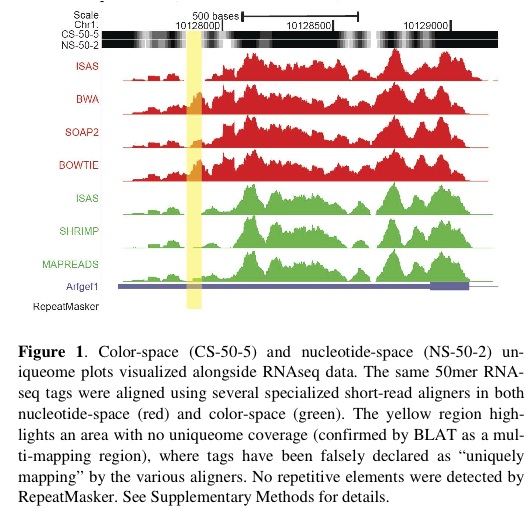
Another good paper, but bad omics word of the day: uniqueome

Wow. This is bad. Really not much to say here other than to point you to a new paper by Koehler et al in Bioinformatics:

The Uniqueome: A mappability resource for short-tag sequencing — Bioinformatics

Paper seems useful. The word. It is simply awful. And the winner of today’s “Bad omics word of the day“.  Hat tips to @leomrtns and @neilfws 

From “The Uniqueome: A mappability resource for short-tag sequencing
Ryan Koehler, Hadar Issac , Nicole Cloonan,*, and Sean M. Grimmond.” Bioinformatics (2010) doi: 10.1093/bioinformatics 

One of my new favorite things: paleovirology

Just a quick post here about a paper that came out about a month or so ago: PLoS Biology: Genomic Fossils Calibrate the Long-Term Evolution of Hepadnaviruses

This paper, by Clément Gilbert, Cédric Feschotte is quite cool.  In it they describe their work on “Paleovirology” where they look for viruses than have “endogenized” by inserting into the genome of some host species.  This endogenization is important in particular when the endogenous form becomes inactive and thus, in essence, trapped in the genome.  This in turn is important because many viruses evolve so rapidly when they are “free” that it is very hard to reconstruct their ancient history through comparative analysis.  But the endogenized viruses serve in essence as a molecular “fossil record” that aids in the comparison and phylogenetic analysis of various families of viruses.  As we get more and more genomes, this searching for and analysis of endogenous viruses will get much better.

Anyway, in the paper they report on endogenous viruses in the Zebra Finch genome that are in the Hepadnaviridae family.  Here is their summary:

Paleovirology is the study of ancient viruses and the way they have shaped the innate immune system of their hosts over millions of years. One way to reconstruct the deep evolution of viruses is to search for viral sequences “fossilized” at different evolutionary time points in the genome of their hosts. Besides retroviruses, few virus families are known to have deposited molecular relics in their host’s genomes. Here we report on the discovery of multiple fragments of viruses belonging to the Hepadnaviridae family (which includes the human hepatitis B viruses) fossilized in the genome of the zebra finch. We show that some of these fragments infiltrated the germline genome of passerine birds more than 19 million years ago, which implies that hepadnaviruses are much older than previously thought. Based on this age, we can infer a long-term avian hepadnavirus substitution rate, which is a 1,000-fold slower than all short-term substitution rates calculated based on extant hepadnavirus sequences. These results call for a reevaluation of the long-term evolution of Hepadnaviridae, and indicate that some exogenous hepadnaviruses may still be circulating today in various passerine birds.

Figure 4. Summary of the evolutionary scenario inferred in this study.

It is an interesting paper and worth a look if for those who have any interest in viral evolution. And I am becoming more and more fascinated by “Paleovirology” these days so I thought I would just post about this article here.  And I guess I am not alone in this opinion that the article is interesting (though I am late).  Here is some coverage of their paper:

Gilbert, C., & Feschotte, C. (2010). Genomic Fossils Calibrate the Long-Term Evolution of Hepadnaviruses PLoS Biology, 8 (9) DOI: 10.1371/journal.pbio.1000495

Good paper but bad omics word of the day: drugome

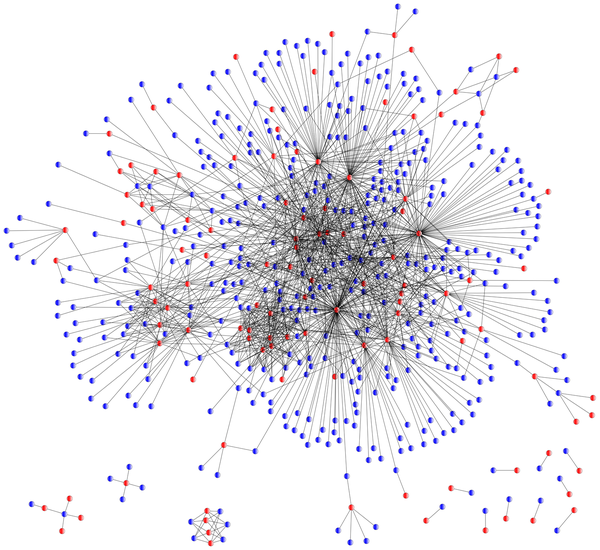
Already tweeted about this but felt it had to be given more prominent status. There is a new, interesting paper in PLoS Computation Biology: The Mycobacterium tuberculosis Drugome and Its Polypharmacological Implications
But that word – drugome. Here is their definition

The resulting drug-target interaction network for all structurally characterized approved drugs bound to putative M.tb receptors, we refer to as the ‘TB-drugome’

I really do not think they need to make that into a “ome” word. Mind you, the study is cool and useful. But that word. It is not very good. And thus they are winners of my “Bad omics word of the day” award.

Figure 2. A protein-drug interaction network to illustrate similarities between the binding sites of M.tb proteins (blue), and binding sites containing approved drugs (red). From Kinnings SL, Xie L, Fung KH, Jackson RM, Xie L, et al. (2010) The Mycobacterium tuberculosis Drugome and Its Polypharmacological Implications. PLoS Comput Biol 6(11): e1000976. doi:10.1371/journal.pcbi.1000976 

Hat tip to @7T1 and @dgaston83 and @toranaga for pointing this one out.

YARFOA: Yet another reason for #OpenAccess: speeding innovation in aquaculture

Just saw this interesting paper arguing that open access to literature is critical for the field of aquaculture. The paper argues that open access to literature has accelerate innovation by promoting more partnerships with hobbyists and with others who might normally be outside the “inner circle.” Definitely worth a read and it fits under my “YARFOA” category – Yet Another Reason For Open Access.

The paper is “The importance of open access in technology transfer for marine ornamental aquaculture: The case of hobbyist-led breeding initiatives” from the Journal Aquaculture, Aquarium, Conservation & Legislation International Journal of the Bioflux Society.

It is is by Andrew Rhyne who is connected with the New England Aquarium and also at Roger Williams University.

I love the concluding paragraph by the way:

Opening the door to an open process. I would hope that others would join me in supporting the free flow of information by publishing their work in open access journals, and encouraging societies like the World Aquaculture Society, the American Fisheries Society, and European Aquaculture Society to go to an open access format. We should fully applaud blogging or posting on discussion forums in real time about efforts to rear new species or develop new live feeds. The dialog that occurs on MOFIB and other online forums can spark innovation that is not possible through traditional formats. I believe that open access is the key to faster breakthroughs, and to better translation between academia, hobbyists, and commercial industry. The Aquaculture field has an opportunity to become an exemplary model for all applied science fields: let’s seize it.

Good omics word of the day: transcriptomics

As many of you know, I spend a lot of time bashing #badomics words.  Some have asked if I just hate all omics words.  And the answer is no.  First, I am only annoyed by words that use “omics” or “ome” in the sense of “genomics” or “genome”.  Thus words that use the “ome” suffix in the sense of a cellular complex (e.g., ribosome, proteosome, etc) are not on my radar.  And words that use “omics” in the sense of “economics” (e.g., Obamanomics”) are not my concern either.  My problem is those that in essence are latching onto “genomics” excessively.

And on twitter as well as in my blog I have bashed many such #badomics words including vaccinomics, waveomics, adversomics, bibliome, epitheliome, nutriome, transactome, N-terminome, miRNAome, modomics, tRNomics, variome, Speechome, connectome, negatome, material degradomics, and many more.  I even give out two types of awards here in this regard: Worst New Omics Word Award and bad omics word of the day.  And alas, I am sure I will give out more.

But today I thought it might be useful to be positive.  And thus I am going to discuss what I view as a good omics word.  Not great mind you.  But pretty good.  And this is “transcriptomics” and its relative “transcriptome”.  Both of these are pretty good words.

From Wikipedia here is the definition of transcriptome

The transcriptome is the set of all RNA molecules, including mRNA, rRNA, tRNA, and other non-coding RNA produced in one or a population of cells. The term can be applied to the total set of transcripts in a given organism, or to the specific subset of transcripts present in a particular cell type. 

This seems to be a perfectly reasonable and useful use of the “ome” suffix.  It is genomic in scale (i.e., all RNA in the cell – not like many badomics words which are too specific).  And it is broad in that it can be used to refer to all the RNA in an organism or cell or such.  The first use I have found is from this paper on yeast in 1997.    But there may be earlier examples.

Anyway – trying to be positive today.  And transcriptome to me is a good omics word.