The dope on brain doping take 2

The New Yorker has a long article on Brain Doping (or as others like to call it, cognitive enhancement) by Margaret Talbot. I was interviewed for it a while ago because of my mischevious April 1, 2008 blog/web joke I coordinated announcing that NIH was cracking down on brain doping.

And although they do not mention my April 1 joke in the New Yorker article, they do quote me

Still, even if you acknowledge that cosmetic neurology is here to stay, there is something dispiriting about the way the drugs are used—the kind of aspirations they open up, or don’t. Jonathan Eisen, an evolutionary biologist at U.C. Davis, is skeptical of what he mockingly calls “brain doping.” During a recent conversation, he spoke about colleagues who take neuroenhancers in order to grind out grant proposals. “It’s weird to me that people are taking these drugs to write grants,” he said. “I mean, if you came up with some really interesting paper that was spurred by taking some really interesting drug—magic mushrooms or something—that would make more sense to me. In the end, you’re only as good as the ideas you’ve come up with.”

I am sure the quote is reasonably accurate. However, it does not include the whole discussion behind the quote. What I said was that staying up all night while on ritalin to write a grant proposal seems silly (and after my Arpil 1 joke was outed, multiple people told me they actually do this). What you need to get a grant funded is good ideas and these do not seem to come from just popping some drug to keep you mind clear when you should be sleeping. So I said something like taking a drug to help give you new ideas – that could make sense (and thus my reference to shrooms which I have by the way never done). Because if that helped you devise some cool new things to do – that it what people look for in grant proposals. Elegant text about something boring – who cares. Not that the writing part of a grant is unimportant but I still do not see how most of these brain doping drugs would help with doing something interesting in science. Ideas without good text – unlikely to get a grant but possible. Good text without a good idea – I would hope no grant would be awarded.

But the quote does make me sound like I am encouraging hallucionagens, which was not the point … oh well. In this case, no criticism of the New Yorker – just wish they had included a bit more about why I said what I apparently said … I guess next time I should just say “Ideas are the key. Not churning out bad text at the last minute”

Davis Picnic Day Parade 2009

Here are some pictures from the Picnic Day Parade today

http://picasaweb.google.com/s/c/bin/slideshow.swf

Genome sequences are not enough

For those interested in either ciliates like Tetrahymena species or how to make sure that a genome sequence is broadly useful to a community of researchers, this email I just got might be of interest.  Basically, in a nutshell, a consortium (of which I led in the past – see our main genome paper in PLoS Biology here and a follow up paper in BMC Genomics here) has been sequencing the genome of Tetrahymena thermophila a really cool ciliate (one clade of eukaryotes) that has been a model organism for much molecular and cellular work.  As part of the NIH portion of funding for sequencing the genome we subcontracted Mike Cherry at Stanford to create the Tetrahymena Genome Database (TGD) based upon his highly successful Saccharomyces Genome Database (SGD).  Now that the grant is over, there is no support for TGD anymore and it is going to at some point become obsolete.  Fortunately, there is support (see email) for a Tetrahymena Stock Center to provide resources to the community like strains and now it looks like this stock center will also take on the task of helping maintain the TGD (with Nick Stover, who used to work at TGD).  Great news and might give some people something to think about in terms of building and maintaining resources for other genome sequencing projects. 

Dear Tetrahymena Community members,

We are delighted to announce that the Tetrahymena Stock Center has been awarded funding by NIH and the National Center for Research Resources (NCRR).

We are very grateful to NIH for continued funding, and to all the members of the Tetrahymena community who have supported our efforts to establish a functional stock center at Cornell University. We are excited that this new funding will allow us to expand the purview of the Stock Center and pursue several goals that will benefit the Tetrahymena community as a whole.

First, we will continue to maintain a large variety of genetic stocks in our secure facilities at Cornell University and make them available to the scientific and educational community. We are constantly seeking to expand the diversity of the strains in the Stock Center as a resource for the community at-large. We are currently are working to complete the acquisition and documentation of several large strain collections, including the critical collections developed by Dr. Eduardo Orias, Dr. Martin Gorovsky, and Dr. Joseph Frankel. In addition, we are now accepting strains from other laboratories to provide a secure site for strains they wish to share with the community. We are also actively providing strains to researchers and educators around the world. We encourage everyone to visit our updated website at http://tetrahymena.vet.cornell.edu/ . We have new expediated online ordering and have streamlined the process for depositing cells. We welcome any comments, suggestions, ideas for other things that you would like to see on this site.

Second, as part of our continuing efforts to make the Tetrahymena Stock Center as useful as possible to the entire Tetrahymena community, we have expanded the purview of the Stock Center to include support for the Tetrahymena Genome Database (TGD). TGD is no longer actively maintained at Stanford and is fast becoming outdated. We believe that making TGD operational under the auspices of the Stock Center and linking support efforts to community annotation strongly complements the overall mission of the Stock Center to facilitate the use of Tetrahymena as a research and teaching organism. We look forward to working with Dr. Nick Stover at Bradley University, who will supervise the development of a genome Wiki and further annotation of the database. Revising the TGD format will be an exciting and challenging task that we hope will involve many members of the Tetrahymena community. We will send out a more detailed explanation of the new TGD format soon. For now, we thank Dr. Mike Cherry for his continued support and help in working with Dr. Stover to make the transition to the Wiki format as easy as possible.

Finally, please continue to use the Stock Center for all of your strain needs, and don’t forget to include the costs for strain ordering in your respective grant applications. Contact us with any questions, suggestions, ideas at tetrahymenastockcenter-mailbox@cornell.edu . We look forward to working with the community to enhance the scope and function of the Tetrahymena Stock Center over the next 5 years.

Sincerely,

Ted Clark

Donna Cassidy-Hanley 

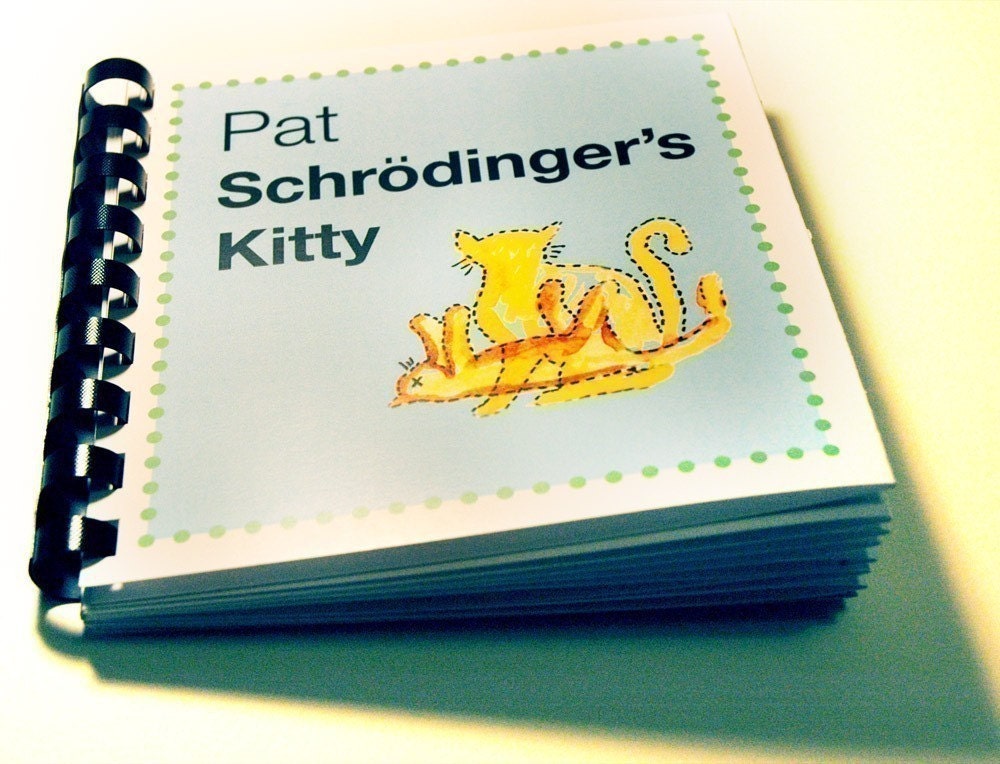
Kids Science Book Recommendation #1: Pat Schrödinger’s Kitty

OMG. I just got my copy of “Pat Schrödinger’s Kitty” by Tiffany Ard. I only found out about this kid’s science book because the author (at least, I think it was the author) linked to a posting of mine from her “electric boogaloo” blog (in a post about April Fools). And from there I read about how she was invited to Scifoo this year (Damn her — why can’t I get invited again) and how it was a really good day because someone wrote a post about her kids science book. So, since I am a total geek and love reading sciency things to my kids I took a look. And it looked pretty good so I ordered one for me and one to give to my geeky brother.

And I just got it today. And I must say, it is f*$# brilliant. It is a spoof on Pat The Bunny (which I had to read over and over to kid #1 and #2) wherein the same general things that happen in Pat the Bunny are replaced by Schrödinger kind of things (e.g., “Paul can interact with billions of neutrinos”). This means a lot to me since as a small child my grandfather, a physicist, used to tell me about relativity and Einstein thought experiments. So I encourage all to get this book, even if you do not have little kids. It is worth a serious giggle for anyone. Still haven’t read it to the kids – had to post about it 20 minutes after opening the mail.

Michael Eisen gives the bird to the Redsox and A’s

Yup, that is my brother, Michael Eisen, on his birthday yesterday, giving the bird to the As and Redsox. RIP Mark Fidrych.

Probiotics Trying to Appeal to Kids with "Cool" Bacteria

Was at the Davis Coop on the way home today and saw something new to me. Looks like companies are trying to make bacteria seem “cool” to kids so that kids will start asking for their probiotics much like they might ask for Captain Crunch. See below:

http://picasaweb.google.com/s/c/bin/slideshow.swf

Not sure I like the trend but I do like the attempt to spread the word about how bacteria are not all bad.

A genomic encyclopedia of bacteria and archaea (video of my talk from the JGI user meeting)

My talk at the JGI meeting on “A genomic encyclopedia of bacteria and archaea” is now up at SciVee.  See below:

http://www.scivee.tv/flash/embedPlayer.swf

And the slides are up at Slideshare

Twisted Tree of Life Award #4: Hoxful Monsters Blog on "Primitive" Animals

Nothing gets me more riled up in evolutionary writings than the use of the term primitive to describe organisms on a “deep” branch in an evolutionary tree. Thus for the following tree

many people would refer to Species 1 as a primitive organism solely on the basis of this tree. In fact, I just saw this in the Hoxful Monsters blog (see here) where it says:

In April 2008, Cassey dunn et el published their famous phylogenomics work in Nature, which placed Ctenophores at the base of the tree making them most primitive animal on Earth. Before that work Sponges were considered as first animals to branch off from rest of the animals and hence occupied a most basal position in the tree of animals for long time. However, some months later another phylogenomics study carried out by Bernd Schierwater et al ; changed things dramatically by placing Trichoplax as most primitive animal replacing Ctenophores. Now a new phylogenomic study published in online section of Current Biology is making headlines , where Sponges regain their position as most primitive animal on Earth.

This is simply wrong as the term primitive, which I avoid at all costs because it is so frequently misused, should only be used to refer to features of organisms not to the branching pattern in an evolutionary tree. Forget for a minute that “primitive” implies that something else is “advanced”, as if we could determine which is which. And lets pretend instead for a minute that “primitive” could be used in an equivalent manner as “ancestral.” Ancestral is a term used to refer to features of organisms present, as the term implies, in an ancestor. Thus is the organism(s) at the node in the tree labelled with the X had some feature (e.g., lets say, they were green) and Species 4 is green while Species 1 is orange and Species 2 and 3 are purple. In this case, in terms of color, Species 4 has ancestral feature and the other species have derived features. And thus, when I am feeling generous, I will grant that one could sort of use the term primitive to say “Species 4 is primitive in terms of color.” I don’t like this usage, because primitive implies something about quality that ancestral and derived do not. But it is not so horribly wrong that I cringe.

But I would like to make two more points in terms of the way primitive is misused.

  • First, even if one species had a large number of ancestral features (and thus for those features resembled an ancestral organism), that species certainly will have some derived features as well. Thus ancestral, derived, and primitive (ick) should only be used to refer to features, not organisms.
  • Second, the particular position a species occupies in a tree does not tell use whether it has ancestral or derived features. Thus is my color example above, Species 1 does not have the ancestral phenotype — it has a derived one. Thus calling organisms that branch deeply in a tree “primitive” is wrong not only because it is referring to an organism not a feature but also because deep branching does not imply ancestral features.
In other words, the fact that if you look only at species in the tree, that Species 1 is the deepest branching individual species, does not in any way tell whether Species 1 has primitive (i.e., ancestral) features. Features present in the common ancestor of the entire group (i.e., the organisms at node X) are the ancestral features. These features could change on any of the branches leading to Species 1,2,3, and 4. If they change, then the descendants will have derived features. If they stay the same they will have ancestral features. The branching order of the species does not explicitly tell us which one retains ancestral features.

This inaccurate use of phylogenetic trees to imply primitive features drives me batty. I was disappointed to see this phylogenetic gobbledygook being used in the HoxFul Monsters blog. And thus, Hoxful Monsters is the winner of my fourth “Twisted Tree of Life” award.

Davis is new home of Bicycling Hall of Fame

Good news for Davis.  It was announced today that Davis is the new home of the Bicycling Hall of Fame.  Yay. See stories here

Evolution phrase of the week: "nickel-famine"

I am quite intrigued by the news stories based on a paper that just came out in Nature on the early history of oxygen producing bacteria (e.g., see the Canada.Com story Thank oxygen-producing bacteria for your existence
and the National Geographic Story Nickel “Famine” Led to Oxygen-Breathing Life?). In short, the paper suggests that about 2.5 billion years ago, the amount of nickel in oceans (and presumably elsewhere) began to decrease, possibly due to changes in volcanism. Furthermore they suggest the reduction in nickel harmed methanogenic microbes which require nickel for multiple processes. Thus the term “nickel famine.” As the methanogens declined, many changes occurred including an increase in the oxygen concentration in the atmosphere (with the oxygen coming from cyanobacteria). And presto, the world became just so much more hospitable for many of us and our relatives. Anyway, the term “nickel famine” really stuck with me, so I am making it my evolution phrase of the week.