Good luck Chris Gunter …

One of my favorite journal editors is moving on.  Chris Gunter, who has been one of the genetics and genomics editors at Nature is moving to be the “Director of Research Affairs at the HudsonAlpha Institute for Biotechnology.” She has been a big promoter of “free access” to articles within Nature and was at least in part responsible for (if not the major person behind) the fact that many genomics papers at Nature were freely available to all (note they were not always fully OA publications but at least they were free, which was more than many other journals, even non profit ones were doing).

As for what Chris will do at HudsonAlpha, the press release says she “will work closely with Dr. Richard M. Myers, HudsonAlpha director, to raise awareness about HudsonAlpha and its research programs on a national level.” RIck was the person who helped push me to formalize my ideas behind “phylogenomics” many years ago when we were both at Stanford and so now two of my favorite genomics folks will be in Alabama. I guess HudsonAlpha is a place to keep an eye on …

Getting John Henry and his hammer into a scientific paper

Gotta love a scientific paper that quotes John Henry stories. In Andy Ellington’s primer on ribozyme evolution (PLoS Biology – Man versus Machine versus Ribozyme) he leads off with

The steam drill was on the right hand side,

John Henry was on the left,

Says before I let this steam drill beat me down,

I’ll hammer myself to death”—The Ballad of John Henry (American, traditional)

His point here is to talk about man versus machine and to then discuss the recent article in PLoS Biology on a “Darwinian Machine” which I wrote about previously. (I think he is also making a bit of a play on words with the hammerhead ribozyme, but I am not sure). Anyway, Ellignton’s article is worth checking out. I especially like the ending

Machine-based continuous evolution should be the best of all worlds, combining man’s mental ability to chart the future with automated control of selection stringency with the still unpredictable mode and tempo of evolution’s relentless drive.

Figure from Ellington’s PLoS Biology paper. I can put it here because it is a fully Open Access paper using a broad Creative Commons license. All I have to do is cite the source. And so I am. Andy Ellington. PLoS Biol 6(5): e132 doi:10.1371/journal.pbio.0060132

Figure reportedly by Angel Syrett (see comments).

Plant kin recognition? (Caution – Anthropocentrism ahead)

A fascinating story in the New York Times today on kin recognition in plants (see Plants Found to Show Preferences for Their Relatives ).

They report

The sea rocket, researchers report, can distinguish between plants that are related to it and those that are not. And not only does this plant recognize its kin, but it also gives them preferential treatment.

And

Dodder is unable to grow its own roots or make its own sugars using photosynthesis, the process used by nearly all other plants. As a result, scientists knew that after sprouting from seed, the plant would fairly quickly need to begin growing on and into another plant to extract the nutrients needed to survive.

But even the scientists studying the plant were surprised at the speed and precision with which a dodder seedling could sense and hunt its victim. In time-lapse movies, scientists saw dodder sprouts moving in a circular fashion, in what they discovered was a sampling of the airborne chemicals released by nearby plants, a bit like a dog sniffing the air around a dinner buffet.

The notion that plants sense and respond to their surroundings is apparently controversial. Or, maybe a better way to put it is, the attempts to compare plant to animal neural functions is controversial. So much so that many plant scientists got together to say enough is enough

Thirty-six authors from universities that included Yale and Oxford were exasperated enough to publish an article last year, “Plant Neurobiology: No Brain, No Gain?” in the journal Trends in Plant Science. The scientists chide the new society for discussing possibilities like plant neurons and synapses, urging that the researchers abandon such “superficial analogies and questionable extrapolations.”

I personally think there is an enormous amount of anthropocentrism here. Sure, plants may not have true brains. But even though many people like to think of animals in general and humans in particular as the be all end all of evolution, last time I checked, plants have been evolving for a long time. And there is no reason to think that they do not have all sorts of cool and wacky ways to sense and respond to the world around them.

The same anthropocentric point of view has led scientists to grossly underestimate the complexity of phenomena in microbes too. Microbes in fact can sense and respond to kin, they can count, they can tell time, they have immune systems. In other words, whether small or large, furry or not, simple or complex (in appearance) lots of cool things have evolved in lineages that do not lead up to humans.

Well, everyone. As we continue to delve into the biology of non animals more deeply, we are going to find all sorts of cool things out there. And yes, some of it will be even more complex and interesting and wacky than what we see in animals.

For other stuff on this story see

Conflicts of interest, full disclosure, and ethical blogging

Well, I am sure many have heard stories about scientific research ethics gone awry.  The latest is an article in the New York Times about two Harvard Psychiatry Professors who failed to disclose all of their income from consulting to the University and to the government.  The story they report is pretty icky, with what appear to be clear conflicts of interest not being reported fully.  And this is of course nothing new.  Conflicts of interest and unethical behavior occur of course in every walk of life.  But scientists cringe at it because when it occurs it is really damaging to the whole enterprise.  

Well, what about bloggers?  Sure there are bloggers railing against conflict of interest and unethical behavior among scientists/MDs (e.g., see Steven Salzberg’s discussion of the recent  “authorship without contribution” controversy).   But that is not what I mean.  What I am interested in here is – what about bloggers disclosing their conflicts of interest?  Is it done?  Is their an ethical code for bloggers?  Should there be?
So I did some web browsing and there is really a remarkable series of discussions about this on blogs and in other places.  For example:
These discussions cover every type of “Science Blogging Ethics” including things like how polite one should be, etc.  Personally, I am not sure I want to go so far as to say their should be a code of ethics.  I think the most important thing to think about is “Full Disclosure” of real and possible conflicts of interest.  Sort of like what “real” news entities do when they are reporting on a story they have some connection to (e.g., the New York Times always puts something like “The New York Times is owned by XXX and the company we are reporting on here is also owned by XXX”  
So from now on I vow to try and do this within my blog (I already do this much of the time when I write about PLoS or my brother but I will try to do it more thoroughly).

More Airport Dinosaurs – Denver This Time

Well, a few days ago I wrote with excitement about the dinosaur fossil in the Chicago Airport that I saw on the way to the ASM Meeting. Something about evolution in public is always a good thing. And then, amazingly, on the way home, while waiting for my connecting flight in Denver, I had a dinosaur moment there too. In Denver, there was some floor art that was some small embedded sculptures (mostly of dinosaurs) in the floor in the terminal. Maybe there is something I do not know here — do all airports have to have something about dinosaurs?

http://picasaweb.google.com/s/c/bin/slideshow.swf

A science blogger on Science writing about a science blog …

Sorry – just had to make up that little title because I had a funny conversaiton with someone where I was trying to say, concisely, that Ryan Gregory, who has a nice blog called Genomicron, had blogged about how Science Magazine had written an article where they referenced my blog about “Genomics by Press Release.”

But I was tired and it did not come out so well when I said “A science blogger wrote about science blogging and how Science wrote about my blog”. And the person just stared at me.

Anyway, all I know now is that it is a lot easier to talk about when Nature writes about “science” blogging

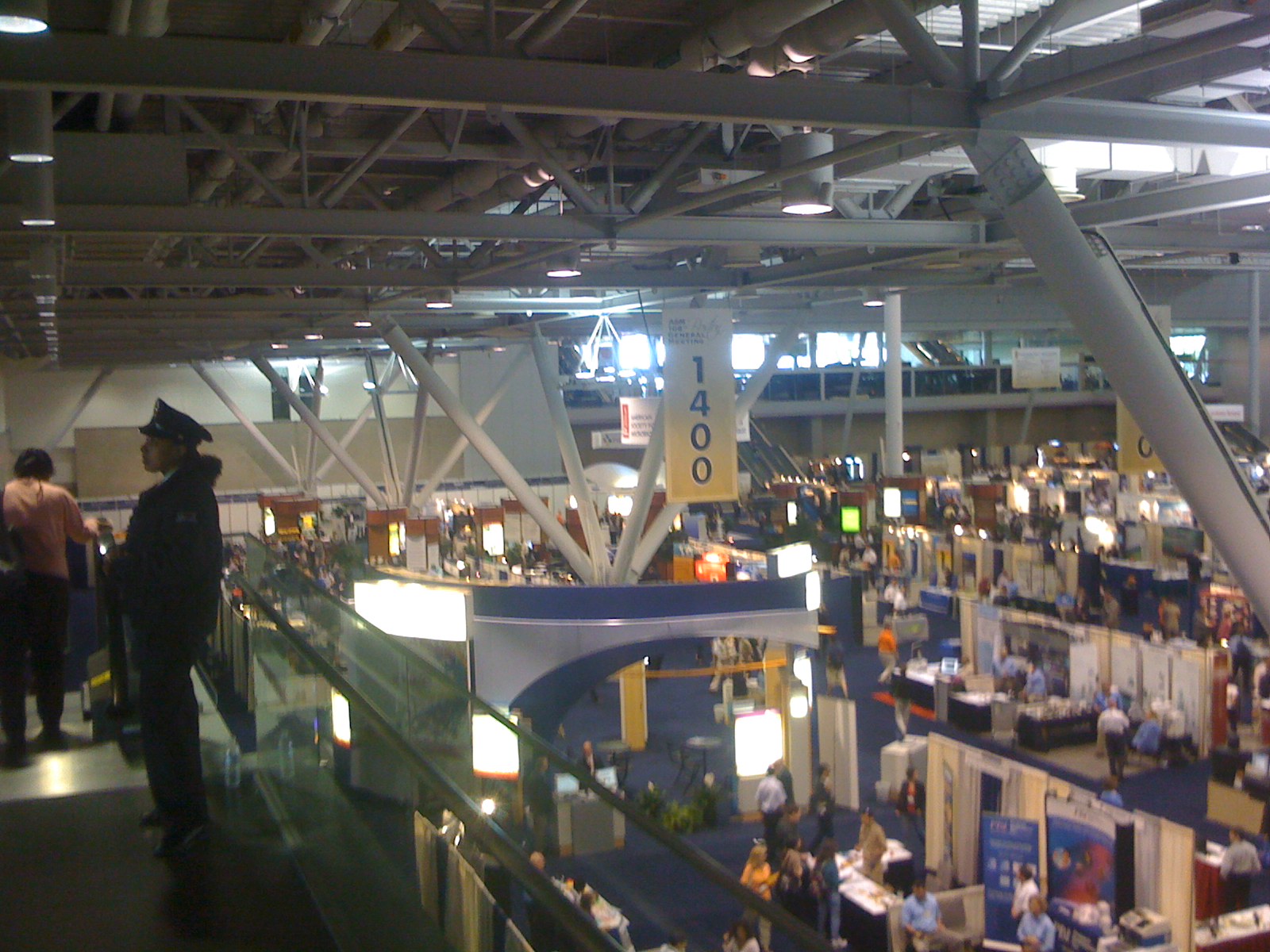
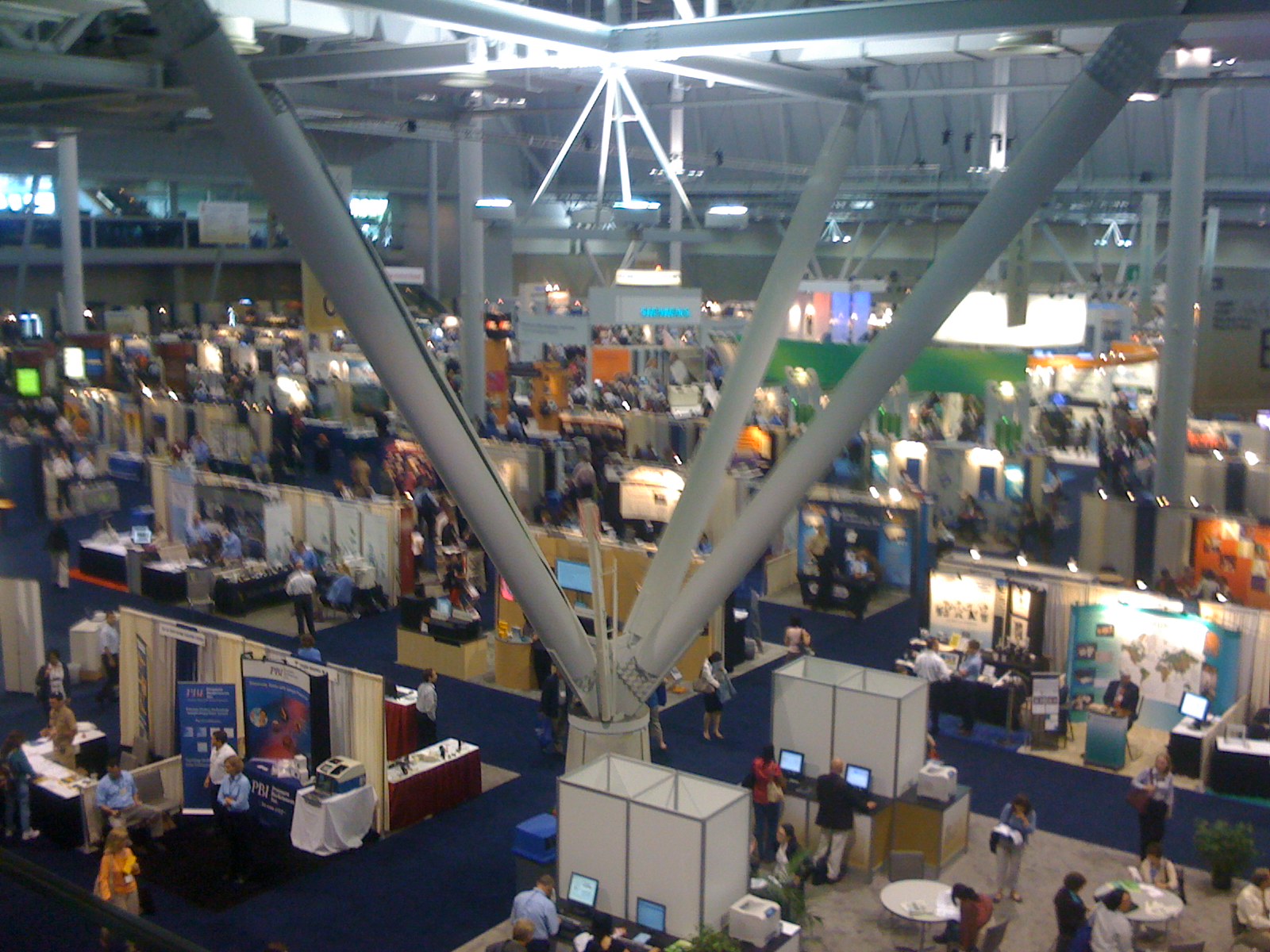
You know the conference you are at is too big when ….

Now – I confess I was really impressed with how ASM handled this enormous meeting I was just at. If you are going to have a big meeting, ASM does a smashing job. And I can see how such big meetings can have their appeal – the diversity of work and activities relating to Microbiology are amazing. However, big meetings are still not my cup of tea.

So here is my top 10 list of “You know the conference you are is too big when …”. All are based on experiences from this meeting.

  1. People communicate within the conference venue by email and cell phones
  2. They give you a foldout map showing the locations of all the different venues/activities/
  3. Colleagues contact you electronically after your talk rather than in person
  4. The lines for food are longer than the lines for security at the airport
  5. There are more:
    • counters at the registration booth than at the airport ticket area
    • meeting staff than scientists at the last conference you attended
    • promotional booths than active players in Major League Baseball (OK, we are not quite there with this meeting but we are close)
  6. The abstract book weighs more than your laptop computer
  7. People use GPS to find their way in the conference center (I wish I had pictures but I saw this happening)
  8. The bus/shuttle scheduling system is more complex than the travelling salesman problem
  9. You need to plan your own schedule by searching a database
  10. You do more walking inside the conference center than outside

ASM Phylogenomics Notes

Well, I just gave my talk on phylogenomic and functional predictions and am going to try and catch up with blogging.

In my talk I discussed how an understanding of function and prediction of function requires an understanding of how functions have evolved.  I am trying to get my talk slides posted here but, alas, I need to deal with some Copyright issues first (OK – here is a little slideshow of my talk … no audio sorry)
//www.youtube.com/get_player

Patricia Babbitt gave a talk after mine on another aspect of phylogenomics and functional predictions.  She has done some really interesting studies (see her lab site here) of functional diversifications and the molecular level by integrating genomic, structural, biochemical and phylogenetic analyses.  She showed some really nice tools for clustering and visualization protein families that, although not phylogenetic, seemed to be very useful for the onslaught of genome data.  Unfortunately, most of her publications are not in OA journals so I cannot use any of the figures here and am not going to bother linking to the papers.
Kimmen Sjolander is talking now about her phylogenomic studies.  She is discussion “Phylofacts” which are precomputer phylogenetic trees of gene families from across the tree of life.  One great thing about her work – most of it is published in OA journals and most of her software is available for free download.

More detail on Phylofacts is available in her Genome Biology paper here.  Kimmen has done some really great work on automating phylogenomic functional predictions and this is one example.  Also see her Flower Power and Sci-Phy and Satchmo and Intrepid and Phylo builder other tools (downlaods and other information are available at her website here.)
Gretta Serres will be speaking next.  I will post on here talk soon …  And now I am posting on it …
She is discussing “linking metabolic diversity to protein families” os something to that effect. She discussed something I never have thought of doing which is the following – take genomes, identify the size of protein families in each genome and then cluster genomes by their similarity of the protein family size.  I assume some others must have done this but it seems like a good way to identify similar duplication pressures on distantly related organisms.  

Yet another reason to avoid big meetings

Big meetings really do suck. I am on the bus from my hotel to the conference center where the ASM meeting is being held.  I knew I should have taken the subway.  But I took the charter bus.  And it seems to be more of a thing for tourists than scientists on the way to a conference.  On the bus they are playing tvs at a volume akin to the last rock concert I went to. No chance to talk to anyone.  No chance to think. No chance to relax.  Ick.  

Gotta love an airport with dinosaurs

On the way to ASM and justsaw a lovely dino in the Chicago airport

More airports need these