URGENT – IF YOU SUPPORT OPEN ACCESS TO SCIENTIFIC LITERATURE – WRITE YOUR SENATOR NOW

I am posting this which I received in an email.

URGENT CALL TO ACTION: Tell your Senator to OPPOSE amendments that strike or change the NIH public access provision in the FY08 Labor/HHS appropriations bill
——————————–

The Senate is currently considering the FY08 Labor-HHS Bill, which includes a provision (already approved by the House of Representatives and the full Senate Appropriations Committee), that directs the NIH to change its Public Access Policy so that participation is required (rather than requested) for researchers, and ensures free, timely public access to articles resulting from NIH-funded research. On Friday, Senator Inhofe (R-OK), filed two amendments (#3416 and #3417), which call for the language to either be stricken from the bill, or modified in a way that would gravely limit the policy’s effectiveness.

Amendment #3416 would eliminate the provision altogether. Amendment #3417 is likely to be presented to your Senator as a compromise that “balances” the needs of the public and of publishers. In reality, the current language in the NIH public access provision accomplishes that goal. Passage of either amendment would seriously undermine access to this important public resource, and damage the community’s ability to advance scientific research and discovery.

Please contact your Senators TODAY and urge them to vote “NO” on amendments #3416 and #3417. (Contact must be made before close of business on Monday, October 22). A sample email is provided for your use below. Feel free to personalize it, explaining why public access is important to you and your institution. Contact information and a tool to email your Senator are online at http://www.taxpayeraccess.org/nih/2007senatecalltoaction.html. No time to write? Call the U.S. Capitol switchboard at (202) 224-3121 to be patched through to your Senate office.

If you have written in support before, or when you do so today, please inform the Alliance for Taxpayer Access. Contact Jennifer McLennan through jennifer@arl.org or by fax at (202) 872-0884.

Thanks for your continued efforts to support public access at the National Institutes of Health.

——————————–

SAMPLE EMAIL

Dear Senator:

On behalf of [your organization], I strongly urge you to OPPOSE proposed Amendments #3416 and #3417 to the FY 2008 Labor, Health and Human Services and Education Appropriations bill (S.1710). These amendments would seriously impede public access to taxpayer-funded biomedical research, stifling critical advancements in lifesaving research and scientific discovery. The current bill language was carefully crafted to balance the needs of ALL stakeholders, and to ensure that the American public is able to fully realize our collective investment in science.

To ensure public access to medical research findings, language was included in the in the FY 2008 Labor, Health and Human Services, and Education Appropriations Bill directing the NIH to make a much-needed improvement to its Public Access Policy — requiring that NIH-funded researchers deposit their manuscripts in the National Library of Medicine’s online database to be made publicly available within one year of publication in a peer-reviewed journal. This change is supported by NIH Director Elias Zerhouni, and a broad coalition of educational institutions, scientific researchers, healthcare practitioners, publishers, patient groups, libraries, and student groups — representing millions of taxpayers seeking to advance medical research.

Amendment #3416 would eliminate this important provision, leaving only a severely weakened, voluntary NIH policy in place. Under the voluntary policy (in place for more than two years) less than 5% of individual researchers have participated — rendering the policy ineffective. The language in Amendment #3417 would place even further restrictions on the policy, ensuring that taxpayers – including doctors and scientists – are unable to take full advantage of this important public resource.

Supporting the current language in the FY08 LHHS Appropriations Bill is the best way to ensure that taxpayers’ investment in NIH-funded research is used as effectively as possible. Taxpayer-funded NIH research belongs to the American public. They have paid for it, and it is for their benefit.

I urge you to join the millions of scientists, researchers, libraries, universities, and patient and consumer advocacy groups in supporting the current language in the FY08 LHHS Appropriations bill and require NIH grantees to deposit in PubMed Central final peer-reviewed manuscripts no later than 12 months following publication in a peer-reviewed journal. Vote NO on Amendments #3416 and #3417.

Whose genome should Roche/454 sequence to make up for selecting Watson’s?

In honor of one of my favorite places on the planet, Cold Spring Harbor Laboratory, I am trying to distract some of the negative attention that has come from James Watson’s latest choice of words. So I am calling on everyone in the community to come up with recommendations for whose genome Roche should sequence with the 454 technology to make up for the fact that they did Watson’s genome. And it would be good if the pick was someone that would make Watson a bit queasy.

Here are my top picks

  • Condoleezza Rice. An absurdly powerful, smart, black woman.
  • Francis Crick. Someone has to have some of his hair somewhere.
  • Rosalind Franklin. Not sure about the hair. But wouldn’t it be great if she was one of the reference genomes.
  • Francis Collins. Apparently no love lost between Francis and Jim.
  • Craig Venter. Sure his genome has been nearly completed. But why not do it again with another method.

Any other suggestions that would stick in Watson’s craw?

Overselling genomics (and men) award #3 – Newsweek Magazine

Newsweek Magazine has a feature on the “10 hottest nerds” that they say are “10 of the most esteemed biologists” in the w0rld. And they ask for their insights into various things. The people are

  • Eric Lander
  • Leroy Hood
  • Craig Venter
  • David Botstein
  • Svante Paabo
  • Philip Sharp
  • Rudolph Jaenisch
  • Kari Stefansson
  • George Church
  • Jay Keasling

Sure these people have done good things and I truly respect most of them in many ways. But are they kidding me? This is who they pick? First of all, all men? Mostly, all people who have been around the block too. Plus, almost all these people work in something connected to genomics (Lander, Hood, Venter, Botstein, Paabo, and Church are major genomics players; Keasling and Sharp and Stefansson are heavily genomics-based).

They couldn’t come up with a single woman? Or anyone doing anything else? Or any new researchers? This whole thing is completely egregious. There are plenty of completely cool things going on in biology that have little if any connection to genomics, that are not men, and/or are not established researchers.

And to get the conversation going here are some people they could have considered to diversify in at least one dimension (i.e., the male versus female thing):

I came up with this list in about 20 minutes, based mostly on people I know. And of course, there are TONS of other women in biology who are doing fantabulous research. Even if one did not know anything, a little time on Google pulls up a vast collection of resources — (e.g., see L’Oreal’s for Women in Science page or this Wikipedia page for more suggestions). And of course lets not forget that genomics is not the only thing going on in biology.

So – Newsweek – you are getting my third “Overselling Genomics Award” and on top of that a bonus “Overselling Men” award. All I can say is – what were you thinking?

Check out Mendels Garden at DBIADW

Just a quick note to suggest people check out Mendel’s Garden at “Discovering Biology in a Digital World

Appendix story in need of an asterix and appendix and a retraction

The appendix. What is it good for?

That was the topic of a series of news stories and a press release last week that somehow I did not blog on even though Thomas Goetz sent me the story. I was busy at a conference mind you but this is such easy pickings. This has got to be one of the poorer science reporting jobs done in a while and also one of the most misleading press releases I have seen. In the press release there are a series of phrases that make it seem like the scientists have discovered a major function for the appendix:

Appendix Isn’t Useless At All: It’s A Safe House For Good Bacteri

AND

William Parker, Ph.D. is one of a team of scientists to discover that the appendix has a function — protecting beneficial bacteria.

And the reporting seems to have bought this hook line and sinker. See

The problem? Wanna know what they actually did in their paper? Well if you have a subscription to the Elsevier published Journal of Theoretical Biology you can go read the paper here. If you do not have a subscription I quote some of the abstract for you

We propose that the human appendix is well suited as a “safe house” for commensal bacteria, providing support for bacterial growth and potentially facilitating re-inoculation of the colon in the event that the contents of the intestinal tract are purged following exposure to a pathogen

The key word here is “propose.” In the paper, they do not actually really show direct evidence for any function. And the title of the journal should hint at this – the Journal of Theoretical Biology. It is a place for scientists to put out new hypotheses, including those that have little evidence behind them. Nothing is wrong with such a journal. Hypotheses are a good thing.

Sometimes things in this journal have lots of evidence and in other cases they do not. In this case I do not think they present any direct evidence and the evidence they present is at best circumstantial and unconvincing. Basically, they lay out a hypothesis that the appendix may have some role in the immune system. Then they highlight a further series of circumstantial connections and inferences to come to the idea that the appendix may have some role in harboring “beneficial” microbes in the gut.

It is an interesting theory. It could be true. But the evidence they present is very very circumstantial and weak at best. They seem to claim that stronger evidence would be impossible to obtain since doing experiments on humans is not easy. But given the large number of people who have had their appendices removed, one could actually do a retrospective study of how well such people recover from pathogen attacks or the use of antibiotics. Until such a study is done, it would be wrong to say these authors discovered anything. What they did is propose a hypothesis for a function of the appendix. The hypothesis might stimulate discussions and some research but lets not oversell it.

In many ways you could consider their hypothesis much like the hypothesis that microbial life existed on Mars. This Mars idea is plausible. But there is currently no evidence for it. Imagine if the reporters said “Life found on Mars” in relation to a paper proposing that life might have existed on Mars. The reporting here is no different – though the stories got it wrong. In part this is because the press release is so misleading. But reporters have got to go beyond the press release or the initial story. Just see Carl Zimmer’s blog for a great example of bad reporting.

Genomics by Press Release Award #1

Well, I have tried to hold off giving out awards here since I kind of botched my last attempt at this. But here goes.

Yesterday, researchers in South Africa announced that they had sequenced the genome of a XDR strain of the bacterium (Mycobacterium tuberculosis) that causes TB. I sniffed around this story because someone who used to work for me, James Sakwa, was mentioned in some of the stories.

The stories proclaim how quickly the researchers were able to sequence this genome with quotes like

(It) took us just over a week, using other technology it would have taken up to a year,” he told AFP.

This sounded a lot like other claims of rapid genome sequencing … and I was skeptical since just doing some shotgun sequencing, with whatever method, does not lead to a complete genome. Alas, it looks like my skepticism is valid. The AP reports

The complete genome sequencing data has not yet been shared with other scientists. Previous tuberculosis strains have already been mapped, and some experts are uncertain how quickly the research will result in new diagnostics or treatments.

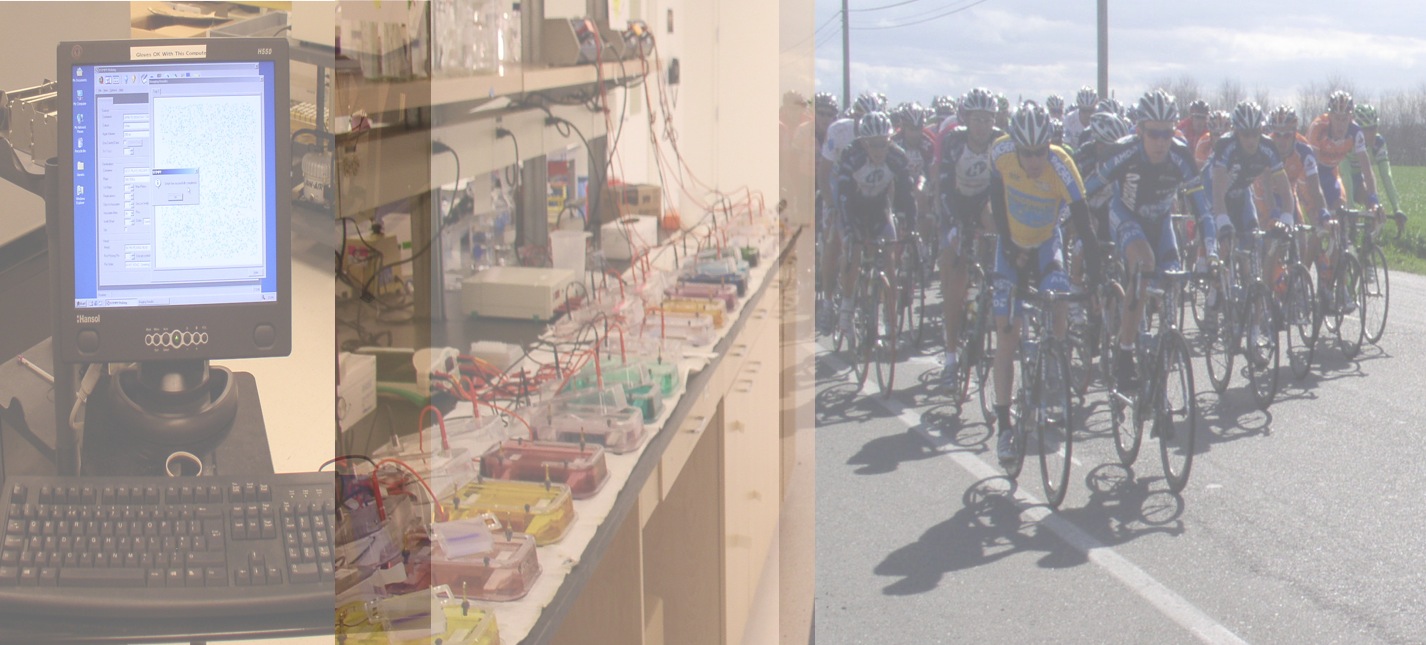
So – there is apparently no paper associated with their work. And the data is not being shared. So in that spirit, I am announcing here that I have sequenced the genome of Albert Einstein Marie Curie and Al Gore Barbara McClintock this morning on my new EXCERCYCLER machine we invented here in Davis. It is a new green sequencing technology that is powered by a bicycle and the sequence data is generated by feeding pieces of DNA into the front derailer and sequence comes out of the back derailer. See hazy image below.

How Al Gore changed my life and Congratulations on a well deserved Novel Prize

My life changed a great deal in 1989 when Al Gore came to speak at Harvard for the Environmental Action Committee in which I was involved. In honor of his Nobel Peace Prize here are my notes from his talk which I had intended to write up for a Biology Department newsletter but never did. I never finished the notes but here is the start.

Senator Al Gore ’69 spoke to Science A-30 class (as well as many others) in the end of November. His main focus was change in the global environment (i.e greenhouse effect, pollution, ozone depletion, deforestation, etc.) and what can and should be done about such issues. Senator Gore’s interest in the environment, now almost a crusade, was sparked in a class he took at Harvard from Prof. Ravel. Gore suggested that the first step that we as a nation, and as a species, must take is to recognize that there is a problem. He referred to the classical biology example of the frog in a pot of water. If the temperature of the water is increased rapidly then the frog will be leaping at the opportunity to get out. However, if the temperature of the pot is increased gradually the frog may not sense anything, and will cook in its own innocence. According to Gore, today’s society is prone to such a way of thinking. Society is least likely to recognize those changes in the environment that occur over long periods of time. It is like the Far Side cartoon in which a caveman asks his friend if the ice wall looks a bit closer today.

So, the first step is to recognize that changes are going on, and that they are more that just gradual, that they are completely new in quality and quantity. The main problem today as compared to two thousand years ago is that the changes are happening too fast. The population is increasing at a rate never seen before. Rapidly increasing levels of greenhouse gases may lead to changes in climate and temperature that will be too fast for many organisms to respond. Extinction rates, already higher than any time since the “great” dinosaur extinction, may increase even more as organisms get wiped out by the environmental changes. Ozone depletion over the antarctic may just be a warning of a decrease over the temperate and tropical areas. The subsequent increase in UV light levels at the surface of the earth could have catastrophic effects. Industrialists and many government officials suggest that “science” will be able to cure these problems in the future

This same type of graph can be shown for ozone depletion, deforestation, pollution, soil erosion, and species depletion. However, as long as their is a lack of consensus as to the amount of change, and to the degree that any of these changes will affect human’s (especially those alive today), there will be little change in government policy. In essence, Gore says, we are doing what the frog did.

There are quite a few criticisms to Gore’s approach. Technology, that wonderful thing that has brought us strip mining, and artificial hearts, may be able to, in the future, reverse some of those things we are doing now. So why limit growth, when we can clean up later. It’s like when I was a kid, “But mom, I’ll clean up after Tom and Jerry” knowing full well that I wouldn’t and running the risk of getting attacked by one of the dust balls under my dresser. However, if I made a real mess, such as one that would stain something, I had to clean it up then and there. The problem is that everyone seems to think all of these processes that are taking place in the atmosphere are reversible when in fact they may not be. Species depletion clearly is not. And if the other processes are allowed to run amok, we will likely have one big mess on our hands.

I went up and talked to Gore afterwards and found him truly inspiring. It was this discussion that helped guide me to start a new Environmental Issues journal at Harvard and to do various other things for Earth Day 1990. Anyway, all I can say is congratulations to Al Gore, a Nobel Prize well deserved for someone who has been working to help our planet for at least 20 years.

Biofools on Eye in the Sky

Eye on the Sky’s (Michael Ferrari) has a little post on Biofoolery and Water usage. In it he links to the new NAS report on this topic.

Ten things to NOT do at a conference

Well, overall I am liking the GME meeting I am at. But not all of it. And some things here are instructional for what NOT to do at a conference, either as an attendee or as a presenter or as an organizer. Here are some of them

DO NOT:

  1. Go way over your allotted time to speak. Even if the chair of a session lets you do this, don’t. It is rude to the audience and to other speakers.
  2. Lack empathy for your audience. Take a few minutes to imagine what the audience might want to get from your talk. Some of the speakers here are much more concerned with what they will get from the presentation.
  3. Use a lot of slides with way way way too small text or images.
  4. Answer cell phone calls in the middle of the audience. Yes, that’s right, scientists can be jackasses. Imagine that.
  5. Corner people who are on the way to the restroom. Let people go.
  6. Make an opening statement when asking questions like “That was a great talk” or “That was an interesting talk” or anything like that. Don’t be a suckup. Just ask your question.
  7. Be rude to the meeting helpers when you forget something. Come on. If you are not registered for the meeting it is most likely that you screwed something up, not the meeting.
  8. Ask many follow up questions after your question. If you want to have a discussion, buy a beer for someone. If you have a straightforward question that is answerable – ask it. If you want to make a simple statement, fine. If you want to go on and on … get a room.
  9. Write in your blog in the back of the room (hey, I did not say I was perfect).
  10. Have too little time for breaks. The best part of conferences is the coffee and other breaks. No need to have too many talks. Have lots of breaks.

I am sure there are other things to not do … but these are those that come to mind right now.

GME 2007 – Getting feedback on PLoS ONe

While at the GME meeting – I have now been approached by 3 people saying they really liked the discussion I initiated on PLoS One for a paper on metagenomics a few weeks ago. They were not saying they liked my comments but that there was an active discussion about some important topics. I think the function on PLoS One has great potential to engage the broad scientific community in discussions that might have previously been limited to journal clubs. So it is nice to see (1) that people are reading stuff on PLoS One and (2) that they seem to like the commenting function.