4:10 today at @ucdavis: Deanna Beatty on Effects of local management on coral survival, microbiomes, and defenses toward a thermally-regulated bleaching pathogen

***** CPB Seminar Reminder for Tuesday, November 19, 4:10pm in 1022 Life Sciences *****

Speaker: Deanna Beatty

Speaker: Deanna Beatty

Postdoc, Stachowicz Lab, UC Davis

Title: Effects of local management on coral survival, microbiomes, and defenses toward a thermally-regulated bleaching pathogen

Host: Jay Stachowicz

The CPB Seminar schedule for Fall Quarter 2019 is available here.

At @UCDavis 11/12: Shelbi Russell on “A symbiont’s guide to the germline”

***** CPB Seminar Reminder for Tuesday, November 12, 4:10pm in 1022 Life Sciences *****

Speaker: Shelbi Russell

Postdoc, Sullivan Lab, UC Santa Cruz

Title: A symbiont’s guide to the germline

Host: Michael Turelli

The CPB Seminar schedule for Fall Quarter 2019 is available here.

11/6 at @ucdavis: Alice B. Popejoy on “Diversity Measures in Genomic Medicine: Examining Race, Ethnicity and Ancestry in Precision Health Research and Clinical Practice”

Please join us Wednesday, November 6th, for Human Genomics Seminar Series with

Alice B. Popejoy, Ph.D. presenting:

“Diversity Measures in Genomic Medicine: Examining Race, Ethnicity and

Ancestry in Precision Health Research and Clinical Practice”

CHANGE OF LOCATION!! SEMINAR WILL NOW BE AT THE

MEDICAL EDUCATION BUILDING NEXT TO THE CHT IN LECTURE HALL #2222

*SEE MAP BELOW*

Please also see attached schedule for a complete list of speakers for the 2019-2020 Seminar Series!

0

Lunch will be provided

This activity is approved for 1.0 AMA PRA Category One Credit*

1

UCDMC_Campus_Map.pdf

HGSS Schedule Flyer_2019-2020.pdf

HGSS Flyer-Popejoy_Nov 2019_Final.pdf

Today at @ucdavis: Brenna Henn “Improving inference of genetic architecture and selection with African genomes”

***** CPB Seminar Reminder for Today, October 29, 4:10pm in 1022 Life Sciences *****

Speaker: Brenna Henn

Associate Professor, Department of Anthropology, UC Davis

Title: Improving inference of genetic architecture and selection with African genomes

Host: Artyom Kopp

The CPB Seminar schedule for Fall Quarter 2019 is available here.

Today at #UCDavis: Vishnu Chaturvedi “Innovations amidst outbreaks: a laboratory odyssey”

Today

Please share with your department folks – Thank You

Sent on behalf of Dr. Satya Dandekar, Chair, Department of Medical Microbiology and Immunology

Seminar Announcement VC.pdf

#UCDavis Genome Center Halloween Symposium – Oct 31

2019 GC Halloween Flyer.pdf

At #UCDavis 10/4 – Joe DeRisi “Genomic Approaches to Infection and AutoImmunity”

Friday, October 4, 2019

12:10 – 1 p.m.

GBSF 1005

Joseph DeRisi, Ph.D.,

Co-President, Chan Zuckerberg Biohub,

Professor, Biochemistry & Biophysics,

University of California, San Francisco

More details: https://health.ucdavis.edu/medmicro/calendar/documents/2019/DeRisi-Announcement.pdf

Congrats to newly minted “Dr” – Katie Dahlhausen

Congratulations to Katie Dahlhausen (actually, I should write this as “Dr. Katie Dahlhausen”) for finishing her PhD in the Biophysics Graduate Group here at UC Davis.  Her thesis was  entitled “Koala Poop Smells Good: How I Know This and Ways to Increase the Impact of Research Through Education & Outreach”.

Here are some pics / Tweets from her exit seminar and PhD bell ringing ceremony.


Exit Seminar: Katherine Dahlhausen 8/27/19

Exit Seminar: Katherine Dahlhausen

PI: Dr. Jonathan Eisen


Koala Poop Smells Good

How I know this and ways to increase the impact of research through education & outreach


Tuesday, 27th of August

11:00 am – 12:00 pm

Genome and Biomedical Sciences Facility Auditorium (Room 1005)

Open to all ages

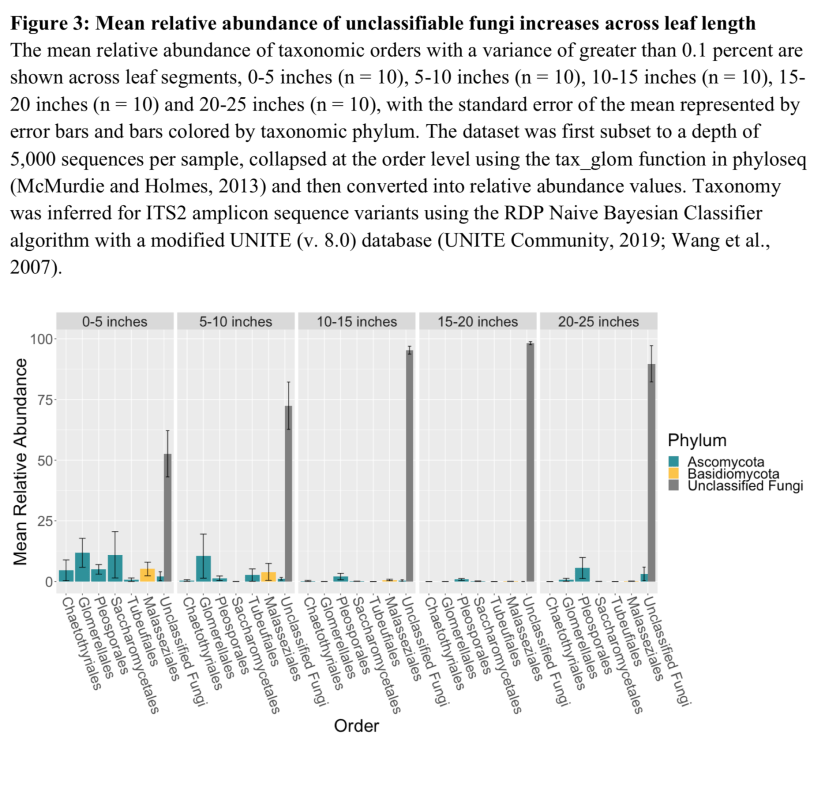
New preprint from the Eisen Lab: Characterization of the mycobiome of the seagrass, Zostera marina, reveals putative associations with marine chytrids

A new preprint is out from the lab (also been submitted for publication).  Paper led by PhD Student Cassie Ettinger.  We would love comments and feedback.

Characterization of the mycobiome of the seagrass, Zostera marina, reveals putative associations with marine chytrids https://www.biorxiv.org/content/10.1101/735050v2 

Cassandra L. Ettinger and Jonathan A. Eisen.


Abstract

Seagrasses are globally distributed marine flowering plants that are foundation species in coastal ecosystems. Seagrass beds play essential roles as habitats and hatcheries, in nutrient cycling and in protecting the coastline from erosion. Although many studies have focused on seagrass ecology, only a limited number have investigated their associated fungi. In terrestrial systems, fungi can have beneficial and detrimental effects on plant fitness. However, not much is known about marine fungi and even less is known about seagrass associated fungi. Here we used culture-independent sequencing of the ribosomal internal transcribed spacer (ITS) region to characterize the taxonomic diversity of fungi associated with the seagrass, Zostera marina. We sampled from two Z. marina beds in Bodega Bay over three time points to investigate fungal diversity within and between plants. Our results indicate that there are many fungal taxa for which a taxonomic assignment cannot be made living on and inside Z. marina leaves, roots and rhizomes and that these plant tissues harbor distinct fungal communities. The most prevalent ITS amplicon sequence variant (ASV) associated with Z. marina leaves was classified as fungal, but could not initially be assigned to a fungal phylum. We then used PCR with a primer targeting unique regions of the ITS2 region of this ASV and an existing primer for the fungal 28S rRNA gene to amplify part of the 28S rRNA gene region and link it to this ASV. Sequencing and phylogenetic analysis of the resulting partial 28S rRNA gene revealed that the organism that this ASV comes from is a member of Novel Clade SW-I in the order Lobulomycetales in the phylum Chytridiomycota. This clade includes known parasites of freshwater diatoms and algae and it is possible this chytrid is directly infecting Z. marina leaf tissues. This work highlights a need for further studies focusing on marine fungi and the potential importance of these understudied communities to the larger seagrass ecosystem.

Figures from the paper are below: