Quick post here. I am working on a web site summarizing everything from our recent meeting we hosted at UC Davis:
To capture what was going on on Twitter I used Storify to make a summary of Day 1. See below.
Quick post here. I am working on a web site summarizing everything from our recent meeting we hosted at UC Davis:
To capture what was going on on Twitter I used Storify to make a summary of Day 1. See below.
UC Davis Genome Center Looking for a Manager for the DNA Technologies Core
Manager of the DNA Technologies and Expression Analysis Cores, (Academic Administrator V)
The Genome Center, UC Davis
The UC Davis Genome Center integrates experimental and computational approaches to address key biological problems in genomics. The Genome Center has five service cores that operate on a recharge basis to provide diverse research groups on and off campus with access to state–of-the-art technologies and technical staff on an at-cost, as-needed basis. The DNA Technologies and Expression Analysis Cores provide a broad range of services with particular emphasis on high-throughput DNA sequencing, SNP genotyping, and expression analysis. More details can be found at
https://recruit.ucdavis.edu/apply/JPF00219.
The Genome Center invites applications for the position of CoreManagerwho will have responsibility for the development and day-to-day running of the DNA Technologies and Expression Analysis Service Cores of the Genome Center. These responsibilities include but are not limited to advising researchers on project design, data interpretation, supervision of core staff, operation of the cores’ instrumentation, evaluation and development of new protocols, oversight of the cores’ finances, and conducting courses to enable researchers to use the cores’ technologies.
This position requires a Ph.D. in Molecular Biology, Biochemistry, Genetics, Chemistry, or related field with at least four years of postdoctoral experience. The individual should have knowledge and experience in molecular biology as reflected in his/her publication record. Demonstrated experience in running a service unit and supervising staff is required. The incumbent must possess broad chemical, biochemical, computational, and technical knowledge sufficient to supervise technical staff, troubleshoot problems, refine technologies, and advise researchers. The position is open until filled. Applications should be completed by February 22nd, 2014 to ensure full consideration. Applicants should apply on-line with names for at least three letters of recommendation at https://recruit.ucdavis.edu/apply/JPF00219.
The University of California is an affirmative action/equal opportunity employer
Meeting about to start and thought I would post announcement here too. Follow on Twitter at #PublishPerish14
Quick post here. There is a new podcast that may be of interest Episode 8: The open access debate | The Life Sciences Podcast. From the Faculty of Life Science of the University of Manchester – they interviewed me, Alicia Wise from Elsevier, two librarians – Jan Wilkinson and Simon Bains and Andrea Baier from the British Ecological Survey and discuss multiple issues associated with open access publishing.
Got this by email and seemed of possible interest though it is not what I expected based on the title.
CFP: The Contours of Algorithmic Life
A conference sponsored by The Mellon Research Initiative in Digital Cultures
May 15-16, 2014 at the University of California, Davis
Submission Deadline: March 1, 2014
Send submissions to algorithmiclife
As algorithms permeate our lived experience, the boundaries and borderlands of what can and cannot be adapted, translated, or incorporated into algorithmic thinking become a space of contention. The principle of the algorithm, or the specification of the potential space of action, creates the notion of a universal mode of specification of all life, leading to discourses on empowerment, efficiency, openness, and inclusivity. But algorithms are ultimately only able to make intelligible and valuable that which can be discretized, quantified, operationalized, proceduralized, and gamified, and this limited domain makes algorithms necessarily exclusive.
Algorithms increasingly shape our world, our thought, our economy, our political life, and our bodies. The algorithmic response of NSA networks to threatening network activity increasingly brings privacy and political surveillance under algorithmic control. At least 30% of stock trading is now algorithmic and automatic, having already lead to
several otherwise inexplicable collapses and booms. Devices such as the Fitbit and the NikeFuel suggest that the body is incomplete without a technological supplement, treating ‘health’ as a quantifiable output dependent on quantifiable inputs. The logic of
gamification, which finds increasing traction in educational and pedagogical contexts, asserts that the world is not only renderable as winnable or losable, but is in fact better–i.e. more effective–this way. The increased proliferation of how-to guides, from HGTV and DIY television to the LifeHack website, demonstrate a growing demand for
approaching tasks with discrete algorithmic instructions.
This conference seeks to explore both the specific uses of algorithms and algorithmic culture more broadly, including topics such as: gamification, the computational self, data mining and visualization, the politics of algorithms, surveillance, mobile and locative technology, and games for health. While virtually any discipline could have something productive to say about the matter, we are especially
seeking contributions from software studies, critical code studies, performance studies, cultural and media studies, anthropology, the humanities, and social sciences, as well as visual art, music, sound studies and performance. Proposals for experimental/hybrid
performance-papers and multimedia artworks are especially welcome.
Areas open for exploration include but are not limited to: daily life in algorithmic culture; gamification of education, health, politics, arts, and other social arenas; the life and death of big data and data visualization; identity politics and the quantification of selves, bodies, and populations; algorithm and affect; visual culture of algorithms; algorithmic materiality; governance, regulation, and ethics of algorithms, procedures, and protocols; algorithmic imaginaries in fiction, film, video games, and other media; algorithmic culture and (dis)ability; habit and addiction as
biological algorithms; the unrule-able/unruly in the (post)digital age; limits and possibilities of emergence; algorithmic and proto-algorithmic compositional methods (e.g., serialism, Baroque fugue); algorithms and (il)legibility; and the unalgorithmic.
For more information, especially on updates regarding featured keynote speakers and performers, check out the conference website at: algorithmiclife.ucdavis.edu
Please send proposals of no more than 250 words to algorithmiclife by March 1, 2014.
Decisions will be made by March 8, 2014.
Nice collection in IJSEM worth looking at. The overview is particularly useful
Overview:
This is the first time in my life I wish I knew how to knit; Calling all knitters: we need germs! – The Glasgow South and Eastwood Extra. Yup – there is an attempt to break a world record for the most hands washed in a single session – and the place doing this is calling for help in making knitted microbes. They have even posted patterns for making knitted microbes including ones for Penicillium, Common cold, Swine Flu, TB, Cholera, and more.
![]() |
| From Pinterest. |
And what could be better than this? They have a Pinterest Board with pics of the ones they have received:
See below
Follow Glasgow CityOfScience’s board Knitted Microbes on Pinterest.//assets.pinterest.com/js/pinit.js
The DOE Joint Genome Institute (DOE JGI) Community Science Program (CSP) is now accepting Letters of Intent for large-scale sequence-based genomic science projects that address questions of relevance to DOE missions in sustainable biofuel production, global carbon cycling, and biogeochemistry. Priority for this call will be given to projects that address the following areas of special emphasis and exploit the diversity of DOE JGI capabilities. The CSP data is immediately made publicly available, without exception.
A summary of the 2015 CSP Call is below. The full Call can be found here:
I. Functional Genomics and Microbiomes of DOE JGI Flagship Plants: Emphasis will be on proposals related to DOE JGI’s “flagship” plant genomes, including poplar, sorghum, Brachypodium, Chlamydomonas, soybean, foxtail millet, Physcomitrella, switchgrass, and miscanthus. These species are of special interest as biofuel feedstocks or as comparators that provide insight into feedstock evolution and phenotype. Projects may fall into the following categories:
a) Gene Atlas and ENCODE-like projects;
b) Large-scale resequencing projects;
c) Plant microbiomes.
II. Probing functional diversity of microbes: To complement its Genomic Encyclopedia of Bacteria &Archaea (GEBA) and 1000 FungalGenomes initiatives, the DOE JGI has begun to explore microbial functional diversity. Proposals are encouraged that extend this effort using high-throughput sequencing, and the DOE JGI’s DNA synthesis capabilities and are expected to use one or a combination of the DOE JGI’s (meta-) genome, (meta-) transcriptome, single-cell and isolate sequencing and resequencing pipelines. ENCODE-like projects for functional genomics that could serve as model organisms for DOE-relevant problems are encouraged and could include new DOE JGI capabilities for genome-wide transcriptomics, including non-coding and small RNAs, and epigenomics, including methylation detection and ChIP-seq.
III. Microbial emission and capture of greenhouse gases in terrestrial systems: Proposals are encouraged that will provide insight into global carbon (including methane) and nitrogen cycles, and/or suggest novel strategies for carbon capture, nitrogen processing, or methane reduction through gene/genome engineering.
IV. Discovery and expression of natural product pathways relevant to energy-related and environmental processes: The DOE JGI has developed a platform that enables the discovery of novel natural products based on technology combining computational genomics, pathway refactoring, host engineering, and high-throughput analytics.
Deadlines
Letters of intent (LOI) will only be accepted electronically and should be submitted at http://proposals.jgi-psf.org/.
· LOI due: April 10, 2014
· Full proposals invited: April 24, 2014
· Full proposals due: June 5, 2014
· Projects begin: October 2014
Questions? Contact:
Axel Visel (avisel), DOE JGI Strategic Planning-Science Lead.
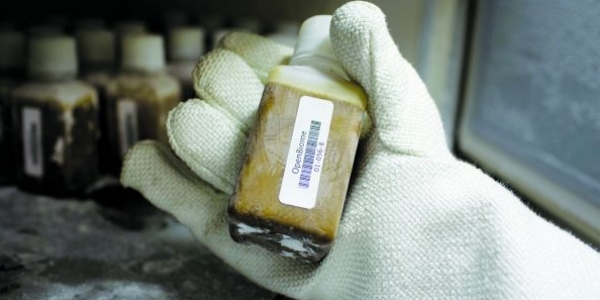
Wow – fascinating story by David Glenn in the Chronicle of Higher Education: Student-Led Project Banks on Promise of Fecal Transplants – Research – The Chronicle of Higher Education. The article tracks the story of Carolyn Edelstein and Mark B. Smith and James Burgess who have created a feces bank called OpenBiome to provide materials for fecal transplants.
Some related posts of mine:
Do you miss your bad germs after you were sick? If you do, this is for you …
Nice outfit too. Found out about this from Laist.