
Nothing conclusive here. I have not tried it yet. But Spore sure sounds like a cool evolution game to play. See Carl Zimmer’s NY Times article and his blog for more.
Category: Misc.

I see PLoS in everything III: PLoS Hats
 Thanks to my mom for this one. PLoS Hats rule.
Share this:

Cool Plant Comparative Genomics Resource: Phytozome
 I spent the last few days at a “retreat” for the Joint Genome Institute and heard about a few things there worth sharing with everyone. I will try and post about some of them in the next few days. Here is one. The JGI and the Center for Integrative Genomics have made a pretty cool tool for comparative analyses of plant genomes. It is called Phytozome and has a variety of simple and nice features. JGI is doing more and more work on plant genomes as part of their energy research and I think Phytozome could turn into a good place to go to get the latest plant genome information. Go to http://www.phytozome.net to see the real thing.
Share this:

I see PLoS in everything #2

OK – I cannot help it. Whenever I see this little train letters in stores everywhere I spell something related to PLoS. If you support OA, please continue the conspiracy and spell something OA-related wherever you find letters like this. PS – Vaughn this is for your kid.
Share this:

Redefining Tomorrow’s Table
Tony Trewavas has an interesting review (Redefining “Natural” in Agriculture) in PLoS Biology of my friend and colleague Pam Ronald’s new book “Tomorrow’s Table: Organic Farming, Genetics and the Future of Food.”
I was planning on eventually writing my own review of her book but not sure when I will get to it. I personally like the book a great deal, and enjoy how it switches back and forth between the authors (Pam and her husband Raoul Adamchak) and how it interweaves personal stories with discussion of the science and practice of organic farming and plant genetic engineering.
Trewaras has some things in the review I agree with a great deal like
“The text deals with many of the questions raised by the public about GE crops in a sensible and balanced manner, quoting various sources of reliable information on the concerns about risks to health and environment that often recur. It also mentions Richard Jefferson, who is Chairman of CAMBIA, a non-profit organisation that attempts to make the tools of biotechnology widely and freely available (http://www.cambia.org/). As a scientist, I cannot help but applaud!”
I personally love what CAMBIA is doing and found the discussion of CAMBIA in the book to be interesting. I have gotten to know Richard Jefferson over the last few years and think he is a true pioneer in revolutionizing biotechnology and freeing it from the shackles of over protectionism.
Trewavas also has a very interesting thread about the value of different opinions. Since this was printed in PLoS Biology and is under a CC license I can reprint it here (with acknowledgment of the source – Citation: Trewavas T (2008) Redefining “Natural” in Agriculture. PLoS Biol 6(8): e199 doi:10.1371/journal.pbio.0060199) and it is worth doing so:
The continuing conversation did not resolve the issues between them. It convinced me, however (if I needed convincing), that while everyone is entitled to their opinions, when dealing with detailed technical matters of science or medicine or any subject that requires enormous qualifications and experience, the notion that all opinions have equal validity is simply downright wrong. If you want real information on the safety of heart surgery procedures, do you follow the advice of a qualified heart surgeon or the local butcher? If you want advice on flying a jumbo jet, do you ask the local bus driver or a pilot with 10,000 hours of experience flying jumbo jets? And if you want advice on how to captain a supertanker, do you ask a person whose experience is limited to rowing a dinghy? Mistakes by surgeons are not uncommon, 70% of air crashes result from pilot error, and occasionally supertankers hit the rocks. But relying on rank amateurs instead of professionals would guarantee instant catastrophe. Many branches of science are very complex. However, being a scientist isn’t enough, of course, as being a scientist doesn’t qualify you to advise on any subject except your specialty. To provide advice that can lead to sensible policy requires not only a thorough understanding of the workings and literature of the particular scientific area but many decades of experience in that field.
It is unfortunate that for the past 40 years, agriculture in particular has been damaged by opinionated groups of the public that have forcefully used fear and anxiety and carefully selected information to try and coerce policy makers to adopt their own mistaken and unqualified views. Fear and emotion do not make for good policy. I applaud Ronald’s conclusion that “if citizens vote, it should be for a specific matter on which they are well informed, not because of general concerns about a new technology.”
The corollary is that on most technical matters, the public can never be well enough informed. If scientific knowledge does not form the basis of policy on technology, basing such policy on ignorance can be guaranteed to generate disaster. It was Slovik in his classic Perception of Risk [3] who demonstrated that non-experts overestimate the frequency of death from rare causes while underestimating the frequency of common causes of death, and who established clearly how additional knowledge changed expert understanding. The use of the local ordinance by activist groups to stop GE farming is only too reminiscent of the damage done by Lysenkoism to Soviet farming in the 40s, which took decades to recover from, once it was abandoned.
Basically, he is indirectly agreeing with Ronald/Adamchak that some negative opinions of GE are simply not valid. Here I think I disagree with all of them. I think much of the objection to GE modification of plants is an esthetic objection and thus presenting scientific arguments for why it is OK to do is a bit off tangent. It is kind of like when someone says “that house is ugly.” Do you respond by saying “Well, actually, the shape and color patterns have been shown to appeal to human sensory systems” Not too helpful. I feel that the same is happening with GE plants — if people’s instinctively do not like them, telling them about the science is not necessarily going to help. Nothing wrong with educating about the science, but I think it is a red herring to say that some of the anti-GE folks do not understand the science and therefore their objections must be wrong. I feel similar vibes in the evolution education discussion going on around the world. I think many people latch on to ID and Creationism because it appeals to them in a esthetic sense. And one needs to be really gentle/careful about bringing science into the discussion (except of course, when one is teaching a science class — then you teach the science).
So sure – I have some quibbles about parts of the book. As does Trewavas (he has to raise some objections – any book review that does not have them seems like fan mail and not a review).
Despite my quibbles here and there, the book really is a must read for those interested in GMOs and/or the organic farming movement as well those thinking about “slow food” and other related topics. In addition it is a wonderful personlized story, with a mixture of recipes, stories of research, discussions of teaching about organic agriculture, and some minor family drama. For the same reason that I like Amy Harmon’s New York Times stories (such as the recent one on evolution) I like this book – it personalizes what is frequently a boring impersonal discussion.
And of course it does not hurt that the heart of the story / discussion is good. Ronald/Adamchak present an overall idea I have a hard time arguing against – GE and organic growth practices both have a lot to offer the world and if we took the good parts of both, a “GE-Organic” system might be highly beneficial to all. For example, in principle, GE plants can lead to a reduction in the use of pesticides and fertilizer. Similarly, they could lead to a reduction in water use and higher crop yields. Since it seems unlikely that the current organic movement will embrace the benefits of GE crops, it will probably require a whole new movement to merge the two. It will also require the companies and organizations that push GE to do it with the environment and health of people and the planet in mind. To me, the biggest problem with GE food and farming is that it seems to be used more to help the farmers and the companies selling stuff than the consumers and the public. If that changed, I can see people embracing GE plants in much the same way they embrace GE medicines.
PS – For more on the book see Pam’s blog here.
Share this:
Twisted Tree of Life Award #1: Salk Institute Press Release on Kinases
I am starting a new award here — for people or sites that do something silly in regard to the “Tree of Life” but should know better. That is, this is for scientists or sciency sites that do something unseemly with the Tree of Life. And the first award goes to the Salk Institute for their press release relating to a paper on kinases in single celled choanoflagellates (OK – the pres release is a month and a half old but I was out sick – and I drafted this 7/8/08). In the press release, which discusses a PNAS paper by Gerard Manning and colleagues (Manning does some really great comparative work on kinases and helped me look at kinases in a few genomes such as that of Tetrahymena thermophila). I note – it seems Manning or someone has paid the OA fee for this paper so anyone can read it.
The paper seems both sound and interesting. And it has a really really cool tree figure.
But the press release has a few doozies. The worst (or best, I guess, depending on your point of view) is the following:
It commands a signaling network more elaborate and diverse than found in any multicellular organism higher up on the evolutionary tree, researchers at the Salk Institute for Biological Studies have discovered.
Yup that is right. A modern organism, living today is somehow “lower” on the tree of life than we are. Too bad the person who wrote the press release did not read Amy Harmon’s recent Times story on evolution education. Or they could have gotten help from the high school science teacher Harmon featured, who taught his students about how modern organisms did not evolve from other modern organisms.
And for using one of my most hated metaphors in all of evolution (higher and lower organisms), Salk gets my first “Twisted Tree of Life Award”
Share this:

Building a new Alvin
Quick post here. For those interested in Deep Sea research, you should check out the story by William Broad in the NY Times on building a replacement for Alvin (New Submersible to Expand Deep-Sea Exploration). Alvin is a wonderful little submarine that I and many others have relied upon for much of our research. But it definitely has some issues. And it looks like Woods Hole Oceanographic Institute is in the processof building a replacement.
Share this:
Tree of Life Imagery at Starbucks
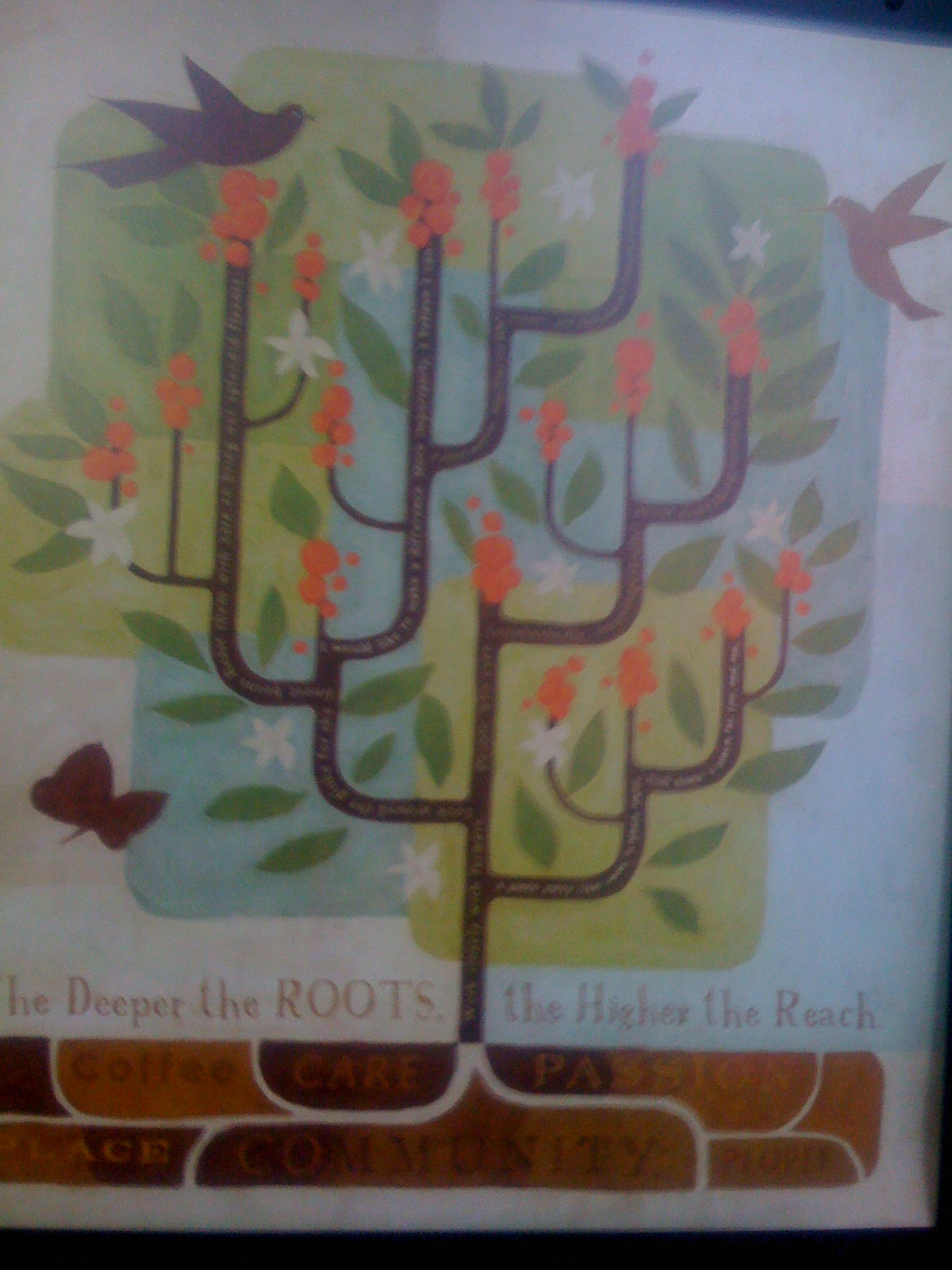
Not the best resolution (damn that iPhone camera) but just thought I would post the picture I saw at a Starbucks in San Francisco where I was for a DARPA meeting discussion the “laws of biology”. You see – even Starbucks is a fan of the Tree of Life.
——————————————
Follow up. After Laura wrote in asking about the origins of this picture I have searched around and found many others interested in it. I note – the caption says “The Deeper the Roots – the Higher the Reach”. I have not found the origins of the print but here are some other discussions
Share this:

Good Open Access News from Max Planck
Mark Patterson reports in the PLoS Blog some really good OA news (see Max Planck Society covers publication fees for PLoS journals). The Max Planck Society which has always be a strong OA supporter, will now pay the PLoS Publication fee for all papers articles where an author is affiliated with the Max Planck Institute. So now any author from there will not have to think about fees if they choose to publish in PLoS. I hope lots of other institutes follow this (not just for PLOS papers but for all OA journals).
Share this:
Shameless Self Promotion # 200: Are We Alone
Just a little quick link here. People might be interested to check out the “Are we alone” Radio Show from July 21, 2008 (Are We Alone). A direct MP3 link is here. Here is there summary of the show from that date:
Remember Mr. Potato Head? You changed his look by snapping in plastic mustaches, googly eyes and feet. Now imagine doing the same with a living cell: inserting the genes you want to create the organism you want. Welcome to the world of synthetic biology. It has potential to create new bio-fuels and life-saving drugs. It also ushers in a host of ethical and safety concerns. We examine both when we discuss this emerging science of mix and match genes. Plus, does doing an end run around Mother Nature challenge the essence of life itself?
Guests:
- Jay Keasling – professor of chemical engineering and biological engineering at UC Berkeley and founder of Amyris Biotechnologies
- Jonathan Eisen – biologist at UC Davis
- Jim Thomas – researcher at ETC group in Ottawa, Canada
- Ed Regis – science writer and author of What Is Life: Investigating the Nature of Life in the Age of Synthetic Biology
- Michael Dosmann – curator of Living Collections at the Arnold Arboretum of Harvard University
This show is produced by the SETI institute and has some interesting topics on different science things.
 Jonathan Eisen's Lab

