A must see if you are around: Today at #UCDavis 4PM – Kelly Gravuer: Mapping Macrobial Concepts to the Microbial Scale Lessons from grassland and agricultural ecosystems

Ph.D. Exit Seminar

Kelly Gravuer Department of Plant Sciences & Graduate Group in Ecology

Mapping Macrobial Concepts to the Microbial Scale Lessons from grassland and agricultural ecosystems

Tuesday
August 23rd
4:00 p.m.
PES 2005

Gravuer Exit Seminar Flyer.pdf

Stanford Biology Faculty Search in Evolution

Of possible interest:

Dear Colleagues,

The Department of Biology at Stanford University is conducting a search for a tenure-track Assistant Professor in the area of evolution. Details about the position is in the attached job advertisement. We ask you to please distribute the advertisement widely.

We hope that you will bring this information to the attention of qualified individuals. If there are candidates you wish to recommend to us, we would very much like to hear from you. Stanford is an equal opportunity employer and is committed to increasing the diversity of its faculty. It welcomes nominations of, and applications from, women and members of minority groups, as well as others who would bring additional dimensions to the University’s research and teaching missions.

Thank you very much for your assistance in helping us to identify candidates for this faculty position.

EvolutionAd_2016.pdf

New Marine Protected Areas postdoc opportunities

From an email:

Dear Colleagues,

CMSI, in collaboration with CA Department of Fish and Wildlife (CDFW), is seeking to fill three postdoc positions in the science of adaptive management of Marine Protected Areas (MPAs). This is an exciting new opportunity to merge innovative research with real world management questions to advance the science of adaptive management in the context of the world’s most extensive MPA networks. Please see the attached announcement for more details.

MPApostdocs.pdf

Chancellor Katehi stepping down at #UCDavis:

Just got this email and am sharing it here:

Dear Colleagues,

I received the attached letter from Chancellor Katehi in which she resigns as the Chancellor of UC Davis. The Divisional Senate admires and applauds her energetic advocacy for California public education and UC Davis in particular. She has been an effective leader in promoting the interests of UC Davis in the state, nation and globally.

Chancellor Katehi’s decision to resign as Chancellor today is understandable, given the recent interactions between the Chancellor and President Napolitano, including the investigation initiated by the President. These circumstances have had a negative effect on the Davis campus and make it impossible for Linda Katehi to be effective as a Chancellor.

The Davis Division is looking forward to a continuing relationship with Professor Katehi as a full-time faculty member. Last October she was hailed for her “visionary leadership in engineering research, entrepreneurship, and education, and for national advocacy of higher education as a major driver of the U.S. economy” by the National Academy of Engineering, when she received the Simon Ramo Founders Award. The Davis Division welcomes her anticipated contributions as a teacher, scholar, and member of the academic community.

Sincerely,

André Knoesen

Chair, Academic Senate

Professor: Electrical and Computer Engineering

August 9 Letter.pdf

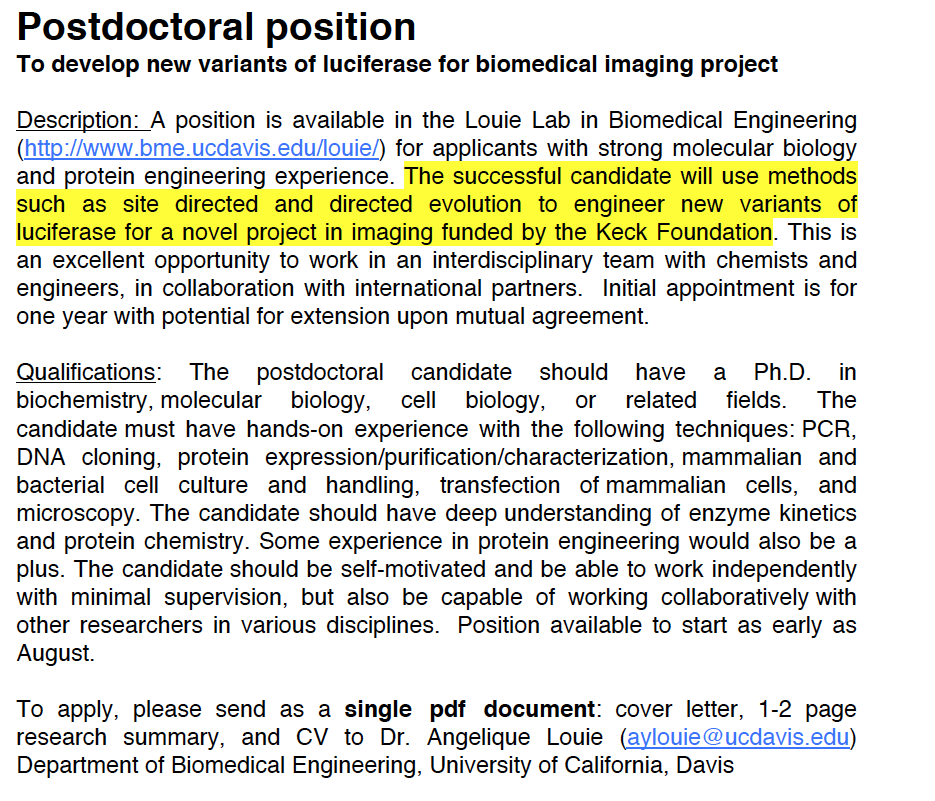
Really interesting post doc position at #UCDavis on directed evolution of luciferase

Postdoctoral position
To develop new variants of luciferase for biomedical imaging project

Description: A position is available in the Louie Lab in Biomedical Engineering (http://www.bme.ucdavis.edu/louie/) for applicants with strong molecular biology and protein engineering experience.

. This is an excellent opportunity to work in an interdisciplinary team with chemists and engineers, in collaboration with international partners. Initial appointment is for

one year with potential for extension upon mutual agreement.

Qualifications: The postdoctoral candidate should have a Ph.D. in biochemistry,molecular biology, cell biology, or related fields. The candidate must have hands-on experience with the following techniques: PCR, DNA cloning, protein expression/purification/characterization, mammalian and bacterial cell culture and handling, transfection ofmammalian cells, and microscopy. The candidate should have deep understanding of enzyme kinetics and protein chemistry. Some experience in protein engineering would also be a plus. The candidate should be self-motivated and be able to work independently with minimal supervision, but also be capable of working collaboratively with other researchers in various disciplines. Position available to start as early as August.

To apply, please send as a single pdf document: cover letter, 1-2 page research summary, and CV to Dr. Angelique Louie (aylouie) Department of Biomedical Engineering, University of California, Davis

About UC Davis: The Department of Biomedical Engineering at UC Davis has 32 faculty, and is a vibrant and multidisciplinary community of more than 120 researchers. The Department is internationally renowned for its research in biomedical imaging, enjoys strong institutional support, and is ranked #6 in the nation, and #1 in California, based on research expenditures by the National Science Foundation. UC Davis also has a School of Medicine (including an NCI- designated Comprehensive Cancer Center), a School of Veterinary Medicine, the California National Primate Research Center, and the Institute for Regenerative Cures offering unparalleled opportunities for collaborative and translational research. Davis is located within 1- 2 hours of San Francisco, Napa Valley, Lake Tahoe and the Northern California coast offering access to a wide range of outdoor and cultural activities and an excellent quality of life.


Yohei Postdoctoral position slk.pdf

UC Davis Liver Research Day 10/5/2016

REGISTER TODAY!: www.surveymonkey.com/r/JBWQJWW
SUBMIT ABSTRACT: Dr. Valentina Medici at vmedici


UCD 2nd ANNUAL LIVER RESEARCH DAY

Metabolic Pathways to Fatty Liver

Wednesday, October 5, 2016
8:00 AM – 3:45 PM
GBSF Building, Auditorium
451 Health Sciences Drive
Davis Campus

8:00-8:30 AM Registration and Continental Breakfast

8:30-8:40 AM Welcome
Christopher Bowlus, MD, Professor and Chief, Internal Medicine, Gastroenterology/Hepatology, UC Davis


Session I

9:00-9:20 AM “Sugar Consumption and Chronic Stress”

Kevin D. Laugero, PhD, Associate Adjunct Professor, Nutrition and USDA WHNRC, UC Davis

9:25-9:45 AM “FXR, Sleeve Gastrectomy and Fatty Liver”

Karen K. Ryan, PhD, Assistant Professor, Physiology and Membrane Biology, UC Davis

9:50-10:10 AM “Lipidomics, Nutrition and Fatty Liver”

Angela M. Zivkovic, PhD, Assistant Professor, Nutrition, UC Davis

10:15-10:35 AM “Methionine Metabolism in ASH and NASH”

Kusum Kharbanda, PhD, Associate Professor, Internal Medicine, Gastroenterology/Hepatology, University of Nebraska

10:40-10:55 AMCoffee Break


Session II

10:55-11:15 AM “Non-invasive Assessment of NAFLD”

Souvik Sarkar, MD, PhD, Assistant Professor, Internal Medicine, Gastroenterology/Hepatology, UC Davis

11:20-11:30 AM “Copper and Lipid Metabolism”

Valentia Medici, MD, Associate Professor, Internal Medicine, Gastroenterology/Hepatology, UC Davis

11:30-11:50 PM “Fructose as a Risk Factor for NAFLD”

Manal F. Abdelmalek, MD, Associate Professor, Gastroenterology, Duke University

11:55-12:55 PM Lunch (provided for the first 50 registrants) AND
Poster Judging (Poster Facilitators: Drs. Christopher Bowlus, Charles Halsted and James Tabibian)


Session III

1:00-1:30 PM “Advanced Glycation End Products in NASH Pathogenesis”

Natalie J. Torok, MD, MSc, Professor, Internal Medicine, Gastroenterology/Hepatology, UC Davis

1:35-1:55 PM “Mitochondria, Lipid Metabolism, Shcs and Fatty Liver”

Gino Cortopassi, PhD, Professor, Molecular Biosciences, UC Davis

2:00-2:20 PM “Fatty Liver and Risk of HCC in Different Populations”

Eric W. Chak, MD, MPH, Assistant Professor, Internal Medicine, Gastroenterology/Hepatology, UC Davis

2:25-2:45 PM Coffee Break

Session IV

2:45-3:05 PM “Emerging Therapies and Clinical Research in NAFLD”

Manal F. Abdelmalek, MD, Associate Professor, Medicine, Gastroenterology, Duke University

3:10-3:30 PM “Studies of Human Stem Cell-derived Hepatocyte-like Cells”

Jan A. Nolta, PhD, Professor, Internal Medicine and Director, Stem Cell Program, UC Davis

3:35-3:45 PM Poster Award Announcements and Closing Remarks

LiverDay_Agenda10-05-16.pdf
LiverDay_CallforAbstracts.pdf

“Careers in High-throughput Sequencing” by illumina on 8/11 #UCDavis

From the inter tubes:

Dear Colleagues,

Davis Postdoc Entrepreneurship and Career group (DPEC) – Knowledge Exchange and Bioinformatics Core will co-host a seminar, “Careers in High-throughput Sequencing”, by Tony Dodge (MSc) and Drew Kebbel (MSc) of Illumina.

Careers in High-throughput Sequencing

Join us for a conversation with Illumina to learn about the future of High-throughput Sequencing in careers in research, emerging markets and entrepreneurship. Tony and Drew will discuss:

  • Career opportunities and applications of High-throughput Sequencing in various markets such as companion diagnostics in drug development, clinical neonatal testing, consumer genomics and bioinformatics, etc.
  • The Illumina Accelerator Program, an incubation program in Mission Bay, San Francisco, which provides entrepreneurial support, seed funding, technology access, and venture capital networks to startups with High-throughput Sequencing applications.

This talk is intended for anyone who is interested in high-throughput sequencing and entrepreneurship; all backgrounds are welcome!

Speakers: Tony Dodge (MSc), Executive Business Specialist at Illumina and Drew Kebbel (MSc), Sequencing Sales Specialist at Illumina

Date: Thursday, August 11, 2016 12:30 pm –2 pm (Networking and refreshments to follow)

Location: Auditorium 1005, Genome and Biomedical Sciences Facility (GBSF), UC Davis campus.

Please RSVP here!

If you have any questions, contact us at dpec .

Illumina_Careers in Sequencing_July2016.pdf

USC / C-DEBI seeks a full-time Diversity Specialist to join its team!

d7079b52-d998-4881-bf03-695189f24e49.png
USC/C-DEBI seeks a full-time Diversity Specialist
[ advertisement PDF ]

The USC Dornsife College of Letters, Arts and Sciences Center for Dark Energy Biosphere Investigations (C-DEBI) is seeking a full-time Diversity Specialist to join its team!

C-DEBI is a multi-institutional research and education center funded by the National Science Foundation Science and Technology Center (NSF-STC) program, headquartered at USC. Focused on the science of exploring microbial life beneath the seafloor, the Center also prioritizes the integration of deep sea research with education and diversity efforts to strengthen the STEM pipeline for future generations. The Diversity Specialist will help to create, coordinate, and lead our diversity efforts to serve our students, postdocs, faculty, and other participants at USC and across the nation. The Diversity Specialist will assist the C-DEBI Education, Outreach, and Diversity Managing Director who supervises the development and management of these programs.

The ideal candidate for the position of C-DEBI Diversity Specialist has:

  • 3 years of experience developing and managing educational STEM programs with multiple institutions with a focus on diversity initiatives
  • Experience working across multiple institutions
  • Strong oral and written communication skills
  • Experience using social media for professional outreach
  • Research experience at Ph.D. or Masters level

Job responsibilities include:

  • Assistance in the planning and organization of C-DEBI Education, Outreach, and Diversity program objectives and content to advance NSF-STC diversity initiatives
  • Support for diversity programs, e.g., Global Environmental Microbiology and Genomics & Geobiology Undergraduate Research Experience, via testing and evaluation, teaching or event planning and the administrative duties associated with running programs
  • Interaction with faculty, researchers, and staff involved with diversity programs at USC and at partner institutions
  • Development and implementation of program policies and procedures
  • Development of strategies for promoting C-DEBI programs, including personal networking, social media, newsletters and publications or other communications materials, and events planning by working with the C-DEBI community to broadcast exciting discoveries and E&O opportunities
  • Personal professional development by staying informed of developments in field
  • Other related duties as assigned or requested with the potential to create new programs

Apply at http://jobs.usc.edu/postings/70927 (Requisition ID 1006784).

We will begin reviewing applications August 19.

The University of Southern California is an Equal Opportunity Employer that Values Diversity.

Pokébiome: A Call for Research Participants

Professor Bonsai is looking for Pokémon trainers to participate in a new study on the Pokémon microbiome or the Pokébiome. The study is open to trainers who are Level 5 or above and preference will be given to trainers who have caught a larger variety of Pokémon.

Cmz4h8pVIAA1zYu.jpg_large-576x1024.jpg
A tenure-hopeful professor in pokélogy at a large well-known research lab, Prof. Bonsai is an outspoken proponent of trapping and releasing Pokémon humanely vs. many of his colleagues who prefer to keep Pokémon under study in small sphere like contraptions

The recent global discovery of Pokémon, adorable 2D animals, by the Nintendo Co., Ltd. may be the most important scientific finding of the century.  Millions of Pokémon trainers have sprung up overnight and have begun rapidly sampling Pokémon from a multitude of geographic locations allowing for never before possible large scale citizen science opportunities. Prof. Bonsai hopes to swab and characterize the microbiomes of all 151 Pokémon that have been discovered (as well as any additional Pokémon that may be found in the future) and their tiny-homes (aka Pokéballs). He hopes that this research will help us better understand Pokémon disease and health as well as possibly revolutionize the way we store and transport our 2D friends.

IMG_2016-07-18-11505380-608x1024.png
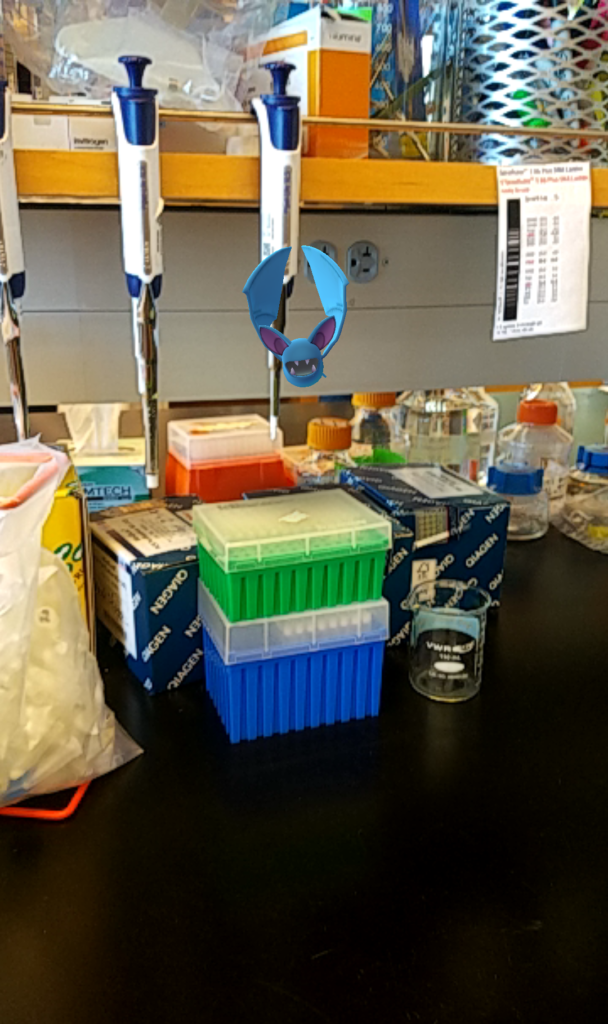
A Pokémon, belonging to trainer Amy Swabem, appears in the lab and is ready to be sampled for Pokébiome analysis.

Additionally, Prof. Bonsai is hoping that he can utilize a 2012 study, A Phylogeny and Evolutionary History of the Pokémon,  from the Annals of Improbable Research to study the co-evolution of microbes with their Pokémon hosts before, after and during their evolutions.

IMG_2016-07-10-10220459-608x1024.png
Above you can see a “mushroom Pokémon”. Prof. Bonsai is extremely interested to know if this Pokémon is a true fungi or an oomycete and whether or not it has other species of fungi associated with it.

Unfortunately, this study is currently limited to Pokémon that are solid (e.g. no ghost Pokémon) and those that are not flammable (e.g. no fire types) due to sampling issues. Prof. Bonsai and his team are currently testing out alternative sampling methods and hope that these Pokémon will be able to be included soon. If you are interested in participating please contact Prof. Bonsai via mail using a flying-type Pokémon.

Worth a read: A simple proposal for the publication of journal citation distributions

This paper in BioRXiv is definitely worth checking out.

Abstract is below:

Although the Journal Impact Factor (JIF) is widely acknowledged to be a poor indicator of the quality of individual papers, it is used routinely to evaluate research and researchers. Here, we present a simple method for generating the citation distributions that underlie JIFs. Application of this straightforward protocol reveals the full extent of the skew of distributions and variation in citations received by published papers that is characteristic of all scientific journals. Although there are differences among journals across the spectrum of JIFs, the citation distributions overlap extensively, demonstrating that the citation performance of individual papers cannot be inferred from the JIF. We propose that this methodology be adopted by all journals as a move to greater transparency, one that should help to refocus attention on individual pieces of work and counter the inappropriate usage of JIFs during the process of research assessment.

Source: A simple proposal for the publication of journal citation distributions | bioRxiv


Screen Shot 2016-07-09 at 8.56.53 AM


Screen Shot 2016-07-09 at 8.56.33 AM