CPB Seminar at #UCDavis today: Environmental gradients and interactions with soil biota shape adaptation in teosinte

CPB Spring Quarter Seminar Reminder – Tuesday, May 19, 2015 – 4:10pm – 1022 Life Sciences

May 19: Anna O’Brien
Graduate Student, Population Biology Graduate Group, UC Davis
Title: “Environmental gradients and interactions with soil biota shape adaptation in teosinte”

At #UCDavis today Sam Diaz-Munoz, 11:15 am

Department of Microbiology & Molecular Genetics Recruitment Seminar

Samuel Diaz-Munoz, Ph.D.
(NYU)

"The Evolution of Viral Social Interactions"

Monday, May 18, 2015

11:15 am*


197 Briggs*

*note time and location

Diaz-Munoz Seminar 5-18-15.doc

Talk at #UCDavis today: Michael Fischbach on Small molecules from the human microbiota – GBSF noon

Seminar today

“Insights from a global view of secondary metabolism: Small molecules from the human microbiota”

Michael Fischbach, Ph.D.

Assistant Professor, Department of Bioengineering and Therapeutic Sciences, University of California, San Francisco

Friday, May 15, 2015 12:10 – 1:00 PM

Genome and Biomedical Sciences Facility Auditorium (GBSF 1005)

Fischbach.pdf

Michael Fischbach at #UCDavis 5/15 noon: Insights from a global view of secondary metabolism: Small molecules from the human microbiota

FridayGBSF 1005
Noon

Dr. Michael Fischbah of UCSF
"Insights from a global view of secondary metabolism: Small molecules from the human microbiota”

5/18 at #UCDavis Hunter Fraser on “Exploring the impact of noncoding genetic variation in humans”

“Exploring the impact of noncoding genetic variation in humans”

Hundreds of genome-wide association studies (GWAS) have found that the vast majority of human genetic variation impacting complex traits occurs outside of protein-coding regions, yet our understanding of these noncoding variants is still quite poor. I will describe our recent efforts to explore the impact of these functional variants. We have developed new experimental approaches to detect which variants affect key components of transcriptional regulation such as transcription factor binding, DNA methylation, and histone modification. We are also developing new computational methods for detecting natural selection in noncoding regions, revealing a dominant role of cis-regulatory changes in recent human adaptation.

Speaker: Hunter Fraser

Assistant Professor

Stanford University

Monday, May 18, 2015

4:10-5:00 PM

1022 Life Sciences

5/13 at #UCDavis: Alex Csiszar on “The Scientific Journal: A Political History” #ICIS

Please join us for Alex Csiszar (Harvard University) speaking on "The Scientific Journal: A Political History"

Wednesday, May 13, 2015, 12:00 pm – 1:30 pm
2nd Floor Instruction Room, Shields Library

Lunch will be served – Please RSVP at this link if you plan to attend http://goo.gl/forms/4D9nm6NXps

Scientific journals are expected to do a lot of different things. They are often identified with both the cumulative and the present state of knowledge possessed by scientific communities. Journals are supposed to be public enough that any interested reader might access them; yet at the same time they are rigorously exclusive. To publish in a particular set of journals is to be deemed an expert in the corresponding scientific field. When questions arise as to what scientific consensus is on some matter of concern, governmental bodies, the public, and journalists routinely look to the reputable journal literature dealing with that subject. The list of a researcher’s papers is a unit by which careers are measured and a dominant factor in decisions about hiring, tenure, and grants. Scientific journals are both permanent archive and breaking news, both complete record and painstaking selection, both public forum and the esoteric domain of experts.

This talk will explore how and why this improbable state of affairs came into being over the course of the nineteenth century. The shift whereby the authority of science came to be vested increasingly in serialized print did not come about through any deliberate decision taken by scientists based on the fitness of the periodical press to play this role. Far from emerging out of a timeless need for a secure communications medium and format, the ascendancy of the scientific journal occurred as European scientific elites sought to establish their collective legitimacy to speak authoritatively about nature following the political upheavals of the Napoleonic Wars. Since that time, the scientific journal has been a nodal point where expert cultures of credibility have intersected, uneasily, with public criteria of accountability.

Alex Csiszar is an Assistant Professor of the History of Science at Harvard University. His research concerns the history of scientific authorship, publishing, refereeing practices, and information management from the French Revolution to the twentieth century.

Coming today to a cat near you – microbes

Only three years after first imagined … https://www.kickstarter.com/projects/catbiome/kittybiome-kitty-microbiomes-for-cat-health-and-bi/widget/video.html https://www.kickstarter.com/projects/catbiome/kittybiome-kitty-microbiomes-for-cat-health-and-bi/widget/card.html?v=2

FuturePhy, Call for Participation

Just got this via the email tubes:

FuturePhy is an NSF-sponsored, three-year program of conferences, workshops and hackathons on the Tree of Life. The project aims to promote novel, integrative data analyses and visualization, interdisciplinary syntheses of phylogenetic sciences, and cross-cutting uses of phylogenetics to develop and address new research questions and applications.

The first phase of this mission is critical: to bring together a broad community of people from diverse backgrounds who are active in phylogenetics research, who use the tree of life in research or education, who will benefit in applied or practical ways from a comprehensive tree of life, or who come from a background that offers new perspectives on defining, addressing or transcending key challenges in phylogenetics.

Help accelerate progress in all aspects of phylogenetics research by joining FuturePhy today. Diverse opportunities will be available to attend FuturePhy sessions in person or virtually, and to link FuturePhy to existing projects and initiatives.

We invite you to participate in the project in several ways:

1. Register on http://futurephy.org Scientists from all aspects of the phylogenetic sciences, educators, members of the tree-using community, and others interested in phylogenetics are welcome.

2. Contribute to the discussion forum on http://futurephy.org This is the best way to log your interest and contribute ideas.

3. See our main themes, comment on them and take the survey to rank them: https://www.surveymonkey.com/s/8CWXMRF

4. Email contact with ideas or comments

5. Tweet to the FuturePhy community: @FuturePhy

6. Comment in the FuturePhy thread on http://phylobabble.org

At #UCDavis 5/8 – Special seminar on bees and parasites

Special Seminar: Entomology, Bee biology

"Pesticides, parasites and pollinators: the impacts of environmental stressors on bees"

Prof Nigel Raine Univ of Guelph

Date: Friday May 8
Time: 1 PM
RM: 366 Briggs Hall

Guest post from Rachid Ounit on CLARK: Fast and Accurate Classification of Metagenomic and Genomic Sequences

Recently I received and email from Rachid Ounit pointing me to a new open access paper he had on a metagenomics analysis tool called CLARK.  I asked him if he would be willing to write a guest post about it and, well, he did.  Here is it:

CLARK: Accurate metagenomic analysis of a million reads in 20 seconds or less…
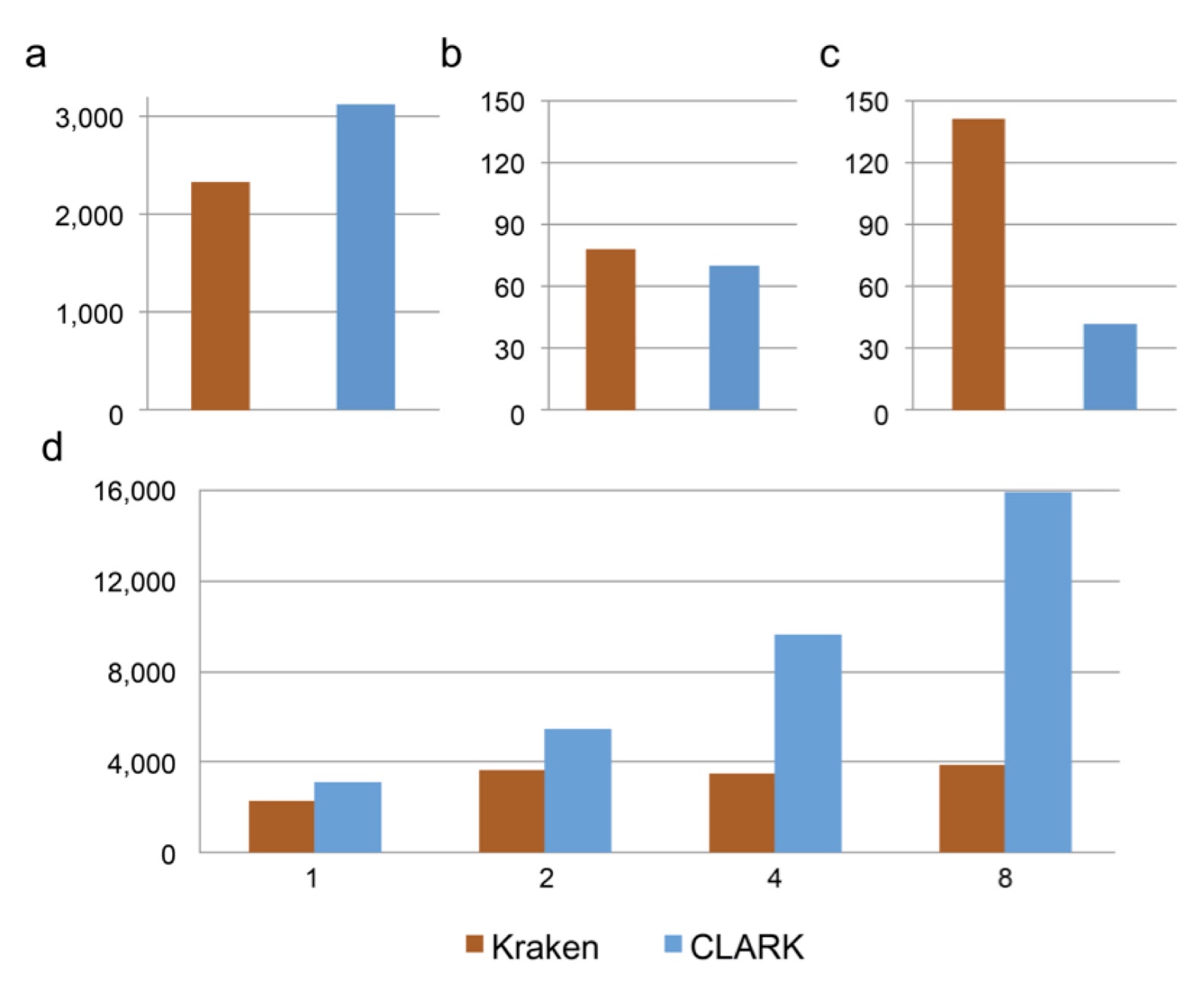
At the University of California, Riverside, we have developed a new lightweight algorithm to classify accurately metagenomic samples while minimizing computational resources better than any other classifiers (e.g., Kraken).  While CLARK and Kraken have comparable accuracy, CLARK is significantly faster (cf. Fig. a) and uses less RAM and disk space (cf. Fig. b-c). In default mode and single-threaded, CLARK’s classification speed is higher than 3 million short reads per minute (cf. Fig. a), and it also scales better in multithreading (cf. Fig. d). Like Kraken, CLARK uses k-mers (short DNA words of length k) to solve the classification problem. However, while Kraken and other k-mers based classifiers consider the whole taxonomy tree and must resolve k-mers that match genomes from different taxa (by using the concept of “lowest common ancestor” from MEGAN), CLARK rather considers taxa defined for a unique taxonomy rank (e.g. species/genus), and, during the preprocessing, discards any k-mers that can be found in any pair of taxon. In other words, CLARK exploits specificities of each taxon (against all others) to populate its light and efficient data structure. It uses a customized dictionary of k-mers, in which each k-mer is associated to at most one taxon and results in fast k-mer queries. Then, the read is assigned to the taxon that has the highest amount of k-mers matches with it. Since these matches are discriminative, CLARK assignments are highly accurate. We also show that the choice of the value of k is critical for the optimal performance, and long k-mers (e.g., 31-mers) are not necessarily the best choice to perform accurate identification.  For example, high confidence assignments using 20-mers from real metagenomes show strong consistency with several published and independent results. 
Finally, CLARK can be used for detecting contamination in draft reference genome or, in genomics, chimera in sequenced BACs. We are currently investigating new techniques for improving the sensitivity and the speed of the tool, and we plan to release a new version later this year. We are also extending the tool for comparative genomics/metagenomics purposes. A “RAM-light” version of CLARK for your 4 GB RAM laptop is also available. CLARK is user-friendly (i.e., easy to use, it does not require strong background in programming/bioinformatics) and self-contained (i.e., does not need depend on any external software tool). The latest version of CLARK (v1.1.2) contains several features to analyze your results and is freely available under the GNU GPL license (for more details, please visit CLARK’s webpage). Experimental results and algorithm details can be found in the BMC genomics manuscript.
Performance of Kraken (v0.10.4-beta) and CLARK (v1.0) for the classification of a metagenome sample of 10,000 reads (average reads length 92bp).  a) The classification speed (in 103 reads per minute) in default mode. b) RAM usage (in GB) for the classification. c) Disk space (in GB) required for the database (bacterial genomes from NCBI/RefSeq). d) Classification speed (in 10^3 reads per minute) using 1, 2, 4 and 8 threads.