It takes a village – and if you are interested in plants – here is one

Continuing to be impressed with PlantVillage. Their mantra is

PlantVillage is built on the premise that the all knowledge that helps people grow food should be openly accessible to anyone on the planet. PlantVillage is a user moderated Q & A forum dedicated to the goal of helping people grow their own food. It is an open freely available resource that helps you solve all your plant related questions.

I first found out about this when David Hughes was visiting UC Davis a few weeks ago to give a talk.  I met with him (to discuss zombie ants – what else) and he told me about PlantVillage which he helps run.

So I registered and I am going to start uploading various information about our plants in my yard and elsewhere.   I tested the system by posting a pic of my peach / nectarine.

Lots of people there posting pics and asking questions about identifying issues with their plants.  Seems like an interesting site.

A Viromics Workshop: Tools & Tricks to See the ‘Virus’ in Diverse Sequence Datasets

Just got this and thought it would be of interest:

Dear colleagues,

We would like to call your attention to a full-day Viromics Workshop being held in advance of the American Society of Microbiology on Saturday May 17, 2014 at the Boston Convention Center. Discounted registration ends April 7th.

WS21 A Viromics Workshop: Tools and Tricks to See the ‘Virus’ in Diverse Sequence Datasets

Description:
Viruses are fundamental to ecosystems ranging from oceans and sediments to plants and humans with impacts ranging from mortality and horizontal gene transfer to metabolic reprogramming. However, our ability to study them has been bottlenecked by the lack of (i) ecologically relevant isolates resulting in ‘unknowns’ dominating culture-independent surveys and (ii) rigorously evaluated
sample-to-sequence pipelines coupled to community-available informatic tools to generate and make sense of complex viral metagenomic datasets. Fortunately this is changing, and rapidly. New tools are emerging that will democratize the tremendous discovery potential of viral metagenomics. This all-day ASM workshop will introduce these emerging tools and empower a new generation of microbiologists to “see” hidden viruses in datasets ranging from viral metagenomes in diverse environments to microbial datasets from single cell and community genomics projects.

Details here:
http://www.abstractsonline.com/Plan/ViewSession.aspx?sKey=96f70e4b-8e7c-4fc6-b652-9f0264ca6a68&mKey=673511f0-c86b-432f-a387-058032b8500b

Organizer:
Matt Sullivan, Ph.D.
University of Arizona

Storer Lectureship in Life Sciences – Dr. Jerry Coyne – 4/9& 4/10 at #UCDavis

Well, this should be interesting …

Public Lecture:

Wednesday April 9, 2014

Faith is not a virtue: the incompatibility of science and religion.”

4:10 PM ARC Ballroom A


Scientific Lecture:

Thursday April 10, 2014

Two flies on an island; Speciation in Drosophila on São Tomé

4:10 PM 176 Everson Hall

Storer Lectureship – Dr. Jerry Coyne.pdf

Why I don’t like to pre-submit slides for talks – lessons from #AAASMoBE meeting

So – I gave a talk at a meeting on Thursday.  The meeting was called “Microbiomes of the Built Environment” and it was sponsored by the Alfred P. Sloan Foundation and run by AAAS.

The meeting organizers, as is often the case, wanted me to submit my slides a few days in advance, in theory to make sure they were loaded into their system and that all worked OK.  Well, as usual, I did not do this.  I like to make my talks fresh – just before the meeting so that I can incorporate new ideas into them and so that they do not have that canned feeling that a lot of talks do.

My talk was to be 15 minutes long and was to focus on my Sloan Foundation funded project “microBEnet: the microbiology of the built environment network” (see http://microbe.net for information about the project). I figured, I would work on the talk on the plane – five plus hours to edit a talk I had given relatively recently on the topic of this project.  And all would be good.  Plus, United had told me there would be WiFi on the plane so if I needed any new material I should be able to get it from the web right?  Well, the flight took off on time – 8 AM on Wednesday morning.  And I opened my laptop once allowed and paid the $15+ dollars for the WiFi and got to work.  Then, about 10 minutes later, the WiFi died and despite heroic efforts by the flight attendants, it never came back. And I plugged away at my slides doing some edits of the following presentation.

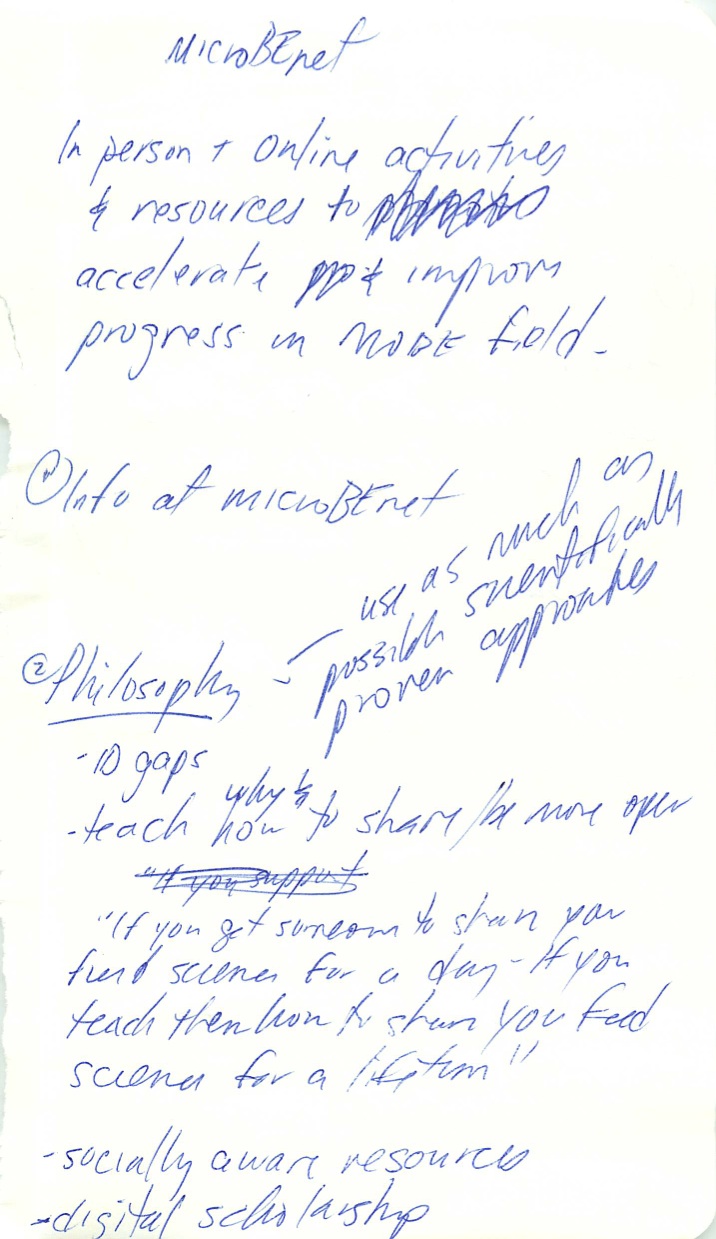
I had given this talk for the Annual Sloan Foundation meeting in May of 2013. I had other talks about microBE.net but they were focused on specific aspects and this was my most recent talk on the whole project. And, well, I started doing some minor edits on it, but, well, the slides felt too filled with boring text. And it did not seem to me to capture what I wanted to talk about. So I did the one thing that always helps me in such cases. I shut my computer and got our a notebook and started writing out and drawing out what I really wanted to talk about. And I finally started to have something I liked.

I liked this because what we are trying to do with microBEnet is to create an actual network and this was a visual way of representing our network. So then I got a bit more detailed

This was better. We were trying to help people in the field and help others who might be interested get connected, stay connected, and get rapid, easy access to information and tools. For example, we have been curating a reference collection for the field. And this reference collection has a lot of inputs and a lot of potential uses. In my previous talk I just listed some of this and had a screenshot of the web site. But it would be better to show this no?

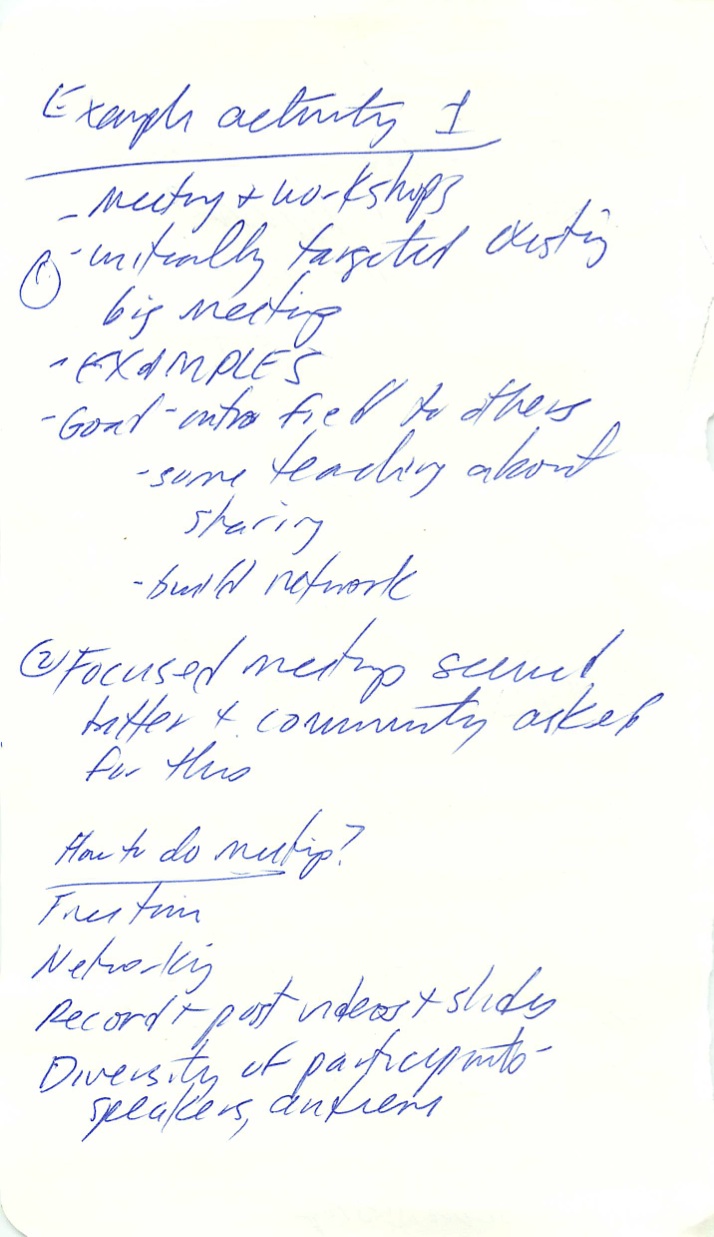
Now this was feeling even better. I had a visual framework for the talk. Now I could fill in the details of what I wanted to cover in each of the parts of the network diagram.

So now I had some idea as to what I might want to say on these topics. No slides yet, but some idea as to what I might want to cover. And then, still not back on the computer I thought it would be good to write out an outline / the flow of the talk again. So I did.

Still felt good.

Now all I needed was a title ..

And then finally I felt I could go back to the computer. And so I started working on converting this all into slides.

For the remaining 2 hours of the flight I tried but it was slow going. I wanted to make as much as possible be visual and I needed all sorts of new slides and material from the web (no web connection still) and more. We landed. I took a Taxi to the hotel. I worked on my talk a bit from my room. I emailed various people asking for certain images and slides. And then I had to go to the speaker’s dinner. And I got back to my room at about 9:30. And then I worked on my talk until about 3. And finally I was close to being done. Got a very brief few hours of sleep. Got up. Went to the meeting. Did a couple of minor modifications of my slides in the back of the room. Posted my slides to Slideshare. And then gave my talk.

Here are the final slides

Not perfect. But much more visual. Much more networky. Much better at showing what we actually do and try to do on my project.  And much fresher to me so it was certainly not a canned talk.  Not a polished talk .. but not a canned one.

For more about the meeting, including videos of talks (including mine) see the Storify I made.

Wrap up of Twitter chat on the human microbiome with a high school bio teacher

It started with this

//platform.twitter.com/widgets.js And eventually we worked out a date, which was yesterday. Now I note I had no idea who these people are/were. But it seemed like a good chance to do some some outreach. So I said yes. And yesterday it happened. OK it was chaotic. But it was fun. Here is a Storify of the Tweets.

mBio – home of some really cool, #openaccess microbiology papers

Am really enjoying the suite of papers coming out in mBio – the Open Access PLOSOne like journal from the American Society for Microbiology.  Here are some examples of recent papers that caught my eye:

And many many more.  Kudos to ASM and mBio.

An important read on “Impact Factor Mania” from Arturo Casadevall & Ferric Fang

Really important article in mBio: Causes for the Persistence of Impact Factor Mania.

Full citation : Casadevall A, Fang FC. 2014. Causes for the persistence of impact factor mania. mBio 5(2):e00064-14. doi:10.1128/mBio.00064-14.

In the article the authors discuss what they call “Impact Factor Mania” and outline what they believe the causes of it are (hyper competition for funding and jobs, paucity of objective measures of the importance of scientific work, hyper specialization of science, benefits to selected journals, benefits to scientists, national endorsements and prestige by association).  They then discuss some of the problems with such mania including distortions in the scientific enterprise, inability to accurately predict impact, ignoring many important studies, limited correlation between IF and article citation, imperfection of citation rate, delay in communications, and creation of perverse incentives.  They discuss some of the existing proposals for reform including DORA and a boycott of high impact journals.  And finally they discuss what scientists can do including: reforming criteria for funding and promotion, use of diverse metrics, increase interdisciplinary interactions, encourage elite journals to become less elite, and a return to essential scientific values.

The article is a perfect follow up on our recent “Publish or Perish” meeting.

June R Workshop from Pat Schloss

From Pat Schloss/ the Mothur-announce mailing list

Hi mothur fans,
I’ll be hosting another Crashcourse in R Workshop for Microbial Ecologists this June. The workshop will run from June 23rd to 25th near the Detroit airport. The workshop is being filled on a first come, first served basis. The workshop is geared towards people with interests in microbial ecology that would like to learn R or to learn it better so you shouldn’t feel like this isn’t for you if you are a beginner. I assume no previous computer programming experience. The workshop is an even blend of lecture/discussion and hands on use of R with real data and typically uses mothur output files as a starting point. This is a new workshop that I am offering, so here is a rough outline of what the workshop schedule will look like (it is subject to some minor changes)…
Monday:

AM Introduction to R – operations, variable types
PM R basics – getting data in and out, packages

Tuesday:

AM Plotting: Core functions
PM Plotting: Lattice / RGL

Wednesday:

AM Programming in R – Functions, loops
PM Programming in R – Controlling flow

Each day there will be a lecture and discussion interspersed with hands-on activities and it will run from 9 to 5. If you would like to meet with me one-on-one to discuss your project, I can do that in the evening and during breaks. Please email me for more details. Thanks,
Pat Schloss

UC Davis Summer Bioinformatics Workshops — Registration is Open!

Registration is open for the 2014 Bioinformatics Summer Workshops!

Now in it’s 7th year, the UC Davis Bioinformatics Training Program will be holding two week-long workshops this summer:

June 16-20, 2014: Using Galaxy for Analysis of High Throughput Sequence Data

Sept. 15-19, 2014: Using Command Line for Analysis of High Throughput Sequence Data

These workshops will be held on the UC Davis campus and will run from 9am to 5pm on the dates indicated.

Details

Both workshops will cover modern high throughput sequencing
technologies, applications, and ancillary topics, including:

· Illumina HiSeq / MiSeq, and PacBio RS technologies

· Read Quality Assessment & Improvement

· Genome assembly

· SNP and indel discovery

· RNA-Seq differential expression analysis

· Experimental design

· Hardware and software considerations

· Cloud Computing

Each workshop will include a rich collection of lectures and hands-on sessions, covering both theory and tools. We will cover the basics of several high throughput sequencing technologies, but will focus on Illumina and PacBio data for hands-on exercises. Participants will explore software and protocols, create and modify workflows, and diagnose/treat problematic data.

In June, workshop exercises will be performed using the popular Galaxy platform (http://usegalaxy.org) on the Amazon Cloud
(http://aws.amazon.com/) which allows for powerful web-based data analyses. There are no prerequisites other than basic familiarity with genomic concepts.

In September, exercises will be performed using the Linux command line. Therefore, for this workshop, it is strongly recommended that participants should also have basic familiarity with the Linux/Unix (or Mac) command line.

Who Should Attend

Prior course participants have included faculty, post docs, grad students, staff, and industry researchers. Anyone with an interest in sequence analysis is welcome!

Registration Info

Attendance is limited to 35 participants per workshop in order to foster an effective learning environment and ensure sufficient one-on-one attention. Course tuition is $1,500 for academic or non-profit participants and $1,800 for other participants. Amazon has kindly provided grants of $100 per participant for Amazon Web Services accounts. This will allow you to perform analysis during and after the course using Amazon’s resources, without purchasing your own high performance computing servers!

To register, click on the links above or go to
training.bioinformatics.ucdavis.edu/. We now accept credit cards, as well as UC recharge accounts, for payment. Registration fees include light breakfast, lunch, and snacks, but do not include dinner, lodging or parking fees.

Questions

If you have any questions, please don’t hesitate to contact us:

· Core main telephone line: 530-752-2698

· Core email: bioinformatics.core@ucdavis.edu

See you this summer!

The UC Davis Bioinformatics Core Team

http://training.bioinformatics.ucdavis.edu

http://bioinformatics.ucdavis.edu/

Alana Firl talk today at #UCDavis 1:30 PM – From retinas to roots

Today there will be a talk by Alana Firl, one of the candidates for the new UC Davis “New Biology” post doctoral position –
http://biosci.ucdavis.edu/ecards/articles/bridging-fellowships.html.

Her talk will be on “Development of functional neural circuits in the retina” at 1:30 PM in LS1022.

In addition, and in a bit of a switch, she is proposing to do her post doctoral work on plant – microbe interactions (with myself and Sundar http://www-plb.ucdavis.edu/Labs/sundar/).  She will be discussing that proposed work briefly as well.