Wanted from #UCDavis peeps: visual media that integrates “Art and Biology”

Just got this email from Daniel Friedman here and thought I would share (with his permission)

Dear Dr. Eisen

This quarter, within MCB121 a group of students are starting a journal that integrates molecular biology with writing and creative work by campus community members. I am the art editor for the journal, and would be honored if I could solicit a commissioned piece from you to be published in an upcoming issue. Should you so decide to participate in this fun challenge, your prompt would be:

With visual media (digital, pen/paper, paint etc) and no written words, represent, explore, or explain a biological phenomenon that excites you – perhaps from your own research, perhaps just something you have always thought was cool.

It would be awesome to see the intersection of personality and quirkiness of each individual professor’s worldview against the common backdrop of a subject matter that we all know and love. Also, please feel free to send this email to any of your colleagues who might be interested – I have certainly only encountered a small fraction of the interesting campus peoples.

Thank you very much for your time, let me know if you have any questions. Peace,

Daniel Friedman

danielarifriedman@gmail.com

This looks awesome: DC Art Science Evening Rendezvous (DASER) 2/20

Wow – this looks awesome.  Bummed I can’t be there — DC Art Science Evening Rendezvous (DASER)

From their web site:

DC Art Science Evening Rendezvous (DASER)
Thursday, February 20, 2014, 6 p.m. (doors open at 5:30)
Keck Center, 500 Fifth St., N.W., Room 100

Free and open to the public. Registration and photo ID required.

Email cpnas@nas.edu by February 6, 2014 to request American Sign Language interpretation.

D.C. Art Science Evening Rendezvous (DASER) is a monthly discussion forum on art and science projects in the national capital region and beyond. DASERs provide a snapshot of the cultural environment and foster interdisciplinary networking. This month, in celebration of its third anniversary, DASER explores the theme of art as a way of knowing. Access the live webcast. It begins streaming at 5:30 p.m. EST.

5:30 to 6:05 p.m. Welcoming remarks

6:05 to 6:10 p.m. Community sharing time. Anyone in the audience currently working within the intersections of art and science will have 30 seconds to share their work. Please present your work as a teaser so that those who are interested can seek you out during social time following the event.

6:10 to 7:10 p.m. Panelists’ presentations (15 minutes each)

Michele Banks, Artist, Washington, D.C.
Diane Burko, Artist, Philadelphia, Pennsylvania
Robert Root-Bernstein, Professor of Physiology and Bioartist, Michigan State University, East Lansing
Nina Samuel, Art and Science Historian and Independent Curator, New York City and Berlin, Germany

7:10 to 8:00 p.m. Discussion

8:00 to 9:00 p.m. Reception

DASER is co-sponsored by Cultural Programs of the National Academy of Sciences (CPNAS) and Leonardo, the International Society for the Arts, Sciences, and Technology. DASER fosters community and discussion around the intersection of art and science. The thoughts and opinions expressed in the DASER events are those of the panelists and speakers and do not necessarily reflect the positions of the National Academy of Sciences or of Leonardo.

Carin Bondar video on "Organisms do Evolve" based on Miley Cyrus’ Wrecking Ball

I love Carin Bondar.

Compare to the original

Worth a look: American Academy of Microbiology report on the Human Microbiome

Definitely worth checking this out: FAQ: Human Microbiome, January 2014. It is a report from the American Academy of Microbiology and it is really well done.  In addition to the report itself there is also and Infographic and a nice little handout.

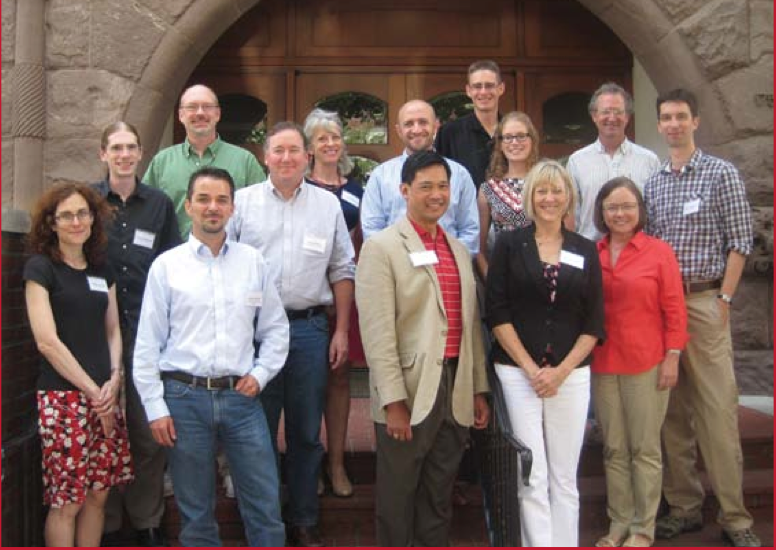
The report was based on discussions with a collection of Human Microbiome Gurus:

And it was written  by Ann Reid and Shannon Greene. It has a variety of useful tidbits and has a reasonable number of caveats – such as “it should be noted, however, that at this point, most studies, even in mice, are looking at correlations between gut microbiome composition and factors like weight, insulin sensitivity, and other metabolic measures.”

#UCDavis encouraging those with the flu to stay home rest and recover

Good to see this. I note – I have a lab policy that anyone who is sick MUST stay home. That forced my home for most of this week despite actually wanting to be in the lab / office for work.

See forwarded email below:

Dear MSOs/CAOs,

Following up on recent news reports about the major flu virus in the Sacramento area, Human Resources has reminded us to please encourage those are sick to please stay home, rest and recover. This will help prevent colleagues and friends from getting the flu.

While it takes about two weeks for the flu shot to work, it is probably not too late to get one since there are least two more months of flu season.

Please circulate this information us as is appropriate in your department/center.

Thanks.

Donna

Donna Watkins Olsson
Executive Assistant Dean

Interesting NSF Funding Opportunity – "Genealogy of Life"

From the web site:

SYNOPSIS
All of comparative biology depends on knowledge of the evolutionary relationships (phylogeny) of living and extinct organisms. In addition, understanding biodiversity and how it changes over time is only possible when Earth’s diversity is organized into a phylogenetic framework. The goals of the Genealogy of Life (GoLife) program are to resolve the phylogenetic history of life and to integrate this genealogical architecture with underlying organismal data. 

The ultimate vision of this program is an open access, universal Genealogy of Life that will provide the comparative framework necessary for testing questions in systematics, evolutionary biology, ecology, and other fields. A further strategic integration of this genealogy of life with data layers from genomic, phenotypic, spatial, ecological and temporal data will produce a grand synthesis of biodiversity and evolutionary sciences. The resulting knowledge infrastructure will enable synthetic research on biological dynamics throughout the history of life on Earth, within current ecosystems, and for predictive modeling of the future evolution of life 

Projects submitted to this program should emphasize increased efficiency in contributing to a complete Genealogy of Life and integration of various types of organismal data with phylogenies. 

This program also seeks to broadly train next generation, integrative phylogenetic biologists, creating the human resource infrastructure and workforce needed to tackle emerging research questions in comparative biology. Projects should train students for diverse careers by exposing them to the multidisciplinary areas of research within the proposal.

Tenure policies not keeping up with the digital revolution

Interesting article in the Chronicle for Higher Education that I was pointed to by Mackenzie Smith:

Digital Humanists: If You Want Tenure, Do Double the Work | Vitae.

The article is by Sydni Dunn – a Staff Reporter at CUE and it discusses a topic of direct relevance the upcoming conference we are hosting here: Publish or perish? The future of academic publishing and careers February 13 – 14, 2013 UC Davis.  The article focuses on some discussions that came up in association with the annual meeting of the MLA – the Modern Language Association.  The discussion was about how to assess scholars in the humanities – especially those who are heavy on the digital side of scholarship.  And the discussion is both scary (to me at least) and fascinating as scholars struggle with how to get their institutions to accept digital scholarship and assess it.

It is definitely worth a read and I note we will have extensive discussions of this general topic at our meeting …


Important new paper on impact of having women as conveners on gender ratio of speakers

There is an important new paper from Arturo Casadevall and  Jo Handelsman: mBiosphere: Scientific meetings: convening committees with at least one woman boost numbers of women speakers. It was published January 7, 2014 in the open access journal mBio. 

Their abstract

We investigated the hypothesis that the gender of conveners at scientific meetings influenced the gender distribution of invited speakers. Analysis of 460 symposia involving 1,845 speakers in two large meetings sponsored by the American Society for Microbiology revealed that having at least one woman member of the convening team correlated with a significantly higher proportion of invited female speakers and reduced the likelihood of an all-male symposium roster. Our results suggest that inclusion of more women as conveners may increase the proportion of women among invited speakers at scientific meetings. 

IMPORTANCE The proportion of women entering scientific careers has increased substantially, but women remain underrepresented in academic ranks. Participation in meetings as a speaker is a factor of great importance for academic advancement. We found that having a woman as a convener greatly increased women’s participation in symposia, suggesting that one mechanism for achieving gender balance at scientific meetings is to involve more women as conveners.

Basically they conclude that having women serve as conveners for sessions and meetings increases the chance that women will be well represented as speakers.

Much of their key findings are shown in Figure 1

From their paper:  FIG 1  Proportion of women speakers as a function of convener gender composition for the years 2011, 2012, and 2013 at the GM and ICAAC meeting. All comparisons were significant at P < 0.05 by Student’s t test

What to do about this? They have some suggestions at the end of the paper

Whatever the mechanism driving the results, practical actions are suggested by the data. The results suggest that an experiment in which at least one woman is included in every team of conveners might increase the proportional representation of women among the speakers at ASM meetings. An alternative might be to explicitly charge conveners with finding speakers who reflect the diversity of microbiologists. These strategies are worth testing. In the process, we might find that our meetings draw on a fuller arc of talent in microbiology and are enriched by increased gender balance. 

This study suggests a simple mechanism for increasing women’s participation in a critical part of a scientific life. Further research should determine whether discriminatory behaviors contribute to the outcomes and whether the outcomes contribute to the loss of women from academic science.

Some press for this article

Some other things I have written about gender ratio in meetings:

New post on ICIS blog about Google Scholar

I have a new post on the ICIS blog about Google Scholar that may be of interest: ICIS: Innovating Communication in Scholarship – Some additional details of my discussion w/ reporter John Bohannon for his Science story on Google Scholar.  The post gives some detail about the discussions I have with John Bohannon in relation to his story that ran in Science today on Google Scholar.

Some additional details of my discussion w/ reporter John Bohannon for his Science story on Google Scholar

There is a story in today’s Science magazine on Google Scholar by John Bohannon.  Entitled “Google Scholar Wins Raves, But Can It Be Trusted” the article discusses some of the pros and cons of using Google Scholar.  The author of the article interviewed me on and off over a few weeks about Google Scholar because I have written multiple blog posts on how I use it.  For example see:

And also a diverse array of posts on Twitter which I will not rehash here.

Anyway – the new article covers some interesting points but is very very short (ahh — the fun with page length restrictions).  So I thought I would post here some of the comments I made about Google Scholar in emails with the reporter.

Bohannon wrote to me on December 1, 2013

Dear Dr. Eisen-

I’m writing a news story for Science about Google Scholar. Have you continued using their article recommendation engine? (I saw your blog post about it from last year.)

(and then he wrote some details about what he was working on which I am not sure he would want me to post here and I have not asked so I am leaving them out)

I’d very much like to hear your thoughts on how Google Scholar has developed, and how well it works as a replacement for traditional library/proprietary/non-open literature databases.

cheers and thanks in advance,
John Bohannon

I wrote back, that same day (unusual for me)

Well, was just hacking around with Google Scholar this AM.

Have you dug into their new function – Scholar Library? I am playing around with it but have not quite figured it out. What I am hoping to do is to figure out how to get recommendations based on lists in the Library. Currently, the recommendation engine has one very very big limitation. It bases recommendations on one’s own publications. And if you are trying to move into a new area – well that is pretty useless.

So – some comments

1. I find the recommendation engine to be very very useful still. One of the best ways to find out about new papers. With the limitation mentioned above.

2. I use automated Google Scholar searches to find all sorts of papers of interest. This helps cover topics more broadly than the recommendation engine.

3. There are other recommendation systems out there – but I have not used them too much.

4. As for “free and open” – I don’t think I would use such terminology here. Yes, Google Scholar is free. But is it open? I don’t think so. For example, I am not sure if they publish / release all their code that works behind the scenes. And I am not sure how open the results are (not saying it is not open – I just don’t know).

5. The citation information is a wonderful tool – and it is great to have this information be freely available. I use it routinely for all sorts of purposes including getting around the massive limitations of IF. One issue however with GS is that it takes citations from ALL sorts of sources including non peer reviewed material and even material that people may not have been aware was even publicly available. So – citation counts are generally higher – sometimes much higher – in GS than with other metrics. I note – I put info for my Citations based on GS on my CV and various other places.

And this allows GS to be seriously gamed in terms of citation counts.

6. GS is still clunky in a few ways and I hope that Google puts more effort into it. It could become THE tool for academic scholarship searches and tracking but it has some bugs and minor annoyances still.

Just some quick thoughts. Let me know if you have any other questions.

Jonathan Eisen


He then wrote back with some questions.  Again, I won’t share the whole email here at this time but I will share the specific questions he asked.  And I then wrote back with some answers

Question:

** Care to share a recent example? Something nicely illustrates its usefulness.

Answer:


Question regarding my comment on other systems

Me: There are other recommendation systems out there –  but I have not used them too much.

Bohannon: ** Are there?  For example?  I should take a gander.

Me: Mendeley has one – called recommended or something like that

Question regarding my comment on free vs. open
Bohannon: Right, good point. Free but not really open. Do you feel like this is a worrying limitation? Is it realistic to make it open?  Or at least, more open?
Me: Well, I am certainly not one to tell others how to run a business.  So I am thankful for any free or open material released / produced by for profits.  But there is a major worry here which is – if we do not know how the system works – we do not know if it is biased or how it can be gamed, etc.  And if it is not fully open then if we invest in making use of it, Google could simply kill it at any time and we would have no source material to use for other purposes.
Question regarding my comment on Impact Factor
Bohannon: What is an example of a massive limitation of IF that GS solves? And I wonder why GS can’t tell the difference between peer-reviewed and non-peer-reviewed sources. I’ll add that to questions below.
Me: GS helps with article level metrics as opposed to journal level metrics like IF.  I can look up citations to all my papers quickly.  And I can track metrics like H index and I10 and others.  IF – being a journal level metric – is not really that informative in my opinion (and that of many others)

Question on other things GS could do:

Bohannon: What do you see as the most important things that need to be fixed before it could really take over?

Me:

1. Transparancy in how it works and it what they are planning
2. Make it open source
3. Ability to create reference collations easily (e.g., like Mendeley or Zotero or CiteULike or Endnote).

Questions for Google

Bohannon: * Any other questions you’d like Google to answer, or features to request?

Me:

Well many features to request.

1. Better hot linking of all authors of a paper. Right now they only seem to link the 1st author to their google scholar page.

2. Better handling of long author lists.

3. Better ability to upload collections exported from other tools.

And many more …

After this Bohannon then wrote me another email with additional questions which I answered, briefly

Bohannon: Questions I should have asked but forgot:
Bohannon: When was the last time you exclusively used paper journals to find articles? (Ever?)
Answer from me:
never – or a very very very long time ago
since I started using email / the web 20+ years ago I have tried to use electronic / digital searches to find papers
Bohannon: What electronic services did you use before GS?
Answer from me:
Pubmed searches of course
And pubmed had some automated email alerts that I used to use
I also used lots of searches of journal web sites
And some journals offered automated searches too
The best thing out there was probably “related articles” in Pubmed
Bohannon: Have you switched entirely to GS?
Answer from me:
No – I still use pubmed searches quite a bit – partly because they are less cluttered than GS searches
I still occasionally search journal web sites but that is rare
And I actually use straight google searches a lot

And then another question

Bohannon: Oh, and when did you start using GS?  And when did it become your main search service?

(Sorry for the shotgun interrogation!)

Answer 1 from me:

heh – I have no idea …

Answer 2 from me:

I note – I think right now Twitter is the best source of information about new papers — far better than GS …

And I looked through my email and found that for a few years I used F1000 automated searches

And then in response to a follow up comment about Twitter from Bohannon I said

Yes, did not say Twitter was fun … but if you follow the right people, they can crowdsource for you all of the right literature better than GS


And then on Dec 6 Bohannon wrote me about visualizations

Hi Jonathan-

We’re sorting out some art for the article about Google Scholar.  I’m thinking that the best option would be a cropped screen shot of one of your Google Scholar automatic article recommendations.  Would you be OK with that?
Do they come as an email or appear in browser? If email, you can just fwd it.  If browser, could you take a screen shot and send it?
The idea is to show people what GS article recommendations look like, using your own experience for a visual.


So I sent a few things including these


Screen Shot 2013-12-06 at 12.09.09 PM


Screen Shot 2013-12-06 at 12.05.40 PM

We had a few other discussions about related topics but I thought it might be useful to see that general gist of the discussion and some of my thoughts on Google Scholar in more detail.  I note, at our meeting in February on the Future of Scholarly Publishing and Careers here at UC Davis Anurag Acharya from Google Scholar will be talking and will be on a discussion panel that will focus broadly on “metrics” for scholars so should be interesting.