Well, have already written a bit about my fun trip to DC on Twitter and Facebook but thought I would sum it up here too. Last week I had to go to DC for a meeting relating to a Department of Homeland Security grant we have in my lab (it was the annual meeting of the program). Of course the point of the whole trip was to present about our work. And for the record – here are the slides for my talk I gave on Wednesday.
But alas, going to give talks is not just about the Science is it? It unfortunately is also about the travel. And boy do I hate travel most of the time these days. Here is a tale of my trip …. I was supposed to go on Monday but had to delay going until Tuesday due to illnesses in the family. So I called United and changed my flight and called the Westin in Alexandria and changed my hotel reservation and emailed the meeting organizers and let them know.
All seemed good. Then Tuesday AM I got an email from United saying my flight had been cancelled and I had been rebooked on another flight. After calling up United and finding out that the seat upgrade using my miles / Premier status was not available I at least confirmed that I would be getting in to DC not too late. And so after lingering at home I headed to the airport and got on the flight from SMF to Houston.
I got to Houston, walked around for a while and eventually made my way to the connection to DC. I went to board and the machine gave the ticket agent an error message saying “Passenger is not ticketed for this flight” or something like that. Great. And I had to leave the line, go to the desk and wait a bit until someone helped me. There I found out that United had somehow cancelled the entire rest of my flight and thus I was not only no longer booked on a flight to DC I had no return flight either. After a painful but brief delay somehow they put me on the connection and I got to DC.
It was after getting the error message that I ended up engaging some social media to express my frustration and I tweeted about United. And eventually the United Twitter handler got back to me and helped me confirm that I did now have a return flight.
Anyway – I moved on past the United issue and got in a cab in DC and headed to the Westin Alexandria. I got there and checked in. Sadly I found out there was no food available anywhere at the hotel (it was only 10:50 PM or so). So I decided to just go up to my room and crash. I went up to my room and – well – was seriously in for a shock. My room was a meeting room of some sort overrun with meeting tables and with a small, rollaway bed smushed up against the wall.

Oh my God. You have got to be kidding me. I have serious trouble sleeping when I travel and am not exactly the smallest guy in the world. A rollaway bed in the middle of a conference room? Uggh. So I called up the front desk and asked
“Is this some sort of mistake. Is there supposed to be a bedroom connected to this room?“
And the person from the desk said “No. That is your room.”
And I said “Well, I can’t sleep on that bed“
And he said “Sorry – we are fully booked – that is all we have.”
And I said, again “Listen, I called yesterday and confirmed my room and told you I was coming late and this is not acceptable. I want a normal bedroom with a normal bed. Nothing fancy. Just a bedroom.“
And he said “OK. I have another room.”
So I said “Can someone bring up the key?“
And he said “No. There is no one else here.“
So I said “OK I will come back down.”
 So I got my stuff and went back down and really wanted to ask “Well, why is there a room now if you told me the room with the rollaway bed was the last room” but I held my tongue. And after a computer malfunction that led to a 5-10 minute wait he gave me a new room key.
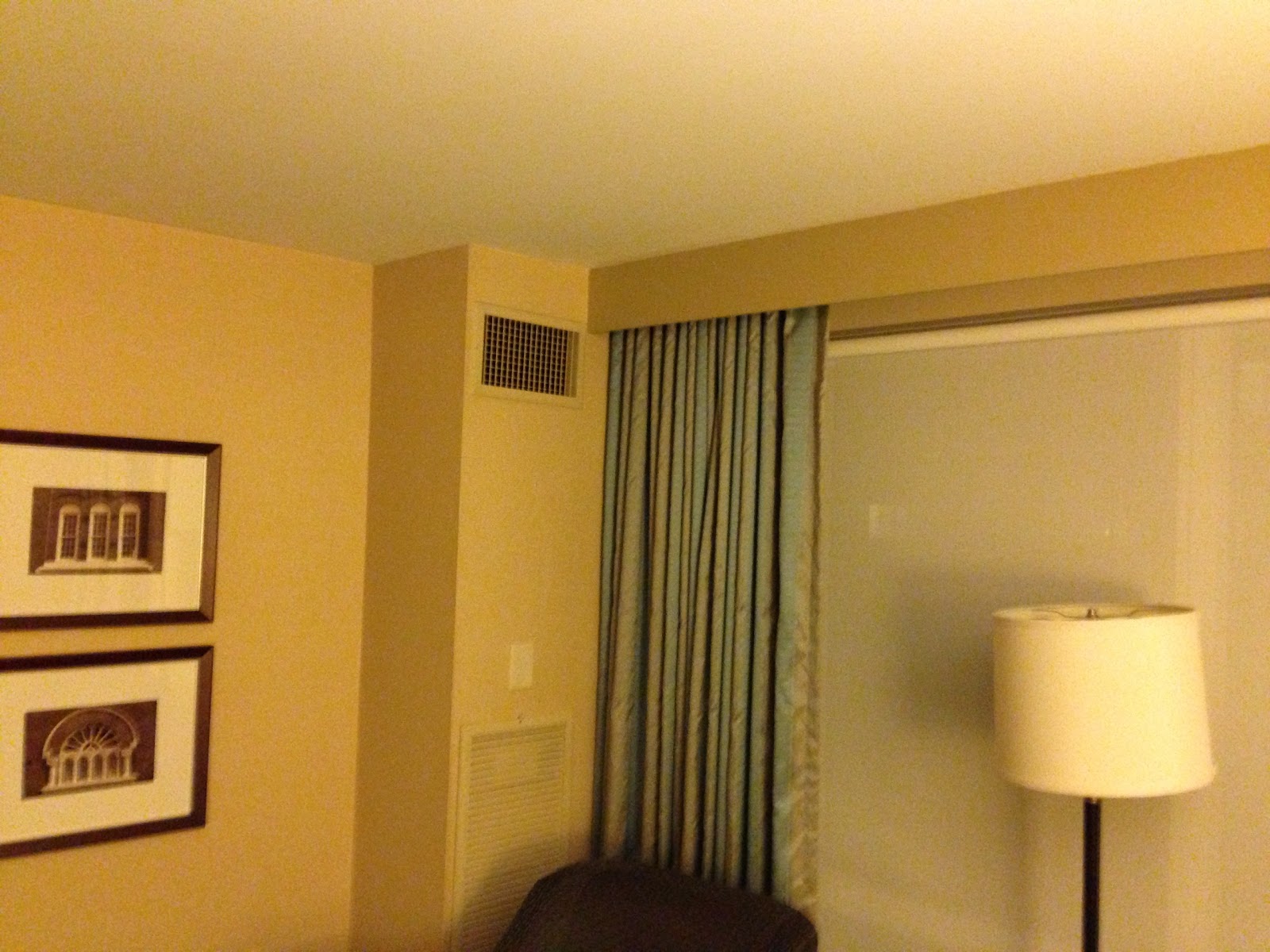
And I was off again. Once there, I opened the door to the room and I knew before even getting into it why they did not give it to me at first. It reeked of cigarette smoke. Like someone had a cigarette testing party in the room. Drowning in smoke smell. I took a pic of the air vents to represent the smell … for what that was worth. So I immediately went to the phone and called the desk again.
Me: “Hey it’s the guy who you just gave a new room to. This room is even worse. Unbearable cigarette smell here. Is this a smoking room?”
“No we don’t have smoking rooms.”
Me: “So did the cleaning crew mark this room as having been smoked in and you gave it to me even though it has not been cleaned yet without telling me?“
Answer “No.”
Me “I need a different room.”
Him: “Ok – let me look. (click click click). OK I have another room“
Me: “Can someone bring the key up?“
Answer: “I don’t think so.”
Me: “OK I will come back down.”
So down I went and finally got a third room.

And this one was OK. Meanwhile I was also positing details of the debacle to Twitter and Facebook. And enjoying (in a theater of the absurd kind of way) some of the responses I got from miscellaneous people and also the communications with the Westin Twitter handler. Here below is a Storify of some of the communications around both the United issue and the Westin issue.
//storify.com/phylogenomics/i-f-ing-love-science-but-f-ing-hate-travel-much-of.js[View the story “I f#ing love science but f#ing hate travel much of the time” on Storify]
But perhaps the most entertaining part were the DM messages from the @Westin person. Here is the thread – copied and pasted from Twitter
- @Westin: 1/2 We do apologize for the inconvenience. We spoke to the hotel and was informed that you have been shifted to another room
- @Westin: 2/2 with a king bed. Please let us or the front desk know if you need any further assistance.
- Me: Third try … Why wouldn’t the cleaning crew inform them of the smoky room? It was awful
- Me: And why would they give me a room with a rollaway as the only bed without saying anything?
- Me: I would like to formally request a free night in exchange for this absurdity
- @Westin: 1/3 We truly apologize for the inconveniences.Your booking was made through a group rate & that was originally the room type booked for you.
- @Westin: 2/3 Unfortunately, we are unable to grant you that request as hotel has accommodated by shifting rooms for you to a king bed. We spoke to
- @Westin: 3/3 the hotel regarding the strong smell next door as there are no smoking rooms at the hotel. Someone will reach out to you in the morning.
- Me: ????- are you saying they booked me a room with a rollaway bed?
- Me: Are you saying the room did not smell of smoke ???
- @Westin: We understand your frustration & do apologize again for the inconvenience. The management team will reach out to you in the morning to
- @Westin: further follow up on your concerns as they are in the best position to address situations. Please feel free to let us know if you require
- @Westin: any additional assistance from our team


And then I had an email exchange with a representative of the Westin Alexandria that ended up being somewhat interesting.
Good Morning Mr. Eisen,
I have received your feedback from our corporate office in regards to your check-in experience last night.
First of all, please allow me to apologize on behalf of my team and the hotel for the inconvenience you went through last night. Our hotel was closed to sold out last night so there were some challenges in the room assignment with the preference of each of our guest.
I also meant to touch base with your directly this morning but I have noticed you have already departed the hotel.
I will go ahead and take care of your night for the inconvenience you went through and it will also be my pleasure to recognize you as a loyal SPG member by giving you a credit of 5,000 SPG Points.
If there is anything further I can assist you with, please feel free to contact me directly. I hope you will choose us again for your future travel plan in Alexandria. When you do so, please let me know so I can review your accommodation.
Once again, my sincere apologies for the inconvenience.
Be Well,
ThomasTHOMAS
POTEAU
Director of Operations
THE WESTIN ALEXANDRIA
400 Courthouse Square, Alexandria, Virginia 22314
Thanks for the email.
I appreciate what you have done. I would very much like to know of you can give me some explanation of what happened – like why was I sent to a room with a rollaway bed with no warning or explanation. And whether the second room I was sent to was empty because of the smoke smell and if so why I was sent there?
Thanks
Jonathan Eisen
Mr Eisen,
In a sold out situation like last night, we review the last arrivals and room assignment and with your SPG status, my front desk supervisor upgraded you to our hospitality suite. Yes this is a room which doesn’t have a permanent bed so we put a rollaway in this room, however this is a much larger room (suite) than our Traditional King. Most of our guests usually don’t mind the situation and actually enjoy the larger room. Since our rollaway beds are heavenly beds like any of our beds, the size of the bed is the only difference and most of the time acceptable with our guests.
That being said, yes, we should have been proactive and contact you to verify the accommodation, informed you during the registration of the situation and being accommodating in taking care of your rate knowing it was an inconvenience for you. My apologies for that, I have addressed it with my team this morning.
As far as the smoking room, again when we only have a couple of rooms available, it becomes much more challenging. The room had been treated for smoke for the last 2 days by the housekeeping team and was turn back to market due to our occupancy level. When our system assigned you that room, the agent didn’t know that room had smoking issue since it was back in his system as an available room.
I personally walked this room this morning and confirm the smell was still very much a discomfort. I have removed the room from our inventory for further treatment.
Once again, I am sorry for the inconvenience and hope you will come back to stay with us again in the near future so I can personally make sure we provide you with the service levels Westin offers.
Be Well
ThomasTHOMAS
POTEAU
Director of Operations
THE WESTIN ALEXANDRIA
Thanks very much for the further explanation. I note – IF someone had said that that was a heavenly bed I might have tried it, but I have extensive experience with rollaway beds because I have two kids. And the rollaways are almost always unusably by me. So perhaps when you inform the people what to do they should say “We only have a rollaway bed BUT it is comfortable and is a Heavenly bed. That might have made everything fine … but without that knowledge I just thought I got screwed …
Jonathan
Thank you. I agree and I will certainly take on the feedback and share with my team so we can better explain it to our guest.
THOMAS
POTEAU
Director of Operations
THE WESTIN ALEXANDRIA
//storify.com/phylogenomics/dhs-talk.js[View the story “DHS talk” on Storify]
I note – the return trip was OK. United let me change my flight to an earlier one. I got home in time to read to my kids before they went to sleep. And other than being exhausted and still a little peeved, I think it went OK.