Eisen Lab Blog

Seminar at #UCDavis – Jeffrey Lawrence “Action of Natural Selection on Pentuplet Codons” 3/21 4 PM

Jeffery G Lawrence

Department of Biological Sciences University of Pittsburgh

Action of Natural Selection on Pentuplet Codons
(in bacteria and yeast)

LSB 1022 4PM

THURSDAY March 21, 2013

Open source software tool for the week: AXIOME: automated exploration of microbial diversity

Just found this paper via Google Scholar Updates:
GigaScience | Abstract | AXIOME: automated exploration of microbial diversity

From Josh Neufeld’s lab this paper describes a series of tools for automation of microbial diversity analyses.

Abstract:
BackgroundAlthough high-throughput sequencing of small subunit rRNA genes has revolutionized our understanding of microbial ecosystems, these technologies generate data at depths that benefit from automated analysis. Here we present AXIOME (Automation, eXtension, and Integration Of Microbial Ecology), a highly flexible and extensible management tool for popular microbial ecology analysis packages that promotes reproducibility and customization in microbial research.
FindingsAXIOME streamlines and manages analysis of small subunit (SSU) rRNA marker data in QIIME and mothur. AXIOME also implements features including the PAired-eND Assembler for Illumina sequences (PANDAseq), non-negative matrix factorization (NMF), multi-response permutation procedures (MRPP), exploring and recovering phylogenetic novelty (SSUnique) and indicator species analysis. AXIOME has a companion graphical user interface (GUI) and is designed to be easily extended to facilitate customized research workflows.
ConclusionsAXIOME is an actively developed, open source project written in Vala and available from GitHub (http://neufeld.github.com/axiome) and as a Debian package. Axiometic, a GUI companion tool is also freely available (http://neufeld.github.com/axiometic). Given that data analysis has become an important bottleneck for microbial ecology studies, the development of user-friendly computational tools remains a high priority. AXIOME represents an important step in this direction by automating multi-step bioinformatic analyses and enabling the customization of procedures to suit the diverse research needs of the microbial ecology community.

Workflows like this are what many many people need.  I note – I have not used this yet but it looks promising.  It has some parallels to the WATERS workflow package that came from my lab a few years ago (see more about it here: https://phylogenomics.wordpress.com/software/waters/.)  Alas WATERS is no longer being actively developed.  Anyway – AXIOME has additional features and certainly seems like it would be useful to many people.

Wanted: examples of family friendly policies for tenure review

I am on a committee at UC Davis that is part of an National Science Foundation “ADVANCE” grant that UC Davis’ Chancellor Linda Katehi and others at UC Davis received last year.  The goal of the project is “increasing the participation of women, especially Latinas, in academic science, technology, engineering and mathematics careers.

More about the UC Davis ADVANCE program

One of the things the committee I am on is charged with is looking into how the policies and practices of tenure review might differentially impact women and minorities.  So – related to that I am writing to ask if people out there have examples of what one might call “family friendly” policies relating to extending the amount of time one is allowed before tenure review occurs.  Some questions I would love answers to for various institutions:

  • What are the policy guidelines for tenure review?
  • Can the tenure clock be extended for family related issues (e.g., birth of a child, adoption of a child, dependent medical care, etc)?
  • What is the specific wording of such policies?
  • How are such policies explained to tenure review committees and letter writers?

For UC Davis here is what I have been able to find (well, with help from the other people on the committee)

I posted a quick request to Twitter earlier.

//platform.twitter.com/widgets.js And got some responses

//platform.twitter.com/widgets.js

Any other information would be great.  I am hoping to make this an “open discussion” of such issues rather than just an internal UC Davis discussion …
//platform.twitter.com/widgets.js

Lab meeting March 19th 2013

We will be having lab meeting tomorrow from 1:30 to 3pm in room 4202 of the genome center.
Russell Neches is presenting.

Where does your autocomplete take you in your web browser A-Z?

Not sure what the basis for this is but when I start typing in a Web address in Safari on my laptop(s), the system attempts to autocomplete the address.  Useful in many cases.  A bit annoying in others.  So I decided to see where autocomplete takes me for each letter of the alphabet.  Not sure how often this changes or that the basis for it is …but it does say something about sites I visit often.  A bit scary that so many of these are from goggle .. but they do run the world I suppose …

A: apple
B: blogger
C: cnn
D: docs.google.com
E: espn
F: facebook
G: google
H: huffington post (no idea where this comes from — don’t remember going to their site recently …)
I: iseem2
J: jawbone.com
K: kayak.com
L: linkedin.com
M: mail.google.com
N: news.google.com
O: opentable.com
P: plus.google.com (a bit surprised P does not go to my blog …)
Q: http://qblog.aaronsw.com
R: reddit.com
S: scholar.google.com
T: twitter.com
U: ucdavis.edu
V: velonews.com
W: www.facebook.com
X: xfinity.com
Y: youtube.com
Z: zooniverse.com

Digging around in National Science Foundation "news" is mostly a lesson in science by press release

Last week I wrote about how the National Science Foundation was involved in a painful press release about microbial genomics and evolution: Ugg – story about gene transfer/evolution based on NSF press release has a NASA-esque smell.  Today after getting some emails from people about this I decided to look to see if this was unusual or just what NSF press releases tend to look like.

I went to this site: News – US National Science Foundation (NSF) and decided to look at the links for stories I might know something about.  Here are some of them – a mix of NSF Press Releases and Links to outside PRs.

Alas most of these have some issues – some more than others.  Going through them one by one

Untangling Life’s Origins.  Link to an outside PR about work supported by NSF.  Not so bad – some painful stuff in the PR like the following:

  • “They are not the standard trees that people see in phylogenetic analysis,” he said. “In phylogenetic analysis, usually the tips of the trees, the leaves, are organisms or microbes. In these, they are entire biological systems.”
  • But overall reasonably tolerable compared to the others.
Home Toxic Home.  Link to an outside PR.  Filled with really painful stuff. Some examples
  • Most organisms would die in the volcanic sulfur pools of Yellowstone and Mount Etna. Robust simple algae call it home, and their secrets to survival could advance human medicine and bioremediation. ”  Everything could advance human medicine and just about any other topic if you stretch it.  And it is a big stretch to find any connections here.
  • “Michael Garavito, Michigan State University professor of biochemistry and molecular biology was part of a research team that revealed how primitive red algae use horizontal gene transfer, in essence stealing useful genes from other organisms to evolve and thrive in harsh environments. ”  Ahh.  Back to the same general story that got me riled up to begin with.  This also has the fun “primitive” reference for algae which are not in any obvious way primitive. 
  • The algae’s membrane proteins are biologically quite interesting because they’re receptors and transporters, the same classes of proteins that play key roles in energy metabolism and human immune response,” said Garavito. “This has applications in human medicine because virtually all of the important pathways that contribute to disease treatment involve membrane proteins.” So let me get this straight.  The algae has membrane transporters and receptors.  And therefore it is relevant to studies of human disease because many diseases are due to problems in transporters and receptors.  So – what organism on the planet then would not be relevant?  Uggh. 
  • They then clarify “What makes the algae’s membrane proteins attractive as a model for humans is their robustness. Other traditional candidates, such as yeast, insect cell cultures and slime mold, are fragile. The algae give researchers extra time to manipulate and examine their membrane proteins.”  Oh.  I see.  So nobody has ever thought of this before.  No work has ever been done on organisms that are “robust” as a model system.  Like – say – thermophiles?  Wouldn’t that be cool (or hot) to work on.  
  • There is more. I will not cover it.
Genetic Study of House Dust Mites Demonstrates Reversible Evolution.  Outside PR that is just completely full of crap.
  • A few days ago I posted about this to Facebook and to Twitter.  
  • And it still riles me up.  Some lines to treasure:
  • In evolutionary biology, there is a deeply rooted supposition that you can’t go home again: Once an organism has evolved specialized traits, it can’t return to the lifestyle of its ancestors. 
How to Thrive in Battery Acid and Among Toxic Metals.  This is the specific PR that got me riled up to begin with.  Awful.
“True Grit” Erodes Assumptions About Evolution.  Actually this one seems OK.

While most of what I looked at that seemed painful was from outside groups – I wonder whether NSF does any screening of outside press releases before posting them to their News site.  Given how bad some of the NSFs press releases are I am not so sure how they deal with outside PR.  But why aren’t they linking to actual news stories by real journalists?  Instead they simply link to PRs from groups supported by NSF.  Yuck.

Updates about the Undergraduate Research Conference

Hello Everyone,

I have a few updates with regard to the Undergraduate Research Conference.

The abstract that I turned in originally had a few mistakes, so I made sure to contact the Undergraduate Research office at the Student Community Center. Initially, they said that they wouldn’t allow any corrections upon submission of the abstract, but I was slightly insistent, so they agreed.

The updated abstract has been developed after considering everyone’s inputs and modifying the original abstract as necessary. As of now, it reads as below:

Aquarium Biogeography and Succession of Microbial Communities in Aquatic Environments

The biological sciences teaching laboratory for UC Davis maintains a wide variety of large aquaria, including freshwater and marine tanks, designed to mimic both temperate and tropical ecosystems. In this study, we seek to better understand the biogeography of microbial communities associated with these tanks. Using a culture-independent, DNA-based community census approach (i.e., 16S rRNA PCR surveys), we tackle two main questions: 1) how do microbial communities vary with respect to various environmental parameters (temperature, salinity, pH, oxygen and nitrogen concentrations) both within and across tanks; and 2) how does the structure of microbial communities change in response to ecosystem disturbance. To address this second question, we coincided our data collection with the establishment of two new aquarium systems (coral ponds).  We use high-throughput DNA sequencing of the 16S rRNA gene to generate a microbial community profile from hundreds of samples. These microbial community profiles are then compared across tanks (marine vs. fresh water, warm vs. cold) and in response to disturbances introduced during the establishment of the coral ponds.

I hope this acts as an almost accurate summary of what we are doing. The abstract was accepted, reviewed and approved by the URC people, so we are all set as far as that is concerned.

I need to also come up with a poster to represent our lab and the kind of work we do, and I get access to free poster printing services for that, so yay! This work is going to start next quarter, and I’m hoping that some of you will pitch in and help me out to make a good job of it and represent our lab in the way it deserves to be showcased. Also, I don’t know if others are allowed to co-present with me. If you are interested, do contact the URC office, I think it’s a great opportunity.

I attended the mandatory meeting for all participants of the conference. It was hosted by Tammy Hoyer of the Undergraduate Research Office today. It was pretty informative in the sense it gave me information on all the resources that were made available to me and what I could expect at the Undergraduate Research Conference.

Also, Tammy mentioned about the Undergraduate Research Journal, Explorations. They are currently taking papers, and I believe the deadline is 6th June, if I heard correctly. I know we wouldn’t have completed all of our research by then, but just letting you know of the opportunity.

Well, that’s all for now.

Also, starting next quarter, I will try my best to do the 8 hour a week thing, will be coming in on Mondays and Fridays, a 4+4. I hope to work with most of you during that time.

Good luck for finals!

YAGGP? – Yet another gratuitous genomics plot?

After my talk at Future of Genomic Medicine 2013 meeting last week a few people asked if I would post these slides on my blog. So here they are:

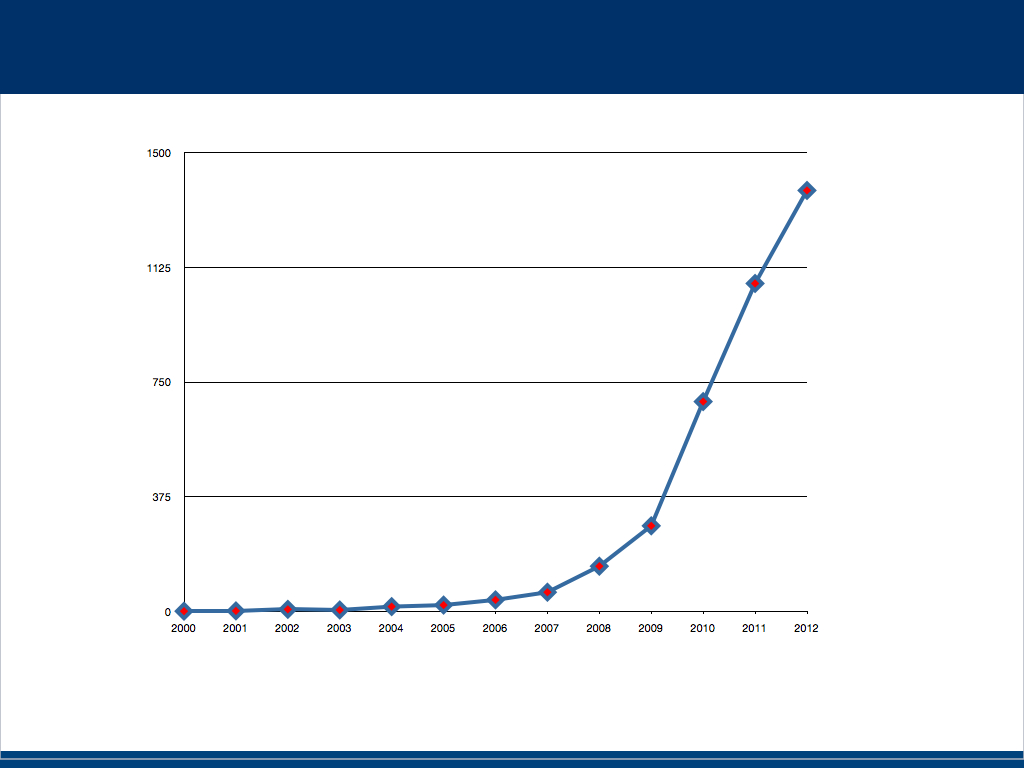
As part of my talk last week I started off showing this slide:

Such figures are part of many genomics talks 

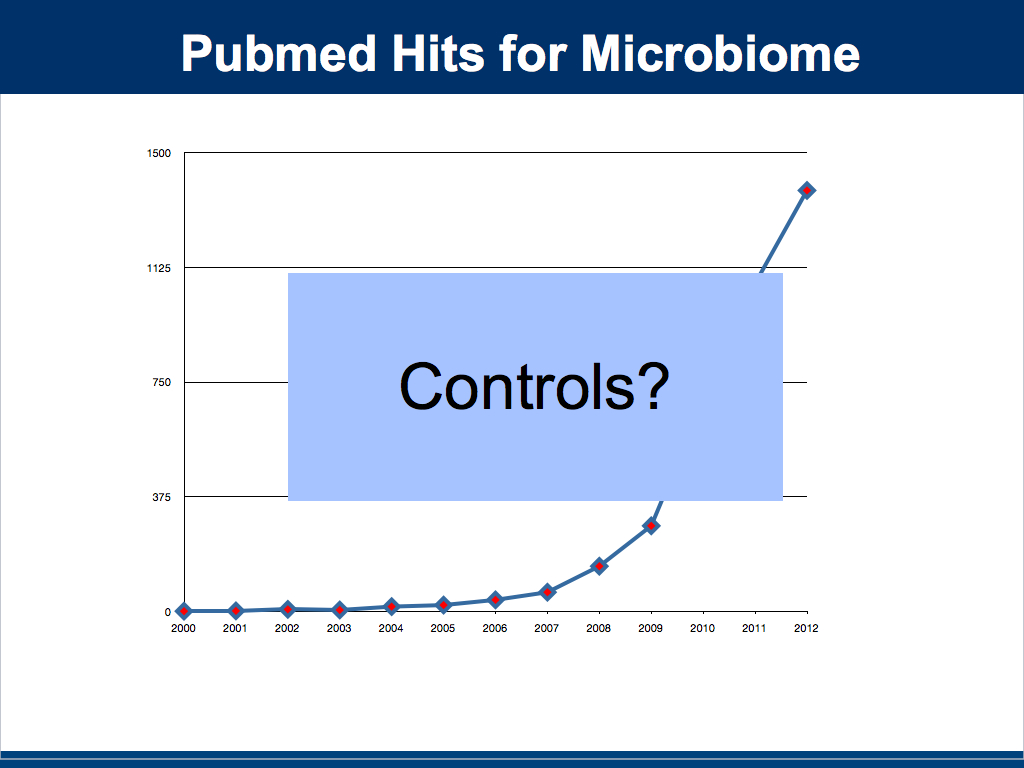
But this was not about sequencing growth / improvements.  Instead it was about hits for the word “microbiome” in Pubmed.

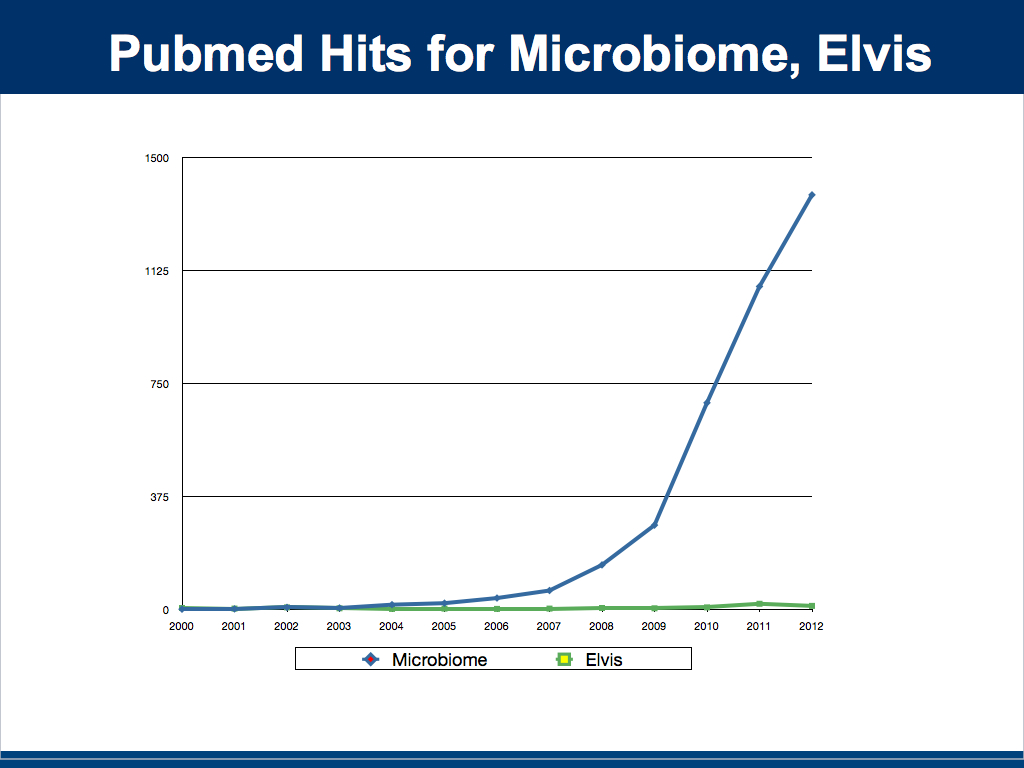
Of course, there are more papers today than ever so it is important to do some sort of control search.  

So I chose to search for “Elvis” in an homage to an old story on protein sequences:

The results clearly prove that studies of the microbiome are on the rise …

Sign up: SMBE Satellite Mtg. on Eukaryotic-Omics 4/29-5/2 at #UCDavis

Going to be good:

Eukaryotes | SMBE Satellite Meeting on Eukaryotic -Omics – April 29 to May 2, UC Davis Conference Center

No bias here – given that it is organized by Holly Bik in my lab and it is at UC Davis. The lineup of speakers is great and the topic is timely.  So sign up  …

Speakers:

Rachel Adams UC Berkeley Groundtruthing next-gen sequencing for microbial ecology: is beta diversity robust to errors in pyrosequencing?
Nicholas A. Bokulich UC Davis Regional Patterns in Grape Fungal Consortia Define Wine Fermentation Communities
Sara Branco UC Berkeley Fungi at a small-scale: spatial zonation of fungal assemblages around single trees
C. Titus Brown Michigan State University Sequencing and assembly of diverse eukaryotes: like metagenomics, but much harder
Peter Countway Bigelow Laboratory for Ocean Sciences Title TBA
Simon Creer Bangor University, Wales Title TBA
Tom Delmont Marine Biological Laboratory, Woods Hole Phaeocystis antarctica spatiotemporal diversity, activity and its relation to prokaryotes and viruses using physiological and ‘omic approaches
Jonathan Eisen UC Davis The need for a phylogeny driven genomic encyclopedia of eukaryotes
Laura Eme Dalhousie University Large scale phylogenomic analyses of Blastocystis subtype 1 reveals a major role for lateral gene transfer in adaptation to parasitism of the human gut
Jack Gilbert Argonne National Lab Addressing microbial eukaryotic biogeography in home, hospitals and the world
Jean-David Grattepanche Smith College Title TBA
Victor Hanson-Smith UC San Francisco Identifying Loci of Functional Evolution in Ancestral Genes
Ian King University of Guelph Biomonitoring 2.0: A high-throughput genomics approach for comprehensive biological assessment of environmental change
Andrew Krohn Northern Arizona University Rhizosphere microbial community dynamics of drought-stressed pinyon pines (Poster)
Franck Lejzerowicz University of Geneva Exploring the deep-sea foraminiferal diversity by multiplexed RNA and DNA-based ultra-deep sequencing and ultra-fast bioinformatic analyses
Matthew Morgan CSIRO Australia Next-generation sequencing reveals the impacts of inundation and drought on eukaryote biodiversity in semi-arid floodplain soils
Laura Wegener Parfrey University of Colorado, Boulder Incorporating microbial eukaryotes into analyses of the human microbiome
Katherine Pollard UC San Francisco Title TBA
Dorota Porazinska University of Florida Discrimination of microscopic pests of agricultural importance with NGS
Thomas Richards NHM London Title TBA
Surya Saha Cornell University Composition of the Maize Endophytic Microbiome is Correlated with Maize Genotype (Poster)
Søren Sørensen University of Copenhagen Title TBA
Fabian Staubach Stanford University Host species and environmental effects on bacterial communities associated with Drosophila in the laboratory and in the natural environment
Sarah Stephenson CSIRO Australia Metagenetic examinations of benthic eukaryl estuarine communities
Joshua Stern Georgia Institute of Technology Searching for the Phylogenetic Place of Eukaryotes, Using Data from STORI
W. Kelley Thomas University of New Hampshire Title TBA
Xianfa Xie Virginia State University Comparative genomic study of the origin and evolution of eukaryotes

UC Davis Symposium on “The Analysis of Complex and Massive Data”; Saturday, April 13

Forwarding this:

Colleagues,

We would like to invite you to the interdisciplinary symposium on

“Analysis of Complex and Massive Data”

that the Department of Statistics is hosting on Saturday, April 13, here at

the UC Davis campus.

Below is the official announcement that was distributed via other mailing lists
recently. (Apologies for cross-posting.)

More information can be found at http://www.stat.ucdavis.edu/symposium2013/.