
On the PLOS Biologue (the blog for PLOS Biology) I have a post that may be of interest. I discuss our efforts to increase the diversity of the people involved in the various Boards of PLOS Biology. This is my first task I have taken as the Chair of the PLOS Biology Advisory Board. See the post: Working to increase diversity of PLOS Biology Academic Editors and Advisory Board members.
Eisen Lab Blog

Lab meeting Tuesday, Jan 22nd 2013
We will be having lab meeting on Tuesday from 1:30 to 3:00pm at the genome center in room 4202.
Russell Neches is presenting.
Share this:
Back in business
We’ve been sampling every day for Coral Ponds 1 and 2. We are up to almost 500 samples… which means we have a lot of DNA extractions to do.
I’ve noticed a few things in the last month. The coral used to be white, but now it is covered with a reddish algae. This is good because clearly things are changing, which is what this study is about! If macroscopic things (for example, the visible algae) are changing, then the microscopic things (microbial community) are most definitely changing as well!
On a side note, Matt and I discovered the time it took for a full round of sampling at maximum efficiency. With water filtering being the rate limiting step of our sampling process, we focused on wasting no time with the filtering. By this I mean, we had the next liter of water ready to go instantly after the current liter was done filtering. We also set a timer to remind us to keep adding water to the filter. Out of curiosity, I timed our last filtration and it took 17 minutes and 30 seconds. Overall we were able to complete the sampling in about 1 hour and 50 minutes. Being the mathematician that I am (just kidding), I assumed each filtration (6 total) took about 17 minutes and 30 seconds and calculated the time that water was not being filtered from the time we started to the time we finished: 5 minutes! I’d we were pretty productive.
Share this:
Progress Report
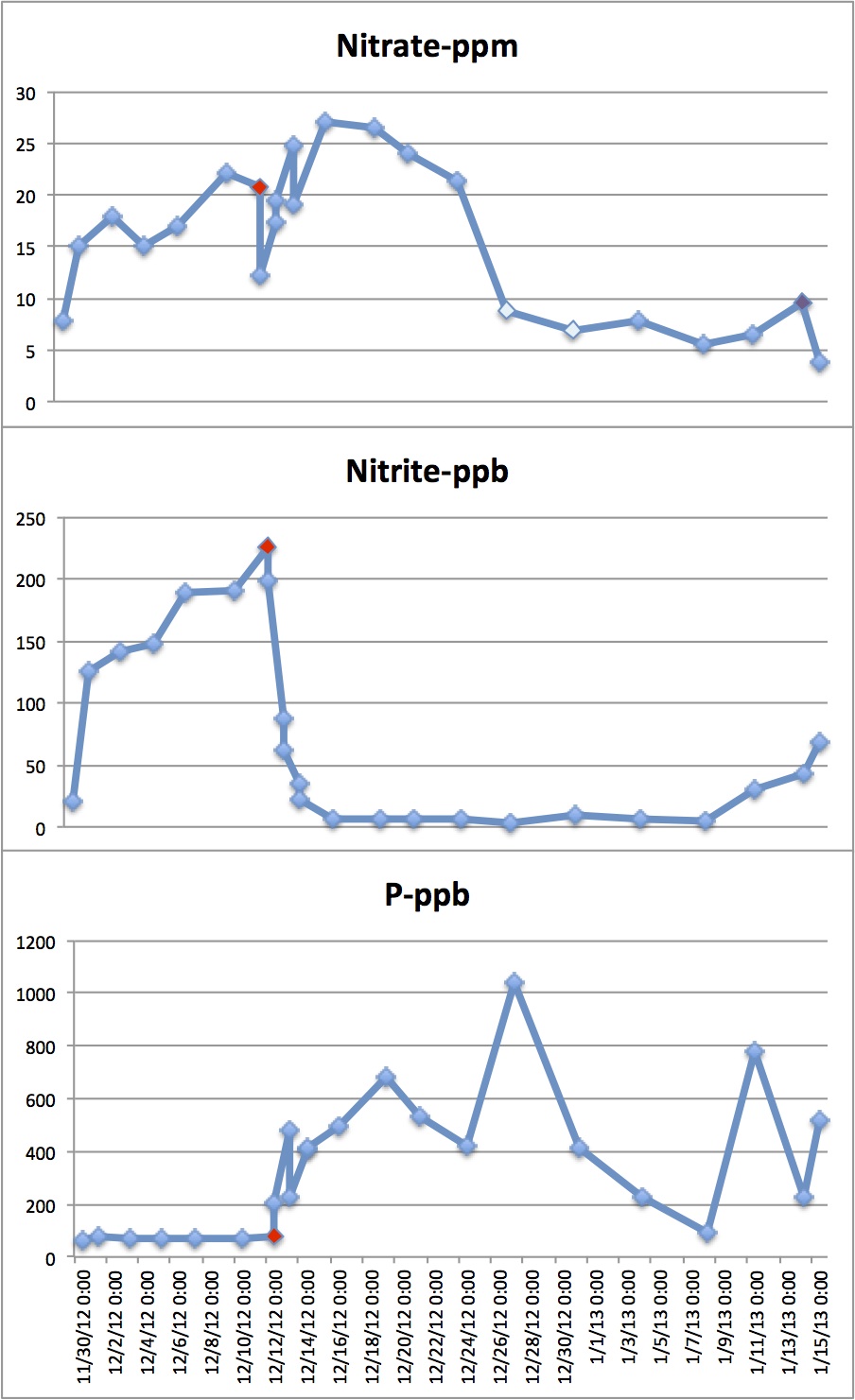 The first coral pond has been running for 49 days now. We have followed them through their initial construction, the inoculation from an established coral tank and now the addition of live rock so that more corals can be added. Our collection of over 400 samples is continuing to grow and we are seeing nice trends in our water chemistry parameters. We are excited to start looking at the DNA and have been extracting a number of samples.
Here is a quick look at coral pond one. I believe David has already shown some of this data. The red dot is the time point when we inoculated the coral ponds with microbes from an established coral reef tank.
Share this:

Evolutionary Biology of the Built Environment Working Group: Call for Participants
Call for participants: Evolutionary Biology of the Built Environment Working Group. Details copied from the announcement pasted below:
The Basics: We need your help. We are organizing the first working group aimed at understanding the evolutionary biology of the built environment—our bedrooms, our houses, our backyards and our cities. This working group will occur June 10 – 14, 2013, in Durham, North Carolina. We are now inviting applications for participants in the working group.
Why: As recently as one hundred thousand years ago the indoor environment did not exist. Yet, this is now where most humans spend the majority of their life. One might imagine that in its relatively short history the built environment might have had time to accumulate very few species. Far from the case, an emerging body of literature shows that hundreds of multicellular species and thousands of unicellular species can be found in houses and buildings more generally. Among the species found in homes are those whose presence (or absence) is likely to have a large impact on human health and well-being, species including beneficial microbiota on the body but also pathogens and potential pathogens or toxic species such as extremophilic fungi. Yet, with the exception of a few deadly pathogens (such as MRSA), the evolutionary history of most of the species with which we most intimately interact in our homes remains unknown. To remedy our lack of knowledge and take advantage of recent advances in disparate fields we will bring together scientists studying both the fauna (microbiologists, entomologists, mammalogists, and any other -ologists you can convince us have some bearing on house biomes) and environment (engineers, architects) along with social scientists (anthropologists) and evolutionary biologists (e.g. theoreticians, bioinformaticians, geneticists) to begin to build a framework for the evolution of the indoor and more generally built biome. Our goal is to develop a framework for a comprehensive understanding of the evolution of the species we most intimately interact with, particularly in the context of considering how to build and design our environments so as to favor beneficial (rather than dangerous) evolutionary trajectories. We aim to understand both how to prevent the extinction of beneficial species and to favor the evolution of lineages and species with beneficial attributes, whether those be ecological functions, health benefits or simply aesthetic value.
Who: We’d like to convene a diverse group of scientists and practitioners at various stages in their careers, from graduate students and post-docs to senior scientists, representing an array of disciplines including the organismal -ologies (e.g. microbiology, entomology, etc.), engineering, architecture, anthropology, evolution, genetics, bioinformatics, art and design. We want to be inclusive of any field that you can convince us has something to bear on studying evolution in the built environment.
How: We are currently accepting applications to be part of this working group. If you are interested, you can apply online apply online here, but do so soon. We will select a group of 30 scholars and practitioners from the applicant pool who will meet in Durham with the goal of producing a series of general audience and peer-reviewed publications about the evolutionary biology of the built environment.
Sponsored by a partnership between the Sloan Foundation and the National Evolutionary Synthesis Center.
Have questions? Drop us a note at yourwildlife@gmail.com.
Share this:
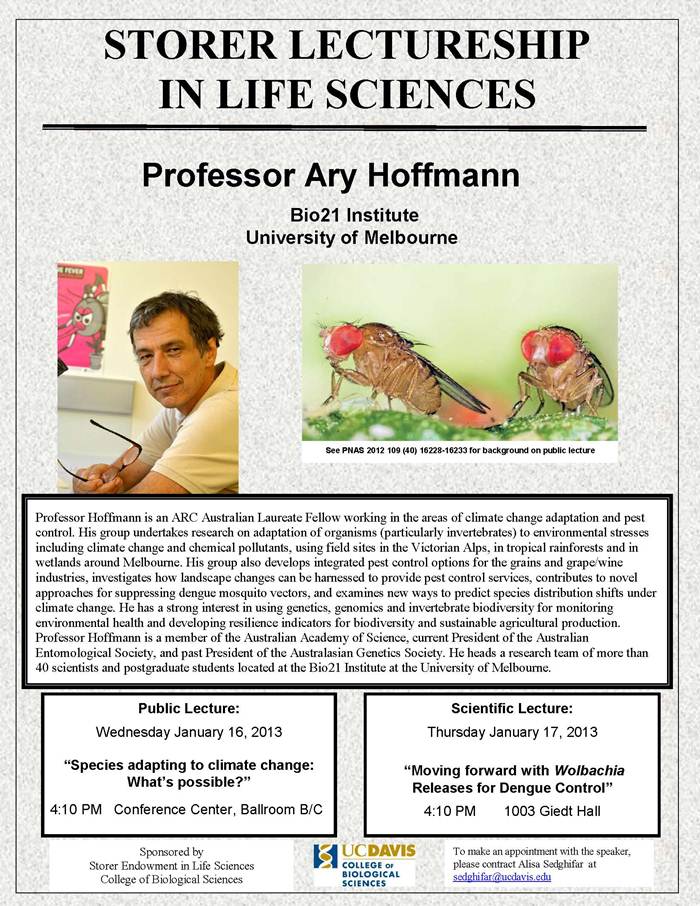
At #UCDavis: Ary Hoffmann-1/16-17th Climate change, Dengue, Wolbachia and more

Phyloseminar: ""Language phylogenies and cultural evolution" Online 1/16 2 PM PST
“Language phylogenies and cultural evolution”
“Charles Darwin famously noted that there were many curious parallels between the evolution of species and languages. Since then evolutionary biology and historical linguistics have used trees to conceptualise evolution. However, whilst evolutionary biology developed the vast discipline of phylogenetic methods, linguistics dabbled with computational methods before rejecting them. The last decade or so has seen the introduction of phylogenetic methods into linguistics, often with some startling results. In this talk I will present some of these studies, and discuss how phylogenetics can help us grapple with the problems of linguistic and cultural evolution. These problems range from testing population dispersal hypotheses, to investigating the shape of cultural evolution, to inferring the rates at which languages change.
West Coast USA:14:00 (02:00 PM) on Wednesday, January 16
East Coast USA:17:00 (05:00 PM) on Wednesday, January 16
UK:22:00 (10:00 PM) on Wednesday, January 16
France:23:00 (11:00 PM) on Wednesday, January 16
Japan:07:00 (07:00 AM) on Thursday, January 17
New Zealand:11:00 (11:00 AM) on Thursday, January 17
Share this:
Today at #UCDavis: The True Cost of Oil talk by Garth Lenz
Forwarding this:
This is a final reminder about the awesome opportunity you have to see the talk by Garth Lenz TODAY, Tuesday, Jan 15th at 5:10pm.
Garth Lenz <
> on these issues and his work, and will be visiting UC Davis to share a slideshow of his photos and talk to us about this important environmental issue. It is a pertinent topic, as the country moves toward a final decision about the XL pipeline which would drive the expansion of the mining operations in the Tar Sands. And hearing this story from a world-renown photojournalist like Garth is truly a unique opportunity.His talk is being sponsored by the Society for Conservation Biology, Davis and the Geology Students. It is titled “The True Cost of Oil: Images of Beauty and Devastation”
Join us on TODAY, Jan 15th at 5pm in 2 Wellman Hall to see his presentation. Free admission to students and the public.
Please bring your own coffee cup if you can!
Garth Lenz poster with UCD.pdf
Share this:
Lab meeting Jan 15th 2013
We will be having lab meeting from 1:30 to 3pm in the Genome Center, room 4202.
Jenna Morgan Lang is presenting.
Share this:
10 things you can do to REALLY support #OpenAccess #PDFTribute
I wrote a post earlier today in relation to the #PDFTribute movement: Ten simple ways to share PDFs of your papers #PDFtribute. I wrote it largely to give people an outlet and information and ideas about how to better share PDFs of their academic work. I think the more people share the better.
However, I also got shit from my brother Michael – co founder of PLoS on Twitter about how this is partly a “feel good” action. I do think he underestimates the surge of anger over the death of Aaron Swartz and the momentum right now in the semi-civil disobedience being seen in the #PDFTribute movement. But I also think he is right in part. So, I thought I would follow up with suggestions for what people should do in the future to really support full and open access to the academic literature.
- Only publish in fully open access journals. See DOAJ — Directory of Open Access Journals.
- Do not do ANY work for non open access journals. That includes reviewing, suggesting reviewers, etc.
- Cancel all subscriptions to closed access journals. The subscription model is part of the problem.
- Work for open access journals.
- Embrace openness in other aspects of your academic work. See for example Open science – Wikipedia, the free encyclopedia and Open Humanities Alliance
- Learn the difference between “open” and “freely available.” See Peter Suber, Open Access Overview (definition, introduction) and Open Access | PLOS
- Reward people in job hiring, merits and promotions for their level of openness. Do not reward them for closed activities.
- Lobby for more open access requirements at the Federal, State, and Institutional level. Make sure they are not mealy mouthed or mediocre. See What the UC “open access” policy should say for example.
- Embrace other changes in scientific publishing such as post-publication review that enable more rapid sharing of publications (see The Glacial Pace of Change in Scientific Publishing).
- Read up on what else you can do (e.g., Peter Suber, What you can do to promote open access) and come up with your own ideas. Oh and share them. Openly.
Related posts from The Tree of Life
Other ideas? Please post in comments.


