For more information see these stories
- Robosquirrels versus rattlesnakes (UC Davis news)
- One Per Cent: Robosquirrel vs rattlesnake in head-to-head battle (New Scientist)
- Robosquirrels help with study of rattlesnakes (GizMag)

For more information see these stories
Congratulation to her on being named the L’Oreal-UNESCO 2012 Laureate for Women in Science in North America. Below is a little YouTube Video about her in relation to this award:
Also Pam Ronald has written a wonderful story about her at her “Tomorrow’s Table” Blog.
Also check out her awesome Ted talk:
Bonnie Bassler rocks.

DIY Science & Citizen Science & Open Science all rolled into one -PLOTS is coming to Davis, CA & UC Davis. See Davis – publiclaboratory.org for more information.
I really love this world of sharing and openness in science. Here is a video of Carl Zimmer’s Keynote talk from the DOE Joint Genome Institute User meeting.
I note – before his talk I took Carl out to lunch. Since of course I cannot do anything in a standard way, I bought some sandwiches and some drinks and snacks and took him to the top of Mt. Diablo which is nearby Walnut Creek. Alas, it took a LONG time to drive up to the top and it was very very windy. And as I started to get a bit queasy from all the turns I think Carl probably was wondering what I was doing. But the view from the top was nice (even though the firggin’ visitor center and their nice viewing area was closed). We did see some snow which was also nice.
And then we headed back down, down, down, down, down. So- I am telling you this because we got back about 1.5 hours before his talk so he did not have much time to recover from the long and windy road. And yet, I loved his talk.
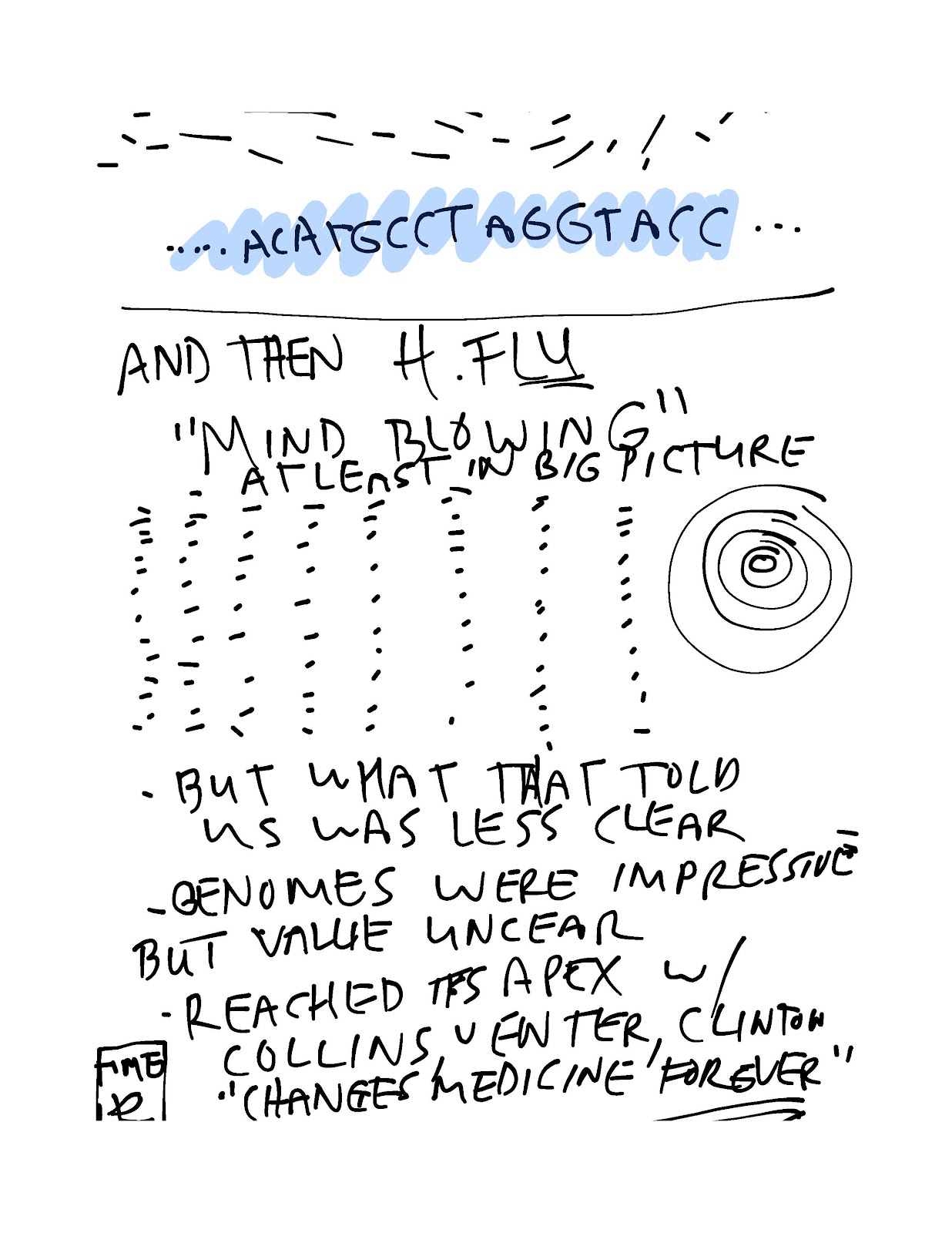
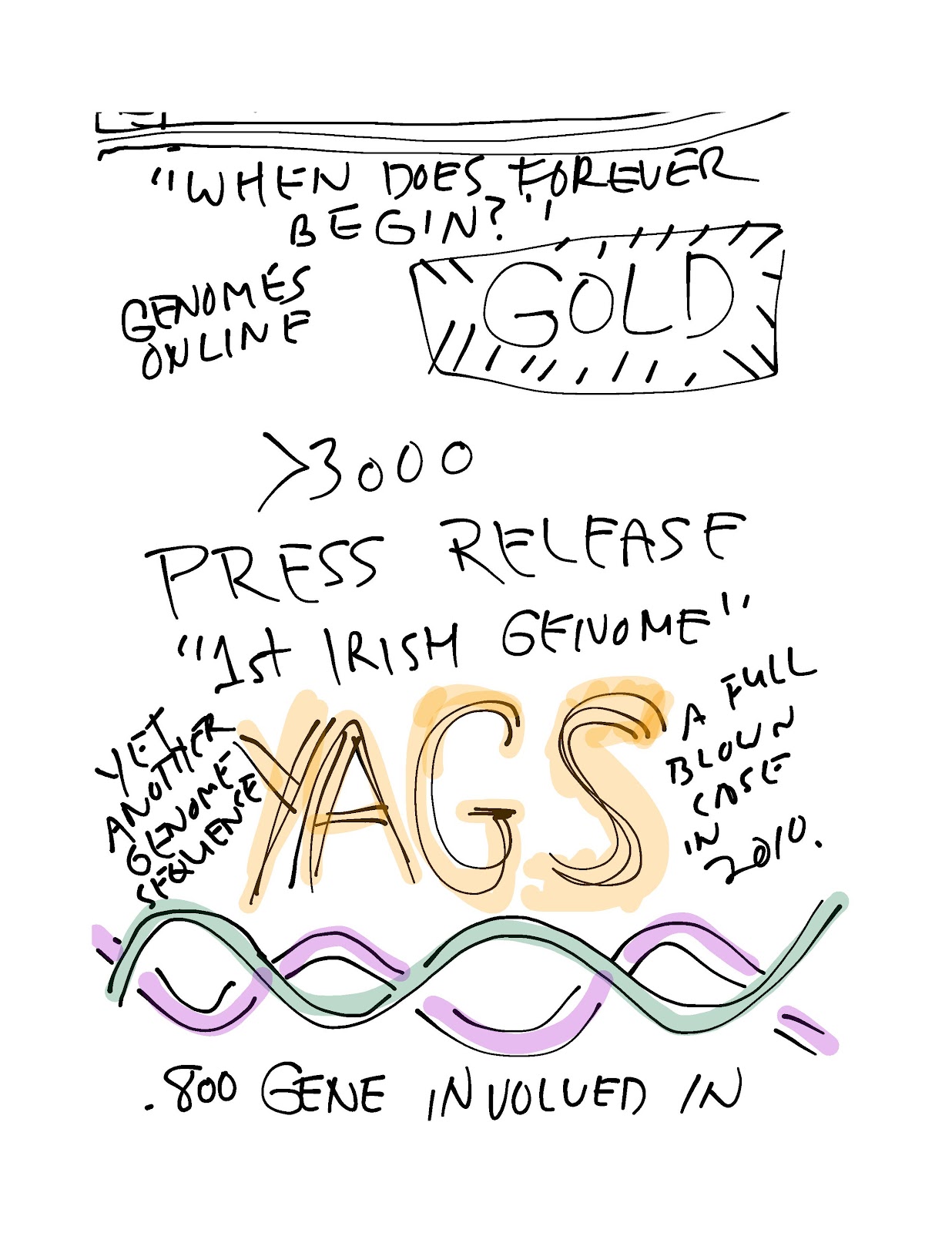
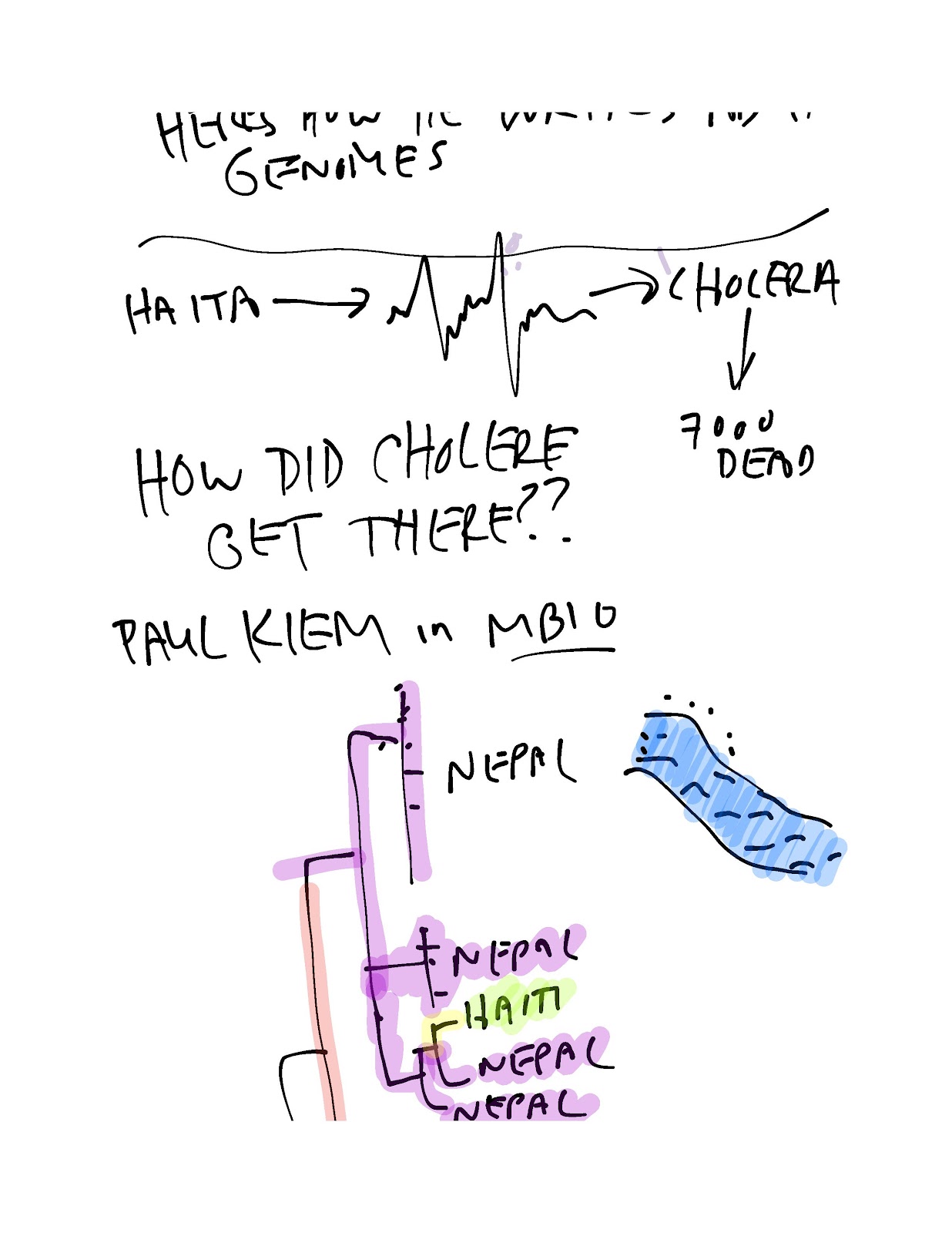
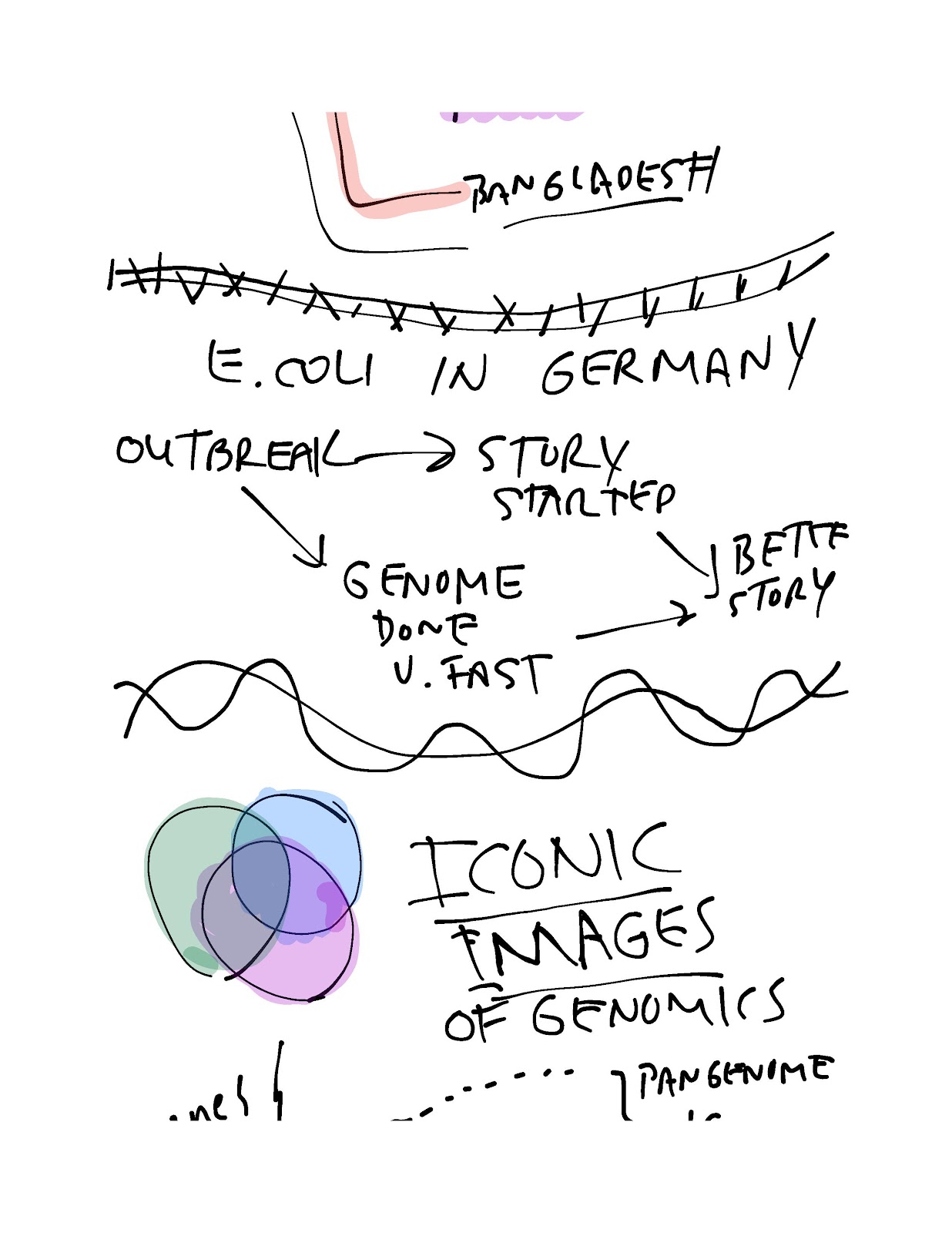
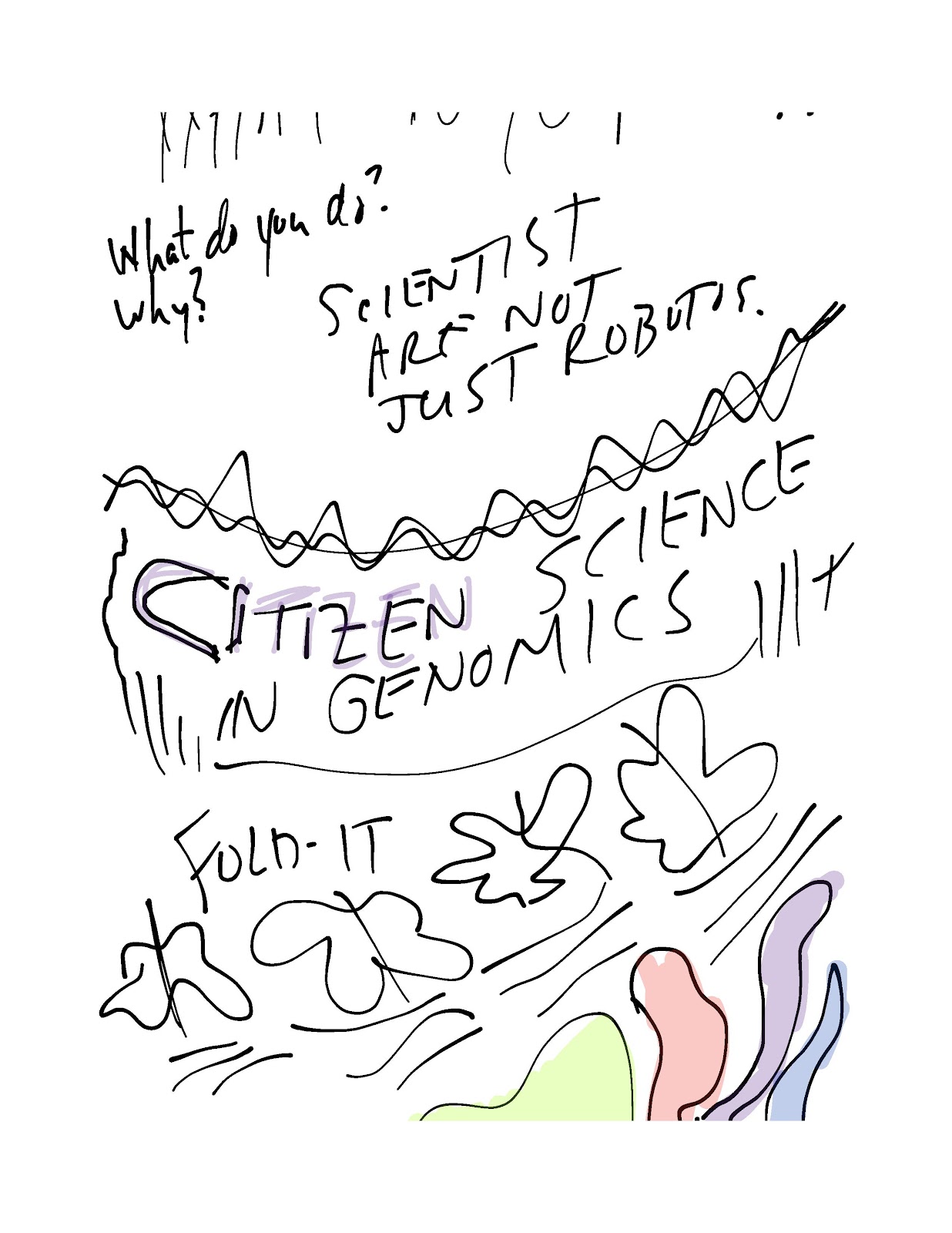
For his talk I took “visual” notes using my iPad. I made these using Notability and then it exports as a PDF which was awkward and then I took that an converted to JPGs since Blogger won’t deal with PDFs.







 |
| From here. |
Guest Post Today from Claudiu Bandea .
Claudiu wrote to me after my paper on “Stalking the Fourth Domain” came out.
He wrote
Jonathan,
I posted a comment on your ‘PLoSOne paper’ blog, but I thought of sending you this mail.
You might be interested in taking a look at the attached paper presenting a fusion model for the origin of ‘ancestral viruses’ from parasitic or symbiotic cellular species, and its implication for the evolution of viruses and cellular domains, which I’m attaching here (you can see the entire series, including comments, at: http://precedings.nature.com/documents/3886/version/1). Possibly, the novel sequences you discovered belong to such ‘transitional forms’ between the cellular domains and the viral domains.
I know it’s a lot of material, but you might want to focus on Fig. 4 and the related discussion about TOLs from the perspective of the current hypotheses on origin and evolution of viruses. Because of your interest in TOL, I want to ask your thoughts on the difference between the concept of TOL based on the line-of-descent, the ways it was historically intended, and the current approaches of using (mostly) sequences which, as you know, due to LGT might not necessarily reflect the line-of-descent relationships.
Best,
Claudiu
After a bit of a back and forth I offered to let him write a guest post on my blog about this. He accepted my offer. I note – I am not endorsing any of his ideas here and to be honest I have not read his papers he refers to – I have skimmed them and the seem interesting but have not had a chance to read them. I also note – I am a bit uncomfortable with the fact that I cannot seem to find any Web Profile / Web Site / Blog / etc. with more detail about him and his work. On one hand – ideas are ideas and they can and should stand on their own. On the other hand context is useful in many cases and I feel like I am missing some context here. He works at the CDC but I am not sure what he actually does there. But in the interest of open discussion of ideas and since, well, not having a web site is certainly not a crime, his post is below.
The most efficient way of silencing ideas is not by criticizing them but by pretending they don’t exist. The antidote might be the blogging world.
A couple of decades ago, I published a novel model on the evolutionary origin of ancestral viral lineages. Recently, I updated this model and integrated it into an ambitious unifying scenario on the origin and evolution of cellular and viral domains, including the origin of life; well, that might have just buried it so deep that it’s gone for good even for those with an open mind and noble intentions.
So, I would like to ask you the favor of reviewing and criticizing this model. As a primer, you might want to read a comment I posted last summer on a book review by Robin Weiss. The book was Carl Zimmer’s A Planet of Viruses and the review by Dr. Weiss, one of the most distinguished contemporary virologists, was entitled Potent Tiny Packages, which symbolizes our century-long perspective on the nature of viruses as virus particles. If we have reasons to call Earth a planet of viruses, as I think Carl successfully made the point, then viruses require our full attention, including the right to be correctly identified and to be included in the Tree of Life.
I know, this is a lot of material, but I hope you’ll find it interesting, and I would be thrilled to address your questions and listen to your ideas.
So – I have this friend who is in need of help. Suppose you have a collaborator who, well, it is just not working out with. At one point you were sympatico. You were friends with scientific benefits (i.e., you worked together well and were friend too). (No it is not you dear reader – it is someone else). What do you do now? How does one break off a relationship with a collaborator. You might be Co-PIs on a project. You might share students. Or you might study the same system. You might share space or equipment or jointly run some project. But now you just can’t bear the sight of them.
But the problem is – they still love you. And they don’t know how you feel. What do you do? How do you break off the relationships when there is no “unfriend” or “unfollow button”? I don’t know (really, it has never happened to me, I swear and no it is NOT you dear reader).
I have looked for an Ann Landers or Dear Abby for scientists but have no found one. So perhaps we need a new blog or site for people to “break up” as collaborators. Something like IBreakUp or one of these other services. But I think de-collaborating is more complex – more like a divorce than a breakup. Anyone out there know of services to help scientists de-friend a collaborator? Anyone know of stories where someone had to do this and it became complicated? Please post – I have even opened up anonymous commenting in case someone wants to use such a function.
More phylogeny fun from Rod Page. Been reading up on his blog post: iPhylo: Browsing TreeBASE using a genome browser-like interface. Seems very cool.
Please post and distribute
The Genome Center and School of Medicine would like to present faculty candidate:
Justin Siegel, Ph. D
University of Washington, Seattle
“Metagenomic Enzyme Design”
Friday, April 6, 2012
12:00-1:00 p.m.
4202 GBSF
Siegel search flyer 2 [Read-Only] [Compatibility Mode].pdf


