Eisen Lab Blog

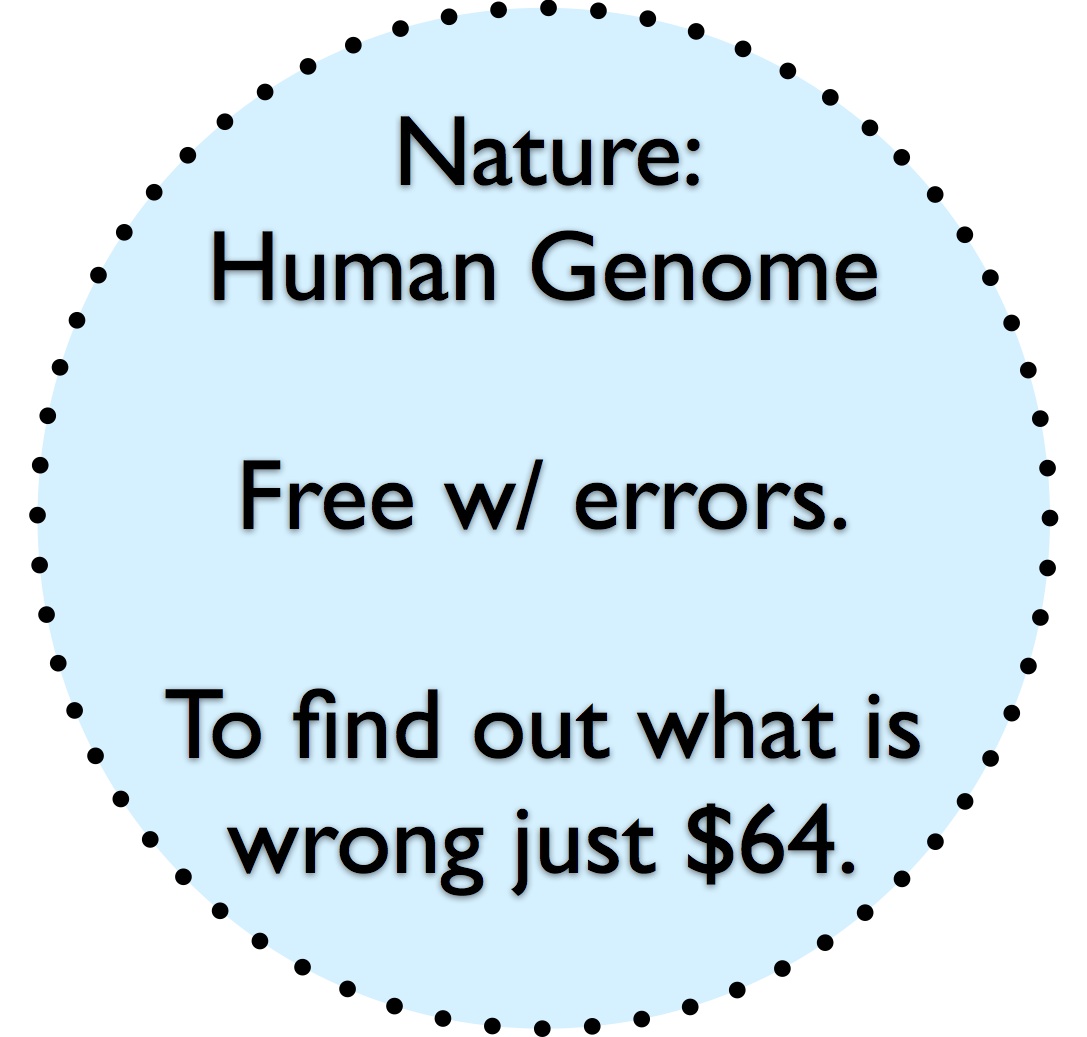
Nature’s access absurdity: Human Genome Paper free but access to corrections will costs $64

Ahh – the saga continues.  Though I peripherally noted this in a previous post this deserves a post of it’s own.  Nature Publishing Group has a policy of making genome sequencing papers freely available.  Alas, not all such papers have in fact been made freely available (see Hey Nature Publishing Group – When are you going to live up to your promises about “free” genome papers?  and A Solution to Nature Publishing Group’s Inability to Keep Free Papers Free: Deposit them in Pubmed Central for more on this).

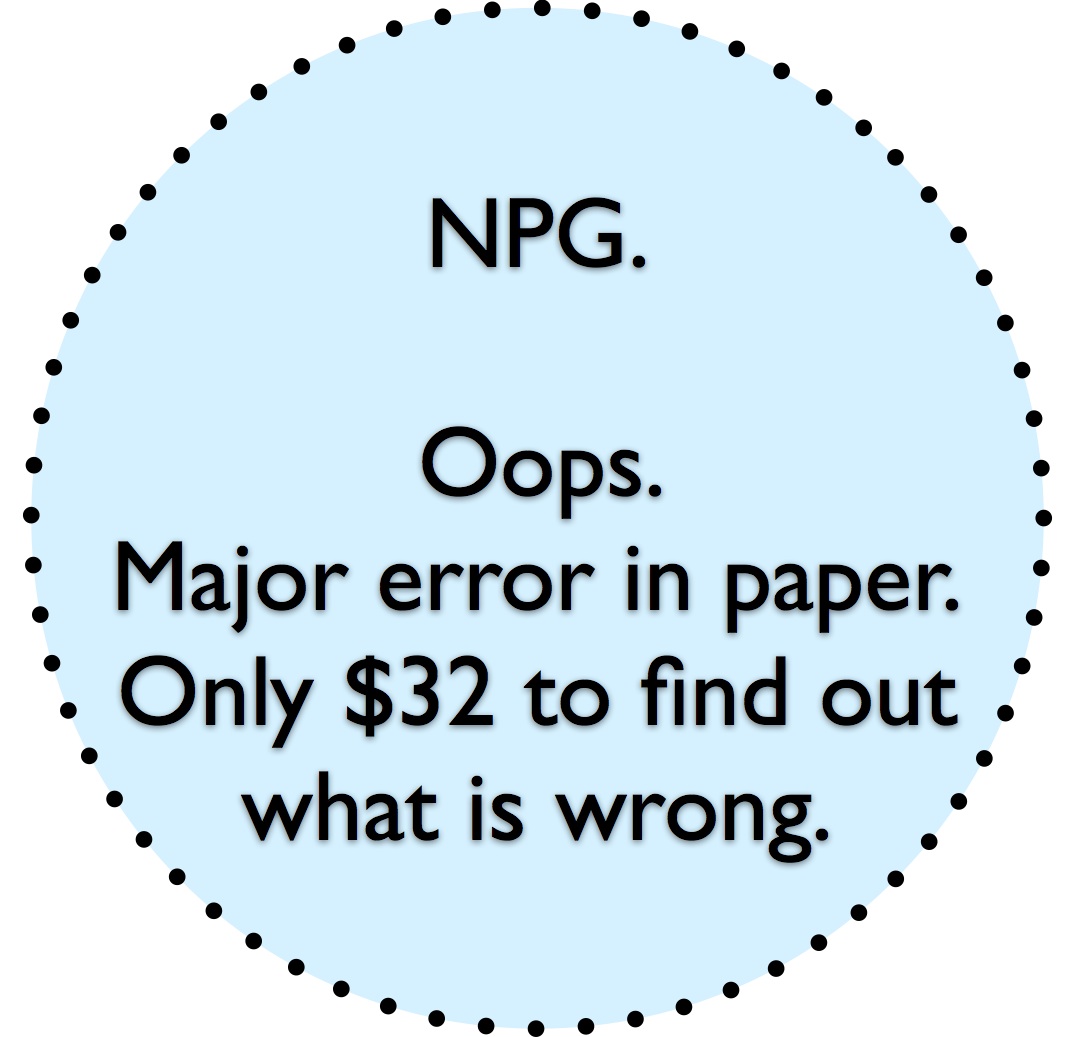
But I have discovered a just painful though funny absurdity with NPG’s money making machine.  They have in fact made the Lander et al. Human genome paper from 2001 freely available.  But there is an Erratum to this paper.  And if you want to get it (and without getting it there is no way to know what is being corrected), you have to pay $32: Access : erratum: Initial sequencing and analysis of the human genome : Nature.  Oh, and in addition a Correction “We have identified several items requiring correction or clarification in our paper on the sequencing of the human genome” for this paper also costs $32.  So the incorrect version of the paper is free but the corrections will cost you $64.

I wonder, for papers for which people pay $$, if there are corrections do they get them for free?

Bay Area Biosystematists Meeting at Fairfield Osborn Preserve, Sonoma State University

Capturing Biological Diversity at Northern California Nature Preserves

Saturday, 31 March, 2012

Bay Area Biosystematists Meeting at Fairfield Osborn Preserve, Sonoma State University

Northern California is a biologically rich environment where many lineages of organisms from diverse origins have come together and have rapidly diversified. It is also a populated region with diverse land uses, an environment-conscious population, and many invasive species that threaten native ecological communities. Environmental change models offer differing predictions about future conditions in the region. Our speakers will describe the coverage of topographic and biological diversity found in the North Coast region, especially in nature preserves. They will also describe current efforts to document long-term changes in the environment.

Program organized by Nathan Rank and Claudia Luke of Sonoma State University.

Speakers:

Claudia Luke, Sonoma State University Nature Preserves- Introduction to topic and speakers.

Lisa Micheli, Pepperwood Preserve- Ground up development of a network to quantify biotic and environmental change in the North Coast region.

Stuart Weiss, Creekside Center for Earth Observation, Think Big, Connect More: The Bay Area Conservation Lands Network.

Schedule and venue:

2:00 – Guided tour of Preserve trails. We will explore ponds and creeks and visit an overlook with chapparal vegetation. We will also observe invertebrate and amphibian diversity in Preserve wetland habitats.

5:30 – Pizza, salad, and beverages at Fairfield Osborn Preserve Education Center (6544 Lichau Road, Penngrove CA) cost approx. $12.

6:30 – talks followed by discussion.

Please email RSVP to Nathan Rank, rank@sonoma.edu by Thursday March 29th. Please specify whether you wish to come on the Preserves guided tour at 2:00 or just to the pizza and talks.

For directions, enter the address above into Google Maps or download directions at (http://www.sonoma.edu/preserves/docs/application/osborn_directions.pdf). Parking is free, carpooling encouraged.

All are welcome, members or not. If you want to join the Biosystematists, a venerable yet exceptionally lively group that provides the only inter-institutional seminar/discussion forum addressing evolutionary topics in the Bay Area, visit our website at: http://www.biosystematists.org/ to sign up for our mailing list.

A Solution to Nature Publishing Group’s Inability to Keep Free Papers Free: Deposit them in Pubmed Central

Well, tick tock tick tock.  I am still awaiting some explanation for Nature Publishing Group once again charging for access to genome papers that they promised would be available for free.  See my last post for more details: The Tree of Life: Hey Nature Publishing Group – When are you going to live up to your promises about “free” genome papers? #opengate #aaaaaarrgh

In the meantime I have come up with a solution even if NPG folks cannot figure one out.  It is very simple.  How about Nature Publishing just deposit’s all genome papers in Pubmed Central and thus even when the money making machine of Nature switches some setting and makes the papers not freely available at the Nature web site(s) for some time, the papers will  still be officially free in Pubmed Central.  I think this is probably the only solution I would trust given that this is at least the third time this has happened.

Well, Annapurna has decided laps are for losers; now she curls up on my chest

Hey Nature Publishing Group – When are you going to live up to your promises about "free" genome papers? #opengate #aaaaaarrgh

This is just ridiculous.  Nature Publishing Group in 2007 announced that they were making all papers in their journals that reported genome sequences would be made freely available and would be given a Creative Commons license: Shared genomes : Article : Nature.

About a year ago I posted to twitter (using the hashtag #opengate) and my blog about how Nature Publishing Group was not following through on their promises.  See for example

and more including some from others
Amazingly, and pleasantly, I note, in my complaining I exacted some responses from people from Nature Publishing Group who swore that these were just oversights and they would fix them.  Well, alas, the money collecting machine of Nature Publishing Group is back.
For example, currently the following papers are not freely available even though at one point they were or they clearly fit in the “Shared genomes” definition Nature Publishing Group so happily promotes:
These above are all papers of mine, so I noticed them first (I noticed this when trying to create a Pintarest Baord for all my papers and not being able to get to a free page for these papers meant I couldn’t add them to the Board.  Could it be that Nature Publishing Group is just trying to get my goat?  Let’s see.  A brief search found these papers by others – all also not freely available even though all clearly fit Nature’s own definition of genome sequencing papers:
Here are some others

I think the funniest (and scariest) part may be the corrections and errata that are not freely available. And these are just the articles I found in a 15 minute search. I am sure there are more.  Yes, Nature Publishing Group has made many genome papers freely available.  That is great.  Much better than many other publishers.  But the cracks in your system are large and suggest that nobody there is actually dedicated to seeing through on the promises.  Promises are meaningless.  Follow through is the key.  Come on Nature Publishing Group – how about assigning a “Free access ombudsman” or something like that who will make sure that free means free.  I am sick of writing these posts.  You should do your own QC …

UPDATE: see some more recent blog posts of mine about this topic:

UPDATE 3-28-12 1 PM PST:
Well, if you look at the comments, Nature is apparently trying to fix this and most of the articles I listed above are now freely available (the corrections are still not free but they claim to be working on it).  But a simple search of Nature finds there are still some papers that are closed off that shouldn’t be:

It’s not that hard to find these.  It baffles me a bit how people at Nature don’t seem to be able to find them.  But maybe I am just really good at searching …

Costa’s Hummingbirds in #DavisCA

Got some new friends

https://picasaweb.google.com/s/c/bin/slideshow.swf

12 hours of me: Slideshows w/ audio from "BIS2C: Biodiversity & the Tree of Life" at #UCDavis

Well, it has taken a few months of processing but I have finally gotten my lectures from the introductory biology course I teach uploaded in some way to share.  The course is “BIS2C: Biodiversity and the Tree of Life” and it is the third quarter of a three quarter introductory biology series at UC Davis.  Each year some 2300 or so students take this series which means that we at UC Davis have to offer each of the courses (BIS2A, BIS2B, and BIS2C) each quarter.   Every fall I co-teach BIS2C.  Alas we do not have a lecture hall big enough for 700 students, so we do the course in two sections.  The way we teach it each of the faculty double up and teach their part of the course to each section.  The course also has a weekly lab.  It is a machine of sorts.

This fall I taught 13 lectures for the course.  I covered basically phylogenetic methods, the big picture of the tree of life, and microbial diversity.  I used the Apple presentation program Keynote for slides for my lectures and I used the “Record Slideshow” option to record audio in synch with the slides.  After a bit of pain, I managed to convert these recordings into video and then posted them to Youtube.  And today I am sharing them with you.  There are imperfections of course.  But I thought some might find them useful.  Plus I have made a YouTube playlist for all the lectures if you want to just sit down and enjoy 12 hours or so of me.  Now if only Youtube would allow me to change the thumbnail image for each lecture …  Plus I note – next year I will be doing much more interactive learning in class so this may be the last record of some of these lectures …

Lecture 1: Introduction to Course and the Tree of Life

Lecture 2: Trees, Taxa and Groups

Lecture 3: Characters

Lecture 4: Phylogenetic Inference

Lecture 5: Phylogenetic Inference

Lecture 6: The Tree of Life

Lecture 7: The Three Domains

Lecture 8: Three Domains and Microbial Diversity

Lecture 9: Microbial Diversity

Lecture 10: Endosymbioses and Lateral Gene Transfer

Lecture 11: Endosymbioses and Lateral Gene Transfer

Lecture 12: Extremophiles

Lecture 13: Human Associated Microbes

And now I have a billion plus infinity dollars

P72

Just a typical Friday in #davisca – printing our own money

P58

Call for abstracts: Automated Function Prediction, 2012

Call for abstracts: Automated Function Prediction, 2012

Locale: Long Beach, California USA
Date: July 14, 2012 (Just before ISMB 2012)
URL: http://biofunctionprediction.org

Important dates:

April 18, 20112: Deadline for submitting abstracts.

May 9, 2011: Notifications for accepted abstracts e-mailed to
corresponding authors

May 16, 2011: Deadline for presenters to confirm acceptance of
invitation to speak.

July 14, 2011: AFP SIG preceding ISMB 2012

An ISMB Special Interest Group Meeting

Automated Protein Function Prediction

Sequence and structure genomics have generated a wealth of data, but
extracting meaningful information from genomic information is becoming
an increasingly difficult challenge. Both the number and the diversity
of discovered sequences are increasing, while the fraction of genes
whose function is known is decreasing.In addition, there is a need for
annotation which is standardized so that it could be incorporated into
function
annotation on a large scale. Finally, there is a need to assess the
quality of the function
prediction software which is out there.

For these reasons and many more, automated protein function prediction
is rapidly gaining interest among computational biologists in academia
and industry.

The AFP SIG has been part of ISMB since 2005.
We call upon all researchers involved in gene and protein function
prediction to submit an abstract to the AFP meeting. Authors of select
abstracts will be invited to give a talk and/or present a poster.

This year, AFP is delighted to have Jonathan Eisen from the University of
California, Davis as its keynote speaker. Prof. Eisen is a pioneer in the
field of function prediction.

>From his lab page:
http://bobcat.genomecenter.ucdavis.edu/mediawiki/index.php/Main_Page

"Dr. Eisen has published more than 200 scientific papers and is a co-author
of a relatively recently published Evolution
Textbook<http://evolution-textbook.org/>.
Dr. Eisen is also a strong proponent of the Open Access movement in
scientific publishing and is Academic Editor in Chief of PLoS
Biology<http://www.plosbiology.org/>.
Dr. Eisen is also an active and award winning science blogger (see his Tree
of Life blog here <http://phylogenomics.blogspot.com/>). For recent news
see http://twitter.com/phylogenomics" <http://twitter.com/phylogenomics>

For further instructions on how to submit abstracts to AFP 2012, please go
here:

http://biofunctionprediction.org/node/415

We are looking forward to seeing you in Long Beach, California!

Iddo Friedberg on behalf of the AFP organizing committee