Eisen Lab Blog

New Marine Protected Areas postdoc opportunities

From an email:

Dear Colleagues,

CMSI, in collaboration with CA Department of Fish and Wildlife (CDFW), is seeking to fill three postdoc positions in the science of adaptive management of Marine Protected Areas (MPAs). This is an exciting new opportunity to merge innovative research with real world management questions to advance the science of adaptive management in the context of the world’s most extensive MPA networks. Please see the attached announcement for more details.

MPApostdocs.pdf

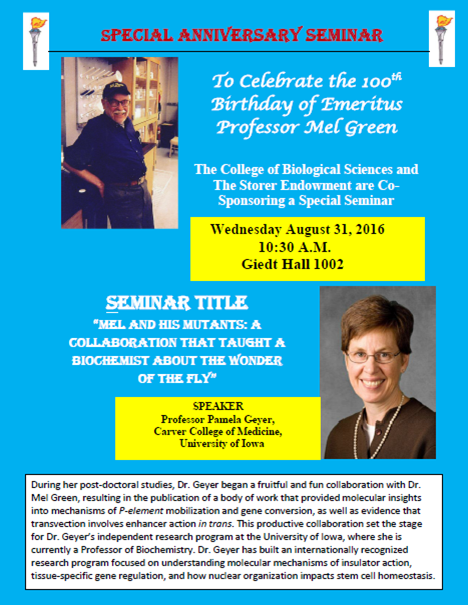
Special Anniversary Seminar to Celebrate the 100th Birthday of Emeritus Professor Mel Green

PLEASE POST AND DISTRIBUTE:

Green celebration Flyer 3.pdf

Chancellor Katehi stepping down at #UCDavis:

Just got this email and am sharing it here:

Dear Colleagues,

I received the attached letter from Chancellor Katehi in which she resigns as the Chancellor of UC Davis. The Divisional Senate admires and applauds her energetic advocacy for California public education and UC Davis in particular. She has been an effective leader in promoting the interests of UC Davis in the state, nation and globally.

Chancellor Katehi’s decision to resign as Chancellor today is understandable, given the recent interactions between the Chancellor and President Napolitano, including the investigation initiated by the President. These circumstances have had a negative effect on the Davis campus and make it impossible for Linda Katehi to be effective as a Chancellor.

The Davis Division is looking forward to a continuing relationship with Professor Katehi as a full-time faculty member. Last October she was hailed for her “visionary leadership in engineering research, entrepreneurship, and education, and for national advocacy of higher education as a major driver of the U.S. economy” by the National Academy of Engineering, when she received the Simon Ramo Founders Award. The Davis Division welcomes her anticipated contributions as a teacher, scholar, and member of the academic community.

Sincerely,

André Knoesen

Chair, Academic Senate

Professor: Electrical and Computer Engineering

August 9 Letter.pdf

Really interesting post doc position at #UCDavis on directed evolution of luciferase

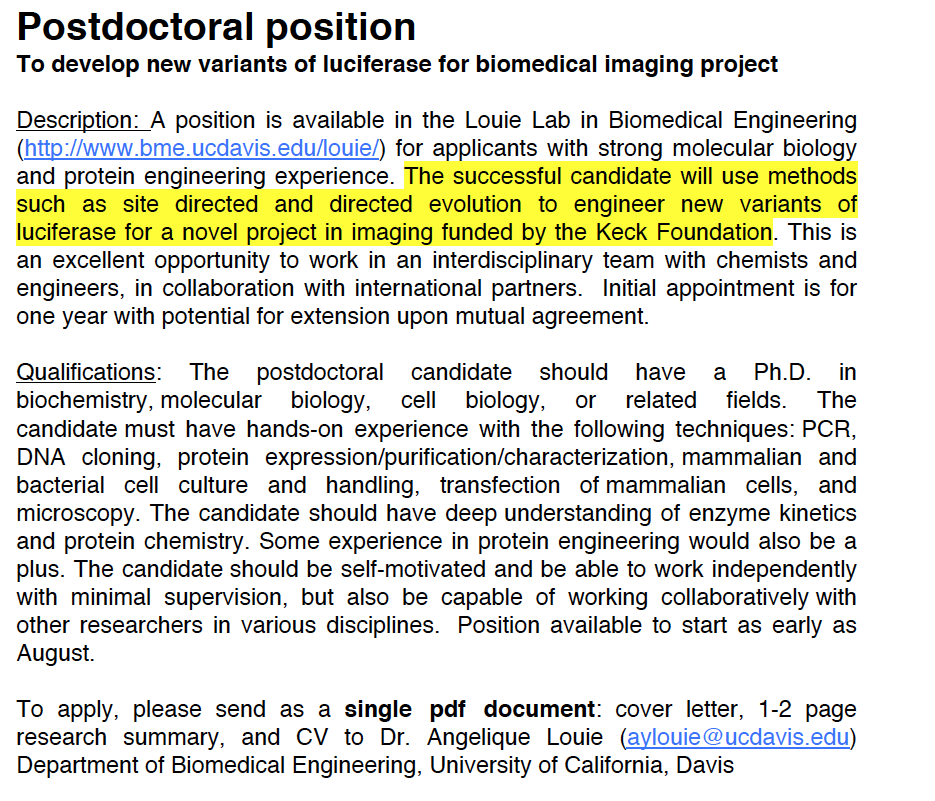
Postdoctoral position
To develop new variants of luciferase for biomedical imaging project

Description: A position is available in the Louie Lab in Biomedical Engineering (http://www.bme.ucdavis.edu/louie/) for applicants with strong molecular biology and protein engineering experience.

. This is an excellent opportunity to work in an interdisciplinary team with chemists and engineers, in collaboration with international partners. Initial appointment is for

one year with potential for extension upon mutual agreement.

Qualifications: The postdoctoral candidate should have a Ph.D. in biochemistry,molecular biology, cell biology, or related fields. The candidate must have hands-on experience with the following techniques: PCR, DNA cloning, protein expression/purification/characterization, mammalian and bacterial cell culture and handling, transfection ofmammalian cells, and microscopy. The candidate should have deep understanding of enzyme kinetics and protein chemistry. Some experience in protein engineering would also be a plus. The candidate should be self-motivated and be able to work independently with minimal supervision, but also be capable of working collaboratively with other researchers in various disciplines. Position available to start as early as August.

To apply, please send as a single pdf document: cover letter, 1-2 page research summary, and CV to Dr. Angelique Louie (aylouie) Department of Biomedical Engineering, University of California, Davis

About UC Davis: The Department of Biomedical Engineering at UC Davis has 32 faculty, and is a vibrant and multidisciplinary community of more than 120 researchers. The Department is internationally renowned for its research in biomedical imaging, enjoys strong institutional support, and is ranked #6 in the nation, and #1 in California, based on research expenditures by the National Science Foundation. UC Davis also has a School of Medicine (including an NCI- designated Comprehensive Cancer Center), a School of Veterinary Medicine, the California National Primate Research Center, and the Institute for Regenerative Cures offering unparalleled opportunities for collaborative and translational research. Davis is located within 1- 2 hours of San Francisco, Napa Valley, Lake Tahoe and the Northern California coast offering access to a wide range of outdoor and cultural activities and an excellent quality of life.


Yohei Postdoctoral position slk.pdf

UC Davis Liver Research Day 10/5/2016

REGISTER TODAY!: www.surveymonkey.com/r/JBWQJWW
SUBMIT ABSTRACT: Dr. Valentina Medici at vmedici


UCD 2nd ANNUAL LIVER RESEARCH DAY

Metabolic Pathways to Fatty Liver

Wednesday, October 5, 2016
8:00 AM – 3:45 PM
GBSF Building, Auditorium
451 Health Sciences Drive
Davis Campus

8:00-8:30 AM Registration and Continental Breakfast

8:30-8:40 AM Welcome
Christopher Bowlus, MD, Professor and Chief, Internal Medicine, Gastroenterology/Hepatology, UC Davis


Session I

9:00-9:20 AM “Sugar Consumption and Chronic Stress”

Kevin D. Laugero, PhD, Associate Adjunct Professor, Nutrition and USDA WHNRC, UC Davis

9:25-9:45 AM “FXR, Sleeve Gastrectomy and Fatty Liver”

Karen K. Ryan, PhD, Assistant Professor, Physiology and Membrane Biology, UC Davis

9:50-10:10 AM “Lipidomics, Nutrition and Fatty Liver”

Angela M. Zivkovic, PhD, Assistant Professor, Nutrition, UC Davis

10:15-10:35 AM “Methionine Metabolism in ASH and NASH”

Kusum Kharbanda, PhD, Associate Professor, Internal Medicine, Gastroenterology/Hepatology, University of Nebraska

10:40-10:55 AMCoffee Break


Session II

10:55-11:15 AM “Non-invasive Assessment of NAFLD”

Souvik Sarkar, MD, PhD, Assistant Professor, Internal Medicine, Gastroenterology/Hepatology, UC Davis

11:20-11:30 AM “Copper and Lipid Metabolism”

Valentia Medici, MD, Associate Professor, Internal Medicine, Gastroenterology/Hepatology, UC Davis

11:30-11:50 PM “Fructose as a Risk Factor for NAFLD”

Manal F. Abdelmalek, MD, Associate Professor, Gastroenterology, Duke University

11:55-12:55 PM Lunch (provided for the first 50 registrants) AND
Poster Judging (Poster Facilitators: Drs. Christopher Bowlus, Charles Halsted and James Tabibian)


Session III

1:00-1:30 PM “Advanced Glycation End Products in NASH Pathogenesis”

Natalie J. Torok, MD, MSc, Professor, Internal Medicine, Gastroenterology/Hepatology, UC Davis

1:35-1:55 PM “Mitochondria, Lipid Metabolism, Shcs and Fatty Liver”

Gino Cortopassi, PhD, Professor, Molecular Biosciences, UC Davis

2:00-2:20 PM “Fatty Liver and Risk of HCC in Different Populations”

Eric W. Chak, MD, MPH, Assistant Professor, Internal Medicine, Gastroenterology/Hepatology, UC Davis

2:25-2:45 PM Coffee Break

Session IV

2:45-3:05 PM “Emerging Therapies and Clinical Research in NAFLD”

Manal F. Abdelmalek, MD, Associate Professor, Medicine, Gastroenterology, Duke University

3:10-3:30 PM “Studies of Human Stem Cell-derived Hepatocyte-like Cells”

Jan A. Nolta, PhD, Professor, Internal Medicine and Director, Stem Cell Program, UC Davis

3:35-3:45 PM Poster Award Announcements and Closing Remarks

LiverDay_Agenda10-05-16.pdf
LiverDay_CallforAbstracts.pdf

“Careers in High-throughput Sequencing” by illumina on 8/11 #UCDavis

From the inter tubes:

Dear Colleagues,

Davis Postdoc Entrepreneurship and Career group (DPEC) – Knowledge Exchange and Bioinformatics Core will co-host a seminar, “Careers in High-throughput Sequencing”, by Tony Dodge (MSc) and Drew Kebbel (MSc) of Illumina.

Careers in High-throughput Sequencing

Join us for a conversation with Illumina to learn about the future of High-throughput Sequencing in careers in research, emerging markets and entrepreneurship. Tony and Drew will discuss:

  • Career opportunities and applications of High-throughput Sequencing in various markets such as companion diagnostics in drug development, clinical neonatal testing, consumer genomics and bioinformatics, etc.
  • The Illumina Accelerator Program, an incubation program in Mission Bay, San Francisco, which provides entrepreneurial support, seed funding, technology access, and venture capital networks to startups with High-throughput Sequencing applications.

This talk is intended for anyone who is interested in high-throughput sequencing and entrepreneurship; all backgrounds are welcome!

Speakers: Tony Dodge (MSc), Executive Business Specialist at Illumina and Drew Kebbel (MSc), Sequencing Sales Specialist at Illumina

Date: Thursday, August 11, 2016 12:30 pm –2 pm (Networking and refreshments to follow)

Location: Auditorium 1005, Genome and Biomedical Sciences Facility (GBSF), UC Davis campus.

Please RSVP here!

If you have any questions, contact us at dpec .

Illumina_Careers in Sequencing_July2016.pdf

USC / C-DEBI seeks a full-time Diversity Specialist to join its team!

d7079b52-d998-4881-bf03-695189f24e49.png
USC/C-DEBI seeks a full-time Diversity Specialist
[ advertisement PDF ]

The USC Dornsife College of Letters, Arts and Sciences Center for Dark Energy Biosphere Investigations (C-DEBI) is seeking a full-time Diversity Specialist to join its team!

C-DEBI is a multi-institutional research and education center funded by the National Science Foundation Science and Technology Center (NSF-STC) program, headquartered at USC. Focused on the science of exploring microbial life beneath the seafloor, the Center also prioritizes the integration of deep sea research with education and diversity efforts to strengthen the STEM pipeline for future generations. The Diversity Specialist will help to create, coordinate, and lead our diversity efforts to serve our students, postdocs, faculty, and other participants at USC and across the nation. The Diversity Specialist will assist the C-DEBI Education, Outreach, and Diversity Managing Director who supervises the development and management of these programs.

The ideal candidate for the position of C-DEBI Diversity Specialist has:

  • 3 years of experience developing and managing educational STEM programs with multiple institutions with a focus on diversity initiatives
  • Experience working across multiple institutions
  • Strong oral and written communication skills
  • Experience using social media for professional outreach
  • Research experience at Ph.D. or Masters level

Job responsibilities include:

  • Assistance in the planning and organization of C-DEBI Education, Outreach, and Diversity program objectives and content to advance NSF-STC diversity initiatives
  • Support for diversity programs, e.g., Global Environmental Microbiology and Genomics & Geobiology Undergraduate Research Experience, via testing and evaluation, teaching or event planning and the administrative duties associated with running programs
  • Interaction with faculty, researchers, and staff involved with diversity programs at USC and at partner institutions
  • Development and implementation of program policies and procedures
  • Development of strategies for promoting C-DEBI programs, including personal networking, social media, newsletters and publications or other communications materials, and events planning by working with the C-DEBI community to broadcast exciting discoveries and E&O opportunities
  • Personal professional development by staying informed of developments in field
  • Other related duties as assigned or requested with the potential to create new programs

Apply at http://jobs.usc.edu/postings/70927 (Requisition ID 1006784).

We will begin reviewing applications August 19.

The University of Southern California is an Equal Opportunity Employer that Values Diversity.

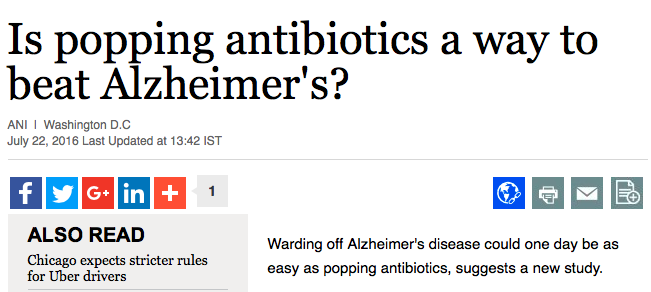
Today’s misleading overselling the #microbiome – U. Chicago on Alzheimer’s and gut microbes


Well, this is disappointing if not disturbing

A new paper is out that has some interesting findings but the paper itself, and the press release form the authors (at University of Chicago) really goes overboard in misstating the findings.

Here is the paper in Scientific Reports. I purposefully am not putting the title of the paper here in the post yet, because amazingly, even the title is misleading.

But here is what a summary of what they showed, based on their results section, which seems interesting and sound

  • Antibiotic treatment of a variety of mice showed alterations in the GI microbiome and in various inflammatory markers circulating in the blood
  • Male mice treated with this antibiotic regime showed reduced Aβ plaque deposition but increased soluble Aβ levels
  • Reactive gliosis surrounding Aβ plaques is reduced in male mice treated with this antibiotic regime 
This is not all they report as they also discuss various controls and other observations about these mice and their brains and their responses to the antibiotic treatment.  
But what they do not report on is any evidence of anything other than a correlation between the GI microbiome changes and the inflammatory markers and the reduced Aβ plaque deposition.  They even state this VERY BRIEFLY in their paper

We are fully cognizant of the fact that the findings reported herein are purely correlative and do not elucidate precise mechanism(s). 

Yet then through other papers parts of the paper they misstate what they find and somehow, almost magically, turn this correlation into evidence for a causative connection.  For example in the abstract

These findings suggest the gut microbiota community diversity can regulate host innate immunity mechanisms that impact Aβ amyloidosis.

No. These findings are consistent with that.  They are also consistent with, for example, the antibiotics affecting microbes in the brain which in turn could affect inflammatory markers.  Or microbes on the skin.  Or in the blood.  Or elsewhere.  I don’t see any evidence here for a causative connection between the gut microbes (which are certainly affected by these antibiotics) and the plaque.

Yet even worse is that this misrepresentation of a causative connection makes it into the title of the article

Antibiotic-induced perturbations in gut microbial diversity influences neuro-inflammation and amyloidosis in a murine model of Alzheimer’s disease

No no no no no no no no.  No evidence that the perturbations in the gut microbes are directly influencing anything in the brain.  It is a good model.  But they need to be more careful with their wording.

And sadly, this gets even worse in the press release about the paper: Antibiotics weaken Alzheimer’s disease progression through changes in the gut microbiome | EurekAlert! Science News

What?  This “through changes in the gut microbiome” is just completely misrepresenting what was shown in the paper.

Here are some misleading parts of the PR

The study, published July 21, 2016, in Scientific Reports, also showed significant changes in the gut microbiome after antibiotic treatment, suggesting the composition and diversity of bacteria in the gut play an important role in regulating immune system activity that impacts progression of Alzheimer’s disease.

Nope. Nope. and Nope.

Thankfully there are a few caveats in the PR too but that does not balance misleading statements.  The worst is saved for the end

“There’s probably not going to be a cure for Alzheimer’s disease for several generations, because we know there are changes occurring in the brain and central nervous system 15 to 20 years before clinical onset,” he said. “We have to find ways to intervene when a patient starts showing clinical signs, and if we learn how changes in gut bacteria affect onset or progression, or how the molecules they produce interact with the nervous system, we could use that to create a new kind of personalized medicine.”

Basically, saying there will be a cure for Alzheimer’s. And then saying if we learn HOW (not if) gut microbes affect onset or progression, then we can better cure or treat this disease.  This is just too bold and misleading for my taste.  Nice paper.  Interesting work and implications. But it is misleading to say they have shown any causative connection between gut microbes and Alzheimer’s in this paper and also very misleading to start to talk about how they will use this to lead to treatments or cures.

Oh, and did I mention this was in mice not humans?  So how do they get from a correlative study in mice to how gut microbes affect progression of Alzheimer’s in humans?  Really this is not OK, even to hint at.

And of course, which such misleading material in their own paper and in their PR it is not surprising that some of the reporting on this is going awry.

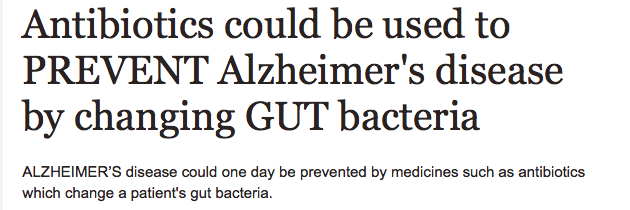
See the Daily Express for example

And the Business Standard
And I am sure many more to come.  Scientists have to be more careful with discussing and presenting the implications of their work.  I love the microbiome field and the possible implications to me are enormous for the role of the microbiome in various areas of biology.  But misrepresenting ones findings, especially when it comes to human diseases, is dangerous and bad for science and bad for the microbiome field.  The author’s of the paper and the people behind the PR at the University of Chicago should publish a correction of the PR and also publish a correction of their paper to correct the misleading representations. And for their misleading material in their paper and in the PR I am giving them a coveted “Overselling the Microbiome” award.


Some responses


Minor correction made

//platform.twitter.com/widgets.js
UPDATE 1

And scarily, one of the authors of the paper, Rudy Tanzi is using the paper to promote his book and his claim that Alzheimer’s can be prevented through manipulation of the microbiome

UPDATE 2 — July 24 – 8:50 AM

I have written to the author of the PRs at U. Chicago to ask for a correction to be made

UPDATE 3 — July 24, 9 AM

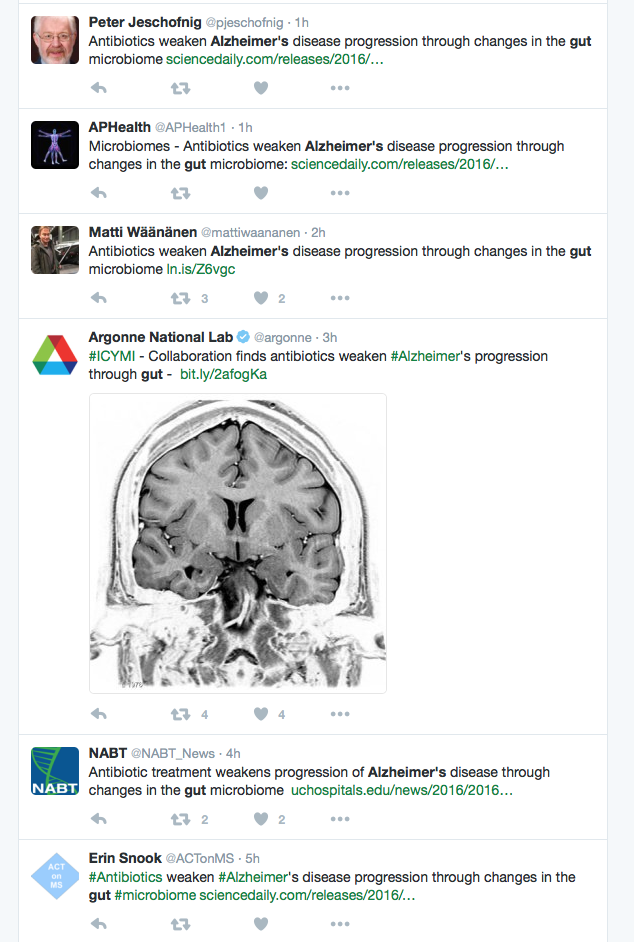
So many people posting links to the misleading articles where all that comes through (e.g., on Twitter) is the headline including the misleading information about the gut. Am responding to many of them but not all.

Fortunately, Argonne National Lab responded quickly

UPDATE 4 — July 24 11:30 AM

I also will contact the author of this article on ScienceNews: Antibiotics might fight Alzheimer’s plaques  because it also has some misleading statements about the gut microbiome connection

Image caption:

PLAQUE FIGHTER  A long dose of antibiotics reduced Alzheimer’s-related plaques (shown here in a human brain) in the brains of mice, results that suggest gut bacteria can influence the disease

1st sentence does better

A long course of antibiotics reduced the levels of a hallmark of Alzheimer’s disease in the brains of mice, possibly by changing the species of bacteria in the gut

But then it reverts

This microbial shift in the gut appeared to affect the brain.

And continues with more

Sisodia and colleagues don’t know how bacteria signal from the gut to the brain to affect A-beta, although their study raises one possibility. 

And then this

If a similar relationship between gut bacteria and Alzheimer’s does exist in people,

UPDATE 5 — July 24 11:45 AM

Sent an email to the author.

Pokébiome: A Call for Research Participants

Professor Bonsai is looking for Pokémon trainers to participate in a new study on the Pokémon microbiome or the Pokébiome. The study is open to trainers who are Level 5 or above and preference will be given to trainers who have caught a larger variety of Pokémon.

Cmz4h8pVIAA1zYu.jpg_large-576x1024.jpg
A tenure-hopeful professor in pokélogy at a large well-known research lab, Prof. Bonsai is an outspoken proponent of trapping and releasing Pokémon humanely vs. many of his colleagues who prefer to keep Pokémon under study in small sphere like contraptions

The recent global discovery of Pokémon, adorable 2D animals, by the Nintendo Co., Ltd. may be the most important scientific finding of the century.  Millions of Pokémon trainers have sprung up overnight and have begun rapidly sampling Pokémon from a multitude of geographic locations allowing for never before possible large scale citizen science opportunities. Prof. Bonsai hopes to swab and characterize the microbiomes of all 151 Pokémon that have been discovered (as well as any additional Pokémon that may be found in the future) and their tiny-homes (aka Pokéballs). He hopes that this research will help us better understand Pokémon disease and health as well as possibly revolutionize the way we store and transport our 2D friends.

IMG_2016-07-18-11505380-608x1024.png
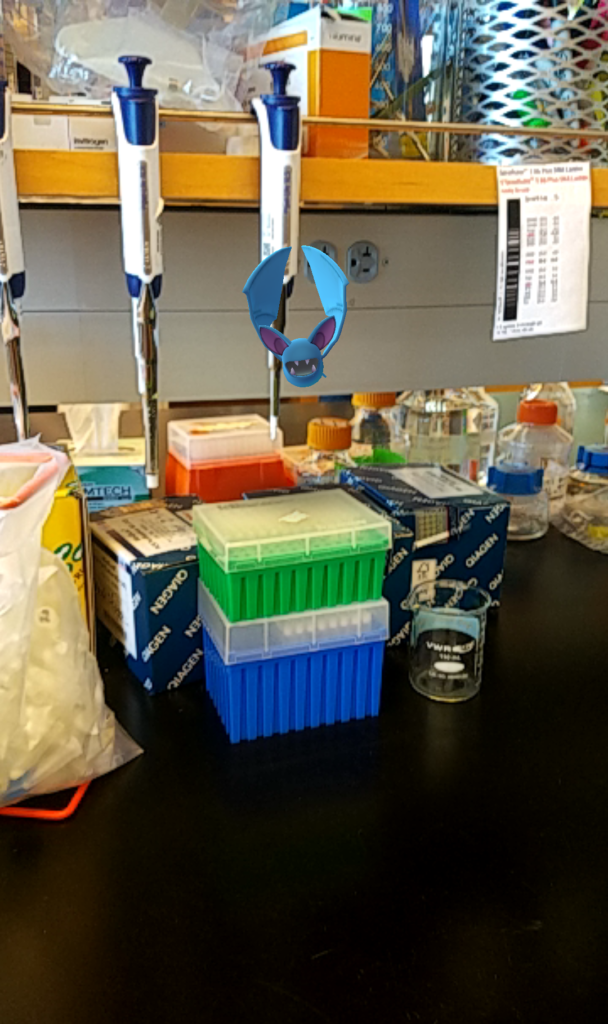
A Pokémon, belonging to trainer Amy Swabem, appears in the lab and is ready to be sampled for Pokébiome analysis.

Additionally, Prof. Bonsai is hoping that he can utilize a 2012 study, A Phylogeny and Evolutionary History of the Pokémon,  from the Annals of Improbable Research to study the co-evolution of microbes with their Pokémon hosts before, after and during their evolutions.

IMG_2016-07-10-10220459-608x1024.png
Above you can see a “mushroom Pokémon”. Prof. Bonsai is extremely interested to know if this Pokémon is a true fungi or an oomycete and whether or not it has other species of fungi associated with it.

Unfortunately, this study is currently limited to Pokémon that are solid (e.g. no ghost Pokémon) and those that are not flammable (e.g. no fire types) due to sampling issues. Prof. Bonsai and his team are currently testing out alternative sampling methods and hope that these Pokémon will be able to be included soon. If you are interested in participating please contact Prof. Bonsai via mail using a flying-type Pokémon.

Overselling the Microbiome Award for @nytimes on thumb sucking, nail biting protecting from allergy

I am continually torn about handing out “overselling the microbiome” awards to many “stories” that are coming out recently on new scientific studies.  On the one hand, many of these studies are quite interesting.  On the other hand, a huge number of them oversell the implications of the work.  And for some reason it seems to me that studies that could indicate a positive role for microbes in some way seem to end up with more misrepresentation than other types of work.  Mind you, I truly believe the cloud of microbes living in and on various plants and animals are likely to play fundamental roles in all sorts of important functions.  But my thinking this and my thinking it is likely does not mean we should go around overstating the implications of work in this area.

And that brings me to the latest example of such overselling  … a story about thumb sucking and nail biting as covered in the New York Times: Thumb Suckers and Nail Biters May Develop Fewer Allergies

The science here is interesting  – it is based on a new paper testing for associations between thumb sucking and nail biting on the one hand and atopic sensitization, asthma and hay fever on the other.  The paper found the following: Children who suck their thumbs or bite their nails are less likely to have atopic sensitization in childhood and adulthood.

Interesting.  But a key part of this is that they discovered a correlation.  Lots and lots and lots of possible explanations for this correlation including some examined in the paper but none of which have been proven.  Some news reports do a good job of covering the topic and discussing how this is still just a correlative observation.  For example see this Washington Post article by Lateshia Beachum.  There they report on the authors comments where the authors seem to think this supports the hygiene hypothesis

“The findings support the ‘hygiene hypothesis,’ which suggests that being exposed to microbes as a child reduces your risk of developing allergies,” Hancox said in a statement.

But then immediately this is countered by some more careful thoughts

Hirsh Komarow, a staff clinician at the National Institute of Allergy and Infectious Diseases, isn’t entirely convinced about the study’s conclusions. “It’s an interesting observation, but it needs more analysis,” Komarow said.

And then he is further quoted with other possible explanations

Komarow also suggested that thumb-sucking and nail-biting could be indicative behaviors that either thwart or encourage allergic reactions. He said being part of a large family and being exposed to microbes from many siblings may affect a child’s allergic sensitization.

And there are other articles out there with a decent amount of caveating.  But sadly the New York Times article by Perri Klass is not so tempered. Here are some of what I consider to be statements without enough caveating or countering:

A new study suggests that those habits in children ages 5 to 11 may indeed increase exposure to microbes, but that that may not be all bad.

No no no.  The new study did not suggest that.  The new study is consistent with that, but it is consistent with many other explanations.

And then there is this:

These differences could not be explained by other factors that are associated with allergic risk. The researchers controlled for pets, parents with allergies, breast-feeding, socioeconomic status and more. But though the former thumb-suckers and nail-biters were less likely to show allergic sensitization, there was no significant difference in their likelihood of having asthma or hay fever.

Well it is nice that the authors of the paper tested for some other possible explanations.  But it is a giant and inappropriate leap to go from that to “These differences could not be explained by other factors that are associated with allergic risk

And then there are multiple quotes from the authors which are not really caveated enough or at all

Robert J. Hancox, one of the authors of the study, is an associate professor in the Department of Preventive and Social Medicine at Dunedin School of Medicine, a department that is particularly oriented toward the study of diseases’ causes and risk factors. He said in an email, “The hygiene hypothesis is interesting because it suggests that lifestyle factors may be responsible for the rise in allergic diseases in recent decades. Obviously hygiene has very many benefits, but perhaps this is a downside. The hygiene hypothesis is still unproven and controversial, but this is another piece of evidence that it could be true.”

Some caveats here but not enough.  This is not “evidence that it could be true” but rather it is data consistent with that model, but also consistent with other models that have nothing to do with the hygiene hypothesis.

And then there is this:

Malcolm Sears, one of the authors of the paper, a professor of medicine at McMaster University in Hamilton, Ontario, who was the original leader for the asthma allergy component of the New Zealand study, said, “Early exposure in many areas is looking as if it’s more protective than hazardous, and I think we’ve just added one more interesting piece to that information.”

No this study did not show that early exposure from thumb sucking or nail biting has any protective benefit.  It showed a correlation between thumb sucking/nail biting and lower risk of sensitization.  It did not show any causal connection.  And even if a causal connection were found, one would still have to test for what was the mechanism and the mechanism could be many things unconnected to microbial exposure.

And then there is this

Dr. Hancox pointed out that the study does not show any mechanism to account for the association. “Even if we assume that the protective effect is due to exposure to microbial organisms, we don’t know which organisms are beneficial or how they actually influence immune function in this way.”

Yes, this is good in some ways.  But why would we assume this?  Stating this without caveats makes it seem like we should assume this.

and

Dr. Sears said, “My excitement is not so much that sucking your thumb is good as that it shows the power of a longitudinal study.” (A longitudinal study is one that gathers data from the same subjects repeatedly over a period of time.) And in fact, as researchers tease out the complex ramifications of childhood exposures, it’s intriguing to look at long-term associations between childhood behavior and adult immune function, by watching what happens over decades. 

None of these quotes are really caveating the claims.  And then the article ends with a statement that seems to indicate that this is all a proven fact

So perhaps the results of this study help us look at these habits with slightly different eyes, as pieces of a complicated lifelong relationship between children and the environments they sample as they grow, which shape their health and their physiology in lasting ways.

Yes, this study is interesting.  And yes, it might be indicative of a causative connection between exposure to microbes on thumbs and nails and reducing risk to allergy.  But no, the study did not show that there is a causative connection, just a correlation.  And thus we cannot conclude at this point that we should “look at these habits with slightly different eyes, as pieces of a complicated lifelong relationship between children and the environments.”  The correlation could be due to other factors that have nothing to do with these habits.  And this is just a massive difference.  Shame on the New York Times for not reporting on this carefully enough.

And thus I am awarding a coveted Overselling the Microbiome Award to the New York Times and Perri Klass.

Hat tip to Mark Sagoff for pointing me to the NY Times article.