Eisen Lab Blog

Clip of Harold Varmus on the Daily Show

There really is no better advocate for Science these days than Harold Varmus. He balances politics and science incredibly well and also simultaneously advocates for applied and basic science as well as access to scientific information. Here is the clip of his latest interview on The Daily Show.

.cc_box a:hover .cc_home{background:url(‘http://www.comedycentral.com/comedycentral/video/assets/syndicated-logo-over.png’) !important;}.cc_links a{color:#b9b9b9;text-decoration:none;}.cc_show a{color:#707070;text-decoration:none;}.cc_title a{color:#868686;text-decoration:none;}.cc_links a:hover{color:#67bee2;text-decoration:underline;}

They copied my posting and I like it …

To me, science is about the spread of ideas and knowledge. And as long as I get credit for my ideas and my writing, I am more than happy for people to run with them. I feel the same way about my blog. Thus I was happy when a blog called The Reef Tank said they wanted to include more science about marine biology there and wanted to cross post some of my marine focused postings.  And they have done the first one here.  All the power to them for wanting to include more science there and happy they are giving my postings another life …

Finally, PDFs of my papers from my home page starting to show up in Google Scholar.

Well, it has finally happened.  And not sure how.  But PDFs of all my papers, which I have posted on my MAC.COM (or now known as ME.COM) homepage are finally showing  up on Google Scholar.  If you go to Google Scholar and type Eisen JA into the window and then look for PDFs for each of the papers some of the files on my .MAC site show up.

When I originally discovered a few months ago that none of my PDFs from this site where showing up on Google Scholar I dug around and discovered in Google’s Faqs that it helps to have links to the PDFs of papers.  This seemed strange since I had links from my blog and that is run by Google now so it was weird that those did not help.  But I added some more links here and there and presto, now the links to the PDFs are showing up inside Google Scholar results.
Mind you, not all of the PDFs have shown up yet and I have no clue why some did and some did not, but this is part of my continuing effort to free up my past publications.  Good start.  Not done yet, but getting there.

Open Access Notes: Harold Varmus on the Daily Show tonight (3/2/09)

Just a quick note here.  For anyone interested in Open Access and science policy in general, Harold Varmus, Nobel Laureate and CoFounder of PLoS, will be on the Daily Show tonight to promote his new book The Art and Politics of Science.  Now when are they going to have my brother on the show?  He was a CoFounder of PLoS.  So what if he does not have a Nobel and never ran NIH.  He has won some cool awards here and there, is an HHMI Investigator, and more importantly, he has a blog and Varmus does not.  Doesn’t that count for something?  
Open Government Highlights: 1000 points of data

Kenneth Duberstein, who was the White House Chief of Staff from 1988-1989 had a very interesting Op-Ed piece in the New York Times Feb 23 (Op-Ed Contributor – 1,000 Points of Data – NYTimes.com). In it he calls for the US Government to allow for all citizens to assess the State of the Union themselves:

What we need now is a Web-based system for measuring our changing society with key national indicators — in a free, public, easy-to-use form. Ideally, it would be run by the nonpartisan National Academy of Sciences, which would ensure it has the best quality of information and is kept up to date. The system would enable us to offer in one place statistical information that we spend billions of dollars collecting but that is now underused and undervalued.

Noting that this idea is possibly going to be a reality, he writes:

Senators Edward M. Kennedy, Democrat of Massachusetts, and Michael Enzi, Republican of Wyoming, plan to soon introduce a bill that would allocate about $7.5 million a year for such a comprehensive database of key national indicators, and the idea already has wide bipartisan support.

Duberstein further states

Great steps forward in American history occur at moments when our deeply held values are reaffirmed in the face of changing realities. Such a moment is at hand. We need a shared frame of reference that will enable us to practice collective accountability.

I think this is a stellar idea. Access to information is critical for our future. Good to see this notion getting more and more support throughout the government.

Darwin in Davis

Since this is kind of a Davis thing too I am cross posting it from my work blog.

Well, this has been a good week for me in Davis in terms of things in which I am interested. First, the Tour of California started in Davis and then tonight we had a Darwin celebration (with cake and talks) in a movie theater in downtown. The three talks were by Rick Grosberg, who gave a good background on Darwin the person, Mau Stanton who talked about Evolution and Society and me, who talked about Uses of Evolution. The shindig was sponsored by the Center for Population Biology and funded by the Storer Endowment. And it was organized by Angus Chandler and Dena Grossenbacher and possibly some others. And the theater was packed to the gills. Food. Folks. And Fun. And I owe some thanks to folks who responded to my FriendFeed posting asking about other examples of Uses of Evolution.

Here are some pics …

http://picasaweb.google.com/s/c/bin/slideshow.swf

Also see

Darwin Celebration in Davis

Well, this has been a good week for me in Davis in terms of things in which I am interested. First, the Tour of California started in Davis and then tonight we had a Darwin celebration (with cake and talks) in a movie theater in downtown. The three talks were by Rick Grosberg, who gave a good background on Darwin the person, Mau Stanton who talked about Evolution and Society and me, who talked about Uses of Evolution. The shindig was sponsored by the Center for Population Biology and funded by the Storer Endowment. And it was organized by Angus Chandler and Dena Grossenbacher and possibly some others. And the theater was packed to the gills. Food. Folks. And Fun. And I owe some thanks to folks who responded to my FriendFeed posting asking about other examples of Uses of Evolution.

Here are some pics …

http://picasaweb.google.com/s/c/bin/slideshow.swf

Also see

Bad evolution puns award #1: Cod in the act of evolution

Sure – we are celebrating Darwin this month and through the year. But one negative of evolution in general is that it seems particularly ripe for puns, and bad ones at that. So I am starting a new award here – the Bad Evolution Puns Award. And the first winner is the Boston Globe for their new article “Cod in the act of evolution” by Murray Carpenter.

My favorite evolution stuff 1. 1900 Darwin Post Card

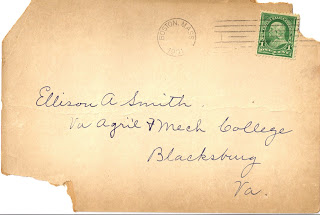
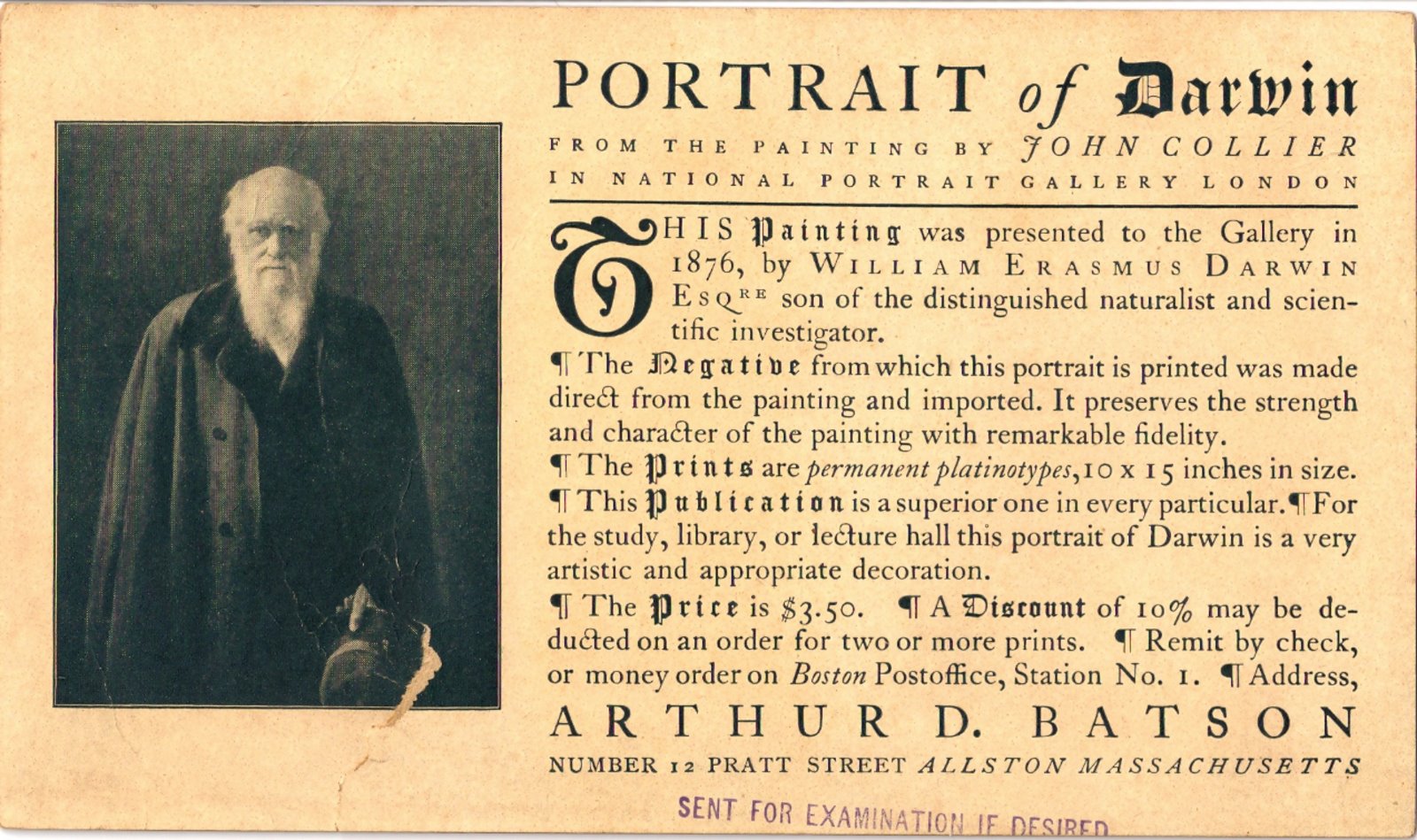
Just starting a new thread here — my favorite evolution stuff.  And here is one.  It is a post card that I found inside a 1880s version of Origin of Species that I bought at a used book store.  The book was part of a collection from Ellison A. Smith which was being sold at a used book store in Georgetown many years ago.  I bought a bunch of old evolution books and inside many of them were post cards advertising portraits of some of the authors.  Here is one — advertising a portrait of Darwin.  Wish I had the portrait …

Is boycotting the right way to deal with anti-evolution sentiment?

Adam Nossiter in the New York Times is reporting that the Society for Integrative and Comparative Biology (SICB) has decided to in essence boycott New Orleans as a site for a future conference. They are doing this in response to a bill passed last year by Louisiana that is considered by many to be a hidden way to introduce religion into scientific teaching (the Times says the bill “allows teachers to “use supplemental textbooks” in the classroom to “help students critique and review scientific theories.”). The SICB wrote a letter to Governor Jindal saying

“It is the firm opinion of S.I.C.B.’s leadership that this law undermines the integrity of science and science education in Louisiana,” 

and

“The S.I.C.B. leadership could not support New Orleans as our meeting venue because of the official position of the state in weakening science education and specifically attacking evolution in science curricula,” “As scientists, it is our responsibility to oppose anti-science initiatives.”

I note that they are going to hold their meeting in Salt Lake City instead, which at least in regard to science evolution and science education and state policy, is a bit better (e.g.,the Utah State Board of Education has made it clear it supports teaching evolution (see here)).

Along with the letter, a group called the Loiuisiana Coalition for Science has issued a press release saying that the state is “reaping what is sowed” by passing the bill.

So the question I have been asking myself is – is a boycott the right thing to do here? I am not sure. On the one hand, I commend SICB for taking a public action that is more than just words. I think it is pretty clear that this bill was designed as a backdoor way to allow religion beliefs to shape what is taught in public school science classes, which is sad. In response to this, I think scientists should do something more than just say this is a bad idea so at least SICB did something.

On the other hand, a boycott is perhaps a bit extreme and comes with many complications. In many cases, engagement is probably a better strategy. It is ironic in a way for a science group to be taking a George Bush-esque approach to dealing with disagreement. I guess I lean away from the boycott step not because it seems completely wrong, but because it seems a bit premature. Perhaps AICB could have held the conference there and organized a series of public discussion about science teaching. And on top of that they could have made a small contribution to a community that has been really hit hard recently.