Eisen Lab Blog

Faculty Positions at #UCDavis in Disease Biology (1 in Entomology, 1 in PlantPath)

UC DAVIS FACULTY POSITION ANNOUNCEMENTS

UC Davis is recruiting two faculty, one each in Entomology and Plant Pathology, to work on organisms related to disease biology. These hires are part of a number of recent and potential future hires in research and teaching in vector-borne diseases, virology, and other plant and animal health-related sciences and will complement a vibrant affiliated faculty community on the campus.

ASSISTANT PROFESSOR OF PLANT PATHOLOGY

The Department of Plant Pathology in the College of Agricultural and Environmental Sciences at the University of California, Davis, is recruiting an Assistant Professor of Plant Pathology, with an emphasis in Virology. This is an academic year (9-month), tenure track, Assistant/Associate Professor position that includes translational research and outreach relevant to the mission of the California Agricultural Experiment Station (AES). The successful candidate is expected to develop an independent, productive and competitively funded research program in fundamental and/or applied Virology, particularly regarding viruses and/or subviral agents associated with plants. The appointee will be responsible for teaching at the undergraduate level in courses supporting Plant Pathology and the Global Disease Biology major, and at the graduate level in virology supporting the graduate program in Plant Pathology. Mentoring of graduate students, undergraduate student advising, curricular development, participation in and development of outreach programs, and performance of departmental and university service is expected. Applicants should submit curriculum vitae including publication list, a statement of research and a separate statement describing teaching interests and background, a summary or abstract of the Ph.D. dissertation, and the names, addresses including e-mail, and telephone numbers of three references online at https://recruit.ucdavis.edu. A statement of contributions of diversity is required.

Inquiries should be directed to Dr. Bryce Falk, Search Committee Chair, bwfalk@ucdavis.edu; 530-752-0302. The position will remain open until filled but to ensure consideration, applications should be received by September 1, 2016. A more detailed job description can be obtained at http://plantpathology.ucdavis.edu.

ASSISTANT PROFESSOR OF ENTOMOLOGY

The University of California, Davis, is pleased to announce the recruitment for a tenure-track faculty position in the molecular and cellular basis of arthropod vector-human pathogen interactions. The successful candidate will join the Department of Entomology and Nematology in the College of Agricultural and Environmental Sciences at the rank of Assistant Professor. Criteria for appointment include: a Ph.D., M.D./Ph.D., or D.V.M./Ph.D. in Entomology or an appropriate field of Life or Biomedical Sciences, a record of excellence in scholarly research, and demonstrable potential to establish a competitively-funded research program. The appointee will be responsible for teaching undergraduate courses in Entomology and/or Animal Biology, be actively involved in undergraduate advising, curricular development and department and university service. The appointee is also expected to guide and mentor graduate students and participate in research and outreach/engagement programs consistent with the mission of the California Agricultural Experiment Station.

Applicants should submit materials via the following website: https://recruit.ucdavis.edu. Additional inquiries can be directed to Dr. Shirley Luckhart, Search Committee Chair, Professor, Department of Medical Microbiology and Immunology (School of Medicine) and Department of Entomology and Nematology (College of Agricultural and Environmental Sciences), Email sluckhart@ucdavis.edu. The position will remain open until filled but to ensure consideration, applications should be received by September 1, 2016.

UC Davis is an affirmative action/equal employment opportunity employer and is dedicated to recruiting a diverse faculty community. We welcome all qualified applicants to apply, including women, minorities, veterans, and individuals with disabilities.

PostDoc at UC Davis on Prunus replant disease (PRD) (including microbiome related studies)

Postdoctoral Scholar

Position Available

Plant Pathology Department

University of California, Davis Campus

Job Details:

The successful candidate will conduct basic and applied research contributing to sustainable management of Prunus replant disease (PRD; a soilborne disease complex), especially as it affects almond orchards. Areas of focus will include (i) metagenomic and transcriptomic examinations of PRD and (ii) optimization of soil-amendment-based strategies, including anaerobic soil disinfestation, to manage the disease. The research will be conducted in lab, greenhouse, and field settings. The lab is committed to development of sustainable, practical management strategies for soilborne diseases of fruit and nut trees. Lab team projects include determining etiology of emerging diseases, development of soil-amendment-based control strategies for soilborne diseases, and development of rootstocks that resist key soilborne pathogens. The desired start date for this postdoctoral position is no later than July 1, 2016.

Qualifications:

The position requires a recent Ph.D. degree in plant pathology, soil microbiology, or a closely related field. Knowledge and experience with modern molecular methods used in environmental examinations (e.g., extraction and purification of nucleic acids from complex samples, PCR, metagenomics, transcriptomics, proteomics), experience with plants, and high motivation to solve complex agricultural problems will be essential. Knowledge and experience in bioinformatics are desirable.

Application Materials:

To apply, please provide (1) a cover letter that captures your related interests, experiences, and career goals, (2) a current CV, (3) contact information for three references that may be consulted, and (4) a listing of pertinent coursework (unofficial transcripts may be used). Please email all application materials, combining where possible into a single pdf file, to Dr. Greg Browne: gtbrowne

Work location: USDA-ARS lab, Plant Pathology Department, UC Davis, One Shields Ave, Davis, CA 95616, USA. Position will involve travel to various field sites in California. UC Davis is a Land Grant University. For more information, see https://www.ucdavis.edu/

For additional information, contact Dr. Greg Browne, (530)754-9351 or gtbrowne

Salary commensurate with experience, per the UCD postdoc pay scale (see

)

Desired start date is July 1, 2016. Preference will be given to applications received by June 10, 2016.

UC is an AA/EO employer

UC Davis is a smoke and tobacco free campus effective January 1, 2014. Smoking, the use of smokeless tobacco products, and the use of unregulated nicotine products (e-cigarettes) will be strictly prohibited on any UC Davis owned or leased property, indoors and outdoors, including parking lots and residential space.

BrownePostdocPositionAvailableAd fin(004).docx

Lee Kump 6/1 at #UCDavis – How did the atmosphere become oxygen-rich?

________

Seminar Announcement

The Dept. of Earth and Planetary Sciences is hosting the Eldridge Moores Distinguished Visiting Scholar, Professor Lee Kump of Penn State University who will be delivering the Distinguished Lecture “How did the atmosphere become oxygen-rich?” at 4:10 pm June 1st in 55 Roessler Hall.

Please see the attached flyer for details -an abstract follows as well.

How did the atmosphere become oxygen-rich?

Two things are certain about the history of atmospheric oxygen: when Earth first formed, there was none, and today we have 21%. To piece together the rest one uses geological, isotopic and biological proxies and tolerances. Most scientists now agree that the Archean (prior to 2.5 billion years ago) the atmospheric was essentially anoxic except, perhaps, for geologically brief intervals of oxygenation. Then, with the transition from the Archean to the Proterozoic Eon, the atmosphere passed through a low threshold set by the appearance of mass-independent sulfur isotope fractionation of some 1/100,000th of the modern level. How high it rose is unclear, but the proxies suggest a Proterozoic atmosphere of 0.1 to 1% of modern oxygen levels and a second rise into the Phanerozoic to near modern levels.

This talk will focus neither on the timing of these stepwise increases nor on an assessment of the constraints on oxygen level. Rather it will explore the long-term drivers and feedbacks that together may explain why atmospheric oxygen levels followed this trajectory. The first topic is the initial rise (the Great Oxidation Event) at 2.4 Ga, an enigma because of indications that oxygenic photosynthesis was invented and exploited globally long before then. We propose that a shift in the dominant style of volcanism from submarine in the Archean and subaerial in the post-Archean, tied to the stabilization of the continental cratons, can account for this first rise in atmospheric oxygen.

The second rise, in the Neoproterozoic, is even more challenging to explain. We explore the hypothesis that it was tiedl to the “greening” of the land surface, i.e., the establishment of biotic soils with fungi that not only accelerated weathering whose metabolic wastes, together with their microbial collaborators, led to oxygen depletion in soils. To restore the balance between O2 production during organic carbon burial and O2 consumption during weathering, the O2 level had to rise.

Neither of these hypotheses has exceptionally strong support, so the take-home message is that the stepwise oxygenation of the atmosphere had to be the result of fundamental and permanent changes in the exogenic cycle; it can’t be the result of events (such as organic carbon burial events).

MooresScholar_LeeKump2016_v2.pdf

Today at #UCDavis: Kabir Peay on ‘Microbes, mutualism and the nature of soil biodiversity’

Kabir Peay

Stanford University

"Microbes, mutualism and the nature of soil biodiversity"

4:10pm

Social Sciences 1100.

Abstract: Microbes are a critical component of the diversity and function of ecosystems. Among microbes, fungi are key regulators of decomposition rates, facilitate plant nutrient uptake and have a profound impact on agriculture and industry. Technical breakthroughs in DNA sequencing have revealed incredible fungal diversity, and shown that fungal symbioses are ubiquitous in plants. Despite this, there is still a limited understanding of the ecological and evolutionary forces that structure high diversity fungal communities, and how fungal symbioses influence plant community structure and function. My lab uses a combination of ecological theory, molecular biology techniques, and field and laboratory experiments to study fungal communities in terrestrial soils. In particular, I focus on fungi involved in mycorrhizal symbiosis, the most common form of plant-microbe mutualism. My research is focused on three linked topics: (i) how fungal communities assemble at both local and continental scales, (ii) how the structure of fungal communities influences decomposition and nutrient availability, and (iii) how nutrient uptake through mycorrhizal symbiosis to influences plant growth. By integrating these three topics I hope to build a ‘roots-to-biomes’ understanding of ecological communities and ecosystem function.

#UCDavis summer program on “Girls Saving the World through Engineering”

The UC Davis Department of Civil and Environmental Engineering will be offering a free five day camp will engage girls in sustainable engineering design: "Girls Saving the World through Engineering." Through hands-on activities, design challenges, and discussions, girls will 1) understand how civil engineers help the public through environmentally-friendly, cost-effective solutions; 2) discover emerging areas in civil engineering, including bio-inspired design, and 3) envision different pathways to engineering and for engineers. The camp is funded by the National Science Foundation and organized through the Center for Bio-mediated, Bio-inspired Geotechnics. The Center focuses on ecologically friendly, cost-effective solutions, inspired by nature, for development and rehabilitation of resilient and sustainable civil infrastructure systems. It serves as a nexus for two transformative trends in engineering: biologically-based design and sustainability.

Please see our registration website for more information: https://www.eventbrite.com/e/girls-saving-the-world-through-engineering-day-camp-tickets-24789427846.

Dates: July 25th to July 29nd (9am – 4pm)

Location: 1065 Kemper Hall, UC Davis

Ages: Girls entering 3rd, 4th and 5th grades

Logistics: Breakfast, lunch and snacks will be provided for students. The camp will run from 9am to 4pm each day. To allow for transportation flexibility, students can be dropped off between 8am and 9am and picked up between 4pm and 5pm each day.

Register Online at http://www.eventbrite.com/e/girls-saving-the-world-through-engineering-day-camp-tickets-24789427846

Contact: Colleen Bronner, Ph.D. (cebronner

Program Fellow position at the Gordon and Betty Moore Foundation in Symbiosis

Well, this could be a nice job …

The Gordon and Betty Moore Foundation’s science program supports exceptional scientists, invests in new technologies, and brings together new scientific partnerships. We believe in the inherent value of science and the sense of awe that discovery inspires. We believe that unleashing the potential of inquiry and exploration not only leads to scientific progress, but can also deliver important societal benefits. We take risks and look for opportunities to transform or create entire fields.

To complement activities in the Marine Microbiology Initiative (MMI) and other current science program grantmaking, we seek a program fellow to explore opportunities for further foundation impact in the realm of symbiosis. Here, we refer to symbiosis as the interactions between microbes (bacteria, archaea, and protists) and animals, plants, fungi, and other microbes. We also consider the role of viruses in these relationships. We consider symbiosis broadly in terms of habitat (terrestrial and marine), degree of interdependence (transient, obligatory, endosymbiotic, and that which results in organelle evolution), and time (ancient to modern).

https://www.moore.org/about/careers?gnk=job&gni=8a7886f854bce6550154bf941c3b639b

Program Fellow Science Symbiosis.pdf

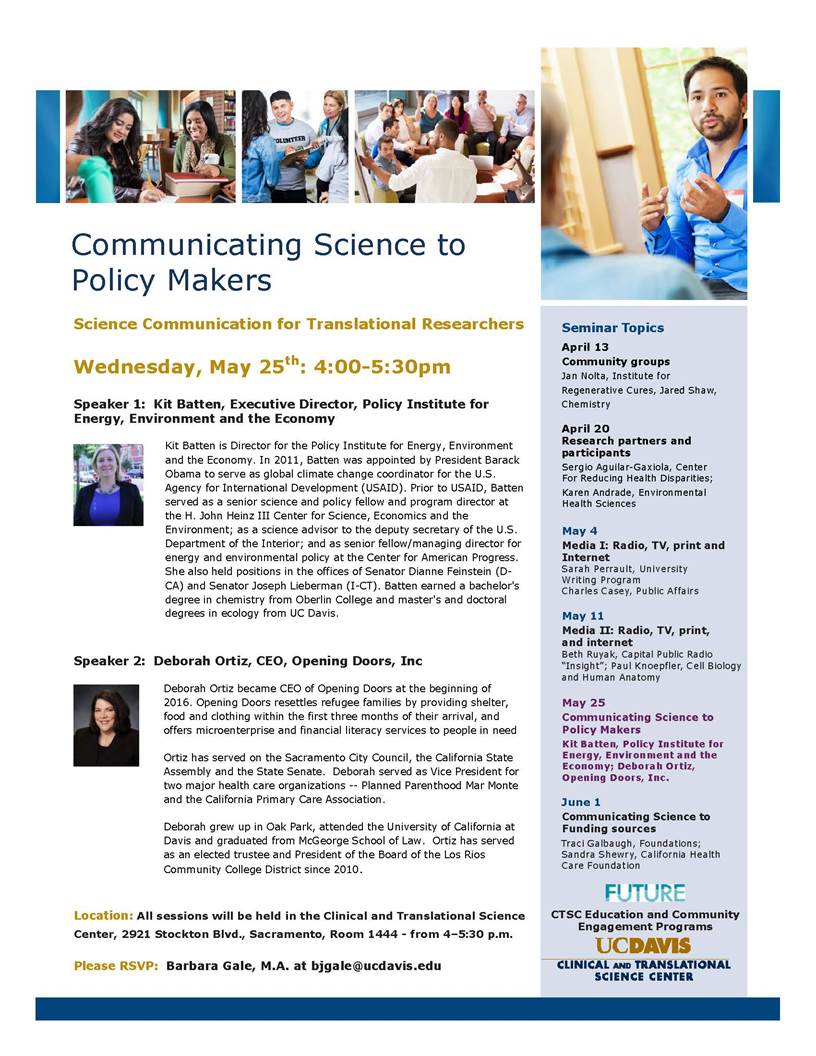
Communication Science to Policy Makers” May 25 – Kit Batten and Deborah Ortiz

From: bounce-315852-23241907
Date: May 17, 2016 at 3:34:18 PM PDT
Cc: “Linda A Ziegahn” <laziegahn>
Subject: CTSC ANNOUNCEMENT: Science Communication Seminar Series – “Communication Science to Policy Makers” May 25 – Kit Batten and Deborah Ortiz

Communicating Science to Policy Makers 5-25-16.pdf

Pleasantly surprised by the National Microbiome Initiative

So I got this email a few weeks ago inviting me to the White House.
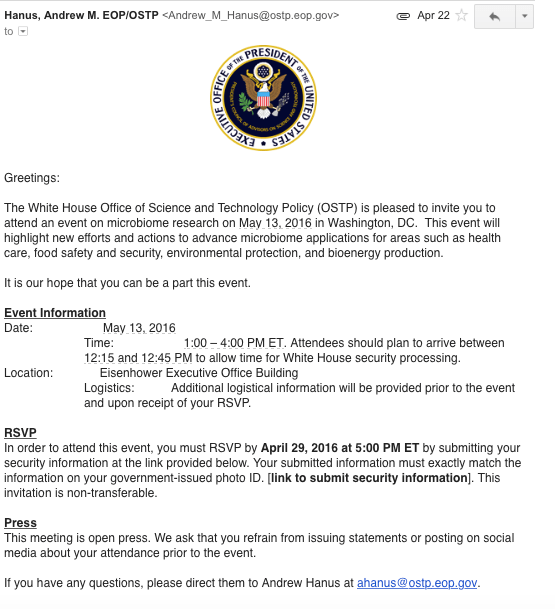
Not every day that I get invited to the White House.  And I thought I was probably on their shit list after removing my name from the “Unified Microbiome Initiative” paper due to it being non open access.  So I asked a colleague if she could teach in my large introductory biology class for me on May 13 and she said yes.  So I RSVP to the meeting and told my mom I would be coming to the DC area (where I grew up).  And I told everyone, proudly “I am going to the White House”.

I realized I had a tight schedule for flying in and out since I had to be back in Davis Saturday AM.  So I wrote to the White House to ask about the schedule for the event.  You see, I had no information as to what this event was going to be about.
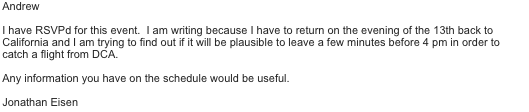
And, they did tell me this would work although they would not tell me what the meeting was about.

I then bought my tickets and got excited to be going to the White House.  However, fate would not be so kind to me.  My daughter got sick last week (bronchitis, and multiple spin off issues) and so I started to wonder if I really should go away.  So I tried to find out what was happening at this event.  I wrote a few friends who I knew were going and one of them told me there would be a series of talks and another told me they did not know.  So – without much other information to go on, and with a strong desire to take care of my daughter as much as possible, I cancelled my trip.

Then yesterday I got an email from a NY Times reporter

And so we connected and talked for a bit.  I found out from the phone call that the White House was announcing their Microbiome Initiative (which I knew was in the works but for which I basically knew no details).  The reporter Gardiner Harris asked me how I felt about “Big Science” types of projects and, well, I did not say nice things about them.  And I stand by those critiques of Big Science.  I talked about how I disliked the Human Microbiome Project in many ways because it fed too much money to a few groups and was prone to the same problems of other Big Science projects.  And that they were generally a waste of money.  We also discussed how I thought science worked better when administrators got out of the way and let peer review have more of a role in determining what was important.  And I said that if the new White House initiative was another top down science effort, then this would likely be a bad thing.  Or something like that.  But I did also say that I had no idea what the White House was going to announce about and I hoped it was more supportive of small science.

So the article came out and I was featured in it
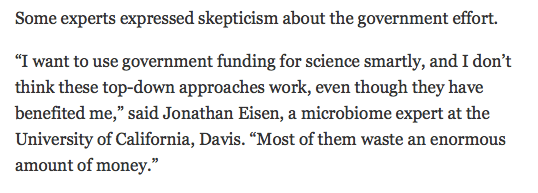
Definitely something I stand by.  I think top-down approaches to science do not work well.

I woke up early this AM and started posting about the evils of Big Science.  And then I finally found an announcement with actual details on the National Microbiome Initiative being announced today.  And I was pleasantly surprised.  This was not about a big, top down approach to science.  It was more about a collection of projects under one big umbrella theme of microbiome studies.
Yes there were some top down aspects to it.  But only a component. So once I saw this, I realized my quote in the NY Times was not ideal.  Yes Big Science is bad.  But this National Microbiome Initiative is not really the standard bearer of Big Science.  It is not really even Big Science.  It is more   of a “Organizing Distributed Science”.

And I found one article out there about the project that captured this essence of it:  The White House Launches the National Microbiome Initiative  by Ed Yong in the Atlantic. He nails it with this section

The National Microbiome Initiative is not the Human Genome Project—a single project with a definitive goal. It consists of many organizations operating independently; to paraphrase Whitman, it contains multitudes.

So my quote in the NY Times was technically correct – Big Science is bad.  But it also not quite right in the context it is presented – since the NMI is actually not really (or at least not completely) Big Science.  I do wish the context of the quote had been presented a bit more  (well, more specifically that I did say I did not know the full details of what they were actually proposing).  Lesson learned.  Be really careful about commenting about things “generally” without knowing the details.  I definitely regret doing that here.  I did in fact say what is reported so can’t complain about being misquoted.  But I should have been more careful regarding the caveats and context.

I note – it is unclear to me how much of these smaller distributed projects would have happened without the NMI.  My guess is most of them would have happened and that the NMI is a bit of a public relations effort.  Ed Yong also captured this issue in his piece:

A cynic might be forgiven for seeing this as an exercise in branding, encapsulating what microbiome scientists were already doing under a catchy umbrella.

And I also worry as always that “Microbiomania” (hype about the microbiome) will get worse with this announcement of the NMI.  And it probably will.

But in the end I am very happy that this is not a run of the mill top down Big Science project (like the Human Genome Project or the Human Microbiome Project or the Human Brain Project).  It is much more nuanced than that.  Much more distributive.  Much more likely to support small science and creative science and such.  And that is a good thing.

True Must See TV: John Oliver on Science, Hype, and Science Reporting

This is really really really worth watching. I was pointed to it by dozens of people. And they were all right about it. Thanks people.
 

Also see these stories about it

5/17 at #UCDavis Brandon Cooper “Wolbachia frequency variation in space and time in a hybridizing host clade”

***** CPB Seminar Reminder for Tuesday, May 17, 2016, 4:10pm in 1022 Life Sciences *****

Speaker: Brandon Cooper
Postdoctoral Researcher, UC Davis
Title: “Wolbachia frequency variation in space and time in a hybridizing host clade”
Host: Michael Turelli

The entire CPB Seminar schedule for Spring Quarter 2016 is available here.