Posted video of a recording I made of a talk for BIATA2021 meeting. Phylogenomic Case Studies: The Benefits (and Occasional Drawbacks) of Integrating Evolutionary and Genomic Studies
Slides here

Posted video of a recording I made of a talk for BIATA2021 meeting. Phylogenomic Case Studies: The Benefits (and Occasional Drawbacks) of Integrating Evolutionary and Genomic Studies
Slides here
PR from MPG here: Symbionts without borders – Bacterial partners travel the world
Authors:
Significance (from the paper)
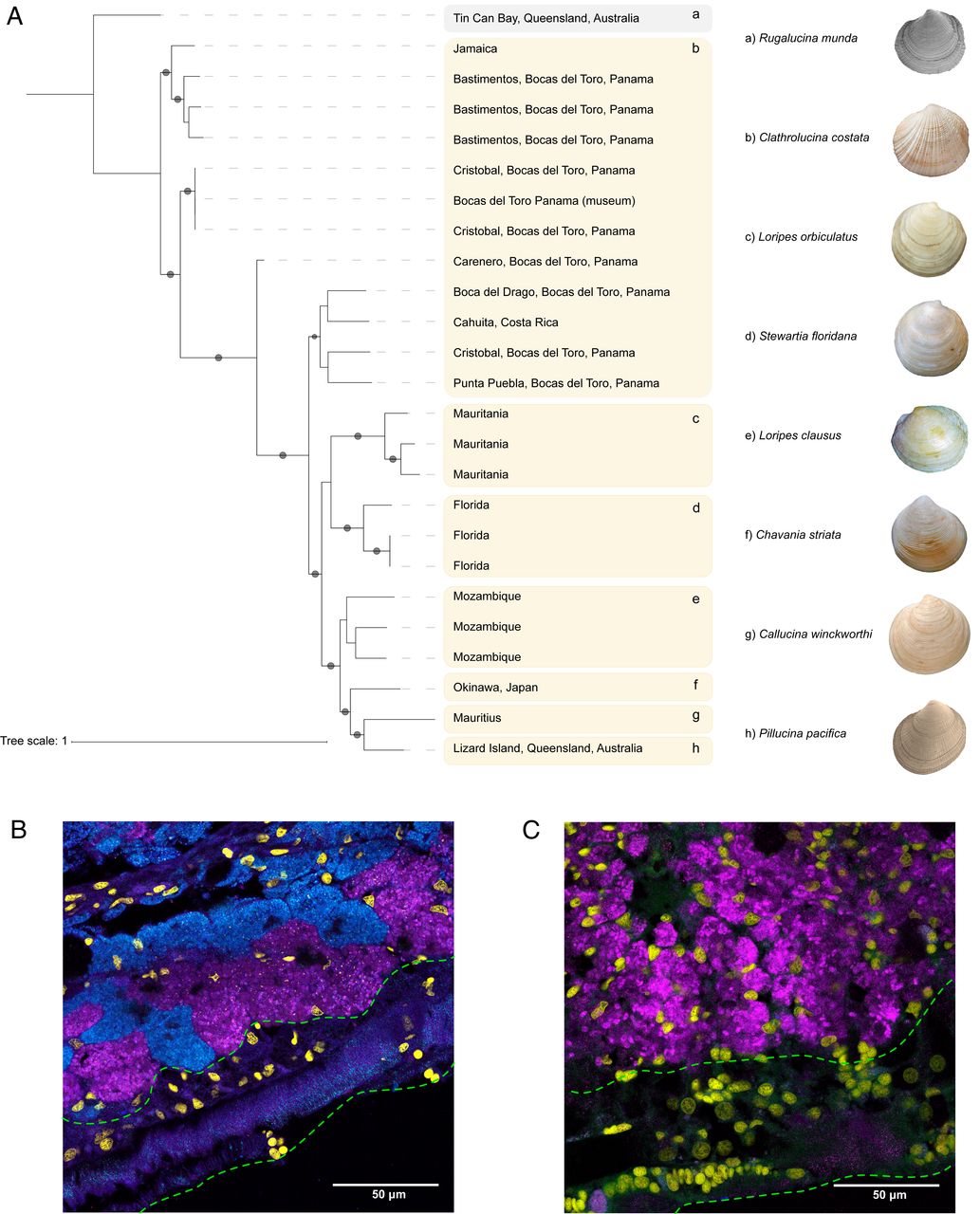
Knowledge of host–symbiont biogeography is critical to understanding fundamental aspects of symbiosis such as host–symbiont specificity. Marine animals typically acquire their symbionts from the environment, a strategy that enables the host to associate with symbionts that are well-suited to local conditions. In contrast, we discovered that in the chemosymbiotic bivalve family Lucinidae several host species distributed across the globe are all associated with a single cosmopolitan bacterial symbiont. The genetic cohesiveness of this global symbiont species is maintained through homologous recombination across its extensive geographical range. The remarkable flexibility in the lucinid association is advantageous to both host and symbiont as it increases the likelihood of locating a compatible partner across diverse habitats spanning the globe.
In the ocean, most hosts acquire their symbionts from the environment. Due to the immense spatial scales involved, our understanding of the biogeography of hosts and symbionts in marine systems is patchy, although this knowledge is essential for understanding fundamental aspects of symbiosis such as host–symbiont specificity and evolution. Lucinidae is the most species-rich and widely distributed family of marine bivalves hosting autotrophic bacterial endosymbionts. Previous molecular surveys identified location-specific symbiont types that “promiscuously” form associations with multiple divergent cooccurring host species. This flexibility of host–microbe pairings is thought to underpin their global success, as it allows hosts to form associations with locally adapted symbionts. We used metagenomics to investigate the biodiversity, functional variability, and genetic exchange among the endosymbionts of 12 lucinid host species from across the globe. We report a cosmopolitan symbiont species, Candidatus Thiodiazotropha taylori, associated with multiple lucinid host species. Ca. T. taylori has achieved more success at dispersal and establishing symbioses with lucinids than any other symbiont described thus far. This discovery challenges our understanding of symbiont dispersal and location-specific colonization and suggests both symbiont and host flexibility underpin the ecological and evolutionary success of the lucinid symbiosis.
Acknowledgements (from the paper)
We thank Gustav Paulay (FLMNH, Gainesville, FL), Amanda Bemis, and John Taylor (NHM, London) for providing preserved samples. John Taylor also provided high-resolution images of lucinid clams for Fig. 2. We thank Liz Hambleton (University of Vienna), Miriam Weber, Christian Lott, Boris Unger, Dorothée Makarow, Natalie Elisabeth (University of California, Berkeley), Diana Chin, Tim Oortwijn, and Arthur Curry for providing fresh samples. We also thank Thalassa for 300 million y of sheltering lucinids. We are grateful to Stephanie Markert for providing access to the proteomics data, Ipek Yamin Meric and Nora Grossschmidt for helping with DNA extractions, Marina DeLeón for help with fieldwork and travels in Costa Rica, Cassandra Ettinger for early discussions of the study, and Guillaume Jospin for support with the bioinformatic analyses. We thank Xavier Didelot for discussions on the recombination analysis. L.G.E.W. was supported by Grant GMBF5603 from the Gordon and Betty Moore Foundation (J.A.E. was Principal Investigator on the same grant). The work was also supported by the European Research Council Starting Grant EvoLucin and a Vienna Research Grant for Young Investigators from the Vienna Science and Technology Fund (WWTF, VRG14–021) and the Austrian Academy of Sciences. Sequencing was carried out at the DNA Technologies and Expression Analysis Cores at the University of California, Davis Genome Center (supported by NIH Shared Instrumentation Grant 1S10OD010786-01), the Biomedical Sequencing Facility at CeMM (https://www.biomedical-sequencing.org/) in Vienna, Austria, and at the Joint Microbiome Facility (JMF) of the Medical University of Vienna and the University of Vienna (project ID 1911-1). Thanks to Petra Pjevac and Gudrun Kohl for sample processing at JMF. The gill embedding was performed by the Histopathology Facility at Vienna BioCenter Core Facilities, a member of the Vienna BioCenter, Austria.
Funding: Gordon and Betty Moore Foundation (for the part from my lab at least). Part of a collaboration with STRI.
David Coil has been coordinating a project to do air filter testing for Sars-CoV-2 in Davis, CA schools in collaboration with Heather Bischel, Karen Shapiro, Roque G Guerrero, Randi Pechacek, and others. This has been supported by the Healthy Davis Together project.
Recently there have been a few news stories about this work and I thought I would post some links here.
KCRA: Here’s the new way COVID-19 testing is happening at 2 Davis schools
Woodland Daily Democrat: Davis Joint Unified School District prepares against COVID-19 with air filters
Also see UC Davis Live on this topic: https://www.ucdavis.edu/news/media-advisory-uc-davis-live-back-to-school-safely
And see the Healthy Davis Together page on this: https://healthydavistogether.org/airfiltertesting/
A new paper is out from the lab from a large collaboration between UC Davis and Colorado State University.
This was supported by a grant from the UC Davis Innovation Institute for Food and Health.
My lab has been involved in a collaboration with many others at UC Davis on studying SARS-CoV2 in surface samples from the UC Davis hospital. A preprint of a paper on this topic has been posted to medRxiv with David Coil as the first author. See: SARS-CoV-2 detection and genomic sequencing from hospital surface samples collected at UC Davis | medRxiv
See Isolation and sequence-based characterization of a koala symbiont: Lonepinella koalarum
Paper based on PhD thesis work of Katie Dahlhausen and wrap up of analysis led by Laetitia Wilkins.
Full citation:
2020. Isolation and sequence-based characterization of a koala symbiont: Lonepinella koalarum. PeerJ8:e10177 https://doi.org/10.7717/peerj.10177
Acknowledgements. We thank Céline Caseys ORCID: 0000-0003-4187-9018 for her idea to search eggNOG annotations against KEGG Class 1.11 Xenobiotics biodegradation and metabolism pathways; Chris Brown ORCID: 0000-0002-7758-6447 for his script to download assemblies in batch from GenBank; Cassandra L. Ettinger ORCID: 0000-0001-7334-403X for valuable comments on the pangenome analysis and help with revising the figures. We also thank Dr. Joseph Gillespie ORCID: 0000-0002-5447-7264, Dr. Raphael Eisenhofer ORCID: 0000-0002-3843-0749 and two anonymous reviewers for comments on the submitted manuscript. Isolate 16S Sanger sequencing was performed at the UC Davis College of Biological Sciences DNA Sequencing Facility.
TODAY:
MIC 291: Selected Topics in Microbiology
Work-in-Progress Seminars
Associate Professor Clarissa Nobile
UC Merced
Molecular & Cell Biology
“Candida albicans biofilms: Importance, regulation, and a serendipitous discovery”
Wednesday, February 19, 2020
4:10 pm
1022 Life Sciences
Clarissa Nobile flyer, Feb 19 2020.pdf
Peter Turnbaugh, Ph.D.,
MMI 291 Seminar Series,
Friday, February 14, 2020.
"Eating for Two Trillion: Reciprocal Interactions between Diet and the Human Gut Microbiome”
12:10 pm
GBSF 1005.

This weeks Entomology and Nematology Seminar:
Dr. Corrie Moreau
Cornell University
"Piecing Together the Puzzle to Understand the Evolution of the Ants: Macroevolution to Microbiomes"
Briggs 122 at 4:10PM, Wednesday January 15, 2020
A summary from her lab website:
Research in our lab focuses on the symbiotic factors that drive speciation, adaptation, and evolutionary diversification. We use ants and other insects to tease apart the factors that influence patterns of evolution – from the rise of the flowering plants, symbioses ants have with other insects and plants, and their gut-associated microbial community are all potential underlying factors that may have facilitated their ecological dominance in almost all terrestrial ecosystems.
More at her website:
Moreau lab
Posting this email I received about an interesting talk on January 13.
Ironically, I have jury duty that AM so not sure if I can make it.
————–
Dear Davis Community,
This coming Monday, January 13th, California Supreme Court Justice Mariano-Florentino Cuéllar will join The UC Davis Forums on the Public University and the Social Good in conversation regarding the legal implications of the challenges facing higher education today.
In this wide-ranging discussion moderated by Associate Vice Chancellor for Academic Diversity Raquel Aldana, Justice Cuéllar will speak on the legal implications of the challenges facing higher education today. In light of recent national discussions over such issues as admissions policies and practices, Statements on Contributions to Diversity and Equity, immigration policies, and DACA, Justice Cuéllar will address how UC Davis might remain a leader in setting current policies and practices that are both true to its mission and legally defensible. Taking the long view from his years of experience working on issues of equity and excellence, Justice Cuéllar is in a unique position to reflect on the import of college access in the context of the California Master Plan for Higher Education.
This conversation-style Forum will take place Monday, January 13th, 2020 in the Multipurpose Room (2nd Floor) of the Student Community Center. The Forum is from 3 to 4:30 PM with a reception to follow.
Please RSVP on our Eventbrite page here.
For more information about this Forum, please visit the links or view the flyer below.
We look forward to seeing you there.
facebook./com/ucdavisforums