Eisen Lab Blog

At #UCDavis 3/9: “Authorship and the Promises of Digital Dissemination,”

20160309_ucdavis_poster_smallA cross-disciplinary panel discussion on authorship in the digital age, with a focus on the specific goals and needs of academic authors.Authors who write to be read care about how their works are published and what that means for reader access. While traditional options and copyright arrangements still predominate in many fields, there are ever-increasing ways to share works of authorship. What works best to get textual and visual works out there and under what circumstances? Join us for this panel discussion with Authors Alliance, where we will explore the opportunities and challenges authors face in maximizing the reach of their work, both in and outside of academia.

20160309_UCDavis_poster_small.pdf

Nina Jablonski talk at #UCDavis on Evolution of Skin Pigmentation

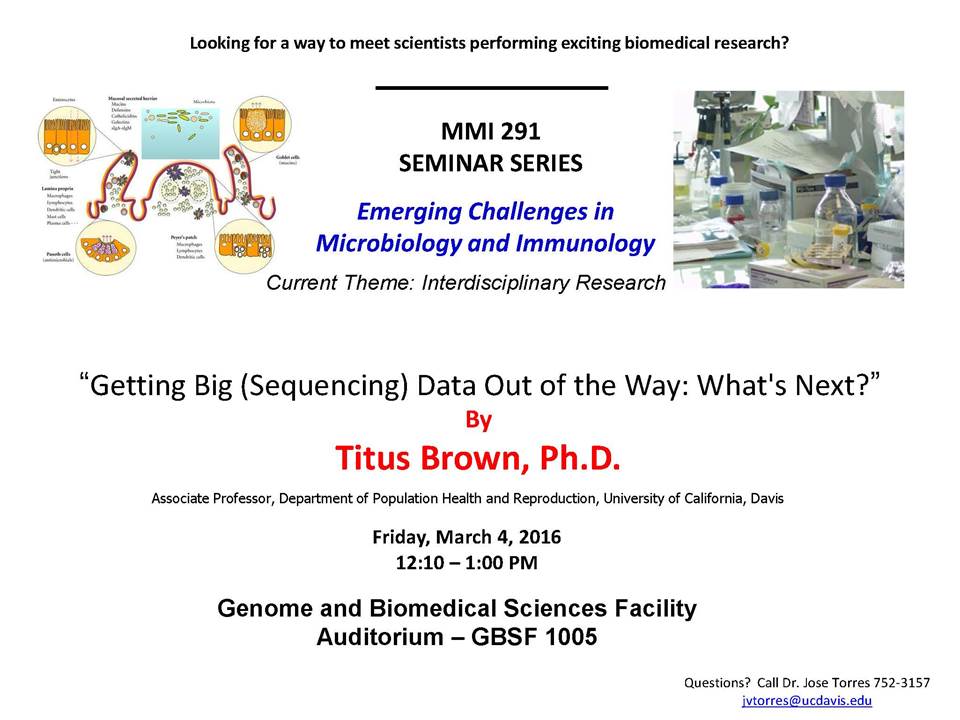
Titus Brown at #UCDavis 3/4: Getting Big (Sequencing) Data Out of the Way: What’s Next

Brown.pdf

3/9 at #UCDavis: Workshop: Authorship and the Promises of Digital Dissemination


AUTHORSHIP AND THE PROMISES OF DIGITAL DISSEMINATION

Wednesday, March 9, 4:00- 5:45 pm

UC Davis School of Law, King Hall, Rm 2100A

A cross-disciplinary panel discussion on authorship in the digital age, with a focus on the specific goals and needs of academic authorsAuthors who write to be read care about how their works are published and what that means for reader access. While traditional options and copyright arrangements still predominate in many fields, there are ever-increasing ways to share works of authorship. What works best to get textual and visual works out there and under what circumstances? Join us for this panel discussion with Authors Alliance, where we will explore the opportunities and challenges authors face in maximizing the reach of their work, both in and outside of academia.

Participants:
Mario Biagioli (Law, STS)
Stephanie Boluk (English)
Jonathan Eisen (Biology)
Alexandra Lippman (STS)
Rick Prelinger (UCSC and director of the Prelinger Archive)
Kim Stanley Robinson (Mars Trilogy)
Pam Samuelson (Authors Alliance)
MacKenzie Smith (Library)
Madhavi Sunder (Law)

Today at #UCDavis Gerald Quon “Regulatory genomics approaches to prognosis prediction and interpretation of ge netic variation”

Regulatory genomics approaches to prognosis prediction and interpretation of genetic variation”

Professor Gerald Quon
UC Davis Genome Center

2:10 p.m., Friday 2/26/16, in LSA 1022

Omics technologies can play an important role in many aspects of the management of human health, ranging from the prediction of patient prognosis and response to treatments, to interpretation of genetic variation associated with complex diseases and identification of drug targets. However, the widespread adoption and success of omics technologies in the clinic is still relatively limited due to technical and biological challenges in data collection and interpretation. My research focuses on developing machine learning and statistical approaches to address these challenges, and in this talk, I will discuss two examples. First, I will demonstrate how we have improved transcriptome-based prediction of cancer patient prognosis by developing a computational model to perform in silico micro-dissection of heterogeneous tumor samples. Second, I will present a novel statistical model that predicts the functional impact of non-coding genetic variation associated with complex diseases, and show how we have used this model to gain insight into type 2 diabetes and cholesterol genetics.

Richard Sharp talk 3/2 at #UCDavis on Ethical Issues in Precision Medicine

Today at #UCDavis: Major Issues in Modern Biology – Dr. Nina Jablonski

Help look for lost Raptor Center Swanson’s hawk near #DavisCA

Positing this email that I received:

Hi,

The California Raptor Center (located in UCD’s South Campus) lost its education Swainson’s hawk on Wednesday night or Thursday morning during the storm that came through recently. We need help looking for him. Please e-mail Bret at bcstedman if you have any leads.

He can’t survive for very long in the wild. He is virtually blind in one eye and can hardly see through the other, but he can fly. With the strong winds we’ve been having, we have no idea where he might be at this point.

He’s a light-morph Swainson’s hawk. Here’s what he looks like while out for an education/outreach program: https://thetideline.files.wordpress.com/2015/06/swainsons-hawk-2.jpg

One distinguishing characteristic from other Swainson’s hawks that may be visible are the leather anklets he has on both legs. If you get a good look at him, you may also see a bald spot above his right eye.

Thanks!

P.S. Please feel free to distribute this message to any other birding/wildlife/nature groups who could help with the search. The more eyes we have looking for him, the better.

Jill Bible Exit Seminar 3/14: Anthropogenic impacts on native Olympia oysters: understanding the roles of local adaptation and multiple stressors

Hello all,

Announcing Jill Bible’s Exit Seminar on March 14th at the Bodega Marine Laboratory:

March 14 Monday
Bodega Marine Laboratory
Jill Bible, Ph.D. candidate, Ecology Graduate Group, UC Davis
Exit Seminar: “Anthropogenic impacts on native Olympia oysters: understanding the roles of local adaptation and multiple stressors”

BML Seminar Spring 2016.pdf

Monday at #UCDavis Gene Robinson “Me to We: Using Honey Bees to Find the Genetic Roots of Social Life”

Chancellor’s Colloquium Distinguished Speaker Series

Gene E. Robinson (2.22.16)

"Me to We: Using Honey Bees to Find the Genetic Roots of Social Life"

Gene E. Robinson obtained his Ph.D. from Cornell University in 1986 and joined the faculty of the University of Illinois at Urbana-Champaign in 1989. He holds a University Swanlund Chair and is also the director of the Institute for Genomic Biology (IGB) and director of the Bee Research Facility. He is the author or co-author of over 275 publications and pioneered the application of genomics to the study of social behavior, led the effort to gain approval from the National Institutes of Health for sequencing the honey bee genome, and founded the Honey Bee Genome Sequencing Consortium. Monday, February 22, 2016 at 4 p.m. Mondavi Center Studio Theatre.

More information on the series and link to RSVP: http://chancellor.ucdavis.edu/colloquium/