Eisen Lab Blog

Cool opportunity: Postdoctoral Scholar: Disease transmission in societies

http://www.cidd.psu.edu/jobs/postdoctoral-scholar-disease-transmission-in-societies

Postdoctoral Scholar: Disease transmission in societies

Campus/Location: University Park Campus Date Announced: 11/27/2014

Work Unit: College of Agricultural Sciences Job Number: 54802

Department: Entomology

The laboratories of Drs David Hughes, Ephraim Hanks and Matt Ferrari are seeking a Postdoctoral Scholar. This position is in collaboration with the lab of Dr Shweta Bansal at Georgetown University, another position is available at Georgetown University, and funded by the NSF-NIH-USDA-BBSRC Ecology and Evolution of Infectious Disease (EEID) Program. The position is available in the Centre for Infectious Disease Dynamics (www.cidd.psu.edu), The Pennsylvania State University, University Park Campus.

The Postdoctoral Scholar position at Penn State involves the development of mathematical models to understand the transmission of diverse agents inside ant colonies. These agents range from beneficial agents such as food to agnostic agents like beads to detrimental agents such as parasites. The position is a mixture of both theoretical work and empirical work (with ant colonies in a lab setting). Possibilities for both field work and molecular work exist. We are seeking expertise in compartmental models of disease spread and statistical and agent-based models of animal behavior. Candidates should demonstrate a track record of publication; have strong organizational, written, and oral communication skills; and be able to work both independently and as part of a collaborative team. For further information, please feel free to contact Dr Hughes (dph14; +1 814- 863-6073). Interested applicants should submit a curriculum vitae, a 1-2 page statement of research interests that explicitly describes professional qualifications for this position, and contact information for three referees. Review of applications will begin immediately, and continue until a suitable candidate is found.

David Hughes: Hughes, is a behavioral ecologist who has studied social insects and their diseases in 11 countries on 5 continents. He has worked with diverse diseases as well as the behavior of healthy and infected ants under field (rain- and temperate forests) and laboratory conditions. www.hugheslab.com

Ephraim Hanks: Hanks is a spatial statistician and has worked extensively in the modeling of animal movement and connectivity. He has studied the spatial spread of disease in black spruce and mule deer, and the spatial properties of random walk models on networks. http://sites.psu.edu/hanks/

Matt Ferrari: Ferrari is a computational epidemiologist and statistician who has worked extensively on the analysis of time-series surveillance data to predict epidemic dynamics and evaluate management interventions. http://theferrarilab.com/

Shweta Bansal: Bansal is a network epidemiologist and has worked extensively on the effects of immunity on network structure and disease dynamics. She is studying infectious disease-related network structure in several wildlife populations including Australian bottlenose dolphins and Mojave Desert tortoises. Bansal is based in Georgetown University which is 3.5hrs drive away.http://bansallab.com/

California Council on Science and Technology – CCST S&T Policy Fellowship Applications Open

Just received this from the Moore Foundation

Dear Friends and Colleagues,

Please help us spread the word!

We have opened up the application period for the 7th year of CCST Science and Technology Policy Fellowship (see below) that places professional scientists and engineers in the California State Legislature for one-year appointments. We greatly appreciate your help spreading the word about the fellowship program to your colleagues at academic institutions with doctoral programs as well as federal state, and industry labs, alumni organizations and professional scientific organizations. Please forward this email to anyone you feel would be interested in the CCST Science and Technology Policy Fellowship.

The Fellowship program is proving to be an extraordinarily effective way of bridging the science and policy communities. Fellows are actively engaged in the most important policy issues being addressed in California. Energy, healthcare, water, business climate, conservation, security—you name it and we can point to a current or former Fellow in Sacramento working on the topic. See attached for the current cohort of fellows who just began their one-year fellowship.

Applications are due February 28, 2015.

Learn more here: ambermace or (916) 492-0996.

p1x1.gif&c=5977bf80-11cf-11e4-ad73-d4ae52754db0&ch=98071060-11da-11e4-aee6-d4ae52754db0

CONTRIBUTE TO THE SCIENCE POLICY DISCUSSION IN CALIFORNIA…

BY APPLYING FOR A 2015-2016

CCST SCIENCE AND TECHNOLOGY POLICY FELLOWSHIP!

2.png
Offered by the California Council on Science and Technology (CCST), the CCST Science and Technology Policy Fellowship places professional scientists and engineers in the California State Legislature for one-year appointments. The program is designed to enable Fellows to work hands-on with policymakers in addressing complex scientific issues as well as assume all the other legislative responsibilities of full-time legislative staffers. The Legislature benefits from having the expertise of a trained Ph.D.-level scientist, who brings significant analytical, problem solving, research, and communication skills applied through the lens of the scientific method and the Fellows gain an invaluable, hands-on learning experience about the intersection of science, technology, and policy.

Building on the successful and highly acclaimed national model of the Science and Technology Policy Fellowships offered by the American Association for the Advancement of Science (AAAS) in the federal public policy arena, the CCST Science and Technology Policy Fellowship creates a similar interface in the California Legislature. The fellows learn the intricacies of the California legislative process and serve as fulltime legislative staff to provide recommendations, answers to technical questions, and clarification of policy options for a wide variety of issues, including those with science and technology related attributes.

Please explore our website to learn more about the CCST Science and Technology Fellowships and to complete the application and instructions.

Year 6 CCST S&T Fellows[2].pdf

Today at #UCDavis: Zach Lewis on “Influences on the Infant Intestinal Microbiome”

MIC 291: Selected Topics in Microbiology

Work-in-Progress Seminars

Zachery Lewis
Exit Seminar
(Mills Lab)

"Influences on the Infant Intestinal Microbiome"

Wednesday, December 10, 2014

4:10 pm

1022 Life Sciences

Host: Prof. John Roth, Dept. of Microbiology & Molecular Genetics

Lewis 12-10-14.doc

New lab paper: The microbes we eat: abundance and taxonomy of microbes consumed in a day’s worth of meals for three diet types

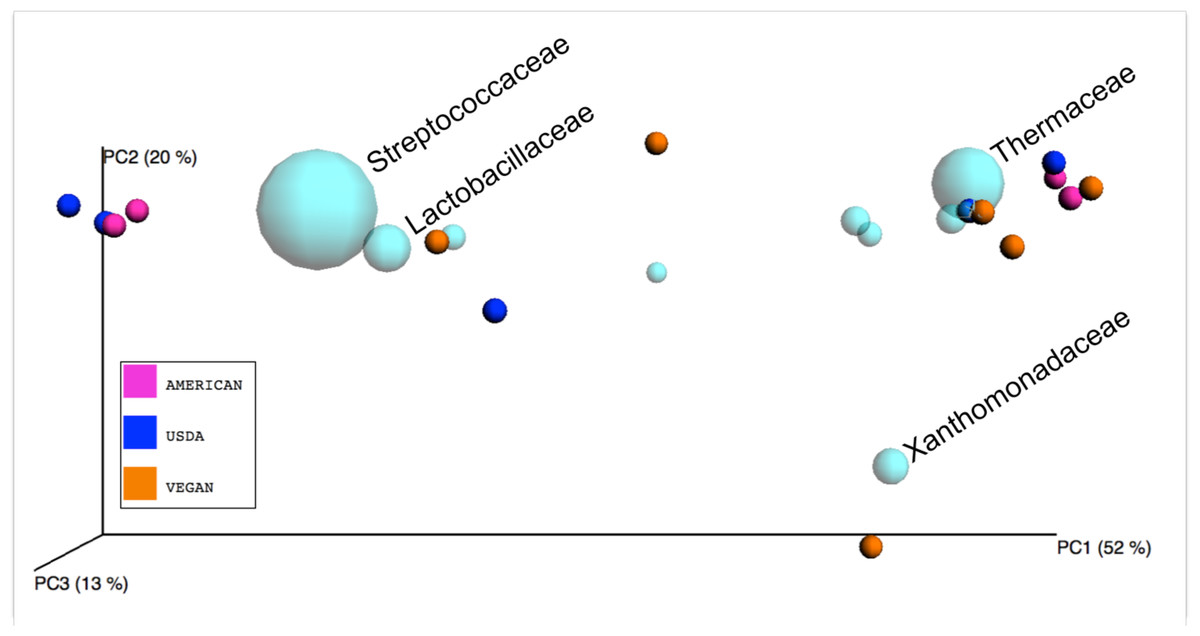
A new paper out from my lab (with Jenna Lang as the 1st author and in collaboration with Angela Zivcovic from the UC Davis Food For Health Initiative and the Department of Nutrition):  The microbes we eat: abundance and taxonomy of microbes consumed in a day’s worth of meals for three diet types.  The work in the paper focuses on characterizing the abundance and taxonomy of microbes in food from three model diets.

Basically, Angela prepared meals for these three diets

Food was purchased and prepared in a standard American home kitchen by the same individual using typical kitchen cleaning practices including hand washing with non-antibacterial soap between food preparation steps, washing of dishes and cooking instruments with non-antibacterial dish washing detergent, and kitchen clean-up with a combination of anti-bacterial and non-antibacterial cleaning products. Anti-bacterial products had specific anti-bacterial molecules added to them whereas “non-antibacterial” products were simple surfactant-based formulations. The goal was to simulate a typical home kitchen rather than to artificially introduce sterile practices that would be atypical of how the average American prepares their meals at home. All meals were prepared according to specific recipes (from raw ingredient preparation such as washing and chopping, to cooking and mixing).

And then she blended them and we characterzied the microbial communities in the blended samples:

After food preparation, meals were plated on a clean plate, weighed on a digital scale (model 157W; Escali, Minneapolis, MN), and then transferred to a blender (model 5,200; Vita-Mix Corporation, Cleveland, OH) and processed until completely blended (approximately 1–3 min). Prepared, ready to eat foods that were purchased outside the home were simply weighed in their original packaging and then transferred to the blender. 4 mL aliquots of the blended meal composite were extracted from the blender, transported on dry ice and then stored at −80 °C until analysis. The following analyses were completed using these meal composite samples: (1) total aerobic bacterial plate counts, (2) total anaerobic bacterial plate counts, (3) yeast plate counts, (4) fungal plate counts, and (5) 16S rDNA analysis for microbial ecology.

And Jenna Lang coordainted the sequence analysis and then Angela and Jenna (with some help here and there from me) coordianted the analysis of the different microbial data and the writing of the paper.

Figure 5: Biplot of taxa in sample PCoA space.

Lots of interesting things reported in the paper (read it, I insist).  I note – this is a demonstration project in a way – trying to get the community and others to think about the source pools of microbes that come into our system from our food.  It is by no means comprehensive or conclusive (read the caveats section of the paper).  Congrats to Jenna and Angela for all their hard work. Anyway – the paper is Open Access in PeerJ.  Eat it up.

UPDATE: Some press and blog coverage

Some history of hype regarding the human genome project and genomics

Just taking some notes here – relates to a discussion going on online.  Would love pointers to other references relating to hype and the human genome project (including references that think it was not overhyped).  I note – see some of my previous posts about this issue including: Human genome project oversold? sure but lets not undersell basic science and various Overselling Genomics awards. 

Here are some things I have found:

White House press conference on announcing completetion of the human genome

Genome science will have a real impact on all our lives — and even more, on the lives of our children. It will revolutionize the diagnosis, prevention and treatment of most, if not all, human diseases. In coming years, doctors increasingly will be able to cure diseases like Alzheimer’s, Parkinson’s, diabetes and cancer by attacking their genetic roots. In fact, it is now conceivable that our children’s children will know the term cancer only as a constellation of stars.

Collins et al. New Goals for the U.S. Human Genome Project: 1998–2003

The Human Genome Project (HGP) is fulfilling its promise as the single most important project in biology and the biomedical sciences— one that will permanently change biology and medicine.

Human Genome -The Biggest Sellout in Human History

The Human Genome Project: Hype meets reality

NOVA: Nature vs. Nurture Revisited

After a decade of hype surrounding the Human Genome Project, punctuated at regular intervals by gaudy headlines proclaiming the discovery of genes for killer diseases and complex traits, this unexpected result led some journalists to a stunning conclusion. The seesaw struggle between our genes (nature) and the environment (nurture) had swung sharply in favor of nurture.

The human genome project, 10 years in: Did they oversell the revolution? in the Globa and Mail by Paul Taylor referring to: “Deflating the Genomic Bubble

Also see Genomic Medicine: Too Great Expectations? by PP O Rourke

Also Has the Genomic Revolution Failed?

And Human genome 10th anniversary. Waiting for the revolution.

Science communication in transition: genomics hype, public engagement, education and commercialization pressures.

The Medical Revolution in Slate.

A Decade Later, Genetic Map Yields Few New Cures in the New York Times.

In announcing on June 26, 2000, that the first draft of the human genome had been achieved, Mr. Clinton said it would “revolutionize the diagnosis, prevention and treatment of most, if not all, human diseases.” 

At a news conference, Francis Collins, then the director of the genome agency at the National Institutes of Health, said that genetic diagnosis of diseases would be accomplished in 10 years and that treatments would start to roll out perhaps five years after that.

NNB report: Ten years later, Harvard assesses the genome map where regarding Eric Lander:

At the same time, , he said genomic research has “gone so much faster than I would have imagined.” He cited ” an explosion of work that will culminate, I think in the next five years, in a pretty comprehensive list of all the target that lead to different kinds of cancers and give us a kind of roadmap for finding the Achilles heel of cancers for therapeutics and diagnostics.”

while at the same time he blamed the press for the hype

From Great 15-Year Project To Decipher Genes Stirs Opposition in the Times June 1990

‘Our project is something that we can do now, and it’s something that we should do now,” said Dr. James D. Watson, a Nobel laureate who heads the National Center for Human Genome Research at the National Institutes of Health. ”It’s essentially immoral not to get it done as fast as possible.”

  • Note the article has many complaining about the hype in the genome project even then ..

From SCIENTIST AT WORK: Francis S. Collins; Unlocking the Secrets of the Genome

And, Dr. Collins adds, there is nothing more important in science and medicine than the project he heads

Dr. Collins predicts that within 10 years everyone will have the opportunity to find out his or her own genetic risks, to know if cancer or heart attacks or diabetes or Alzheimer’s disease, for example, lies in the future. 

From READING THE BOOK OF LIFE: THE DOCTOR’S WORLD; Genomic Chief Has High Hopes, and Great Fears, for Genetic Testing June 2000 in the NY Times

The story goes through some predictions Francis Collins made for the future in a talk.  These included:

  • BY 2010, the genome will help identify people at highest risk of particular diseases, so monitoring efforts can focus on them.
  • In cancer, genetic tests will identify those at highest risk for lung cancer from smoking. Genetic tests for colon cancer will narrow colonoscopy screening to people who need it most. A genetic test for prostate cancer could lead to more precise use of the prostate specific antigen, or P.S.A., test by identifying those men in whom the cancer is most likely to progress fastest. Additional genetic tests would guide treatment of breast and ovarian cancer.
  • Three or four genetic tests will help predict an individual’s risk for developing coronary artery disease, thus helping to determine when to start drugs and other measures to reduce need for bypass operations.
  • Tests predicting a high risk for diabetes should help encourage susceptible individuals to exercise and control their weight. Those at higher risk might start taking drugs before they develop symptoms.
  • BY 2020, doctors will rely on individual genetic variations in prescribing new and old drugs and choosing the dose. Pharmaceutical companies will take a second look at some drugs that were never marketed, or were taken off the market, because some people who took them suffered adverse reactions. It will take many years to develop such drugs and tests.
  • Cancer doctors will use drugs that precisely target a tumor’s molecular fingerprint. One such gene-based designer drug, Herceptin, is already marketed for treating advanced breast cancer.
  • The genome project holds promise for the mental health field. ”One of the greatest benefits of genomic medicine will be to unravel some biological contributions to major mental illnesses like schizophrenia and manic depressive disease” and produce new therapies, Dr. Collins said.

Some notes on "Citations for Sale" about King Abdulaziz University offerring me $$ to become an adjunct faculty

There is a news story in the Daily Cal titled “Citations for Sale” by Megan Messerly about King Abdullah University King Abdulaziz University trying to pay researchers who are highly cited to become adjunct professors there to boost their rankings.  This article stemmed from a blog post by Lior Pachter.  I was interviewed by the Daily Cal reporter about this because I had sent Lior some of the communications I had had with people from KAU where they tried to get me to do this.
I am posting here some of the email discussions / threads that I shared with Lior and Megan.
Thread #1.
Here is one thread of emails in which KAU tried to get me to become an Adjunct Professor.  I have pulled out the text of the emails and removed the senders ID just in case this would get him in trouble.
Received this email 3/6/14

Dear Prof Jonathan, 

How are you? I hope every thing is going well. I hope to share work with you and initiate a collaboration between you and me in biology department, Kind Abdulaziz university . My research focuses on (redacted detail). I hope that you would agree . 

Redacted Name,Ph.D
Assistant Professor, Faculty of Sciences, King Abdulaziz University, Jeddah, KSA.

My response:

What kind of collaboration are you imagining?

His response:

Hi Prof Jonathan, 

Let me to explain that the king abdulaziz university initiated a project which is called Highly Cited Professor ( HiCi). This project can provide a contract between you and our university and from this contract you can get 7000 US$ as a monthly salary .So  this project will allow you to generate two research proposal between you and a research stuff here in order to make an excellent publications in high quality journals as you always do. 

I hope that I was clear. I’ m looking forward to hear from you. Finally, I think that a very good chance to learn from you. 

 Another email from him:

Dear prof Jonathan, 

I’ d like to tell that Prof Inder Verma will come tomorrow to our university  as a highly cited professor and he also signed a contract with us. At March 28 Prof Paul Hebert will come to our university and we actually generated two projects with Prof Paul. I hope you trust me and you call Prof  Inder and  Paul to be sure. 

From me:

I trust you – just am very busy so not sure if this is right for me
Sent from my iPhone

From him:

You will come to our university for just two visits annually and each visit will take only  one week. Take you time to think. Bye

Another email from him

Seat Dr Jonathan, 

What is your decision?

My response:

You have not really provided me with enough information about this.

From him:

Well, you will sign a contract as a highly cited professor between you and KAU. if it happen you will get 7,000 US$ per month for one year as a salary.  From  this project you would be able to generate two proposal with around 200,000 US$ and you will get incentives from each one. In the further we can initiate a mega project with 1.5 million US$.   Is that clear? 

From me:

I could use a formal , legal description of the agreement that one is expected to sign 

From him:

You can ask Prof Dr. Inder Verma he is now in my department and he did two presentation today. Also you can ask my professor prof  Paul Hebert, biodiversity institute of Ontario who will come to my department in March 28,2014.

From him:

if you would agree . Coul you please provide me with your CV with list of publication? 

From him:

Are you agree or no?

From me:

No 

You have not provided me with anywhere near enough info to evaluate this 

Do you have any legal agreement I can look at?

From him:

Agreement from KAU
without providing me with your CV I could not be able to talk to university administration. I told you before ask under verma or Paul Hebert both of them have contract. Dr verma ” editor in chief of PNAS who is left KAS since 4 hours ago. Finally, its up to.

From me:

No thanks
Not interested from what you have told me

Thread #2
Received this email on 12/17/13

Dr. Mansour Almazroui
12/17/13
to jaeisen
Dear Prof. Jonathan Eisen ,

I am Dr. Mansour Almazroui, Highly Cited Program Manager, at King Abdulaziz University (KAU), Jeddah, Saudi Arabia. On behalf of KAU with great pleasure, I would like to invite you to join our innovative collaboration program that is called “International Affiliation program”.

KAU is considered as the largest university in the region serving more than 150,000 students, with around 4,000 faculty members and 30 colleges. For more information please locate us at:  http://www.kau.edu.sa.

The envisaged program aims to elevate our local research activities in various fields. We only extend our invitation to highly ranked researchers like you, with a solid track record in research and publications to work with KAU professors.

Joining our program will immediately put you on an annual contract, as a Distinguished Adjunct Professor. In this regard, you will only be required to work at KAU premises for three weeks in each year of your contract.

We hope you to accept our invitation and looking forward to welcome you.  Please don’t hesitate to contact me for any further query or clarification.

Sincerely,
Mansour

————————————————————————————–
Dr. Mansour Almazroui
Highly Cited Program Manager,
Office of the Vice President for Graduated Studies and Research,
King Abdulaziz University (KAU).
&
Director, Center of Excellence for Climate Change Research
King Abdulaziz University
P. O. Box 80234, Jeddah 21589,
Saudi Arabia

I wrote back

I am intrigued but need more information about the three weeks of time at KAU and the details on the contract. 

Jonathan Eisen  

Sent from my iPhone

Got this back

Dear Prof. Jonathan Eisen , 

Hope this email finds you in good health. Thank you for your interest. Please find below the information you requested to be a “Distinguished Adjunct Professor” at KAU. 

1. Joining our program will put you on an annual contract initially for one year but further renewable. However, either party can terminate           its association with one month prior notice.
2. The Salary per month is $ 6000 for the period of contract.
3. You will be required to work at KAU premises for three weeks in each contract year. For this you will be accorded with expected three         visits to KAU.
4. Each visit will be at least for one week long but extendable as suited for research needs.
5. Air tickets entitlement will be in Business-class and stay in Jeddah will be in a five star hotel. The KAU will cover all travel and living             expenses of your visits.
6. You have to collaborate with KAU local researchers to work on KAU funded (up to $100,000.00) projects.
7. It is highly recommended to work with KAU researchers to submit an external funded project by different agencies in Saudi Arabia.
8. May submit an international patent.
9. It is expected to publish some papers in ISI journals with KAU affiliation.
10. You will be required to amend your ISI highly cited affiliation details at the ISI highlycited.com web site to include your employment and         affiliation with KAU.   

Kindly let me know your acceptance so that the official contract may be preceded.
Sincerely,
Mansour

I promtly forwarded this to my brother with a note:

One way to make some extra money … Sell your reputation / ISI index  

Sent from my iPhone

And my brother eventually shared this with Lior  …
UPDATE 1: 12/5/2014

One key question is – what are the rules and guidelines and ehitcs of listing affiliations on papers.  Here are some tidbits on this

From Nature Communications:

The primary affiliation for each author should be the institution where the majority of their work was done.

From Taylor and Francis

The affiliations of all named co-authors should be the affiliation where the research was conducted.

From SAGE

Present the authors’ affiliation addresses (where the actual work was done) below the names.

UPDATE 2: Some other posts of relevance

UPDATE 3: A Storify

PhD Opportunity in Birmingham, UK on the ‘Omics of oil spills w/ @hollybik

Just got this by email from Holly Bik who was a PostDoc in my lab until a few months ago ..
Dear Colleagues,

I wanted to bring to your attention a PhD opportunity in my group at the University of Birmingham, UK – apologies for any cross-posting:

Using ‘omic methods to determine how sediment communities of microbial eukaryotes respond to oil spills and environmental disturbancehttp://www.findaphd.com/search/ProjectDetails.aspx?PJID=59530&LID=124

The focus of the project would span both shallow-water and deep-sea sediments, including natural hydrocarbon seeps and locations impacted by the 2010 Deepwater Horizon oil spill. The project would be ideal for candidates looking to develop skills in bioinformatics and computational biology.

This studentship is available to UK and EU candidates that meet NERC’s requirements for both academic qualifications and residential eligibility (http://www.nerc.ac.uk/funding/application/studentships).

Regards,

Holly

Faculty position – Integrative Genetics – University of Akron

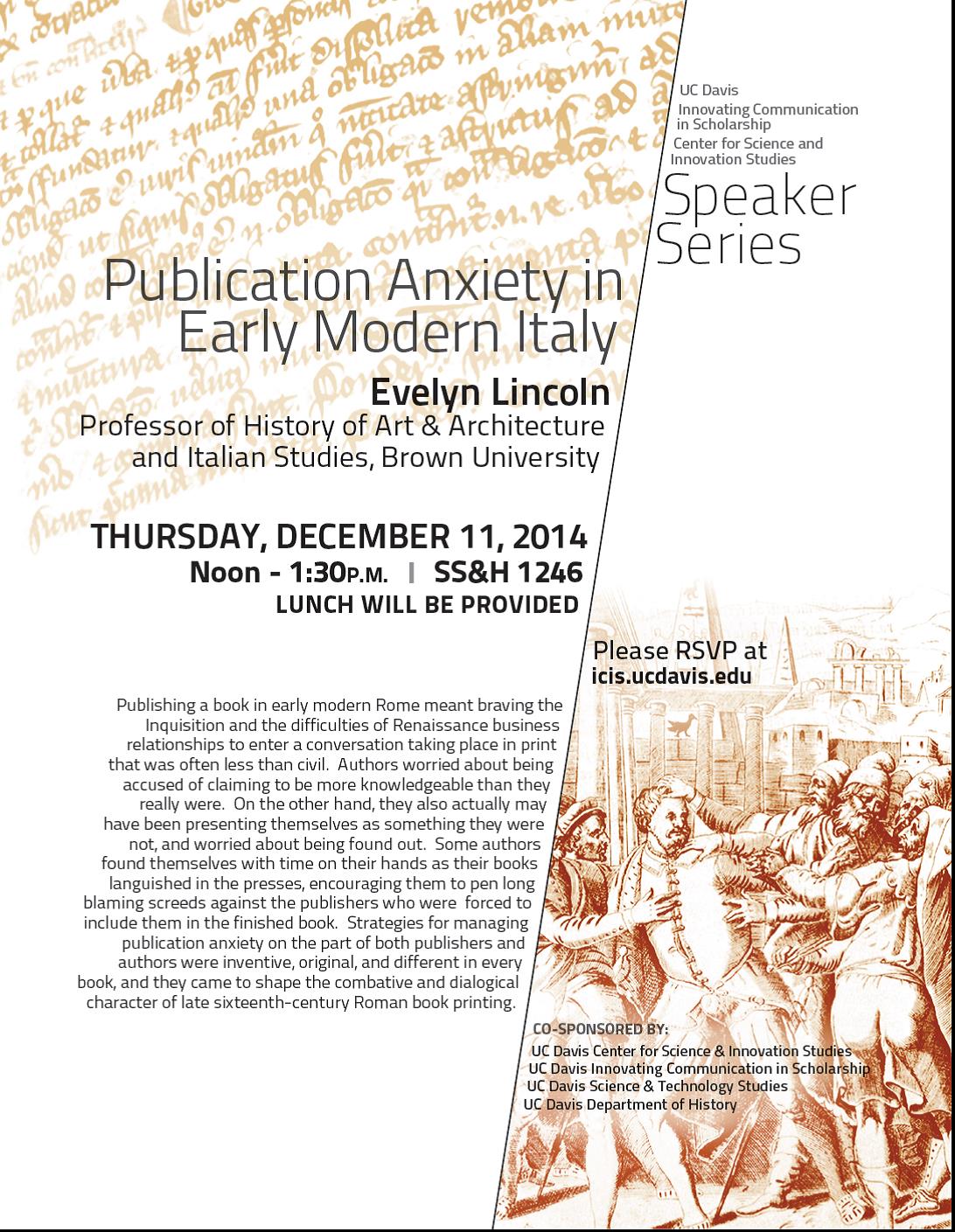
Talk at #UCDavis 12/11 by Evelyn Lincoln “Publication Anxiety in Early Modern Italy”

Please join Innovating Communication and Scholarship (ICIS), the Center for Science and Innovation Studies (CSIS), and Science and Technology Studies for a lunchtime event with Evelyn Lincoln on:

Publication Anxiety in Early Modern Italy

When: Thursday December 11th from 12:10 – 1:30 PM

Where: Room SS&H 1246 (STS /CSIS Room)

Discussant: Alessandro Delfanti

Lunch provided. Please RSVP if you plan to attend.

Abstract: Publishing a book in

early modern Rome meant braving the Inquisition and the difficulties of

Renaissance business relationships to enter a conversation taking place

in print that was often less than civil.

Authors worried about being accused of claiming to be more

knowledgeable than they really were. On the other hand, they also

actually may have been presenting themselves as something they were not,

and worried about being found out. Some authors found themselves

with time on their hands as their books languished in the presses,

encouraging them to pen long blaming screeds against the publishers who

were forced to include them in the finished book. Strategies for

managing publication anxiety on the part of both publishers

and authors were inventive, original, and different in every book, and

they came to shape the combative and dialogical character of late

sixteenth-century Roman book printing.

Evelyn Lincoln is Professor of the History of Art & Architecture and Italian Studies at Brown University. Her first book,

the Invention of the Italian Renaissance Printmaker (Yale, 2000) traced the careers of pictorial printmakers in Italy in the first century of its development. Brilliant Discourse. Pictures and Readers in Early Modern Rome (Yale, 2014) looks at the role played by the publication of

illustrated technical manuals in forming networks of printers,

publishers, artists and patrons, all of whom were also readers. Her

research investigates knowledge networks formed through making

and using pictures in the early modern world.

After you RSVP, you will be emailed with the paper to be discussed.

Talk at #UCDavis 12/2: Parasite manipulation of host phenotype: mechanisms, behavior, ecology, and evolution

Kelly Weinersmith

Exit seminar Tuesday (Dec 2nd) at 9AM in 2120J Wickson Hall.

"Parasite manipulation of host phenotype: mechanisms, behavior, ecology, and evolution."

Exit Seminar Flyer Weinersmith.pdf