Went to a dinner last night that was in honor of Sean Carroll who is visiting Davis as part of the “Storer” lecture series. It was the first time I have met Sean — but I have followed him and his writing extensively. I already found him to be one of the best of the best in science and in explaining evolution. I really liked “The Making of the Fittest” and now he has a new one — which I have not read but it sounds great. It is called “Remarkable Creatures: Epic Adventures in the Search for Origin of Species“. He was also quite entertaining at the dinner and handled being peppered with questions very well. Alas I have to miss his talk today since I am at the Joint Genome Institute for a discussion about metagenomic sequencing of samples from Yellowstone National Park.
Tag: Evolution
Darwin Celebration in Davis
Well, this has been a good week for me in Davis in terms of things in which I am interested. First, the Tour of California started in Davis and then tonight we had a Darwin celebration (with cake and talks) in a movie theater in downtown. The three talks were by Rick Grosberg, who gave a good background on Darwin the person, Mau Stanton who talked about Evolution and Society and me, who talked about Uses of Evolution. The shindig was sponsored by the Center for Population Biology and funded by the Storer Endowment. And it was organized by Angus Chandler and Dena Grossenbacher and possibly some others. And the theater was packed to the gills. Food. Folks. And Fun. And I owe some thanks to folks who responded to my FriendFeed posting asking about other examples of Uses of Evolution.
Here are some pics …
http://picasaweb.google.com/s/c/bin/slideshow.swf
Also see
10 simple ways to honor Charlie D (aka Darwin)
If you do not know, Thursday is a big day – Darwin Day 2009. A global celebration in honor of the 200th anniversary of Charles Darwin’s birth. Today I am making a suggestion of 10 simple things you can do to honor Darwin:
- Read one of his books OTHER than Origin of Species (see Darwin online for some there). My favorite is the Voyage of the Beagle but there are many others.
- Stop using the terms Darwinism and Darwinian evolution (see Safina for more on this – I thought this article was a bit of overkill but still has some important points).
- Vote against anyone who says Intelligent Design should be taught in science class or that you should “teach the controversy.” Or at least endorse right thinking candidates.
- Contribute to evolution education in some way – teaching, writing a book, releasing teaching materials, donate to a museum (e.g., California Academy) or other organization (e.g., NCSE) or even the cool HMS Beagle Project. Just help educate the world about the science of evolution.
- Attend some Darwin Day celebration(s).
- Get a cool evolution tattoo (see Zimmer for more) or display your support in some outward way.
- Support the National Science Foundation (if you are in the US) as they are the strongest supporters of Evolution related research.
- Name your kid or pet or boat or city after him.
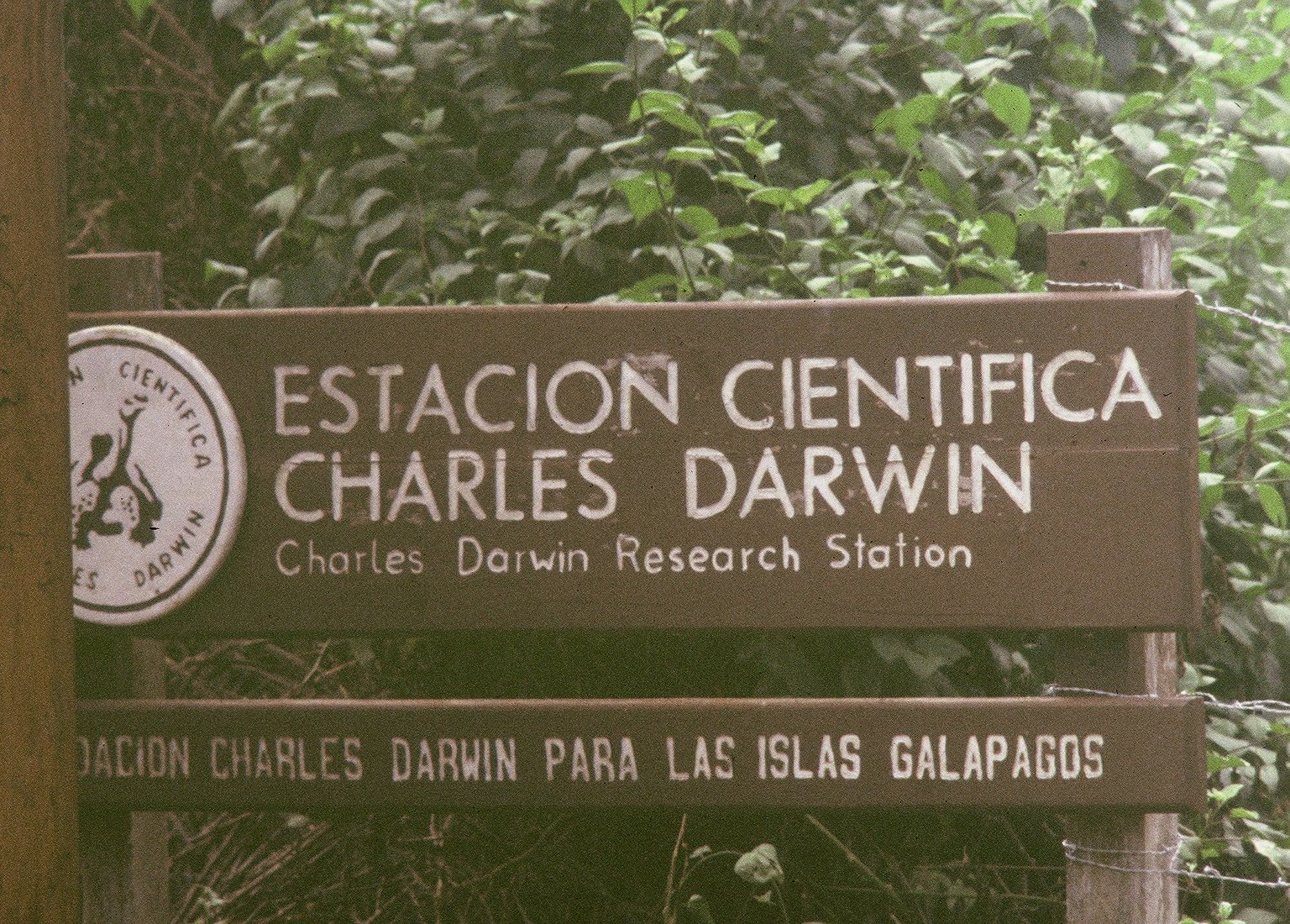
- Visit the Galapagos or at least check out the Darwin Station online.(see pics below …)
- Insert your own here …..
Obama’s Science Team Big on Evolution
Much has been written and will be written about how Obama is taking science seriously. To me, one great sign of this is that not only is evolution OK to talk about now, but – gasp – many of his science team actually have worked on evolution. For example:
- Eric Lander, part of Obama’s council of advisors on science and technology, has written many papers either directly or indirectly about evolution.
- Harold Varmus also on this Council, has written about evolution of viruses (e.g. here),
- Jane Lubchenco is an ecologist who in much of her work has an evolutionary ecology angle
Conflict between religion and evolution? Not according to the Papal Conference on Evolution …
Darwin on the Wall
Tracing the evolutionary history of Sarah Palin: links to a parasitic nematode and the pathogenic fungus Botryotinia fuckeliana
You see, as a total sequence analysis dork, when I see names, I frequently ask whether the letters in the name include only letters which are used as amino acid abbreviations. I started this game when the brilliant notes/letters came out in Science in the early 90s about whether ELVIS was overrepresented in protein sequences. Of course, despite being 20 years old, Science still keeps these under wraps requiring registration to see them (see for example the Stevens letter).
Anyway, alas, three of the major candidates for the US election have names that do not use traditional amino acid abbreviations so I am stuck with analyzing Sarah Palin. But that is OK because of her professed aversion to evolution and support to Creationism (and since sequence analysis is inherently an evolutionary study).
So – I took here name and went to the NCBI Blast page and did some searches. And what came up? Well, here are some of the top hits from the blastp searches (which I used to compare the pretend peptide “SARAHPALIN” with all the peptides in the non redundant collection at Genbank).
>ref|XP_001545292.1|hypothetical protein BC1G_16161 [Botryotinia fuckeliana B05.10]
gb|EDN25226.1|predicted protein [Botryotinia fuckeliana B05.10]
Length=383
GENE ID: 5425746 BC1G_16161 | hypothetical protein
[Botryotinia fuckeliana B05.10]
Score = 26.9 bits (56), Expect = 189
Identities = 8/9 (88%), Positives = 8/9 (88%), Gaps = 0/9 (0%)
Query 1 SARAHPALI 9
SARA PALI
Sbjct 209 SARAQPALI 217
>ref|YP_061725.1|homoserine dehydrogenase [Leifsonia xyli subsp. xyli str. CTCB07]
gb|AAT88620.1|homoserine dehydrogenase [Leifsonia xyli subsp. xyli str. CTCB07]
Length=451
GENE ID: 2939000 thrA | homoserine dehydrogenase
[Leifsonia xyli subsp. xyli str. CTCB07] (10 or fewer PubMed links)
Score = 26.9 bits (56), Expect = 189
Identities = 8/9 (88%), Positives = 8/9 (88%), Gaps = 0/9 (0%)
Query 1 SARAHPALI 9
SAR HPALI
Sbjct 267 SARVHPALI 275
>ref|ZP_02031476.1| hypothetical protein PARMER_01474 [Parabacteroides merdae ATCC
43184]
gb|EDN87136.1| hypothetical protein PARMER_01474 [Parabacteroides merdae ATCC
43184]
Length=299
Score = 26.1 bits (54), Expect = 340
Identities = 7/8 (87%), Positives = 8/8 (100%), Gaps = 0/8 (0%)
Query 3 RAHPALIN 10
RAHPAL+N
Sbjct 170 RAHPALVN 177
>ref|XP_567332.1|hypothetical protein CNJ01520 [Cryptococcus neoformans var. neoformans
JEC21]
ref|XP_773201.1|hypothetical protein CNBJ1950 [Cryptococcus neoformans var. neoformans
B-3501A]
gb|EAL18554.1|hypothetical protein CNBJ1950 [Cryptococcus neoformans var. neoformans
B-3501A]
gb|AAW45815.1|hypothetical protein CNJ01520 [Cryptococcus neoformans var. neoformans
JEC21]
Length=437
GENE ID: 3254188 CNJ01520 | hypothetical protein
[Cryptococcus neoformans var. neoformans JEC21] (10 or fewer PubMed links)
Score = 26.1 bits (54), Expect = 340
Identities = 8/9 (88%), Positives = 8/9 (88%), Gaps = 0/9 (0%)
Query 1 SARAHPALI 9
SAR HPALI
Sbjct 415 SARQHPALI 423
>ref|YP_001626035.1|citrate synthase [Renibacterium salmoninarum ATCC 33209]
gb|ABY24621.1|citrate synthase [Renibacterium salmoninarum ATCC 33209]
Length=386
GENE ID: 5822379 RSal33209_2898 | citrate synthase
[Renibacterium salmoninarum ATCC 33209]
Score = 25.7 bits (53), Expect = 456
Identities = 9/11 (81%), Positives = 9/11 (81%), Gaps = 2/11 (18%)
Query 1 SARAHP--ALI 9
SARAHP ALI
Sbjct 218 SARAHPYAALI 228
>ref|YP_001817256.1|integral membrane sensor hybrid histidine kinase [Opitutus terrae
PB90-1]
gb|ACB73656.1|integral membrane sensor hybrid histidine kinase [Opitutus terrae
PB90-1]
Length=936
GENE ID: 6208547 Oter_0366 | integral membrane sensor hybrid histidine kinase
[Opitutus terrae PB90-1]
Score = 25.2 bits (52), Expect = 611
Identities = 7/7 (100%), Positives = 7/7 (100%), Gaps = 0/7 (0%)
Query 3 RAHPALI 9
RAHPALI
Sbjct 256 RAHPALI 262
>ref|YP_001757871.1|putative anti-sigma regulatory factor, serine/threonine protein
kinase [Methylobacterium radiotolerans JCM 2831]
gb|ACB27188.1|putative anti-sigma regulatory factor, serine/threonine protein
kinase [Methylobacterium radiotolerans JCM 2831]
Length=331
GENE ID: 6141303 Mrad2831_5232 | putative anti-sigma regulatory factor,
serine/threonine protein kinase [Methylobacterium radiotolerans JCM 2831]
Score = 25.2 bits (52), Expect = 611
Identities = 7/8 (87%), Positives = 8/8 (100%), Gaps = 0/8 (0%)
Query 2 ARAHPALI 9
ARAHPAL+
Sbjct 299 ARAHPALV 306
>ref|ZP_01466013.1| hydrolase, TatD family [Stigmatella aurantiaca DW4/3-1]
gb|EAU63211.1| hydrolase, TatD family [Stigmatella aurantiaca DW4/3-1]
Length=209
Score = 25.2 bits (52), Expect = 611
Identities = 7/7 (100%), Positives = 7/7 (100%), Gaps = 0/7 (0%)
Query 3 RAHPALI 9
RAHPALI
Sbjct 79 RAHPALI 85
>ref|YP_001558323.1|glycosyl transferase group 1 [Clostridium phytofermentans ISDg]
gb|ABX41584.1|glycosyl transferase group 1 [Clostridium phytofermentans ISDg]
Length=357
GENE ID: 5743305 Cphy_1206 | glycosyl transferase group 1
[Clostridium phytofermentans ISDg]
Score = 25.2 bits (52), Expect = 611
Identities = 8/10 (80%), Positives = 8/10 (80%), Gaps = 0/10 (0%)
Query 1 SARAHPALIN 10
S RAHP LIN
Sbjct 113 SERAHPLLIN 122
There does not appear to be a perfect match in the NCBI NR protein database. But take a close look at the #1 scoring hit. That is right, it is from and organism called Botryotinia fuckeliana. No comment on the appropriateness of this name, but it does contain a term I will probably use a lot if she gets elected.
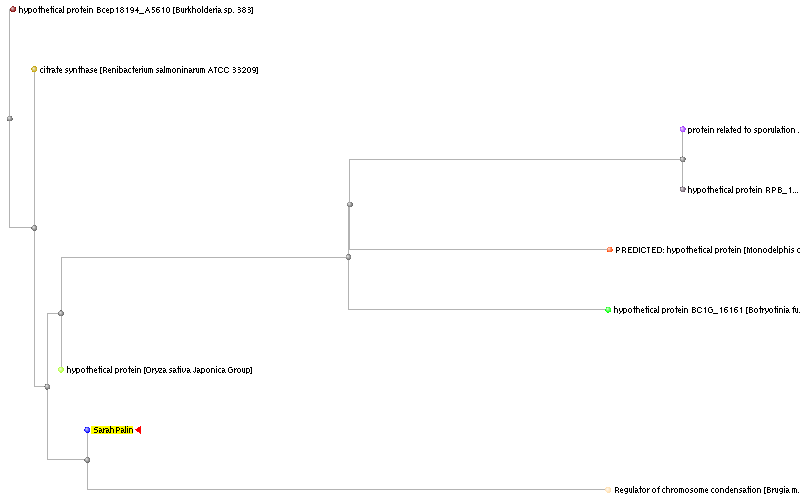
Of course, anybody who has heard me blather on and on about evolution knows that I am always talking about how blast top hits are not a good measure of relatedness per se (see my NAR paper where I first talked about this in 1995). So – I decided to build a tree of Sarah Palin. I used the NCBI Distance Tree option which you can do from blast searches.
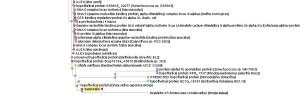
Since most likely you cannot see that in enough detail – here is a zoom in.
That one did not come through on the Blog so well either so I decided to output the tree in Newick format and then I searched for a program that could draw a better figure on the web (we have tools in my lab to do this but I am trying to do this all on the web as an exercise). And I found a web site that makes drawtree available. And I plugged in the Newick format and it made a nicer one.
Though making trees from really short sequences is not ideal, in this tree, Sarah Palin is shown to be at the root of a branch including a protein from the parasitic nematode Brugia malayi. So if we take an evolutionary interpretation it seems that this causative agent of filariasis (well, a protein from this agent) is descended from SarahPalin. In other words, she seems to be ancestral to this parasite.
So in conclusion – by similarity – SarahPalin is closest to a plant pathogen with an unusual name. And by phylogeny SarahPalin is ancestral to a parasitic nematode. Sounds about right.
Forget Lincoln-Douglas – How about a Lincoln-Darwin debate?
This questioning spirit is one of the most appealing facets of Darwin’s character, particularly where it finds its way into his published work. Reading “The Origin of Species,” you feel as though he is addressing you as an equal. He is never autocratic, never bullying. Instead, he is always willing to admit what he does not know or understand, and when he poses a question, he is never rhetorical. He seems genuinely to want to know the answer. He’s also a good salesman. He knows that what he has to say will not only be troubling for a general reader to take but difficult to understand—so he works very hard not to lose his customer. The book opens not with theory but in the humblest place imaginable: the barnyard, as Darwin introduces us to the idea of species variation in a way we, or certainly his 19th-century audience, will easily grasp—the breeding of domestic animals. The quality of Darwin’s mind is in evidence everywhere in this book, but so is his character—generous, open-minded and always respectful of those who he knew would disagree with him, as you might expect of a man who was, after all, married to a creationist.
Top five metaphors Darwin considered and rejected for "The Tree of Life"

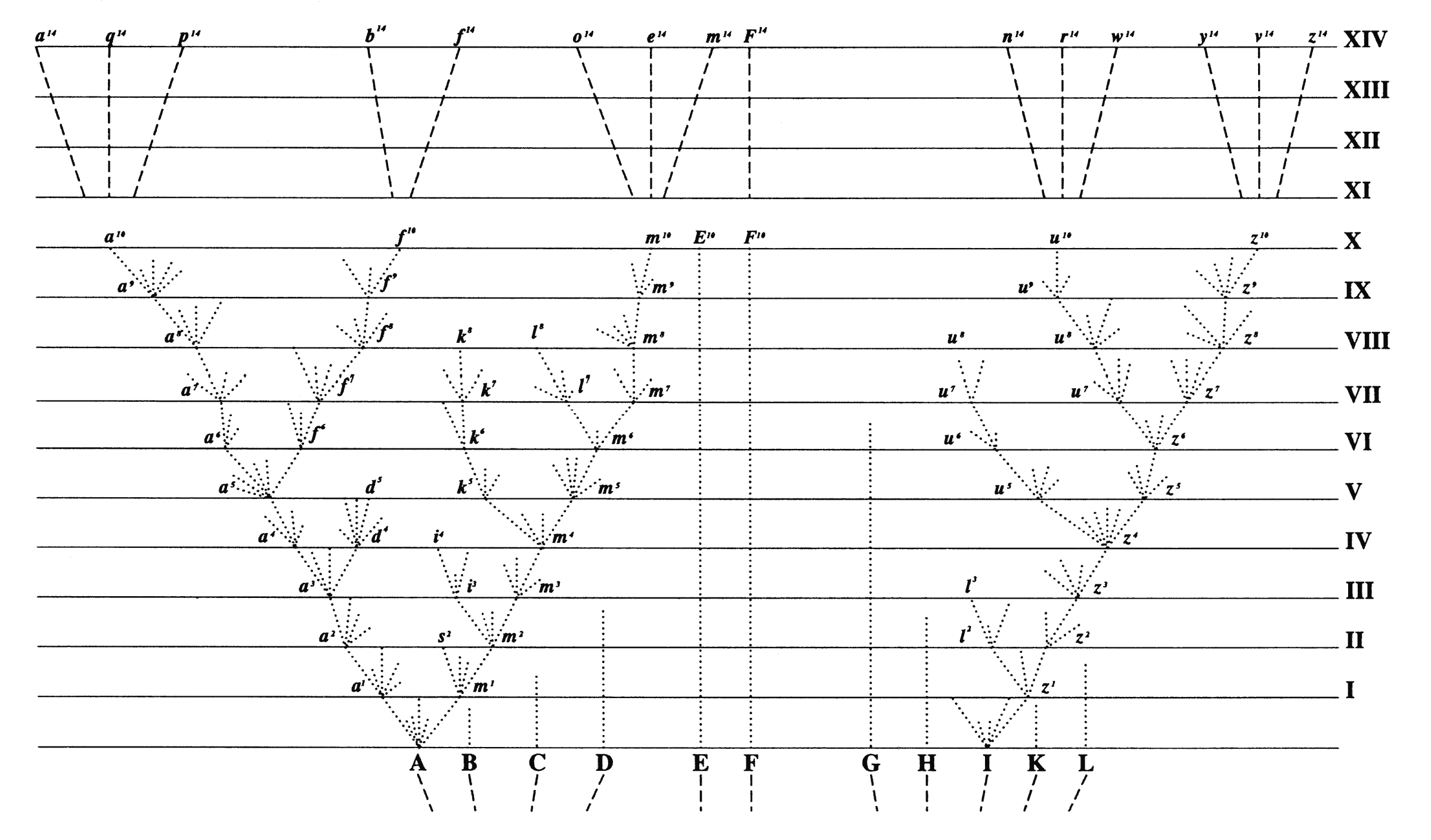
Well, as I am desperately trying to prevent Hollywood from corrupting the term “Tree of Life” and I got to thinking. Why did Darwin and others have to use the metaphor of a tree to represent the branching history of organisms through evolutionary time? Why did other metaphors not get used? Well, thanks to a little research I did by communicating with Darwin directly (as I did when he announced his endorsement of Obama), I have found out that Darwin went through many other metaphors before settling on the “Tree of Life.” (note the tree-like figure here which is based on the one figure in the Origin of Species).
And here are the top 5 other such metaphors for what is now known as “The Tree of Life”
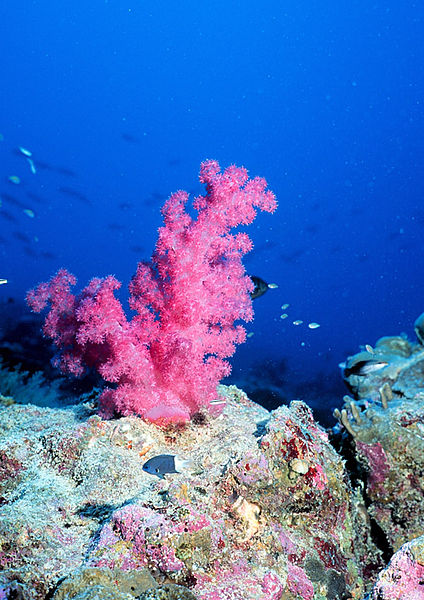
The coral of life. Darwin particularly liked this one as he did some work on marine organisms. But ultimately he rejected it because he was worried about anti-evolutionists killing coral to get back at Darwin.
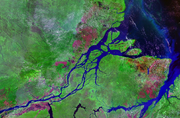
The watershed of life. Rivers exhibit branching patterns much like trees. The big problem Darwin saw was that sometimes separate river branches reconnect to each other, which did not follow his model for descent. If only Darwin knew about lateral gene transfer.
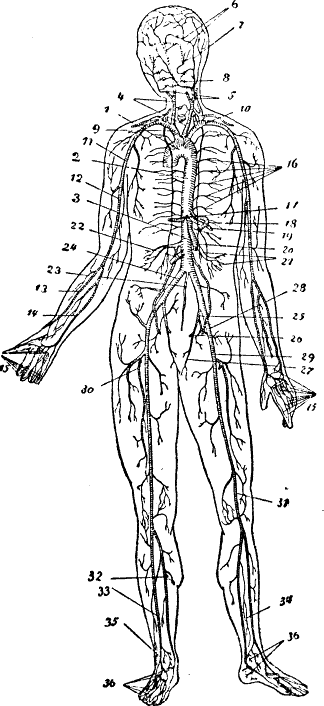
The blood vessels of life. Darwin was desperate to find visceral connections for people to evolution. This one would have been great. The big problem here was the “going” and “coming” nature of arteries and veins.
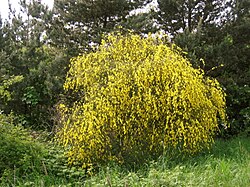
The shrub of life. Thus turns out to have been one of Darwin’s favorites because it captures the richness of diversity more than a sparsely branching tree. However, shrub, even then, was used as a derogatory term to refer to height challenged individuals. And Darwin did not want to upset this key constituency so he avoided this term.
The lungs of life. While this has some positive features (e.g., it is unidirectional like a tree), thankfully Darwin did not stick to this or we would have competition from “LOL” for all the domain names.
Other possibilities included “the Plumbing System of Life” and “the Highway Map of Life”. If you know of others Darwin may have considered, let me know.
How Darwin won the evolution race
There is a cool article in the Observer today on the “race” between Darwin and Wallace on publishing the theory of natural selection (How Darwin won the evolution race | Science | The Observer).
When I read this I cannot help wonder what would have happened if this race had happened today. With publishing and the spread of ideas occurring at a much slower pace in the past, Darwin could afford a bit of time to polish up all the lines of thought and evidence presented in the Origin of Species. It is really his work on building up such evidence that helped convince people of the importance of natural selection. So – if this had happened today – Darwin and Wallace would certainly have been on Science Friday. Lots of bloggers would have written about it. But would Darwin have taken the time to polish up his loose ends or would he have just rushed out his short paper on natural selection and then gotten caught up in the hype and debate?
Anyway, the article has some good bits both about the history and about the acceptance (or lack thereof) of evolution and natural selection today. My favorite lines is:
Natural selection is simply too important for society to live without it, he (Steven Jones) argues. It is the grammar of the living world and provides biologists with the means to make sense of our planet’s myriad plants and animals