At #UCDavis: Academic Women’s Leadership Workshop on 4/28

Davis Postdoc Entrepreneurship and Career group (DPEC) presents

Speakers: Dr. Tanya Smith (Prof. Harvard University) and Dr. Beth Russell (Prof. Nazareth College)
Date: Thursday 28th April 2016, 4:30–7 pm (refreshment to follow)

Location: Gladys Valley Hall, Room 1020, School of Veterinary Medicine, Davis campus.

Please RSVP here!

If you have any questions, contact Siobhan at soleary (or) Valentina at valcampanelli.

Academic Women’s Leadership: An Informative and Interactive Workshop

Graduate students, postdocs, staff, and faculty are invited to participate in an interactive discussion of how women are experiencing and influencing academic culture. We’ll present the results of a national survey of academic women in STEM fields and consider how leadership, mentorship, community building, and education can create a more inclusive culture at UC Davis. All genders are welcome!

Bio: Dr. Tanya Smith is an Associate Professor of Human Evolutionary Biology at Harvard University. She received her BS in Biology from the State University of New York at Geneseo and her PhD in Anthropological Sciences from Stony Brook University. Dr. Smith subsequently created and managed a research unit at the Max Planck Institute for Evolutionary Anthropology in Leipzig, Germany before returning to the US for a tenure-track position at Harvard University. She oversees a Dental Hard Tissue Laboratory and studies the evolution of human development. In addition to publishing more than 60 scholarly articles and delivering more than 80 lectures, Dr. Smith has been interviewed by National Public Radio, Voice of America, British Broadcasting Corporation, New York Times, and Slate Magazine. Her research has been featured in documentaries produced by the BBC, PBS Nova, and the Discovery Channel, and the scholarly journals Nature and Science. While still in graduate school, she organized the first Stony Brook University Women’s Leadership Symposium, and subsequently co-founded the Physical Anthropology Women’s Mentoring Network, serving hundreds of graduate students, postdoctoral fellows and junior faculty. Dr. Smith has lectured and led workshops on professional development for women and junior faculty at Duke University, Harvard University, Stony Brook University, and the University of Washington. Her postgraduate training includes the MIT Leadership Skills for Engineering and Science Faculty program, the NSF-funded Women Evolving Biological Sciences (WEBS) program, and the Coaches Training Institute Co-Active Leadership Program. Dr. Smith is a member of the Association for Women in Science, the American Association of University Women, is active on Linked In and Twitter (@DrTanyaMSmith).

Bio: Dr. Beth Russell is an Associate Professor of Social Work at Nazareth College. Her primary appointment is in the Greater Rochester Collaborative Master of Social Work Program. She teaches practice-based classes including specialty coursework in sexual health, evidenced based practice, leadership, supervision, and diversity. She received a PhD in Education with a specialty in Counselor Education and Supervision from the University of Rochester, New York; a Master of Social Work from the University of Michigan, Ann Arbor; and a Bachelor of Science in Human Development and Family Studies from Cornell University. In addition to being a professor, she has worked in a variety of practice settings, including as a case manager for the chronically mentally ill, clinical social worker and sex therapist in a university hospital outpatient setting, child therapist, supervisor of mental health counselors, adult therapist, program evaluator, and a research consultant on several community projects. Her professional interests include sexual health, sex therapy, interpersonal practice, and evidence-based practice. Dr. Russell’s current research focuses on health professionals’ training in sexual health and their clinical practices; intimate partner violence; leadership and diversity issues in academia; and women’s well-being. Dr. Russell has authored and co-authored peer-reviewed journal articles, continuing education courses, book chapters, a book, and several book reviews in the past twelve years. She is a member of the Council of Social Work Education, the National Association of Social Workers, the American Association of Sex Educators, Counselors, and Therapists, and the American Association of University Women, and can be found on Linked In and Twitter (@BethRussellphd).

Academic Women’s Leadership-April2016.pdf

Microbiomes of the Built Environment NAS Meeting Webcast 4/11 10:30-5 EST

This may be of interest:

Microbiomes of the Built Environment: From Research to Application

The National Academies of Sciences, Engineering, and Medicine are conducting a consensus study that will examine the formation and function of microbial communities in built environments, the impacts of such microbial communities on human health, and how human occupants shape complex indoor microbiomes. This study is intended to provide an independent, objective examination of the current state of science regarding built environment microbiomes and their impacts on human health, and then attempt to bridge gaps in moving this research to an application stage, in which building materials and architecture will be designed with microbiomes in mind. The study is being conducted by a committee of experts and the consensus report is expected to be released in 2017.
The study’s first public meeting will be held on April 11, 2016 in Washington, DC. You may view the webcast of the public sessions, to be held from 10:30am – 5:00pm EDT by clicking here.
Please direct any questions or comments to builtmicrobiome@nas.edu
This study is sponsored by the Alfred P. Sloan Foundation, U.S. Environmental Protection Agency (EPA), National Aeronautics and Space Administration (NASA) and the National Institutes of Health (NIH).
AGENDA
Monday, April 11
10:30am Welcome Public Observers and Study Sponsors Committee Member Introductions
What are microbiomes of built environments and why is the study topic a compelling one to address?
Joan Bennett, Committee Chair
10:45 Discussion of Statement of Task with Study Sponsors
Sponsoring organizations will provide perspectives on the context for the study, how the study relates to their missions, and what they see as key needs and challenges for understanding microbiomes in built environments. Invited speakers will each provide 10 minutes of opening remarks.
Paula Olsiewski, Alfred P. Sloan Foundation
Tina Bahadori and Laura Kolb, Environmental Protection Agency David Tomko, National Aeronautics and Space Administration Lisa Chadwick, NIEHS, National Institutes of Health (remotely)

Committee Discussion with Sponsors
12:15 Lunch
1:30 Setting the Stage for the Study
Presentations will highlight developments and challenges in several background areas. Invited speakers will each give 15 minute presentations.
1:40 Built environment microbiome interfaces: Why is improving our understanding of these interactions an exciting topic and perspective on the eld?
Gary Andersen, Lawrence Berkeley National Laboratory and University of California, Berkeley
2:00 Understanding and modeling building systems: What’s known and how might these parameters impact indoor microbiomes?
Jelena Srebric, University of Maryland
2:20 Example of built environment microbiome studies and their potential human health links
Benjamin Kirkup, Naval Research Laboratory
2:40 Understanding microbes in water systems
Amy Pruden, Virginia Polytechnic Institute and State University
3:00 Committee Discussion with Speakers 3:30 Break
Light snack will be provided
3:50 Further Discussion: Major Issues Relevant to the Study
Opportunity for committee members, sponsors, speakers, and meeting participants to further
discuss points raised during the presentations and to identify additional topical areas, gaps, or needs that may be relevant to the study’s statement of task.
4:30 Public Comment Period
Opportunity for meeting participants to share additional information or ideas they would like the committee to consider.
5:00 Meeting Adjourns

Live webcast of NAS “Microbiomes of the Built Environment” meeting 4/11

Live Webcast of NAS Microbiomes of the Built Environment meeting

Monday April 11

10:30am – 5:00pm EDT

More information:

Microbiomes of the Built Environment: From Research to Application

The National Academies of Sciences, Engineering, and Medicine are conducting a consensus study that will examine the formation and function of microbial communities in built environments, the impacts of such microbial communities on human health, and how human occupants shape complex indoor microbiomes. This study is intended to provide an independent, objective examination of the current state of science regarding built environment microbiomes and their impacts on human health, and then attempt to bridge gaps in moving this research to an application stage, in which building materials and architecture will be designed with microbiomes in mind. The study is being conducted by a committee of experts and the consensus report is expected to be released in 2017.

The study’s first public meeting will be held on April 11, 2016 in Washington, DC. You may view the webcast of the public sessions, to be held from 10:30am – 5:00pm EDT by clicking here.

Please direct any questions or comments to builtmicrobiome@nas.edu

This study is sponsored by the Alfred P. Sloan Foundation, U.S. Environmental Protection Agency (EPA), National Aeronautics and Space Administration (NASA) and the National Institutes of Health (NIH).

Today at #UCDavis: Outi Savolainen on “Examining genetics of local adaptation in the perennial outcrossing Arabidopsis lyrata”

Via Sebastien Schreiber

Dear Colleagues,

I hope your Spring quarter has started on a good note. The first Ecology and Evolution seminar will be given by Outi Savolainen from the University of Oulu in Finland. Outi works on the genetics of adaptation and speciation. Her group uses genomic tools to examine the genetic basis underlying genetic variation in adaptive traits, such as timing of growth in Scots pine and the timing of flowering in Arabidopsis lyrata (see https://wiki.oulu.fi/display/PGG/Outi+Savolainen).

The title, time and place for her talk is as follows:

Title: Examining genetics of local adaptation in the perennial outcrossing Arabidopsis lyrata

Date: Thursday April 7 at 4:10pm

Place: 1100 Social Sciences

Today at #UCDavis: Helping Faculty Prepare Underrepresented Students of Color for Doctoral Succes

Reminder: This can count towards the MCT Fellowship.

Helping Faculty Prepare Underrepresented Students of Color for Doctoral Success

A Discussion of Teaching Practices and Institutional Structures

Monday, April 4, 2016

2:00 – 3:00 pm

Voorhies 126

This roundtable discussion addresses institutional structures of higher education and practices around preparing underrepresented students of color for doctoral programs. It features faculty members from Hampton University, a historically black university founded in 1868, who will share their experiences and expertise in teaching students at Hampton University and in advising and mentoring undergraduate research.

Our discussion will engage

· the teaching and mentoring of underrepresented students of color

· teaching and advising across different kinds of institutional spaces

· institutional structures and its impact on underrepresented students of color

· race in higher education

Panelists:

Dr. Amee Carmines, Department of English, Hampton University

Dr. Joyce Jarrett, Department of English, Hampton University

Dr. Mark Jerng, Department of English, University of California, Davis

Dr. Amee Carmines is Professor of English at Hampton University. Her academic focus is western and world literature and critical theory. During her twenty-nine year tenure at the university, she has served as faculty mentor to student fellows associated with the Dana Scholars Program, UNCF Mellon/Mays Undergraduate Research Program, and with IRT Fellows. She also routinely teaches central courses, such as literary criticism and senior seminar.

Dr. Joyce Jarrett holds the endowed chair of Distinguished Professor of English at Hampton University. She has taught a range of courses to include African American literature, senior thesis, advanced writing, and introduction to literary studies (a required tools course for majors). Currently, she also serves as a UNCF Mellon/Mays faculty mentor. Dr. Jarrett has also served the university in numerous administrative posts: Chair of the Department of English, Executive Assistant to the President, and Provost.

Dr. Mark Jerng is Associate Professor of English and Graduate Adviser for the PhD Program in English at University of California, Davis. He is Lead PI for the UCD Summer Program for Literary Analysis and Success in the Humanities (SPLASH).

This event is sponsored through the UCD Summer Program for Literary Analysis and Success in the Humanities (SPLASH), a UC-HBCU initiative that funds collaborations across the UCs and historically black colleges and universities. UCD SPLASH brings Hampton University undergraduates to UC Davis for an 8-week summer program during which they work with faculty mentors and develop independent research projects. The goal is to provide an undergraduate research experience as well as professionalizing activities in helping prepare students for applying to PhD programs in English and literature programs.

April 4 UCD-Hampton U Roundtable Event.pdf

CPB Seminar – Tuesday, March 29, 2016 – 4:10pm in 1022 Life Sciences – Meetings with Speaker Dr. Carlon…

***** CPB Seminar Reminder for Tuesday, March 29, 2016, 4:10pm in 1022 Life Sciences *****

Speaker: Dave Carlon
Director of the Bowdoin Coastal Studies Center and Associate Professor of Biology, Bowdoin College Brunswick
Title: “Two marine hybrid zones and their evolutionary applications ”
Host: Andrew Whitehead

The entire CPB Seminar schedule for Spring Quarter 2016 is available here.

Some notes on requesting for 700s for UC Admins …

How to find form 700s for UC officials?

This turns out to be simple yet slow and offline.  Here is what I found from the UC Davis Counsel site.

Accessing UC Davis Records

  • Identifying Records: To help us provide records promptly, please provide specific information about the records you seek including the record name, subject matter, author’s name, date, office, or department that created the record.
  • Time Deadlines: UC Davis has 10 days to determine if it will disclose the requested records. A limited 14-day extension may apply. If records cannot be provided within these deadlines, we will provide an estimated delivery date, and the records will be disclosed in a reasonable period of time.
  • Copying Fees: UC Davis charges 20 cents per page as the direct cost for duplicating records. When the campus must compile or extract electronic data or perform computer programming, it may charge its full costs.
  • Exemptions: UC Davis will provide access to all public records upon request, unless the law provides an exemption from mandatory disclosure. Examples of exempt records may include: personnel records, investigative records, drafts, confidential legal advice, records prepared in connection with litigation, and information that may be kept confidential under other state or federal laws.

Requests for Statements of Economic Interest Forms (Form 700)

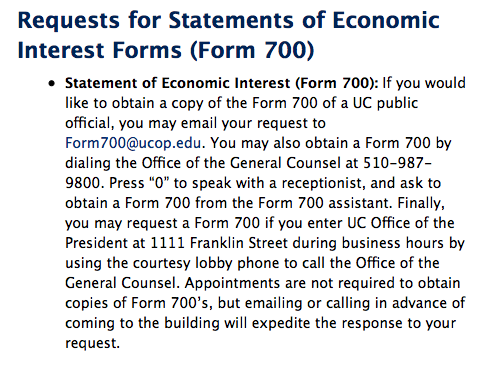
  • Statement of Economic Interest (Form 700): If you would like to obtain a copy of the Form 700 of a UC public official, you may email your request to Form700@ucop.edu. You may also obtain a Form 700 by dialing the Office of the General Counsel at 510-987-9800. Press “0” to speak with a receptionist, and ask to obtain a Form 700 from the Form 700 assistant. Finally, you may request a Form 700 if you enter UC Office of the President at 1111 Franklin Street during business hours by using the courtesy lobby phone to call the Office of the General Counsel. Appointments are not required to obtain copies of Form 700’s, but emailing or calling in advance of coming to the building will expedite the response to your request.

You may submit a request for records by email to publicrecords@ucdavis.edu. Prior to making a request, you may find information in the Frequently Asked Questions section helpful.


So I just wrote to them to see how long this takes (sent 3/24 at 7:28 AM)

Hello
I am writing to request a copy of the form 700 filings for the UC Davis Chancellor Linda Katehi for the last 10 years.  If it is not possible to request the form for this many years I would like to request it for the most recent year.
Sincerely
Jonathan Eisen


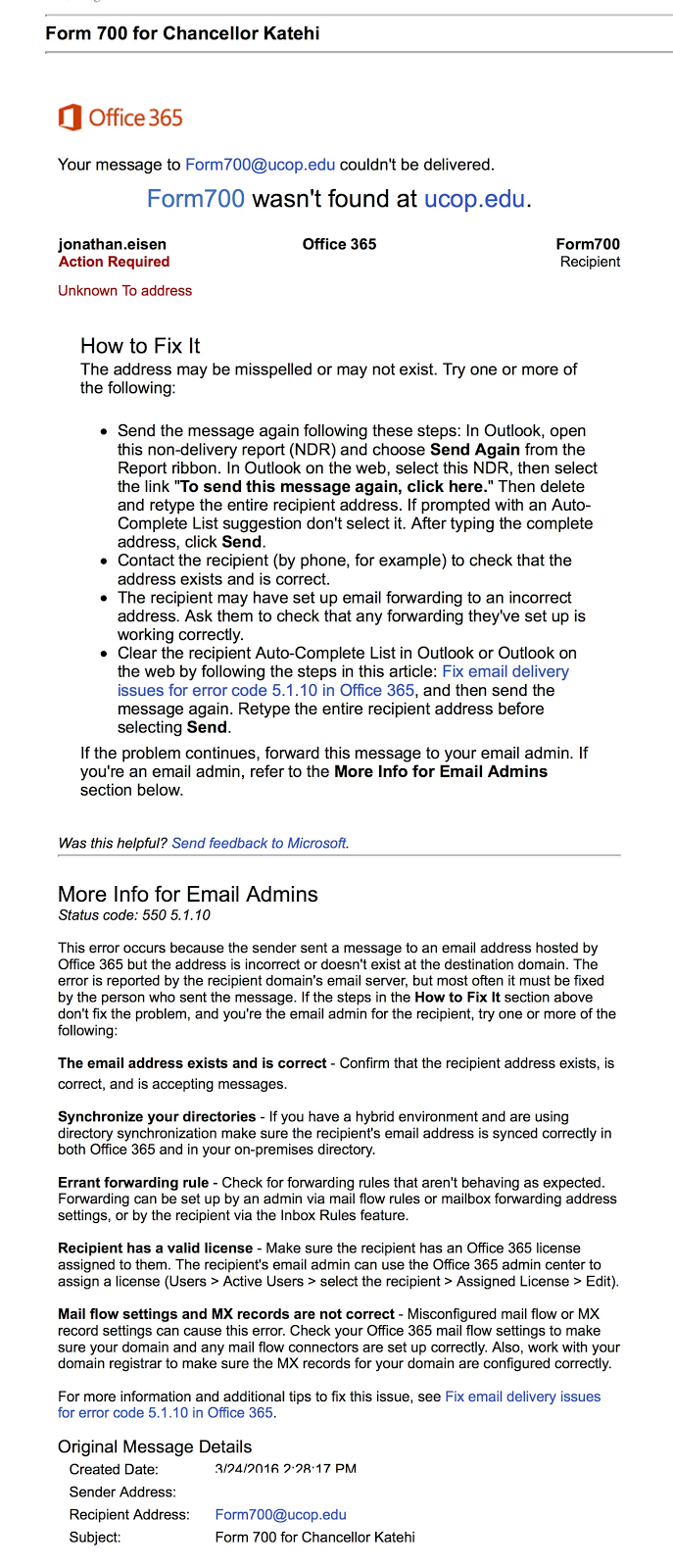
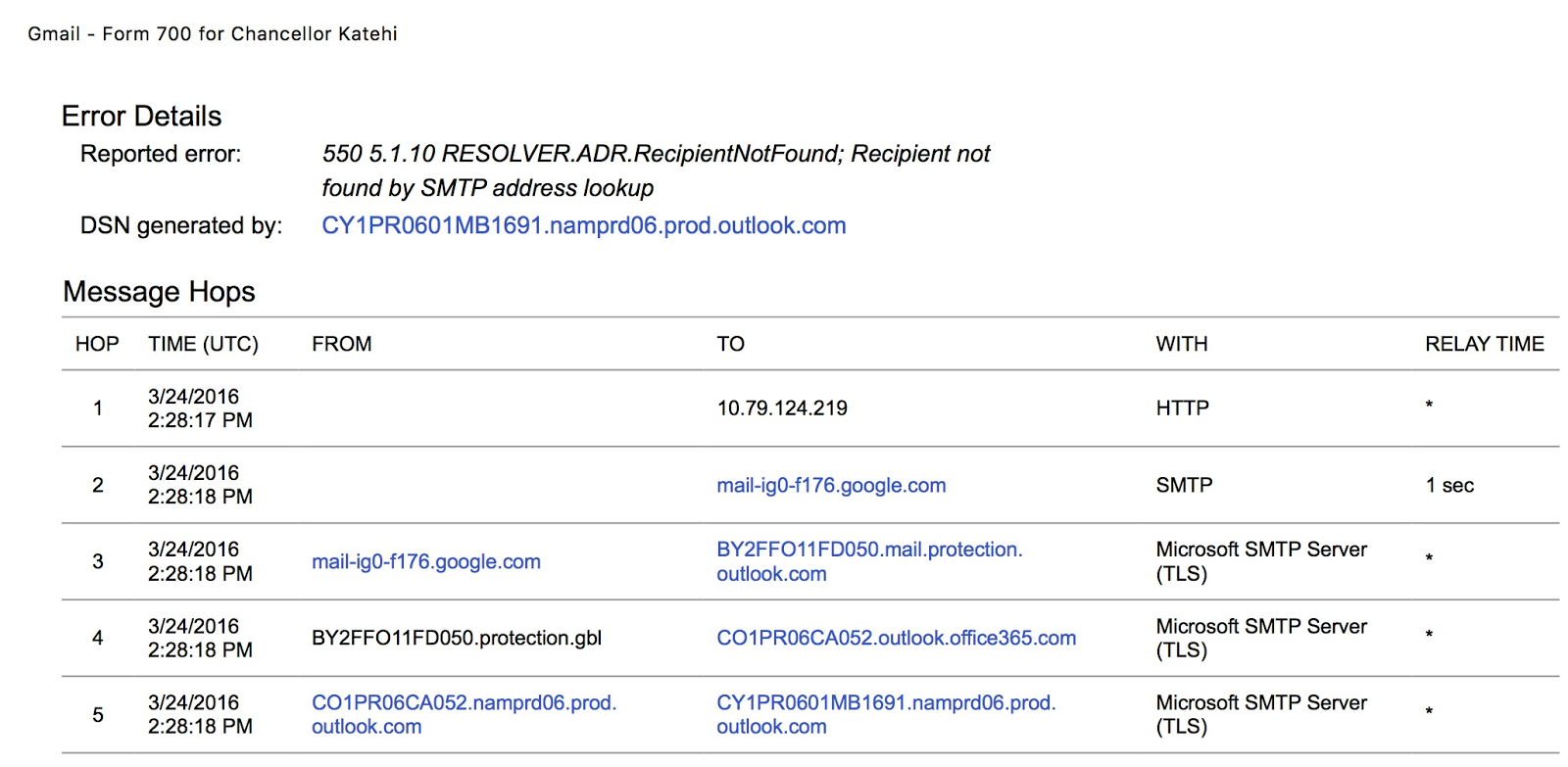
OMG.  And just a minute later I find out the message bounced.  See “simple” returned message below.  WTF am I supposed to do with that?


So – I guess getting form 700s is not so easy.  Shocking.

So now I will try to other address listed here.

You may submit a request for records by email to publicrecords@ucdavis.edu

To whom it may concern 

I submitted a request for form 700s based on instructions at http://campuscounsel.ucdavis.edu/public-records/accessing-records.html
Email to the address listed (Form700@ucop.edu) bounced.  So I am writing now to the other address listed. 

I am writing to request a copy of the form 700 filings for the UC Davis Chancellor Linda Katehi for the last 10 years.  If it is not possible to request the form for this many years I would like to request it for the most recent year. 

Sincerely,
Jonathan Eisen

UPDATE 3/24

Someone from the UC Davis office wrote back to me really quickly which is great

Dear Dr. Eisen, I believe the reason that your email bounced back is because it is incorrect.  The correct email for your request is form700info@ucop.edu  (copied above). The Office of the President is the “office of record” for all Form 700s.  I would have to go through the same process as you do to acquire this information.  Please feel free to contact me later next week if you still have not received a response from OP, but usually requests are responded to within a couple of business days.  (FYI – tomorrow is a University holiday.) Regards,

I wrote back to try and get them to correct their web site mistake

Thanks so much for the quick reply.  I note – I got the address from the Office of the Campus Counsel website 

http://campuscounsel.ucdavis.edu/public-records/accessing-records.html 

It would be good to fix that site with the correct address.  See a screen capture below.
Jonathan


A few minutes later they wrote back saying they were going to fix the incorrect email address.  Yay.  One step forward towards transparency. A very small step. But still …


3/29/16 – Forms Received
Got an email with the forms a few minutes ago (~ 4:15 PM)

Dr. Eisen: Attached please find the response to your request for the Statement of Economic Interests, Form 700s, for Chancellor Katehi. Please note: we are required by law to retain Form 700s for only seven years. At this time, we consider CPRA #16-1590 fulfilled and your file will be closed. Thank you. Sincerely, UCOP Public RecordsOffice of General Counsel1111 Franklin St., 5th FloorOakland, CA 94607pra@ucop.edu

So that is about 5.5 days.  Not terrible.  But it would be better for these to be online somewhere.

Blast from the not so distant past – special issue of JMBE on Scientific Ethics

So _ picked up my new issue of Microbe in the mail today and I saw something in it that seemed very intriguing.

A whole section of JMBE – the Journal of Microbiology and Biology Education dedicated to Scientific Ethics.  Sounded intriguing.  So I looked it up.  Took a bit to find it but there it was from December 2014 – Volume 15 number 2

I don’t know about the specific articles but the whole collection seems definitely worth a look and of potentially many uses.

So I have listed the individual papers below.  Kudos to ASM and JMBE for putting this together.  Now off to read some of the papers.


Robert Edgar at #UCDavis 3/30 “Sequence analysis for marker gene metagenomics”

University of California, Davis

Department of Microbiology & Molecular Genetics

College of Biological Sciences

MIC 291: Selected Topics in Microbiology

Work-in-Progress Seminars

Dr. Robert Edgar

(Independent scientist and consultant in fields of computational biology and bioinformatics)

Sequence analysis for marker gene metagenomics

Wednesday, March 30, 2016

4:10pm

1022 Life Sciences

Abstract: Microbial community studies using marker genes such as 16S and ITS present challenging sequence analysis problems due to sparse coverage in reference databases and the difficulty in distinguishing experimental error from true biological variation. I will show that several popular algorithms for taxonomy prediction and for creating de novo clusters (OTUs) have high error rates, and describe new algorithms with greatly improved accuracy.

Dr. Edgar is best known for developing the widely-used MUSCLE and USEARCH programs, which have been cited by thousands of published papers. He also works as a consultant and looks for opportunities to leverage his unique combination of business and scientific skills by helping start-up companies.

Host: Prof. Mitch Singer (mhsinger)

Department of Microbiology & Molecular Genetics

(note – title uses a definition of metagenomics that I do not endorse …)

Edgar 3-30-16.doc

Postdoctoral Scholar Positions at the Thermal Biology Institute

Dear TBI & Friends,

Please forward this position announcement on to folks you think would be interested. We are accepting applications until both positions are filled.

Postdoctoral Scholar Positions Open

Thermal Biology Institute, Montana State University

Two recently funded Postdoctoral Scholar positions are available immediately in the Thermal Biology Institute (TBI) () at Montana State University (MSU). One position will focus on metagenomics and microbial ecology, and a closely aligned position to focus on proteomics and metabolomics of these same systems. TBI conducts research on the biology and interrelated physical and chemical processes of geothermal environments in the Greater Yellowstone Ecosystem, and was established in 1999 and has a successful history of high quality, interdisciplinary biological research in geothermal environments. https://jobs.montana.edu/postings/4528

Complete details attached.

MSU TBI Postdoc Positions.pdf