Today at #CUDavis: MEGAN DENNIS: The Role of Human Structural Variation in Evolution and Disease

**TODAY**

Integrated Genetics & Genomics Graduate Group

Seminars in Genomics & Epigenetics

“The Role of Human Structural Variation in Evolution and Disease”

Megan Dennis

Assistant Professor, Dept. of Biochemistry and Molecular Medicine

UC Davis

Monday, November 2, 2015

4:00 – 5:00 p.m.

1022 Life Sciences

Host: Alex Nord (asnord)

(If you would like to meet with the speaker, please contact their host)

IGG_Fall2015_Seminars.pdf

Dennis_ Announcement.pdf

Today in SPAMMY Journal Editorial Board Invitations

Got this today.  Seems pretty dubious:

ARC Journals of Immunology and Vaccines (AJIV) – Editorial Board Invitation
Dear Dr. Eisen JA,
We introduce ourselves as ARC Publications PVT LTD (Academician’s Research Center) is a premier international, open access, publisher with Hyderabad, India as its head quarters diffusing across the globe covering European, Western and Asian nations. Our primary objective is to publish quality research that undergoes a thorough scrutiny process while giving creative freedom to the researcher. 
This is to bring to your kind notice that we are in the process of recruiting eminent people as Editorial Board Members for our ARC Journals of Immunology and Vaccines (AJIV). It is an Open Access, Academic, Peer-reviewed, quality journal that publishes unbiased original research in the field of Immunology and Vaccination.  We cordially invite you to take the role as Editorial Board Member to be part of our Journal.   
We would request you to submit a manuscript or a two page Editorial article to encourage our journal as we would like to release our first issue with our Journal Editorial Board Member’s articles. We request you to invite your colleagues/ Expertises/ Students to publish your the scientific/ research work with us.
Kindly send us your Resume, Bio data and Photograph for our Editorial office purpose. Your Resumes and Manuscripts could be submitted at editor_ajiv@arcjournals.org.
Thank You.
AJIV – Editorial Office
ARC Publications PVT LTD

Evolution of DNA sequencing talk 2015 version

Crossposted from microBEnet

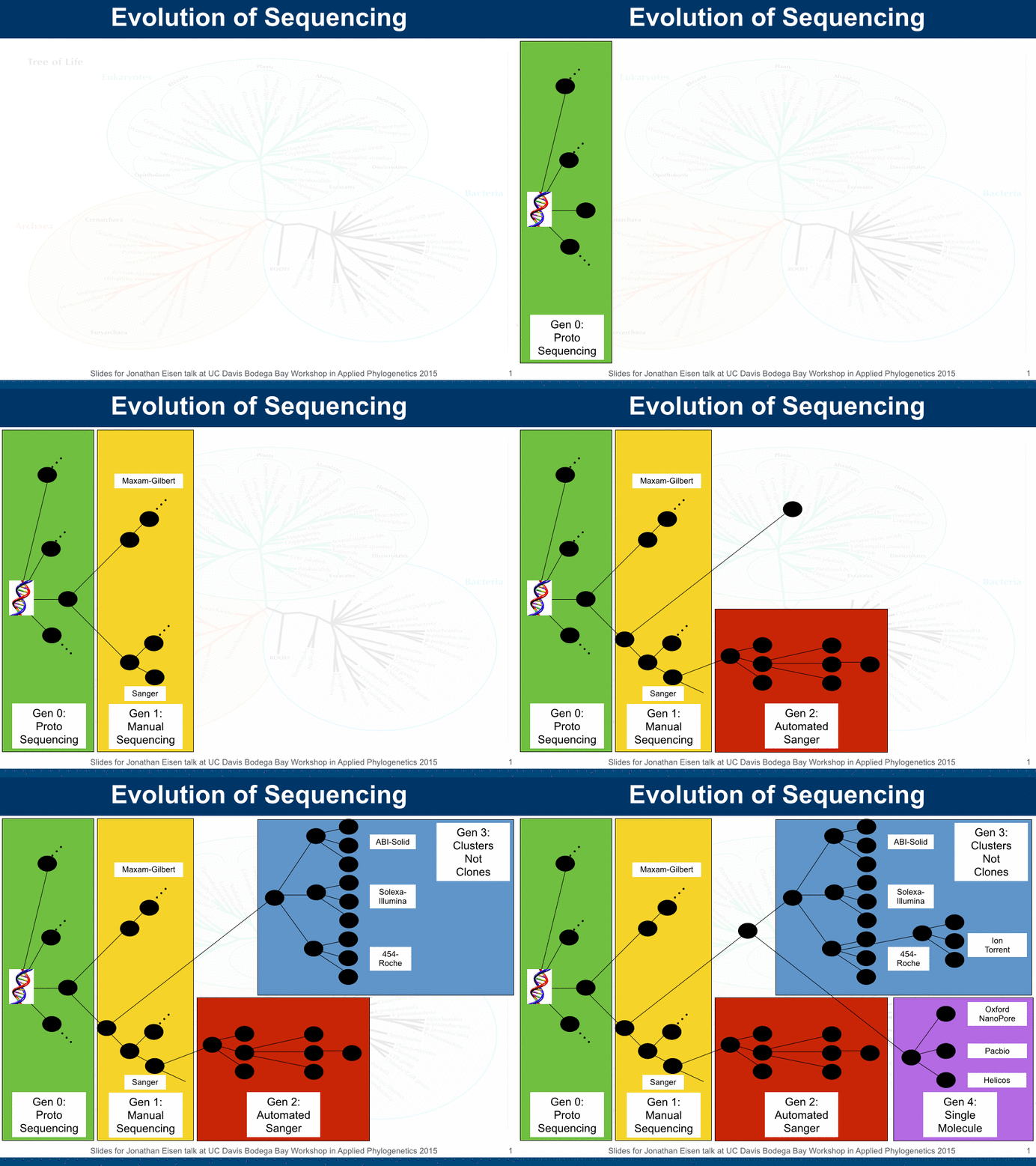
Every year for the last few years I have given a talk on the “Evolution of DNA Sequencing” at the “Workshop in Applied Phylogenetics” at Bodega Bay Marine Lab. I just did the talk and thought I would post the slides here. I note – I also added an evolutionary tree of sequencing methods which I include here as a separate animated gif too.

I note I posted a request to Twitter the day before the talk pointing to last years slides and I got lots of helpful suggestions from people about what to add or change. I included links to Tweets in the talk and thanked those people on the slides. But I would like to thank everyone here too. Published originally on March 10, 2015.  Updated  10/20/15 with information below and republished. Finally posted the video of the talk (recorded using Camtasia) to Youtube.  It is imperfect (there are a few things I said that came out wrong .. it was late at night).  But since it may be helpful to people I am posting it.

At #UCDavis today: “Protein interaction networks and complexes in bacteria”

Medical Microbiology and ImmunologyFaculty Recruitment Seminar

Peter Uetz, Ph.D.

Associate Professor

Center for the Study of Biological Complexity

Virginia Commonwealth University

Richmond, Virginia

Protein interaction networks and complexes in bacteria”

Friday, October 30, 2015

MedSci Building 180C (across from Tupper Hall)

12:10 – 1:00 pm

Please contact Karryn Doyle for additional information at kddoyle: 530.752.9401

PUetz Seminar Announcement.pdf

Today at #UCDavis: Megan Frederickson on “Mutualism ecology and evolution: moving beyond cheating”

Just got this announcement:

This Thursday’s EVE seminar speaker will be Megan Frederickson from the University of Toronto. Megan studies the evolution of cooperation and cheating in mutualisms, and the consequences of diversity for cooperation. To tackle these topics, Megan uses interactions between insects, ants, and microbes. See her website for more info.

Megan’s talk is titled "Mutualism ecology and evolution: moving beyond cheating," and will be at 4:10 in Everson 176.

If you would like to meet with Megan, please email me (amobrien) to coordinate a time.

There will also be a graduate student lunch at 12:10 in 1017 Wickson Hall, please RSVP (amobrien) if you plan to attend.

Also, as a "trailer" for the talk, check out Megan’s work on Devil’s Gardens featured in BBC’a Life in the Undergrowth, narrated by David Attenborough (first segment of: Intimate Relations).

Storify of the IFAL Roundtable on Microbiomes in Food and Agriculture

Here is a quick roundup of the Roundtable discussion I was involved in on Microbiomes in Food and Agriculture run by the IFAL at UC Davis.

Extraterrestrials, or Space Pirates?

A landmark study has illuminated the presence of specific microbes on the ISS strongly suggesting that humans might be on board the spacecraft.  In a routine survey of one air filter and more than one (two) of the vacuum bags used to clean the station, the researchers arrived at unexpected results – the amount and type of microbes found on the ISS are in stark contrast to those found on the meticulously scrubbed and disinfected NASA clean rooms* back on Earth.  Furthermore, these microbes on the ISS seem to resemble those found in association with humans.

NASA-Clean-room-from-Wikimedia-Commons-300x200.jpg

NASA Clean room, image from Wikimedia Commons https://commons.wikimedia.org/wiki/File:327160main_SICDH_FS_img1_lg.jpg

Experts say that if these microbes came from a human, it is entirely possible that they could live on another human.  A major worry is that the astronauts and cosmonauts expected to continue living and working now on the ISS might be living with bacteria, which have been known to cause disease in the past.  It is therefore now the topmost priority to figure out which pathogens are there and how on (from?) Earth they arrived.

Astronaut_Karen_Nyberg_With_Cosmonaut_Fyodor_Yurchikhin_and_Astronaut_Luca_Parmitano-from-Wikidmedia-Commons-300x199.jpg

Astronaut Karen Nyberg with fellow Cosmonaut Fyodor Yurchikhin and Astronaut Luca Parmitano, image from Wikimedia Commons https://commons.wikimedia.org/wiki/File:Astronaut_Karen_Nyberg_With_Cosmonaut_Fyodor_Yurchikhin_and_Astronaut_Luca_Parmitano.jpg

Microbial forensic experts are being called in to analyze the unique “fingerprint” signatures of the microbes left behind, in the hope of identifying the suspects these potential pathogens came from.  Preliminary findings have urged officials to focus their search on anyone who has recently eaten space-grown lettuce.  Next steps to understanding what is influencing the microbes on the ISS include analyzing the effect of a human breathing, eating, washing hair, sneezing, farting, playing the guitar or performing any other act as might be expected of these hypothesized ISS inhabitants.  Due to the limited knowledge of the on-goings of the station, the public is being asked for any information they might know of regarding such activities.

*Designed to eliminate the spread and survival of microorganisms.

Google Trends on Microbiomes and Microbiota

//www.google.com/trends/embed.js?hl=en-US&q=microbiome&tz=Etc/GMT%2B7&content=1&cid=TIMESERIES_GRAPH_0&export=5&w=500&h=330 //www.google.com/trends/embed.js?hl=en-US&q=microbiome,+microbiota&cmpt=q&tz=Etc/GMT%2B7&tz=Etc/GMT%2B7&content=1&cid=TIMESERIES_GRAPH_0&export=5&w=500&h=330
UPDATE: Added a zoomed in version
//www.google.com/trends/embed.js?hl=en-US&q=microbiome&date=1/2011+49m&cmpt=q&tz=Etc/GMT%2B7&tz=Etc/GMT%2B7&content=1&cid=TIMESERIES_GRAPH_0&export=5&w=500&h=330

Assistant Professor in Evolutionary Biology at UMass Boston

Assistant Professor in Evolutionary Biology

Job Description:

The Biology Department at the University of Massachusetts, Boston seeks applicants for a full-time tenure track Assistant Professor in Evolutionary Biology starting September 1, 2016. This individual should be well versed in evolutionary and ecological theory, and special preference will be given to investigators conducting research in the area of global change evolution. Applications are particularly welcome from candidates who use creative molecular, experimental, comparative, paleontological, or theoretical approaches to study the evolutionary responses of living organisms to global changes, but candidates working in any area of evolutionary biology are welcome to apply. The successful applicant is expected to establish an externally funded research program, direct the research of students at the undergraduate, masters and doctoral levels, and interact with a dynamic group of ecologists and environmental biologists. Excellence in teaching at the undergraduate and graduate levels is expected.

Requirements:

A Ph.D. and postdoctoral training (or equivalent professional experience) in evolution, ecology, or population genetics is required.

Additional Information:

UMass Boston has a strong faculty with substantial research programs in environmental areas, and doctoral programs in Environmental Biology; Molecular, Cellular and Organismal Biology; and Environmental Sciences. Excellent opportunities exist to collaborate and engage in multidisciplinary research in the new Integrated Science Complex on campus, across the five UMass campuses and at our Nantucket Field Station.

Application Instructions:

Application materials must be submitted online via the following link: https://umb.interviewexchange.com/jobofferdetails.jsp?JOBID=65133&CNTRNO=7&TSTMP=1445528235220

Applications should include a cover letter addressed to the search committee, a current curriculum vitae, 3-5 representative publications, a statement describing research interests and goals, a teaching statement documenting teaching experience and philosophy, and contact information for three letters of recommendation.

For further information, visit the Biology Department website at liam.revell or ron.etter, search committee co-chairs. Target date for receipt of applications is Dec. 1, 2015, but applications will be reviewed until the position is filled.

The University of Massachusetts Boston provides equal employment opportunities to all employees and applicants for employment without regard race, color, religion, gender, gender identity or expression, age, sexual orientation, national origin, ancestry, disability, military status, or genetic information. In addition to federal law requirements, the University of Massachusetts Boston complies with applicable state and local laws governing nondiscrimination in employment in every location in which the university operates. This policy applies to all terms and conditions of employment.

advisor-mmi291 REMINDER: MMI Faculty Recruitment Seminar on Friday, 10/23 at 12:10 PM in GBSF 1005

Medical Microbiology and Immunology

Faculty Recruitment Seminar

Laura Hertel, Ph.D.

Associate Scientist

Center of Immunobiology and Vaccine Development

Children’s Hospital Oakland Research Institute

Oakland, California

Friday, October 23, 2015

Genome and Biomedical Sciences Facility, Auditorium Room 1005

12:10 – 1:00 pm

“Watch your mouth: human cytomegalovirus infection and reactivation in Langerhans-type dendritic cells

Dr. Hertel will be presenting some new, unpublished data on the effects of different maturation stimuli on Langerhans cells’ susceptibility to direct CMV infection and on their ability to support viral reactivation from latency.

Please contact Karryn Doyle for additional information at kddoyle: 530.752.9401

LHertel Seminar Announcement.pdf