Farm to Table Academy Saturdays 10am in October at #UCDavis

Posting this email I received:

Greetings,

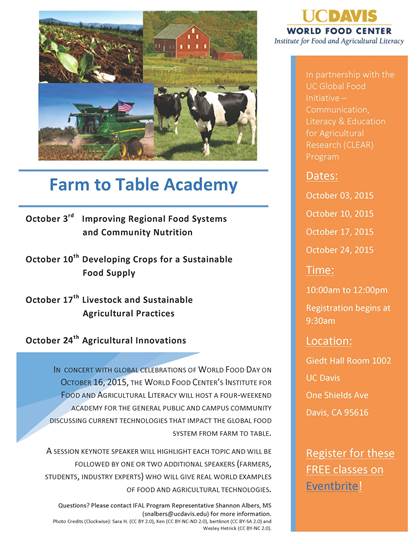
In concert with global celebrations of World Food Day on October 16th, the World Food Center’s Institute for Food & Agricultural Literacy (IFAL) will host a four-weekend academy for the general public and campus community discussing current technologies that impact the global food system from farm to table.

image003Farm to Table Flyer

A session keynote speaker will highlight each topic and will be followed by one or two additional speakers (farmers, students, industry experts) who will give real world examples of the technologies discussed.

October 3rd Improving Regional Food Systems and Community Nutrition

October 10th Developing Crops for a Sustainable Food Supply

October 17th Livestock and Sustainable Agricultural Practices

October 24th Agricultural Innovations

The sessions are FREE; register on Eventbrite for the dates you would like to attend (attendance of all four sessions is highly encouraged): https://www.eventbrite.com/e/farm-to-table-academy-tickets-18439560221.

Danforth Center Junior Faculty position in Plant Biology

Colleagues- The Danforth Center is conducting a junior faculty search. Please share the attached ad with any promising junior scientists you know.

Danforth Center Faculty Position

Description
The Donald Danforth Plant Science Center, in St. Louis, Missouri, is an independent, not-for-profit research organization dedicated to improving the human condition through plant science. The Danforth Center addresses global challenges by facilitating fundamental discovery and enabling translation into entrepreneurial and humanitarian solutions. Currently home to 20 independent labs and with a new wing opening in 2016, the Danforth Center is seeking new faculty at the Assistant and Associate ranks. Candidates are sought who are using creative approaches in any area of science that can be applied to plants. The Center has made significant recent investments to expand and strengthen genome-scale approaches, computational and quantitative biology, robotics, phenotyping and synthetic biology platforms. Candidates for Assistant Member positions must have postdoctoral experience and a record of excellence in research; candidates for Associate Member should have several years of productive, independent faculty-level experience. All candidates should be integrative and collaborative, and interested in contributing to the Center’s mission. Candidates should also possess the ability to raise external grant funds, and exhibit excellent leadership and communication skills. We encourage applications from underrepresented groups, including minorities, women, and people with disabilities. Members of the Center constitute the faculty, and typically have adjunct appointments at partner universities. Salary structures follow a typical academic model. More information about the Center is available at www.danforthcenter.org.

Please submit a cover letter, curriculum vitae, a statement of research plans, three relevant publications and names and addresses of three references online at FacultySearch

The Donald Danforth Plant Science Center is an equal opportunity/affirmative action employer

Cheers

Ivan

##########################################

Ivan Baxter

Research Computational Biologist

USDA-ARS Plant Genetics Research Unit

Donald Danforth Plant Sciences Center

www.baxterlab.org

ivan.baxter

ibaxter

314-587-1438

##########################################

Breakthrough method in microbial ecology: fMRI analysis of ordination plots.

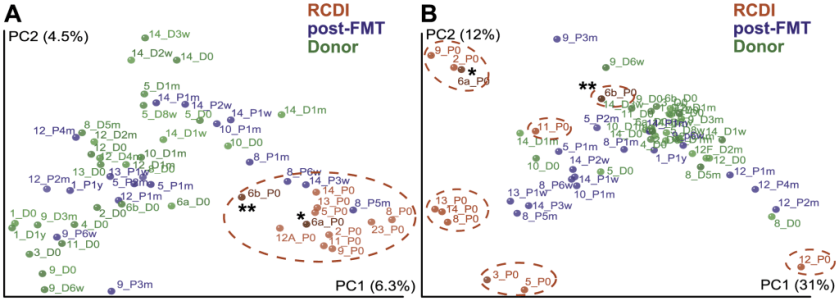
As anyone who has read a recent article on microbial ecology knows, the name of the game is ordination plots. Looking for post-hoc patterns in 16S and metagenomics surveys is pretty much par for the course. Depending on your question and statistical inclinations there are a huge variety of ordination plots to choose from; NMDS, PCA, PCOA… not to mention the distance metrics; UniFrac (weighted or unweighted), Bray-Curtis, Jaccard, etc. One approach is to simply run all these analyses (QIIME does this by default) and then to look for patterns.

journal.pone_.0081330.g004-1024x367.png

journal.pone.0081330.g004
Figure from http://journals.plos.org/plosone/article?id=10.1371/journal.pone.0081330

But how to choose?   If one plot shows a pattern and another shows a different pattern, how is a researcher to decide? Statistics is one possible approach, but we all know what Mark Twain said about statistics.

Better than statistics, is a new approach described in this week’s issue of QIIME THERAPY. In “fMRI analysis of ordination plots”, the authors describe a breakthrough approach for rapid and accurate classification of ordination plots for microbial ecology. Instead of arbitrary statistics, the researchers harbor the power of the unconscious human mind.   Any human can look at a series of dots and see patterns but computers struggle with this simple task.   Ask a 5-year old what shapes they see in an ordination plot and they’ll have ideas.   But, as the authors describe, there are problems when scientists are involved… they tend to overthink the process and focus on irrelevant details like axis labels (meaningless in a PCA plot for example). In this work, the researchers circumvent the conscious brain by placing subjects in an fMRI machine and passing images of ordination plots through their field of vision. Patterns are classified on the basis of the strength of the reaction to the image. The authors show that this method is 93% accurate on mock community data and also unveiled patterns in tests data sets that had been missed by statisticians. In addition, this method takes 10% of the time and requires about 25% of the cost of a statistical analysis.

As a proof of principle, the authors applied this methodology to previously analyzed data from the Human Microbiome Project.   While generally supporting previous conclusions, the authors also found that weighted UniFrac analysis suggested a novel correlation between the microbiome of the Hallux (big toe) and the microbiome of the non-dominant hand of participants. They plan further research to understand the causality of this connection.

Center for Population Biology Fall 2015 Seminar Series

Please find attached the Fall Quarter 2015 CPB Tuesday Seminar Schedule.

Seminars will be held as usual, 4:10pm in 1022 Life Sciences.

Please note that the series starts just prior to the actual first day of Fall Quarter ’15 instruction. So the first seminar is this coming Tuesday, September 22nd with Alisa Sedghifar’s PhD Exit Seminar.

CPB Seminar Series FALL 2015.pdf

Roundup of microBEnet posts of (possible) interest

I spend a decent amount of my blogging time these days writing posts for microBEnet (the microbiology of the built environment network) which is part of a project funded in my lab by the Sloan Foundation.

Some recent posts that may be of interest are listed below:

Temporary lecturer postion for “Introduction to Evolution” at @UCDavis

LECTURER

Introduction to Evolution

(EVE 100)

WINTER 2016 (January 4-March 19, 2016)

Responsibilities: A 60% position teaching EVE 100 – Introduction to Evolution (4 units). Lecture–3 hours, Discussion–1 hour. The course subject provides a general survey of the origins of biological diversity and evolutionary mechanisms. Estimated enrollment: 200

Requirements: Ph.D. and demonstrated effective teaching in the subject course or equivalent course.

Salary: Commensurate upon qualifications.

Please submit letter of application, including summary of qualifications, CV, two letters of recommendation, any applicable teaching evaluation summaries, and a statement of contributions to diversity via the link below link which contains additional information about the position.

https://recruit.ucdavis.edu/apply/JPF00709

OPEN UNTIL FILLED. FOR FULL CONSIDERATION APPLICATION MUST BE RECEIVED BY OCTOBER 12, 2015.

This position may be covered by a collective bargaining unit.

The University of California is an Equal Opportunity/Affirmative Action Employer with a strong institutional commitment to the development of a climate that supports equality of opportunity and respect for diversity.

09/08/2015

Winter 2016 EVE 100 Lecturer Ad.pdf

Postdoc in Ecological Plant Transcriptomics and Microbiome Analysis

DearColleague_Postdoc_2015.pdf

Seminar at #ucdavis 12/26 – Dr. Rebecca Hernandez on Global Change in Aridlands

RHernandez-SeminarAnnouncement-landscape.pdf

#UCDavis Evolution & Ecology Lecturer w/ Potential for Security of Employment Search

`

DEPARTMENT OF EVOLUTION AND ECOLOGY

LECTURER with Potential for

Security of Employment (LPSOE)

The Department of Evolution and Ecology (EVE) invites applications for a full-time Lecturer with Potential for Security of Employment (LPSOE). Faculty in LPSOE positions are eligible for promotion to Lecturer with Security of Employment (LSOE), the equivalent of tenure for ladder rank faculty. LPSOE/LSOE faculty are Academic Senate faculty members whose expertise and responsibilities center on undergraduate education and on the scholarly analysis and improvement of teaching methods. We are interested in the following areas: Ecology, Evolution, Phylogenetics, Genetics, Genomics, and General Education courses on topics related to these areas.

The successful applicant will be responsible for teaching lower, and possibly upper division undergraduate biology classes, as well as biology-based General Education courses for non-biologists. S/he will be expected to play a leadership role in the scholarship of teaching and learning by having a research program in biological science education, assessment strategies, or an academic discipline, and by working with other faculty and LPSOE’s within the college to develop, implement, and assess course learning objectives and new pedagogical methods.

Qualified applicants must have a Ph.D. in biology or science education, experience conducting scientific research in ecology, evolution, genetics, genomics or phylogenetics, preferably with postdoctoral training in teaching, education, or scientific research. Other preferred qualifications include documented success in some or all of the following areas as related to life sciences education: teaching undergraduate classes, use of evidence-based teaching practices, use of modern instructional technology including virtual models, online media in instruction, the ability to identify and develop effective teaching strategies for diverse student populations, conducting life sciences education research, as consistent with a successful discipline-based education research program. Salary will be commensurate with education and experience.

Closing date: open until filled, but all application materials, including letters of recommendation, must be received by October 1, 2015 to be assured full consideration. We are hoping to interview in December. Applicants should submit materials online at: kmartinez, and the faculty contact is Gail Patricelli, gpatricelli. More information on the EVE department and the College of Biological Sciences is available online: (http://www-eve.ucdavis.edu/; http://biosci.ucdavis.edu/index_js.html)

The University of California is an affirmative action/equal opportunity employer committed to excellence through diversity and strongly encourages applications from all qualified applicants, including women and minorities. UC Davis is responsive to the needs of dual career couples, is dedicated to work-life balance through an array of family-friendly policies, and is the recipient of an NSF ADVANCE Award for gender equity.
Local posting ad for LPSOE.docx

Jennifer Gardy’s Cats Poop for Science and @kittybiome