California Council on Science and Technology – CCST S&T Policy Fellowship Applications Open

Just received this from the Moore Foundation

Dear Friends and Colleagues,

Please help us spread the word!

We have opened up the application period for the 7th year of CCST Science and Technology Policy Fellowship (see below) that places professional scientists and engineers in the California State Legislature for one-year appointments. We greatly appreciate your help spreading the word about the fellowship program to your colleagues at academic institutions with doctoral programs as well as federal state, and industry labs, alumni organizations and professional scientific organizations. Please forward this email to anyone you feel would be interested in the CCST Science and Technology Policy Fellowship.

The Fellowship program is proving to be an extraordinarily effective way of bridging the science and policy communities. Fellows are actively engaged in the most important policy issues being addressed in California. Energy, healthcare, water, business climate, conservation, security—you name it and we can point to a current or former Fellow in Sacramento working on the topic. See attached for the current cohort of fellows who just began their one-year fellowship.

Applications are due February 28, 2015.

Learn more here: ambermace or (916) 492-0996.

p1x1.gif&c=5977bf80-11cf-11e4-ad73-d4ae52754db0&ch=98071060-11da-11e4-aee6-d4ae52754db0

CONTRIBUTE TO THE SCIENCE POLICY DISCUSSION IN CALIFORNIA…

BY APPLYING FOR A 2015-2016

CCST SCIENCE AND TECHNOLOGY POLICY FELLOWSHIP!

2.png
Offered by the California Council on Science and Technology (CCST), the CCST Science and Technology Policy Fellowship places professional scientists and engineers in the California State Legislature for one-year appointments. The program is designed to enable Fellows to work hands-on with policymakers in addressing complex scientific issues as well as assume all the other legislative responsibilities of full-time legislative staffers. The Legislature benefits from having the expertise of a trained Ph.D.-level scientist, who brings significant analytical, problem solving, research, and communication skills applied through the lens of the scientific method and the Fellows gain an invaluable, hands-on learning experience about the intersection of science, technology, and policy.

Building on the successful and highly acclaimed national model of the Science and Technology Policy Fellowships offered by the American Association for the Advancement of Science (AAAS) in the federal public policy arena, the CCST Science and Technology Policy Fellowship creates a similar interface in the California Legislature. The fellows learn the intricacies of the California legislative process and serve as fulltime legislative staff to provide recommendations, answers to technical questions, and clarification of policy options for a wide variety of issues, including those with science and technology related attributes.

Please explore our website to learn more about the CCST Science and Technology Fellowships and to complete the application and instructions.

Year 6 CCST S&T Fellows[2].pdf

Today at #UCDavis: Zach Lewis on “Influences on the Infant Intestinal Microbiome”

MIC 291: Selected Topics in Microbiology

Work-in-Progress Seminars

Zachery Lewis
Exit Seminar
(Mills Lab)

"Influences on the Infant Intestinal Microbiome"

Wednesday, December 10, 2014

4:10 pm

1022 Life Sciences

Host: Prof. John Roth, Dept. of Microbiology & Molecular Genetics

Lewis 12-10-14.doc

New lab paper: The microbes we eat: abundance and taxonomy of microbes consumed in a day’s worth of meals for three diet types

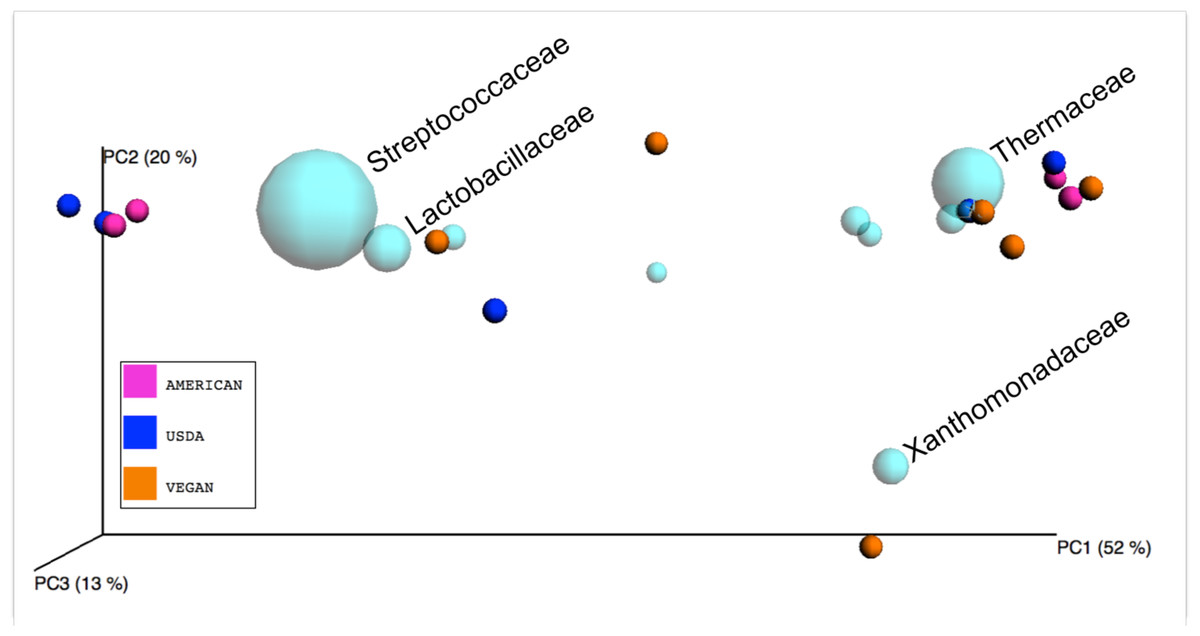
A new paper out from my lab (with Jenna Lang as the 1st author and in collaboration with Angela Zivcovic from the UC Davis Food For Health Initiative and the Department of Nutrition):  The microbes we eat: abundance and taxonomy of microbes consumed in a day’s worth of meals for three diet types.  The work in the paper focuses on characterizing the abundance and taxonomy of microbes in food from three model diets.

Basically, Angela prepared meals for these three diets

Food was purchased and prepared in a standard American home kitchen by the same individual using typical kitchen cleaning practices including hand washing with non-antibacterial soap between food preparation steps, washing of dishes and cooking instruments with non-antibacterial dish washing detergent, and kitchen clean-up with a combination of anti-bacterial and non-antibacterial cleaning products. Anti-bacterial products had specific anti-bacterial molecules added to them whereas “non-antibacterial” products were simple surfactant-based formulations. The goal was to simulate a typical home kitchen rather than to artificially introduce sterile practices that would be atypical of how the average American prepares their meals at home. All meals were prepared according to specific recipes (from raw ingredient preparation such as washing and chopping, to cooking and mixing).

And then she blended them and we characterzied the microbial communities in the blended samples:

After food preparation, meals were plated on a clean plate, weighed on a digital scale (model 157W; Escali, Minneapolis, MN), and then transferred to a blender (model 5,200; Vita-Mix Corporation, Cleveland, OH) and processed until completely blended (approximately 1–3 min). Prepared, ready to eat foods that were purchased outside the home were simply weighed in their original packaging and then transferred to the blender. 4 mL aliquots of the blended meal composite were extracted from the blender, transported on dry ice and then stored at −80 °C until analysis. The following analyses were completed using these meal composite samples: (1) total aerobic bacterial plate counts, (2) total anaerobic bacterial plate counts, (3) yeast plate counts, (4) fungal plate counts, and (5) 16S rDNA analysis for microbial ecology.

And Jenna Lang coordainted the sequence analysis and then Angela and Jenna (with some help here and there from me) coordianted the analysis of the different microbial data and the writing of the paper.

Figure 5: Biplot of taxa in sample PCoA space.

Lots of interesting things reported in the paper (read it, I insist).  I note – this is a demonstration project in a way – trying to get the community and others to think about the source pools of microbes that come into our system from our food.  It is by no means comprehensive or conclusive (read the caveats section of the paper).  Congrats to Jenna and Angela for all their hard work. Anyway – the paper is Open Access in PeerJ.  Eat it up.

UPDATE: Some press and blog coverage

PhD Opportunity in Birmingham, UK on the ‘Omics of oil spills w/ @hollybik

Just got this by email from Holly Bik who was a PostDoc in my lab until a few months ago ..
Dear Colleagues,

I wanted to bring to your attention a PhD opportunity in my group at the University of Birmingham, UK – apologies for any cross-posting:

Using ‘omic methods to determine how sediment communities of microbial eukaryotes respond to oil spills and environmental disturbancehttp://www.findaphd.com/search/ProjectDetails.aspx?PJID=59530&LID=124

The focus of the project would span both shallow-water and deep-sea sediments, including natural hydrocarbon seeps and locations impacted by the 2010 Deepwater Horizon oil spill. The project would be ideal for candidates looking to develop skills in bioinformatics and computational biology.

This studentship is available to UK and EU candidates that meet NERC’s requirements for both academic qualifications and residential eligibility (http://www.nerc.ac.uk/funding/application/studentships).

Regards,

Holly

Faculty position – Integrative Genetics – University of Akron

Talk at #UCDavis 12/11 by Evelyn Lincoln “Publication Anxiety in Early Modern Italy”

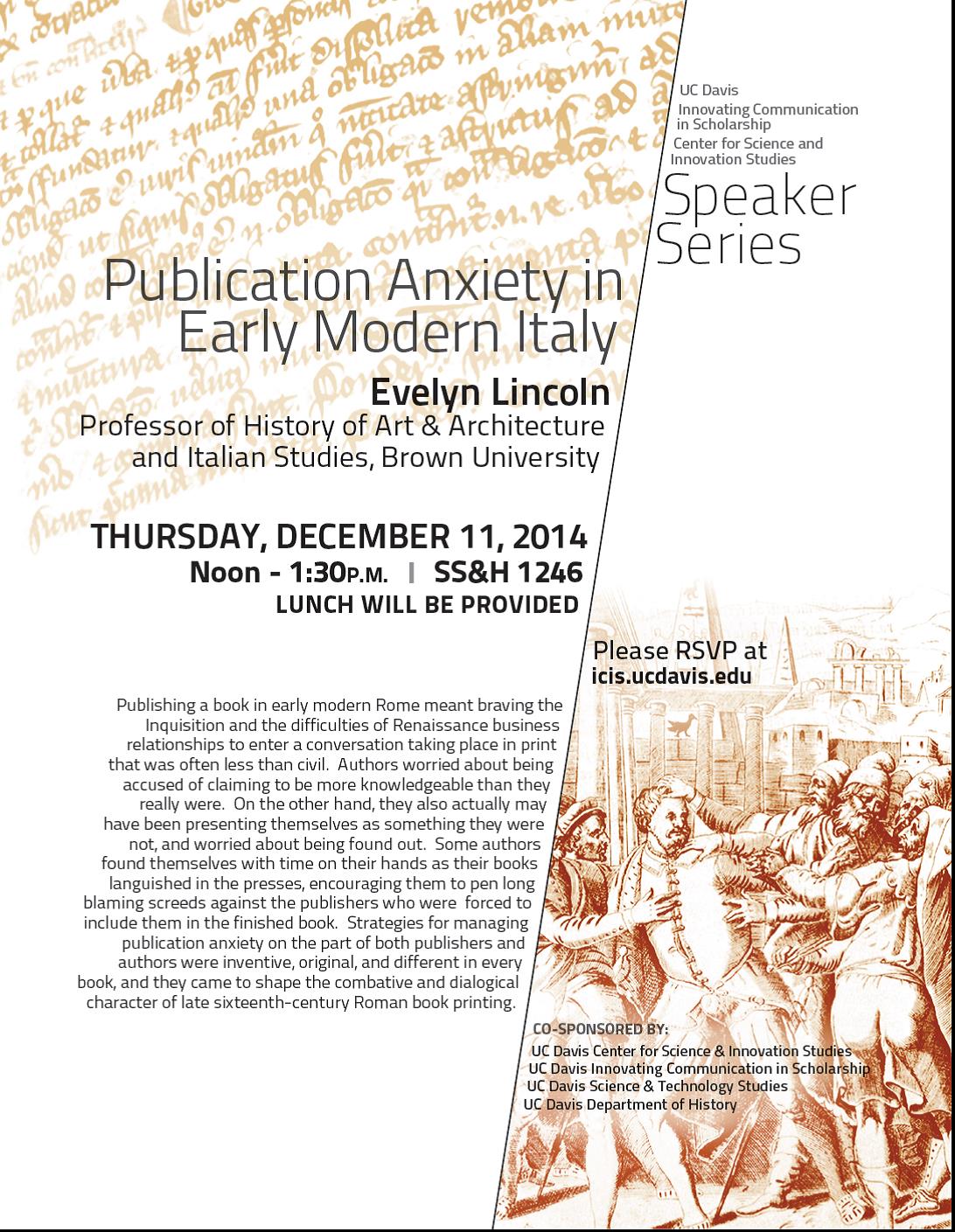
Please join Innovating Communication and Scholarship (ICIS), the Center for Science and Innovation Studies (CSIS), and Science and Technology Studies for a lunchtime event with Evelyn Lincoln on:

Publication Anxiety in Early Modern Italy

When: Thursday December 11th from 12:10 – 1:30 PM

Where: Room SS&H 1246 (STS /CSIS Room)

Discussant: Alessandro Delfanti

Lunch provided. Please RSVP if you plan to attend.

Abstract: Publishing a book in

early modern Rome meant braving the Inquisition and the difficulties of

Renaissance business relationships to enter a conversation taking place

in print that was often less than civil.

Authors worried about being accused of claiming to be more

knowledgeable than they really were. On the other hand, they also

actually may have been presenting themselves as something they were not,

and worried about being found out. Some authors found themselves

with time on their hands as their books languished in the presses,

encouraging them to pen long blaming screeds against the publishers who

were forced to include them in the finished book. Strategies for

managing publication anxiety on the part of both publishers

and authors were inventive, original, and different in every book, and

they came to shape the combative and dialogical character of late

sixteenth-century Roman book printing.

Evelyn Lincoln is Professor of the History of Art & Architecture and Italian Studies at Brown University. Her first book,

the Invention of the Italian Renaissance Printmaker (Yale, 2000) traced the careers of pictorial printmakers in Italy in the first century of its development. Brilliant Discourse. Pictures and Readers in Early Modern Rome (Yale, 2014) looks at the role played by the publication of

illustrated technical manuals in forming networks of printers,

publishers, artists and patrons, all of whom were also readers. Her

research investigates knowledge networks formed through making

and using pictures in the early modern world.

After you RSVP, you will be emailed with the paper to be discussed.

Talk at #UCDavis 12/2: Parasite manipulation of host phenotype: mechanisms, behavior, ecology, and evolution

Kelly Weinersmith

Exit seminar Tuesday (Dec 2nd) at 9AM in 2120J Wickson Hall.

"Parasite manipulation of host phenotype: mechanisms, behavior, ecology, and evolution."

Exit Seminar Flyer Weinersmith.pdf

At #UCDavis 1/22 Dr. Debra G.B. Leonard on “”Leaning In and Moving Up”

UC Davis Women in Medicine and Health Sciences

WIMHS, in Partnership with the Department of Pathology and Laboratory Medicine

PRESENTS:
Debra G.B. Leonard, MD, PhD Professor and Chair

“Leaning In and Moving Up”

January 22, 2015

12:00 pm – 1:00 pm

(Broadway Café box-lunch provided)

FSSB Building, Room 2030 4800 2nd Avenue, Sacramento

Register Online:

https://somapp.ucdmc.ucdavis.edu/academicaffairs /courses/secure/Courses.cfm?Status=10

Dr. Debra G.B. Leonard served as Chief Diversity Officer at Weill-Cornell Medical School. Dr. Leonard will discuss her experience with best practices and challenges in diversifying faculty from her perspective while at WCU.

Debra G. B. Leonard, MD, PhD Professor and Chair Department of Pathology and Laboratory Medicine University of Vermont Medical Center

WIMHS: http://www.ucdmc.ucdavis.edu/wimhs/index.html WIMHSFacebook: http://www.facebook.com/pages/UC- Davis-Women–in-Medicine-and_Science/218743748158322

Jan_2015_WIMHS_Leonard_Lecture_Flyer.pdf

Gordon & Betty Moore Foundation hiring a Program Officer for the Marine Microbiology Initative

The Gordon and Betty Moore Foundation is hiring a Program Officer for their Marine Microbiology Initative (see attachment). I love the Marine Microbiology Initiative and this could be a very interesting job. See http://www.moore.org/about/careers for more info.

MMI Program Officer job description.pdf

Whole issues of Genome Biology/Genome Medicine on "Genomics of Infectious Disease"

Wow this has really got some nice papers: BioMed Central | Article collections | Genomics of infectious diseases special issue.  I note – this goes well as a follow up to the series I co-coordinated in PLOS a few years back: Genomics of Emerging Infectious Disease – PLOS Collections

From their site:

Infectious diseases are major contributors to global morbidity and mortality, and have a devastating impact on public health. The World Health Organization estimates that 1 in 3 deaths worldwide are due to an infectious disease, with a disproportionate number occurring in developing regions. 

While the completion of the first genome sequence of a pathogen, Haemophilus influenzae, in 1995 took decades of work, in recent years, high-throughput technologies have revolutionized the study of pathogens. Whole-genome sequences are now achievable within days and available for multiple pathogens, including those that cause neglected tropical diseases, which has advanced our understanding of the biology and evolution of pathogens. Crucially, such research has enabled important advances in the clinical management of infectious diseases, and continues to guide public health interventions worldwide. 

In this cross-journal special issue, guest edited by George Weinstock (The Jackson Laboratory for Genomic Medicine, USA) and Sharon Peacock (University of Cambridge, UK), Genome Biology and Genome Medicine take stock of where we are now, with a collection of primary research and commissioned articles that discuss different aspects of the genomics of infectious diseases in human populations, including the progress made towards their eradication, and the remaining challenges in terms of both fundamental science and clinical management.

I have copied the list from their site (I am pretty sure this is OK since these are #OpenAccess journals but not 100% sure):


Editorial   Open Access
Ripudaman K Bains Genome Biology 2014, 15:529 (22 November 2014)
Review   Subscription
Lucy M Li, Nicholas C Grassly, Christophe Fraser Genome Biology 2014, 15:541 (22 November 2014)
Research   Open Access
Hayley M Bennett, Hoi Ping Mok, Effrossyni Gkrania-Klotsas, Eleanor J Stanley,
Isheng J Tsai, Nagui M Antoun, Avril Coghlan, Bhavana Harsha, Alessandra Traini, 
Diogo M Ribeiro, Sascha Steinbass, Sebastian B Lucas, Kieren S.J Allinson, 
Stephen J Price, Thomas S Santarius, Andrew J Carmichael, Peter L Chiodini, 
Nancy Holroyd, Andrew F Dean, Matthew Berriman 
Genome Biology 2014, 15:510 (21 November 2014)
Research highlight   Subscription
Patrick Tang, Jennifer L Gardy Genome Medicine 2014, 6:104 (20 November 2014)
Software   Open Access
Darren Abbey, Jason Funt, Mor N Lurie-Weinberger, Dawn A Thompson, Aviv Regev,
Chad L Myers,
Judith Berman Genome Medicine 2014, 6:100 (20 November 2014)
Comment   Subscription
Jeffrey S McLean, Roger S Lasken Genome Medicine 2014, 6:108 (20 November 2014)
Software   Open Access
Michael Inouye, Harriet Dashnow, Lesley-Ann Raven, Mark B Schultz, Bernard J Pope,
Takehiro Tomita, Justin Zobel, Kathryn E Holt 
Genome Medicine 2014, 6:90 (20 November 2014)
Research   Open Access
Mihail R Halachev, Jacqueline Chan, Chrystala I Constantinidou, Nicola Cumley,
Craig Bradley, Matthew Smith-Banks, Beryl Oppenheim, Mark J Pallen 
Genome Medicine 2014, 6:70 (20 November 2014)
Editorial   Open Access
George M Weinstock, Sharon J Peacock Genome Biology 2014, 15:528 (19 November 2014)
Software   Open Access
Todd J Treangen, Brian D Ondov, Sergey Koren, Adam M Phillippy Genome Biology 2014, 15:524 (19 November 2014)
Method   Open Access
Lewis Z Hong, Shuzhen Hong, Han Teng Wong, Pauline PK Aw, Cheng Yan, Andreas Wilm,
Paola F de Sessions, Seng Gee Lim, Niranjan Nagarajan, Martin L Hibberd, Stephen R Quake,
William F Burkholder Genome Biology 2014, 15:517 (19 November 2014)
Editorial   Open Access
Sharon J Peacock, George M Weinstock Genome Medicine 2014, 6:103 (19 November 2014)
Opinion   Free
Gail Geller, Rachel Dvoskin, Chloe L Thio, Priya Duggal, Michelle H Lewis, Theodore C Bailey,
Andrea Sutherland, Daniel A Salmon, Jeffrey P Kahn Genome Medicine 2014, 6:106 (18 November 2014)
Review   Subscription
Yonatan H Grad, Marc Lipsitch Genome Biology 2014, 15:538 (18 November 2014)
Method   Open Access
Christian B Matranga, Kristian G Andersen, Sarah Winnicki, Michele Busby,
Adrianne D Gladden, Ryan Tewhey, Matthew Stremlau, Aaron Berlin, Stephen K Gire, 
Eleina England, Lina M Moses, Tarjei S Mikkelsen, Ikponmwosa Odia, Philomena E Ehiane, 
Onikepe Folarin, Augustine Goba, S.Humarr Khan, Donald S Grant, Anna Honko, 
Lisa Hensley, Christian Happi, Robert F Garry, Christine M Malboeuf, Bruce W Birren, 
Andreas Gnirke, Joshua Z Levin, Pardis C Sabeti

Genome Biology 2014, 15:519 (18 November 2014)

Research   Open Access
Yanjiao Zhou, Martin J Holland, Pateh Makalo, Hassan Joof, Chrissy h Roberts,
David Maybe, Robin L Bailey, Matthew J Burton, George M Weinstock, Sarah E Burr 
Genome Medicine 2014, 6:99 (15 November 2014)
Research   Open Access
James W Wynne, Brian J Shiell, Glenn A Marsh, Victoria Boyd, Jennifer A Harper,
Kate Heesom, Paul Monaghan, Peng Zhou, Jean Payne, Reuben Klein, Shawn Todd, 
Lawrence Mok, Diane Green, John Bingham, Mary Tachedjian, Michelle L Baker, 
David Matthews, Lin-Fa Wang 
Genome Biology 2014, 15:532 (15 November 2014)
Method   Open Access
Maha R Farhat, B Shapiro, Samuel K Sheppard, Caroline Colijn, Megan Murray Genome Medicine 2014, 6:101 (15 November 2014)
Review   Subscription
Paolo Gabrieli, Andrea Smidler, Flaminia Catteruccia Genome Biology 2014, 15:535 (15 November 2014)
Research   Open Access
Jonathan D Herman, Daniel P Rice, Ulf Ribacke, Jacob Silterra, Amy A Deik, Eli Moss,
Kate M Broadbent, Daniel E Neafsey, Michael M Desai, Clary B Clish, Ralph Mazitschek,
Dyann F Wirth Genome Biology 2014, 15:511 (14 November 2014)
Research highlight   Subscription
Anastasia Koch, Robert Wilkinson Genome Biology 2014, 15:520 (13 November 2014)
Research highlight   Subscription
Chase L Beisel, Ahmed A Gomaa, Rodolphe Barrangou Genome Biology 2014, 15:516 (8 November 2014)
Research   Open Access Highly Accessed
Vegard Eldholm, Gunnstein Norheim, Bent von der Lippe, Wibeke Kinander,
Ulf R Dahle, Dominique A Caugant, Turid Mannsåker, Anne Mengshoel, 
Anne Dyrhol-Riise, Francois Balloux 
Genome Biology 2014, 15:490 (7 November 2014)
Opinion   Open Access
Digby F Warner, Valerie Mizrahi Genome Biology 2014, 15:514 (7 November 2014)
Comment   Open Access Highly Accessed
Onikepe A Folarin, Anise N Happi, Christian T Happi Genome Biology 2014, 15:515 (7 November 2014)
Research highlight   Subscription
Eric J Vallender Genome Biology 2014, 15:507 (7 November 2014)
Research   Open Access
Adam J Ericsen, Gabriel J Starrett, Justin M Greene, Michael Lauck, Muthuswamy Raveendran,
 David Deiros, Mariel S Mohns, Nicolas Vince, Brian T Cain, Ngoc H Pham, Jason T Weinfurter,
Adam L Bailey, Melisa L Budde, Roger W Wiseman, Richard Gibbs, Donna Muzny, T
homas C Friedrich, Jeffrey Rogers, David H O’Connor Genome Biology 2014, 15:478 (7 November 2014)
Research   Open Access
Laura Gomez Valero, Christophe Rusniok, Monica Rolando, Mario Neou,
Delphine Dervins-Ravault, Jasmin Demirtas, Zoe Rouy, Robert J Moore, Honglei Chen, 
Nicola K Petty, Sophie Jarraud, Jerome Etienne, Michael Steinert, Klaus Heuner, 
Simonetta Gribaldo, Claudine Médigue, Gernot Glöckner, Elizabeth L Hartland, 
Carmen Buchrieser 
Genome Biology 2014, 15:505 (3 November 2014)
Research   Open Access
Frank Hanses, Christelle Roux, Paul M Dunman, Bernd Salzberger, Jean C Lee Genome Medicine 2014, 6:93 (3 November 2014)
Research   Open Access Highly Accessed
Paul McAdam, Charles vander broek, Diane Lindsay, Melissa Ward, Mary Hanson,
Michael Gillies, Mike Watson, Joanne Stevens, Giles Edwards, Ross Fitzgerald 
Genome Biology 2014, 15:504 (3 November 2014)
Research   Open Access Highly Accessed
Tige R Rustad, Kyle J Minch, Shuyi Ma, Jessica K Winkler, Samuel Hobbes, Mark J Hickey,
William Brabant, Serdar Turkarslan, Nathan D Price, Nitin S Baliga, David R Sherman Genome Biology 2014, 15:502 (3 November 2014)