Help save the world and get $100,000 seed grant to do it

Just got this email and thought I would share since it does relate to some of the themes of my blog. I note that the Gates Foundation is VERY supportive of Open Access publishing as one of their previous grants helped support the journal “PLoS Neglected Tropical Diseases.” I am hoping that at some point the Gatges Foundation will require OA publishing for all of the projects they fund.

The Bill & Melinda Gates Foundation is now accepting grant proposals for Round 2 of Grand Challenges Explorations, a US$100 million initiative to encourage unconventional global health solutions.

Based on your feedback, we have made changes for Round 2 of Grand Challenges Explorations. We modified the topics from Round 1 and added two additional topics. We will no longer require applicants to register for a topic in advance of submitting their proposals. We also updated the application form in response to feedback from the initial round.

Grant proposals are being accepted online at http://www.gcgh.org/explorations until November 2, 2008, on the following topics:

New! — Create new vaccines for diarrhea, HIV, malaria, pneumonia, and tuberculosis
New! — Create new tools to accelerate the eradication of malaria
— Create new ways to protect against infectious diseases
— Create drugs or delivery systems that limit the emergence of resistance
— Create new ways to prevent or cure HIV infection
— Explore the basis for latency in tuberculosis

Initial grants will be $100,000 each, and projects showing promise will have the opportunity to receive additional funding of $1 million or more. Full descriptions of the new topics and application instructions are available at http://www.gcgh.org/explorations.

We are looking forward to receiving innovative ideas from scientists around the world and from all scientific disciplines. Anyone can apply, regardless of education or experience level. If you don’t submit a proposal yourself, we hope you will forward this message to someone else who might be interested.

Thank you for your commitment to solving the world’s greatest health challenges.

Best time to appreciate Open Access? When you’re really sick and want to learn more about what you have.

Well, I have been out sick for a while. But I am now finally apparently getting better. Thanks to the work of scientists who have developed multiple classes of antibiotics. Anyway, more on that later. While I was out sick I spent a lot of time searching the web for information about nasty, cellulitis causing antibiotic resistant bacterial infections. And I was researching some other health related issues that may have contributed to my getting such an infection. Here are some tidbits I learned during this forced homecation.

  • Complete OA still a long way off. One thing I re-learned during this was that it is incredibly frustrating to see how much of the biomedical literature is still not freely available online. Shame on Elsevier and all the others who are still hoarding this important information.
  • Thanks to those providing OA. Related to the above issue, I came to appreciate was the societies and publishers have decided to go the OA route. I spent a lot of time reading material from ASM, BMC, PLoS, Hindawi, and a few others. And I am grateful to these groups.
  • Google rocks for science searching. Cuil, not so much. If you need to find something about some scientific concept or issue, Google really does a great job. While I was out, Cuil was announced as a possible new competitor for Google in searching. From my experience, Cuil is really really lame for science searches. I like their presentation in a magazine style. But the search results were not so good.
Anyway, enough about me. This is just a quick post to say the Tree of Life will be coming back over the next week or two. I am still out sick. But a clear sign to me that I am getting better is that I finally want to blog again.

Closed Access Award #1: American Psychological Association

Well, I wrote up this award a short time ago and already the story has changed. But I am still giving the award. On Tuesday, Peter Suber reported that

The American Psychological Association may have the worst publisher policy to date for NIH-funded authors. Excerpt:

In compliance with [the NIH OA policy], APA will deposit the final peer-reviewed manuscript of NIH-funded research to PMC upon acceptance for publication. The deposit fee of $2,500 per manuscript for 2008 will be billed to the author’s university per NIH policy….

Even after collecting the fee, the APA will not deposit the published version of the article, will not allow OA release for 12 months, will not allow authors to deposit in PMC themselves (and bypass the fee), will not allow authors to deposit in any other OA repository, and will not allow authors to retain copyright.

I agree with Peter that this is a stunningly inane move on their part (for more discussion see Suber’s follow up here). They are basically saying that to carry out a simply electronic submission they will charge $2500.

Apparently someone convinced them this was not the brightest thing in the world to do as they are now reconsidering this move (I learned about this reconsideration from the Scientist magazine blog here … you need to register to read the blog). This blog reports

A statement sent to The Scientist today from APA Publisher Gary VandenBos said: “A new document deposit policy…is currently being re-examined and will not be implemented at this time…APA will soon be releasing more detailed information about the complex issues involved in the implementation of the new NIH Public Access Policy.”

VandenBos was not available for further comment.

Even though they are reconsidering their policy, since they have not out and out rescinded it, I am still giving the American Psychological Association my first “Closed Access Award” for this incredibly silly move

Stanford – Promoting open access while selling access to "closed" journals

Some people may have seen the press Stanford got a few weeks ago regarding the Open Access initiative of their School of Education. For some more information on this see

  • Stanford’s Education School Requires Open Access
  • Stanford University School of Education’s Open Access Mandate—Harvard Medical School Next?
  • Science Commons » Blog Archive » A new open access mandate at Stanford
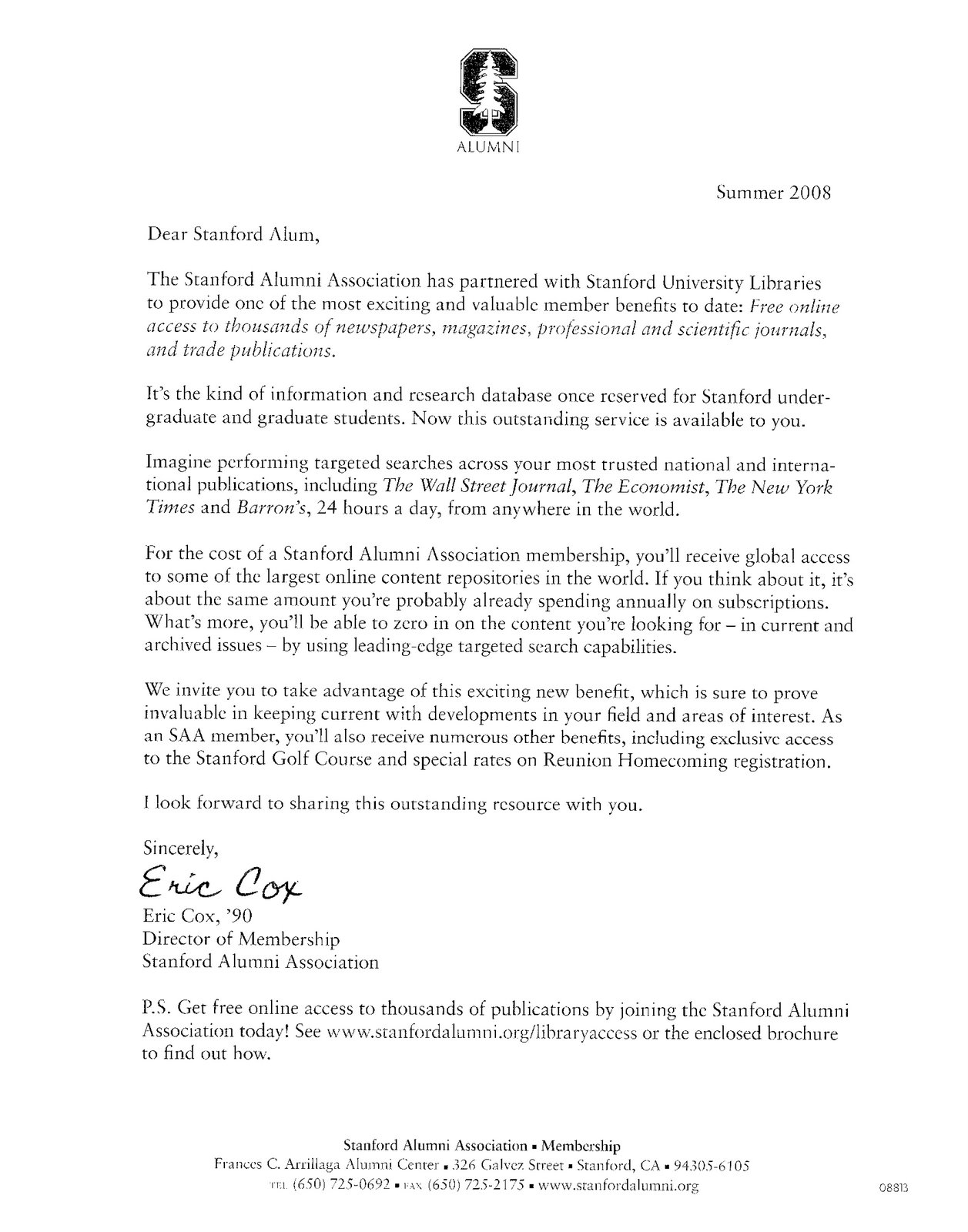
  • Certainly sounds like a good move on their part. And then I got an interesting thing in the mail from the Stanford Alumni Association (I earned my PhD from Stanford) trying to get me to join the association (see letter below). What was the selling point? If I joined I would get access to newspapers, periodicals and even scientific journals, through their library. So Stanford is all for OA in some places. But while they have access to closed journals, they will use that as a recruitment tool to join the Alumni Association. Seems to me like a better way to push for Open Access would be for all of Stanford to take the School of Education’s position and for the university to immediately cancel all subscriptions to completely closed access journals.

    Only Nature could turn the success of PLoS One into a model of failure

    Now, mind, you I like Nature as a publishing unit. They publish some very fine journals. Now, most of them are not Open Access, so I choose not to publish there if I can avoid it. But I still like them. And many of the editors and reporters there are excellent – smart, creative, insightful and such. But Nature the publisher can also be completely inane when it comes to writing about Open Access and PLoS. In a new article by Declan Butler, Nature takes another crack at the PLoS “publishing model”

    The problem with PLoS now is … wait for this … the success of PLoS One. PLoS One it turns out is publishing a lot of papers (including one by me, today). And bringing in a decent amount of money to PLoS apparently (note for full disclosure – I am involved in PLoS Biology as “Academic Editor in Chief” and PLoS Computational Biology as an Academic Editor … although I should note I am not involved in financial discussions at PLoS in any way).
    So why is the success of PLoS One a problem? Well, because it allows Nature to do the old good cop bad cop routine and to write, again, about the “failings” of the PLoS publication model. Now, mind you, the article does not quote a single source for what the PLoS publication model is. But they do say it has failed. From what I can tell here is the logic of the failure argument:
    1. Nature believes PLoS’ model for success revolved solely around PLoS Biology and PLoS Medicine and some of the other other PLoS journals being self sustaining after a few years.
    2. Analysis of some financial information suggests that PLoS Biology and Medicine currently are not breaking even
    3. PLoS One is apparently wildly successful and thus is brining in some money to PLoS.
    4. PLoS One publishes a lot of papers (they discuss this a bit and imply that this is a bad thing because some of the papers must be bad. Note – they do not back this up with any evidence. Silly for me to ask a science journal to use evidence)
    5. Therefore, the entire PLoS Publication model is a failure.
    The problems with this logic are, well, large. Here are some:
    1. Does Nature really think that there ever was a single “model” for how PLoS should be evaluated?
    2. If so, where is the documentation of what this model actually was?
    3. Even if there was a PLoS model and even if it turns out to be not exactly what PLoS is doing now, what is the big deal? If you were a stockholder of any company and they told you “we are never going to change our business model no matter what happens in the world around us” I would recommend you not buy their stock. It is simply farcical to expect any entity to stick to a single simple model forever.
    4. Does not Nature supplement some of their bigger journals with their higher volume other journals?
    5. Most companies these days use high profile entities such as PLoS Biology and PLoS Medicine to attract attention to other portions of their company in order to help bring in money. Is this somehow not allowed by PLoS? Doesn’t Nature do the same thing?
    6. If you look at the figure Nature shows of PLoS $$$, it shows income rising in 2007 and expenses going down. How did that get turned into a bad thing?
    So – I still do like Nature publishing because much of the time it has high quality stuff. It even has high quality stuff commenting/criticizing the Open Access movement and pointing out some of the challenges with it. But this article by Butler is not an impressive piece of work. I really wanted to give him an award but could not think of what to give.
    See also (thanks to Bora for pointing out a bunch of these links)

    Freeing My Father’s Scientific Publications


    Today is Father’s Day. It was a great day for me, hanging out with my kids and wife and doing things around town here in Davis (we kind of made it Father’s Weekend and did some activities on Saturday too). Despite the wonderful weekend, this day is also filled with melancholy for me when I think about my father, Howard Eisen, who died when I was a freshman in college. I miss him greatly. But whenever I think about him I think about how he almost certainly would be really proud that his two sons (me and my brother Michael at Berkeley) are now scientists.

    You see, my father was a scientist too — an MD who did research at the NIH, focusing mostly on hormone receptors. Given my propensities for putting things on the web and trying to disseminate scientific information, I cam up with a plan last night to create some sort of web page in his honor with some information about his work and his life.

    The thing is, I actually know little about his work, because while I was growing up, my parents never really talked about the details of their work (my mom is a scientist too). Sure, we went to the NIH occasionally and most of my parents friends were scientists. And they talked sciency talk. But they did not really discuss details of their work. I think in the end, this is partly why my brother and I did not shun the family business and went into science.

    So, of course, being the obsessed Open Access advocate, the first thing I decided to look at was what publications of my fathers I could get my hands on. This was both to read them and to make them available on this tribute page.

    So – my first step in this journey was to search Pubmed for Eisen HJ. And then I had to remove the publications by another Eisen HJ. And so I was left with 35 publications in PubMed (I know he had some other articles as well as chapters in books and such but this is a good start). So then I asked – which of these were available online in one way or another. According to Pubmed 24/35 were available online. Of those available online:

    • Pubmed Central: 3
    • Free access: 13
    • Fee access: 8
    • Unavailable: 11.

    This made me both happy and sad. I was glad to see some of his publications in Pubmed Central (thanks to PNAS and the Biochemistry Journal for putting them there). It was also good to see many available for free, even if this was only at some journals site. So – thanks to journals like J. Biol. Chem. for making the material available online for free. But I was a bit saddened to see how many of his papers, which are now all over 20 years old, being available only for a fee. And I was also a bit saddened to see how many had not yet made it into the digital world.

    So – what to do next? Well, my goal is to get access to all his papers and then to free them up to the world. So my first step was to see if any of the ones that Pubmed did not have links for might be available online anyway. And indeed a few were. For example, Pediatric Research back issues are available online. And these are free. In addition, his papers in Biochemistry, J. Steroid Biochemistry and Advances in Genetics is available for a fee but it is not linked from Pubmed. So with this information the new tally was

    • Pubmed Central: 3
    • Free access: 14
    • Fee access: 11
    • Unavailable: 7

    Getting digitized.
    So for those 7 that are currently unavailable (at least anywhere I could find) digitally, my next step is to try and lobby the journals to make them available. For some journals, this has some hope (well, not per se my lobbying, but they may make them available). For example, Endocrinology has some back issues available but just not all the way back to some of my father’s publications in that journal. So, I wrote to the journal Endocrinology using the link from the journal site and asked what their plans were for older issues. And I will post here if I get a response. (( UPDATE – THESE ARE TO BE MADE AVAILABLE SOON ACCORDING TO HIGHWIRE PRESS.)) I am doing the same for all the other unavailable publications, although some of the journals seem to not exist anymore.

    Convincing “free” access journals to deposit old papers in PMC.
    My next goal is to see if the “free” access journals have any plans to submit stuff to Pubmed Central. Yes, I know PMC is not perfect, but I believe it is better to have things in PMC than just on a journals website. So I am writing to all these journals to find out if they have any plans to deposit this material.

    Freeing up the “fee for access” papers.
    My final initial goal, and probably the most challenging, is to figure out ways to make the papers that are current “fee for access” available for free. If these were my papers, I suppose I could put many of the PDFs on my own web site. Perhaps I can do this for my father’s publications (does the right to do this get passed down?). Of course, first I have to get the PDFs and it just seems weird to me to have to pay to get access to papers my father wrote. Another possibility is that the journals would let me pay an OA fee to free up these old papers. I am going to look into that although I cannot really afford it. A final possibility would be to get the papers into PMC without the journals explicit agreement. Perhaps because my father was a government employee, the copyright would allow depositing in PMC? I do not know.

    So right now, the process is incomplete. I am actually learning a good deal about OA from looking into older papers rather than just all the new papers I tend to focus on. And hopefully in the process I can free up all of my father’s papers so that his scientific legacy does not fade away as rapidly due to lack of access. And then next maybe I can focus on my grandfather’s publications.

    Anyway — here is a list of my father’s publications with links and/or comments on their availability.

    1. Simons SS Jr, Pumphrey JG, Rudikoff S, Eisen HJ. Identification of cysteine 656 as the amino acid of hepatoma tissue culture cell glucocorticoid receptors that is covalently labeled by dexamethasone 21-mesylate. J Biol Chem. 1987 Jul 15;262(20):9676-80. PMID: 3597435.Click here to read
    2. Cresteil T, Jaiswal AK, Eisen HJ. Transcriptional control of human cytochrome P1-450 gene expression by 2,3,7,8-tetrachlorodibenzo-p-dioxin in human tissue culture cell lines. Arch Biochem Biophys. 1987 Feb 15;253(1):233-40. PMID: 3813564. Click here to read
    3. Eisen LP, Reichman ME, Thompson EB, Gametchu B, Harrison RW, Eisen HJ. Monoclonal antibody to the rat glucocorticoid receptor. Relationship between the immunoreactive and DNA-binding domain. J Biol Chem. 1985 Sep 25;260(21):11805-10. PMID: 3840164Click here to read
    4. Antakly T, Eisen HJ. Immunocytochemical localization of glucocorticoid receptor in target cells. Endocrinology. 1984 Nov;115(5):1984-9. PMID: 6208016. UPDATE – TO BE MADE AVAILABLE SOON ACCORDING TO HIGHWIRE PRESS.
    5. Harmon JM, Eisen HJ, Brower ST, Simons SS Jr, Langley CL, Thompson EB. Identification of human leukemic glucocorticoid receptors using affinity labeling and anti-human glucocorticoid receptor antibodies. Cancer Res. 1984 Oct;44(10):4540-7. PMID: 6331880Click here to read
    6. Reichman ME, Foster CM, Eisen LP, Eisen HJ, Torain BF, Simons SS Jr. Limited proteolysis of covalently labeled glucocorticoid receptors as a probe of receptor structure. Biochemistry. 1984 Oct 23;23(22):5376-84. PMID: 6391542
    7. Nebert DW, Eisen HJ, Hankinson O. The Ah receptor: binding specificity only for foreign chemicals? Biochem Pharmacol. 1984 Mar 15;33(6):917-24. Review. PMID: 6324804Click here to read
    8. Nebert DW, Brown DD, Towne DW, Eisen HJ. Association of fertility, fitness and longevity with the murine Ah locus among (C57BL/6N) (C3H/HeN) recombinant inbred lines. Biol Reprod. 1984 Mar;30(2):363-73. PMID: 6704471Click here to read
    9. Foster CM, Eisen HJ, Bloomfield CD. Covalent labeling of rat thymocyte and human lymphoid glucocorticoid receptor. Cancer Res. 1983 Nov;43(11):5273-7. PMID: 6577947Click here to read
    10. Karenlampi SO, Eisen HJ, Hankinson O, Nebert DW. Effects of cytochrome P1-450 inducers on the cell-surface receptors for epidermal growth factor, phorbol 12,13-dibutyrate, or insulin of cultured mouse hepatoma cells. J Biol Chem. 1983 Sep 10;258(17):10378-83. PMID: 6309801Click here to read
    11. Mariani G, Kortright KH, Eisen HJ, Adamson RH, Waldmann TA. A methodological approach for the study of protein synthesis by cell cultures in vitro. J Nucl Med Allied Sci. 1983 Jul-Sep;27(3):237-47. PMID: 6198498
    12. Simons SS Jr, Schleenbaker RE, Eisen HJ. Activation of covalent affinity labeled glucocorticoid receptor-steroid complexes. J Biol Chem. 1983 Feb 25;258(4):2229-38. PMID: 6687388. Click here to read
    13. Tukey RH, Hannah RR, Negishi M, Nebert DW, Eisen HJ. The Ah locus: correlation of intranuclear appearance of inducer-receptor complex with induction of cytochrome P1-450 mRNA. Cell. 1982 Nov;31(1):275-84. PMID: 6186383Click here to read
    14. Legraverend C, Hannah RR, Eisen HJ, Owens IS, Nebert DW, Hankinson O. Regulatory gene product of the Ah locus. Characterization of receptor mutants among mouse hepatoma clones. J Biol Chem. 1982 Jun 10;257(11):6402-7. PMID: 6896205Click here to read
    15. Nebert DW, Negishi M, Lang MA, Hjelmeland LM, Eisen HJ. The Ah locus, a multigene family necessary for survival in a chemically adverse environment: comparison with the immune system. Adv Genet. 1982;21:1-52. Review. PMID: 7036691. Available online for fee but not linked from Pubmed.
    16. Eisen HJ, Schleenbaker RE, Simons SS Jr. Affinity labeling of the rat liver glucocorticoid receptor with dexamethasone 21-mesylate. Identification of covalently labeled receptor by immunochemical methods. J Biol Chem. 1981 Dec 25;256(24):12920-5. PMID: 6895516Click here to read
    17. Hannah RR, Nebert DW, Eisen HJ. Regulatory gene product of the Ah complex. Comparison of 2,3,7,8-tetrachlorodibenzo-p-dioxin and 3-methylcholanthrene binding to several moieties in mouse liver cytosol. J Biol Chem. 1981 May 10;256(9):4584-90. PMID: 7217100Click here to read
    18. Stevens J, Eisen HJ, Stevens YW, Haubenstock H, Rosenthal RL, Artishevsky A. Immunochemical differences between glucocorticoid receptors from corticoid-sensitive and -resistant malignant lymphocytes. Cancer Res. 1981 Jan;41(1):134-7. PMID: 7448753Click here to read
    19. Nebert DW, Eisen HJ, Negishi M, Lang MA, Hjelmeland LM, Okey AB. Genetic mechanisms controlling the induction of polysubstrate monooxygenase (P-450) activities. Annu Rev Pharmacol Toxicol. 1981;21:431-62. Review. PMID: 7016012Click here to read
    20. Marković RD, Eisen HJ, Parchman LG, Barnett CA, Litwack G. Evidence for a physiological role of corticosteroid binder IB. Biochemistry. 1980 Sep 30;19(20):4556-64. PMID: 7426614. Available online to purchase though no listed in Pubmed.
    21. Eisen HJ. An antiserum to the rat liver glucocorticoid receptor. Proc Natl Acad Sci U S A. 1980 Jul;77(7):3893-7. PMID: 7001446Click here to read
    22. Hannah R, Simkins R, Eisen HJ. Synthesis of alpha-fetoprotein and albumin by fetal mouse liver cultured in chemically defined medium. Dev Biol. 1980 Jun 15;77(2):244-52. PMID: 6156873Click here to read
    23. Okey AB, Bondy GP, Mason ME, Kahl GF, Eisen HJ, Guenthner TM, Nebert DW. Regulatory gene product of the Ah locus. Characterization of the cytosolic inducer-receptor complex and evidence for its nuclear translocation. J Biol Chem. 1979 Nov 25;254(22):11636-48. PMID: 500663Click here to read
    24. Rechler MM, Eisen HJ, Higa OZ, Nissley P, Moses AC, Schilling EE, Fennoy I, Bruni CB, Phillips LS, Baird KL. Characterization of a somatomedin (insulin-like growth factor) synthesized by fetal rat liver organ cultures. J Biol Chem. 1979 Aug 25;254(16):7942-50. PMID: 468799Click here to read
    25. Simkins RA, Eisen HJ, Sparks JW, Glinsmann WH. Development of glucogenesis from galactose by fetal rat liver explants in organ culture. Dev Biol. 1978 Oct;66(2):353-60. PMID: 700252Click here to read
    26. Simkins RA, Eisen HJ, Glinsmann WH. Functional integrity of fetal rat liver explants cultured in a chemically defined medium. Dev Biol. 1978 Oct;66(2):344-52. PMID: 81156Click here to read
    27. Eisen HJ, Glinsmann WH. Maximizing the purification of the activated glucocorticoid receptor by DNA-cellulose chromatography. Biochem J. 1978 Apr 1;171(1):177-83. PMID: 646815Click here to read
    28. Eisen HJ, Glinsmann W. Partial purification of the glucocorticoid receptor from rat liver: a rapid, two-step procedure using DNA-cellulose. Biochem Biophys Res Commun. 1976 May 17;70(2):367-72. PMID: 180989Click here to read
    29. Eisen HJ, Ginsberg AL. Letter: Disulfiram hepatotoxicity. Ann Intern Med. 1975 Nov;83(5):673-5. PMID: 1200504. Back issues not currently available.
    30. Eisen HJ, Glinsmann W. Partial purification of glucocorticoid receptor from rat liver using DNA-cellulose. J Steroid Biochem. 1975 Jul;6(7):1171-3. PMID: 170470. AVAILABLE FOR FEE BUT NOT LINKED FROM PUBMED.
    31. Glinsmann WH, Eisen HJ, Lynch A, Chez RA. Glucose regulation by isolated near term fetal monkey liver. Pediatr Res. 1975 Jul;9(7):600-4. PMID: 125868. AVAILABLE FREE EVEN THOUGH MEDLINE DOES NOT HAVE LINK.
    32. Eisen HJ, Goldfine ID, Glinsmann WH. Regulation of hepatic glycogen synthesis during fetal development: roles of hydrocortisone, insulin, and insulin receptors. Proc Natl Acad Sci U S A. 1973 Dec;70(12):3454-7. PMID: 4357871Click here to read
    33. Eisen HJ, Glinsmann WH, Sherline P. Effect of insulin on glycogen synthesis in fetal rat liver in organ culture. Endocrinology. 1973 Feb;92(2):584-8. PMID: 4682869. Wrote to ask if they will become available.  UPDATE – TO BE MADE AVAILABLE SOON ACCORDING TO HIGHWIRE PRESS.
    34. Hellman DE, Eisen HJ, Goodman HM. The effects of hypophysectomy on phosphorylase activity in adipose tissue and muscle. Horm Metab Res. 1971 Sep;3(5):331-5. PMID: 4332655
    35. Eisen HJ, Goodman HM. Growth hormone and phosphorylase activity in adipose tissue. Endocrinology. 1969 Feb;84(2):414-6. PMID: 4303531. Wrote to ask if they will become available. UPDATE – TO BE MADE AVAILABLE SOON ACCORDING TO HIGHWIRE PRESS. 

    SPARC and Science Commons release guide to creating institutional open acces policies

    A nice new release from SPARC and Science Commons is out. They put together a guide to creating institutional open access policies (see Press Release)

    In the guide they have an overview of the new Harvard Open Access policy, suggestions for what one can do on one’s own campus and a plan of action for bringing about policy change. I know I am going try some of their suggestions here at Davis as I am hoping Davis and the UC in general adopts a policy like Harvard’s (they mention the UC consideration of such a policy in their site)

    Science Commons » Blog Archive » Rockefeller U. Press Uses CC Licenses to Reduce Permission Barriers

    Good Open Access news from Rockefeller Press. They have decided to change their publishing policies and are making them much more open. Emma Hill, who used to work at PLoS Biology and is now the Editor of J. Cell Biol. from Rockefeller has an editorial (with Mike Rossner) about the change including details of the new policy and some of the reasons for the change.

    Among the changes they make and some of the reasons why

    • Giving copyright to the authors.
      • This is a good thing and about time for them to do it. They say: “Preying on authors’ desire to publish, and thus their willingness to sign virtually any form placed in front of them, scientific publishers have traditionally required authors to sign over the copyright to their work before publication. “
    • Adopting a Creative Commons license.
      • They say “What does this Creative Commons License mean? It means that our published content will be open for reuse, distribution, data mining, etc., by anyone, as long as attribution is made to the original work. Share-alike means that any subsequent distribution must follow the rules set out in this license. Non-commercial means that published work can be reused without permission, as long as it is for noncommercial purposes.”
      • This to me is the most important part of their policy. CC licenses change everything – they make it easy for everyone to use the material.
    • They retain an exclusive license for 6 months. After the 6 months, the material has the full CC license and can be distributed anywhere as long as it is attributed and not for commercial use.

    Overall, I think this change is a good thing. It is still not the full Open Access I prefer, but it is a great step in the right direction. Also see a blog by Science Commons discussing the new policy – see Science Commons. They are overwhelmingly positive. See also Peter Suber here.

    On extra nice thing about the policy is they are making it retroactive for all their publications in the past. So lots of Rockefeller press stuff from the past has now become much more open.

    Reminder About the NIH Public Access Policy

    To all interested in Open Access publishing


    Here is an email I just got from NIH

    April 28, 2008

    Dear Members of the NIH Research Community:

    I am writing to remind you that the mandatory NIH Public Access Policy (http://grants.nih.gov/grants/guide/notice-files/NOT-OD-08-033.html) applies to final peer-reviewed manuscripts accepted for publication on or after April 7, 2008. Making published research funded by NIH accessible to everyone, including health care providers, patients, educators and scientists, helps advance science and improve human health. We all have a role to play in achieving this goal, and I appreciate your efforts to make the NIH Public Access Policy successful.

    The NIH Public Access Policy implements Division G, Title II, Section 218 of PL 110-161 (see http://publicaccess.nih.gov/policy.htm), which was signed into law late last year. Compliance with this Policy is a legal requirement and a term and condition for all active grants and contracts awarded as of April 7, 2008. Failure to comply may trigger one or more enforcement actions, depending on the severity and duration of the non-compliance.

    Please see the Public Access Web site for the tools you need to comply with the Policy. The Web site houses Frequently Asked Questions (FAQs), training information, and other resources.

    To ensure compliance with the Policy, please remember to:

    Address Copyright – Make sure that any copyright transfer or other publication agreements allow your paper to be submitted to NIH in accordance with the Policy.

    Submit Papers upon Acceptance for Publication

    1. Some journals will submit the final published article on your behalf, without your involvement. See http://publicaccess.nih.gov/submit_process_journals.htm for a list of these journals.

    2. For any journal other than those on this list, please:

    a. When submitting a paper for publication, inform the journal that the final peer-reviewed manuscript is subject to the NIH Public Access Policy.

    b. Make sure that any copyright transfer or other publication agreement allows the final peer-reviewed manuscript to be submitted to NIH in accordance with the Policy. For more information, see the FAQ Whose approval do I need to submit my article to PubMed Central? and consult with your Institution.

    c. Submit the final peer-reviewed manuscript to NIH upon acceptance for publication at http://www.nihms.nih.gov/. See the Submission Process for more information.

    Cite Papers

    § When citing your NIH-funded papers in NIH applications, proposals or progress reports, please include the PubMed Central reference number (PMCID) for each paper.

    § NIH will monitor compliance through citations. Effective May 25, 2008, when your NIH Program Officer reviews your progress report or application, he or she will be expecting a PMCID in the citation of every applicable paper that arose out of your NIH funding, or a manuscript submission system reference number (NIHMSID) if the PMCID has not been issued. See Section C of our FAQ for examples.

    § If you publish through a journal listed under http://publicaccess.nih.gov/submit_process_journals.htm, there might be a slight delay in assignment of a PMCID. That is okay. We have signed agreements with these journals that allow NIH to resolve submission with them without your involvement. To facilitate your Program Officer’s job, we ask that you indicate ‘PMC Journal- In Process’ until the PMCID is available.

    The NIH Public Access Policy is a legal requirement and represents an important opportunity for science and medicine. We are very interested in your feedback on the Policy and are soliciting input through a request for information from March 31, 2008 to May 31, 2008. Please send any comments or suggestions to http://publicaccess.nih.gov/comments.htm.

    Sincerely,

    Norka Ruiz Bravo, PhD

    NIH Deputy Director for Extramural Research

    Open Access Week

    I guess, in my effort to catch up on work after spending time working on an April fools joke, I missed that last week was the first “Open Access Week” at least, as promoted by some key OA bloggers (see here, here, here, and here). This was done in honor of the new NIH policy on Open Access to Publications that commenced last week.

    Se McBlawg for more detail at: ‘Open Access Week’: Some Posts from the Blogosphere