Q & A about Elsevier, my blog retraction, and #OpenAccess

Jop de Vrieze has written an article related to the Elsevier boycott for ScienceInsider:

Thousands of Scientists Vow to Boycott Elsevier to Protest Journal Prices

In the article, one of the things he discusses is my blog post (which I then “retracted) suggesting people ignore any papers published in Elsevier Journals: Boycotting Elsevier is not enough – time to make them invisible (UPDATED/RETRACTED).

In his article he wrote:

One scientist who strongly supports the boycott is Jonathan Eisen, a microbial genomicist at the University of California, Davis, and the Academic Editor-in-Chief of PLoS Biology, an open access journal. On Tuesday, Eisen urged readers of his blog to go one step further, by no longer paying attention to research published by Elsevier. “In essence, ignore them – consider them dead – make them invisible,” he wrote. But after readers protested that no paper should be ignored just because of where it’s published, Eisen quickly retracted the entire post, which he said had been written “at midnight, with a cat on my lap.” “The response to my post helped make me realize that the semi-sarcastic attempted tone was not coming through correctly,” Eisen writes in an e-mail to ScienceInsider.


de Vrieze did a good job of representing my point of view.  But I thought it might be useful to all of the Q&A in the email with him.  Fortunately, he said this was OK to do so … here are my full answers to his questions:

If you would have adjusted your blog, what would have been the main points your would have reconsidered?

Oh – my blog post was really just a thought question written in anger in the middle of the night. I could have written it better but in the end, the idea behind the post was wrong-headed. Any scientific publication or presentation, no matter where it is made, should be considered a contribution to science. The name of the journal or the
publisher does not matter (nor from my point of view does it matter if something is in a journal per se). Thus even though I was being a bit tongue in cheek in the post suggesting we ignore publications in Elsevier journals – clearly my tone was not coming through and I decided to retract the post.

I note – following the recommendation of Ivan Oransky who runs the Retraction Watch site I left up the original post (though I changed it
to strikethrough font) and posted an explanation for the retraction.
I also tried to chase down twitter and blog and Google+ discussions of my post to say I was “retracting” the post and to explain why and what I had been trying to say.

I also note – I had sense knocked into my head on this by people on twitter like @drugmonkey -so the response to my post helped make me realize that the semi-sarcastic attempted tone was not coming through correctly

For your article you might want to check out the discussions happening on Google+ and on Drug Monkey’s blog.

https://plus.google.com/u/0/103101121348859087349/posts/B8f1XyuY7Gk

https://plus.google.com/u/0/106772544387169323774/posts/TszquaTKeoA

What do you think is the value of this petition?

I support the petition. I think scientist’s and others (humanities too …) need to take a stand against some of the publishing policies and political actions (e.g., support of the RWA) of Elsevier. I note – I already do not review for or publish in or edit for any of their journals. And I think if 1000s of scientists really followed through on this Elsevier might be forced to change their policies.

What do you think needs to change in the system?

I should note – I am personally not against for profit companies and not agains the notion that people can make a profit off of publishing.

The problem I have is really two fold.

  1. I think that research and publications that are supported by taxpayer money should be made available broadly to the public. 
  2. I think there is abundant evidence that more openness in science is beneficial to the progress of science – open data (e.g., Genbank) has revolutionized certain fields. True open access publishing frees up the literature so that not only can anyone access it but also allows anyone to remix and utilize the literature in creative ways (and potentially make a profit from doing so). Open release of software is critical for cases where software is used in scientific publications. And so on. Openness aids in the progress of science.

Thus with #1 and #2 above, I think it is imperative that we move towards more openness. The challenge is – how do we get there? And how do we pay for it? (Note – I am not saying above that being open has no cost – I am saying it is beneficial and politically wise). The problem with Elsevier in my mind is they take government subsidies that pay for journal charges, salaries of their reviewers and editors, and subscription fees for libraries – and in return – amazingly – they generally take ownership of the literature. This seems to be an unsound trade.

So – the question is – can we become more open and afford it? Yes, I think it is pretty clear that there is more than enough money being spent currently on publishing broadly that could be reallocated to open publishing. The success of PLoS and Biomed Central and the move of some societies to release publications rapidly (e.g., ASM) indicates that this is possible (though I note – Science still lags in this area).

I think we are still figuring out exactly how to set up a new system – but the old system of signing over the ownership and / or publishing rights for papers is no longer needed and it is not helpful to scientific progress.

Who should take the first, or most important steps? Scientists? Publishers? Libraries? Institutions?

Everyone. We all need to work together to come up with a system that retains the good things in the old system (e.g., scientific societies, good peer review, paper editing, etc) while being more open. We need to change hiring policies, library subscription systems, peer review, journal search algorithms, and so on.

What, if publishers like Elsevier would disappear, would give scientists a mark of quality or relevance of scientific publications?

Well – the name of a publisher and the name of a journal is a crude mark of quality at best. What should be measured is the ACTUAL quality of publications not a surrogate for quality. Certainly, everyone is busy and surrogates of quality end up being used a lot. But we need to develop systems that measure article quality better and also help people find the right articles for them. There are many examples of things in the works to help do this. The PLoS commenting system was/is an attempt at this. So is Faculty of 1000. I think post-publication peer review is going to be critical. The cream should rise to the top and the more we can do to make sure this happens quickly the better.

Boycotting Elsevier is not enough – time to make them invisible (UPDATED/RETRACTED)

Update: The original post here was written at midnight, with a cat on my lap.  I thought this post conveyed some tongue in cheek aspect of this idea to ignore work in Elsevier journals. (one could view it as a midnight middle finger to Elsevier over some of their policies).  But clearly, based on the responses I am seeing that did not come across.  I accept the error of my ways.  Drug Monkey is right – no work should be ignored – no matter where it is published.   I could explain in more detail what I was trying to convey – but in the end that is like explaining a bad joke.  Instead, I am therefore retracting my blog post.  That is one for Ivan Oransky I guess. Now back to your regularly scheduled programs.

There has been much written in the last few days about multiple calls to boycott journals published by Elsevier due to Elsevier’s generally problematic publishing policies and support of SOPA/ RWA, etc.  People have called for people to not only boycott publishing in Elsevier journals but to also stop reviewing for them, editing for them, and also to try to get libraries to stop subscribing to them.  Some good reading in this area includes:
I think these are good steps.  But I also think they are not enough.  I am therefore calling for people to go one step further – to stop helping promote articles published in Elsevier journals.  Don’t blog about papers in Elsevier journals.  Don’t tweet about them.  Don’t use Elsevier papers for journal clubs.  In essence, ignore them – consider them dead – make them invisible.  Not completely of course.  Any work should be considered a contribution to science or math or whatever your field is.  But there are LOTS and LOTS of things to do with your time.  And if you like to share – to communicate – to discuss – it is easy to find non Elsevier articles articles for those purposes (even better – pick open access articles ..)

This may be a minor thing in the fight for more openness in publishing, but it should help.  After all, for many scientists, the worst thing that can happen is to be ignored.

AAAS meeting – is this one for embargo watch?

Giving a talk at the AAAS meeting in February in Vancouver.  I have avoided AAAS meetings previously because I do not like AAAS’s position on open access issues.  Given that AAAS is at least indirectly a supporter of the recent Research Works Act I am pondering whether or not I will boycott the meeting.   While I ponder that — I thought I would share the presenter instructions I just got from AAAS (see below).

Apparently, my talk is “embargoed” – though I am not sure I understand how that works for a talk (see the part I highlighted in yellow which, well, I almost certainly will not be following).  I do not understand actually what a talk embargo means – am I supposed to not share with people what I am working on so that every piece of data I present at the meeting will never have ben seen by anyone?  Or am I just not supposed to show my talk to anyone?  What exactly is a talk embargo?  And what will they do when I do not follow it?  Maybe Ivan Oransky knows.

I note – I am surprised AAAS does not try to require me to sign over rights to my presentation to them …

This request for materials is from the AAAS media relations team and is separate from any you may receive from your symposium organizer or the AAAS Annual Meeting office.

—————————————-

Dear AAAS Annual Meeting Participant:

If you have already uploaded your materials to the Virtual Newsroom for the 2012 AAAS Annual Meeting in Vancouver, thank you and please disregard the rest of this e-mail.

For those speakers who have not submitted materials, we’d appreciate your prompt attention to this request. We expect a good turnout of reporters at the meeting in February, and we’d like to provide them as much information as possible about your presentation.

Symposium organizers can help as well by uploading relevant papers or overview documents and encouraging your speakers to submit materials. Papers and speaker materials are for use by reporters in preparing stories and are not made available to general registrants at the meeting.

Speakers and organizers can submit materials by going to:
http://www.eurekalert.org/aaasnewsroom/mcm/speakers

Your individual username and password for the site:

Username: xxxx
Password: xxxx

Please provide the following:

— A one-paragraph biographical sketch (not a C.V.)

— A short lay-language summary of your talk, beyond the abstract.

— The text of your talk, if available, or a related (ideally recent) technical paper, either as a Word file or a PDF. PowerPoint presentations are acceptable, but a full text will better serve reporters’ needs.

— Any additional supporting materials, including multimedia files such as JPEG or TIFF photos in high resolution (300 dpi) and/or digitized video clips.

IMPORTANT: Please note that all AAAS meeting presentations are strictly embargoed and your speaker materials should not be released publicly until the time of your presentation.

If you upload your materials by 16 January, we will copy them at our expense for placement in the on-site library of speaker materials, available only to newsroom registrants.

Please notify your institution’s press office of your AAAS Annual Meeting presentation as soon as possible. Your press office can help you submit speaker materials to us and can begin to generate media interest.

If you have any questions, please feel free to contact us.

Draft post cleanup #9: Open Access spam from Bentham

Yet another post in my “draft blog post cleanup” series.  Here is #9; from June 2008.  It can in a way be viewed as an extension of my post from a few days ago about Bentham.  Here is what I wrote in 2008:

OK, I know I am supposed to be supportive of Open Access journals, just because a journal is OA does not mean it is OK. Take “The Open Evolution Journal.” being published by Bentham.

On paper, this could be a useful contribution to the list of OA journals. They have some good people on their Editorial Board and I am glad to see such a big list of people in Evolution seemingly supporting OA publishing.

And Bentham is certainly doing the OA talk and pushing OA as a major option for their publications. In fact, they might be pushing OA a bit too much. For example, in their letter to me they say

All published open access articles will receive massive international exposure and as is usually the case for open access publications, articles will also receive high citations.

Hmm. A bit over the top no? I love OA mind you. But OA in and of itself does not guarantee citations and exposure.

But this is a minor quibble. My real issue with them is the SPAM. I keep getting frigging emails from Bentham for all sorts of journals. And some of the emails I get are for accounts that I cannot easily send email from to use their lame unsubscribe option. I assume others out there get these emails from Bentham too, as I have gotten them from like 20 of their journals so far. And many are in areas that I have no expertise in (I just got one for a Geology journal).

Just goes to show – OA sometimes means “Objectively Annoying.”

YHGTBFKM: Ecological Society of America letter regarding #OpenAccess is disturbing

Wow — I am really disturbed by the letter the Ecological Society of America (ESA) has written to the White House OSTP in regard to Open Access publishing. (For some background see Dear Representatives Issa and Maloney – Are you kidding me? Stop this bill now #ClosedAccess and Calling on Publishers to Resign from The Association of American Publishers Re Anti-Open Access Stance).

In the letter they make many statements that bother me deeply including:

However, it is important to note that there is a significant difference between research results and peer-reviewed publications.

Really – how are they different exactly?

Publishers such as ESA have a long record of reporting, analyzing and interpreting federally funded research.

OMG – seriously?  Apparently ESA is doing the analyzing and reporting and interpreting.  Not the scientists writing the papers.  But the publisher.  Seriously.  This is completely ridiculous.

It is not appropriate for the federal government to expropriate the additional value publishers add to research results.

They can’t be serious.  This is not expropriation in any way.  This is the trying to guarantee that research taxpayers have paid for – that is done by scientists that taxpayers pay the salaries of – is not then published in a way that forces the taxpayers to pay for it again.

Furthermore, subscription revenue helps to support other Society services, including scientific conferences, education programs, and the distribution of science information resources to policymakers and the public.

So now what they are saying is that the government should hand them money via subscription fees so that they can then carry out some services they think are important.  How about this – how about the ESA applies for peer reviewed grants to fund their activities so that these can be reviewed by others.  As it is ESA can do whatever it wants with that money – being fed to it without any peer review – via indirect costs and grant money.

Papers published in ESA journals may therefore be just as relevant in several years as they are today, which means that any potential embargo period will do little to mitigate the financial losses that would result from full open access.

So – the justification here for not making ecological articles available is that they are MORE important over time?  So the taxpayers pays for research that is valuable and because it is valuable over time we should make it less freely available?  Seriously?

And here is the best one:

One way to make taxpayer funded research more visible and accessible to interested members of the public would be to require federally-funded grantees to provide a second version of the research summaries they already prepare, specifically for the lay reader. To aid in online searches, these summaries could also include the source of federal funding institutions and grant numbers. Publishers could also include grant information in paper abstracts which are usually available without a subscription.

That is right, they are suggesting that scientists write a second paper to go with their science papers that would be for the lay reader.  And that these summaries could include grant IDs to help in online searches.  WTF?  So now rather than making the actual scientific papers available they are proposing that scientists write a second paper because lay people would not be able to understand the first paper?  And what about scientists who want to read the papers but are at small institutions?  And never mind that “open access” is not just about money – it is also about “freedom” in the usage of published material.

The ESA has really gone off the deep end on this.  I note – I am in full support of companies and publishers making money.  I am also generally against government regulations.  But this issue is about taxpayers rights, government waste, and the progress of science.  It is simply inexcusable for the government to not use taxpayer money judiciously.


If the government pays for the research, pays for the research supplies, pays the salaries of researchers and peer reviewers, then it is unacceptable that publishers would then limit access to papers and force taxpayers to pay for them again.

The ESA basically is saying “taxpayers should be required to subsidize us“.

Or – another way to look at this – ESA is saying: “Taxpayers – we want your money -but you are too stupid to understand what we are doing with it.

Ridiculous.

Hat tip to Karen Cranston for pointing this out.

Some responses to this post:

//platform.twitter.com/widgets.js

//platform.twitter.com/widgets.js

//platform.twitter.com/widgets.js

//platform.twitter.com/widgets.js

//platform.twitter.com/widgets.js

//platform.twitter.com/widgets.js

//platform.twitter.com/widgets.js

//platform.twitter.com/widgets.js

//platform.twitter.com/widgets.js

//platform.twitter.com/widgets.js

//platform.twitter.com/widgets.js

//platform.twitter.com/widgets.js

Go PLOS Biology – getting lots of press coverage for recent pubs

Just got this email from PLoS Biology and thought I would share – it has links to press coverage of recent PLoS Bio papers  :


We are writing to update you on some papers recently published in PLoS Biology.This is a summary of our recent media coverage for PLoS Biology board members, friends, and for editors. Thank you again for your support of the journal.


On January 3, PLoS Biology published an article by Prof. Alex Rogers et al., which detailed a survey of Antarctic waters along the East Scotia Ridge in the Southern Ocean, revealing a new vent biogeographic province among previously uncharacterized deep-sea hydrothermal vent communities. This received significant coverage in the media, a selection of which is below:

BBC
The New York Times
The Guardian
Washington Post


PBS News Hour (video)
BBC World Service (audio)
Press Association
Discovery News
Reuters (video)
The Telegraph
Wired
Scientific American
National Geographic
Nature
ABC (Australia)
Sydney Morning Herald
MSNBC
CBC (Canada)
Fox News
New Scientist
The Mirror
The Daily Mail
Indian Express

In the same issue, PLoS Biology published an article by Dr David Ornitz and colleagues, which described how FGF20 signaling in mice is required specifically for the differentiation of cochlear outer hair cells – the cells most often damaged during age-related hearing loss. This also received attention in the media, including the following:

NHS Choices
Press Association
The Mirror
The Daily Mail
Scotsman
Irish Examiner

Dear Representatives Issa and Maloney – Are you kidding me? Stop this bill now #ClosedAccess

Should the results of research funded by taxpayer money be freely available? Apparently two in Congress think no – Darrell Issa and Carolyn Maloney have cosponsored a bill that would reverse the NIH open access policies.

Why would they do this? Well, if you follow the money, you can see that they are well supported by Elsevier – one of the publishers vehemently against open access to scientific research results.

For more on this see

Seriously annoyed with Nucleic Acids Research and Oxford University Press right now

Well, I was working on adding some paper links for an online version of my CV and I discovered something very annoying.

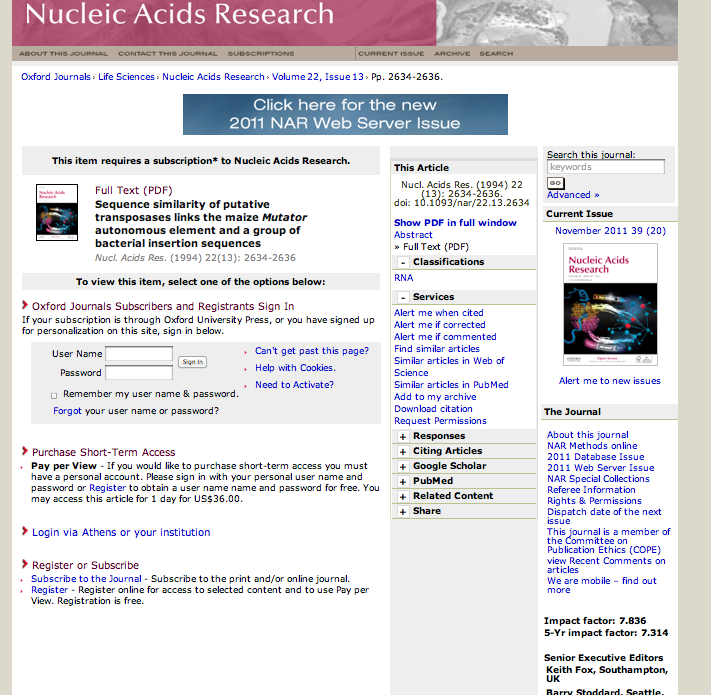
I went to get a link for my 1994 paper in Nucleic Acids Research.  I wrote this paper with my then girlfriend, now wife, and her advisor Ginny Walbot.  The paper was on finding a “transpose” motif in one of the proteins that was part of the autonomous element for the Mutator transposon in maize “Sequence similarity of putative transposases links the maize Mutator autonomous element and a group of bacterial insertion sequences.”

So I went to Pubmed and searched for Eisen JA and Mutator and got the Pubmed entry here.  And then I looked at the links in the upper right and there were two.  One to NAR and one to Pubmed Central.  I note – the paper has been freely available online for years.  I vaguely remembered noticing some issue with the NAR version in the past so I went to that site.  And there it was

Wow.  Even though the paper is freely available in Pubmed Central, NAR is trying to charge for it.

What the f**#?

Same thing for my other NAR articles:


Not sure what the deal with this is.  Could be a glitch.  COuld be a feature.

Wish I had access? Umm … no … and I will definitely not be recommending to my librarian.

Well, I got this email.  I do not view it as a valuable message.  But I thought I would share with others.  I guess the tone annoys me “Wish you had access?”  Well, not exactly.  I wish EVERYONE had access.  Therefore I wish that statisticians would publish in open access journals and that these journals would make more of their material freely available.  See below.

We are pleased to provide you with information on products and services that might be of interest to you. Want to keep receiving these valuable messages in your inbox? Click here to find out how. 
Online version | Mobile friendly
Wiley-Blackwell
Wish you had access?


Over 20 Statistics Journals to Choose From


From subject specific journals to general statistics titles:

Statistics in Medicine   Journal of Time Series Analysis   Naval Research Logistics (NRL)   Journal of the Royal Statistical Society: Series A (Statistics in Society)
             
Statistics in Medicine   Journal of Time Series Analysis   Naval Research Logistics (NRL)   Journal of the Royal Statistical Society: Series A (Statistics in Society)

From introductory statistics to high level research:

Teaching Statistics   Significance   Biometrics   Journal of the Royal Statistical Society: Series B (Statistical Methodology)
             
Teaching Statistics   Significance   Biometrics   Journal of the Royal Statistical Society: Series B (Statistical Methodology)

No. 1 in Statistics and Probability*

From national and international societies:

International Statistical Review   Canadian Journal of Statistics   Statistica Neerlandica   Australian & New Zealand Journal of Statistics
             
International Statistical Review   Canadian Journal of Statistics   Statistica Neerlandica   Australian & New Zealand Journal of Statistics

From long established journals to new titles:

Networks   Applied Stochastic Models in Business and Industry   Pharmaceutical Statistics   Statistical Analysis and Data Mining
             
Networks   Applied Stochastic Models in Business and Industry   Pharmaceutical Statistics   Statistical Analysis and Data Mining


New Journals � Enjoy Complimentary Online Access


WIREs: Computational Statistics   WIREs: Data Mining and Knowledge Discovery   Research Synthesis Methods
         
WIREs: Computational Statistics   WIREs: Data Mining and Knowledge Discovery   Research Synthesis Methods

Get Your Library to Opt-In Now


New & Bestselling Titles in Statistics & Mathematics   There is something for everyone

See the full portfolio


Wish You had Access to More Statistics Journals?


Simply recommend to your librarian Today!

Recommend to your Librarian


Journals – FREE Content Alerting Service


Setting up e-alerts is as easy as 1, 2, 3…
Login or Register on
Wiley Online Library
Click here to select the journals you’d like to receive e-alerts from Click ‘Get email alerts’ once you’ve selected the journals
Login Get email alerts

* Based on the 2010 Journal Citation Reports published by Thomson Reuters


Seen the New Significance Site?


Proving highly popular

Significance

See the latest Web Exclusive articles

World Trade Center anniversary: What did 9/11 really cost?

Battle of the stereotypes: girls against boys

How to win the Rugby World Cup


No 1 Staistics Journal of Thomson Reuters

Your Privacy:
You can unsubscribe by emailing us at e-news@wiley.com with the subject line unsubscribe $EMAIL. We will ALWAYS respect your e-mail privacy and NEVER sell, rent, or exchange your e-mail address to any outside company. For complete details, review our Privacy Policy http://www.wiley.com/privacy.

Need Help:
Visit our Help page to find information on orderingshipping/returnsyour accountsubscriptionsauthor services,mailing lists and RSS feeds. You may also visit our Contact Us page to find a contact for additional assistance with a related product or service. For technical problems, click here.

Please note that all prices are correct at time of going to press but are subject to change without notice. Visit the terms and conditions page for complete information on this offer.

John Wiley & Sons, Ltd. | The Atrium, Southern Gate, Chichester, West Sussex, PO19 8SQ, UK | Tel: +44 (0)1243 779777 | Fax: +44 (0)1243 775878 | Registered Number: 641132 England

John Wiley & Sons, Inc. | 111 River Street, Hoboken, NJ, 07030, USA | Tel: 201.748.6000 | Fax: 201.748.6088
E-mail: wileycustomer@wiley.com

Copyright © 2000-2011. All rights reserved.
PSJ-11-32745 EDT


You have received this e-mail in the genuine belief that its contents would be of interest to you. To not receive these messages from Scientific Direct or other carefully selected organizations, please go to our preference page.

Scientific Direct
1500 Spring Garden Street
4th Fl
Philadelphia, PA 19130
USA

Guest post from Katherine Scott of the Journal of Visualized Experiments on #OpenAccess challenges

Today we have another guest post here. This one is from Katherine Scott from JOVE – the Journal of Visualized Experiments. I really like the concept behind JOVE – high quality videos of experimental protocols. Publications in JOVE were initially freely available to all (see my 2008 post about JOVE here). Alas, a few years ago, things changed with the introduction of a subscription model. This saddened many out there, myself included, since JOVE was a wonderful addition to the collection of freely available scientific resources.  I wish they had been able to avoid this, but it seems that they could not.  Katherine Scott from JOVE explains their side of the story below:


Guest post by Katherine Scott “Open Access from the Perspective of an Academic Journal”

Open access from the perspective of an academic journal. I work for the first and only peer-reviewed science video journal indexed in PubMed and MEDLINE, the Journal of Visualized Experiments (JoVE). We started as an open access resource in 2006, but that model wasn’t sustainable for us. The cost of producing high-quality video simply too high.

So how do we remain profitable without losing our open access roots? Balance.

We started offering subscriptions in 2009, but still try to open up access wherever we can. We recently partnered with Health InterNetwork Access to Research Initiative (HINARI), to give free subscriptions to developing countries in South America, Asia and Africa.

HINARI, a World Health Organization (WHO) initiative, grants developing countries access to one of the largest collections of biomedical and health literature. It was founded in 2002 after a WHO survey found that 56 percent of institutions in the poorest countries had no current subscriptions to academic journals.

“Researchers from developing countries were saying ‘we need access to subscription literature, we can’t afford it, and without it, we can’t be part of the global research community,” said HINARI Library Program Manager Kimberly Parker.

Despite now having a large body of literature available to them, Parker said that students and researchers were still struggling because of language barriers and little access to proper demonstrations of experimental techniques in labs. She believes the visual aspect of JoVE will help address those problems.

Visual demonstrations of experimental techniques is the reason Dr. Lucia Prieto Godino, a post-doc at Cambridge University, asked for permission to use JoVE for the Drodophila Neurogenetics course she is teaching at Kampala International University in Uganda.

“With the JoVE articles they will be able to see the whole protocol, taught by an expert,” said Dr. Godino. “For them, JoVE is particularly important because they can’t pop by another lab to find an expert and learn.”

Now that HINARI will be carrying JoVE videos, the students will not only be able to see the experiments during her course, they will also be able to watch them again at their home institutions.

As much as it may break our hearts that we can’t survive as a purely open access resource to everyone, it’s great to know that subscriptions make it possible for us to provide experimental videos to those who need them most.