Can I just say I love Biomed Central #OpenAccess

Well, I have given Biomed Central a bit of snarky grief the last few days over a few things. First, I posted about to my Posterous site (but not here) a little comment about how their web site looks weird in safari:

Then I posted to this blog a little ditty about how I did not like some parts of a phylogenetic tree they use in marketing:No award to give out but here are some lessons in using Google’s image search to find an image source

My main complaint was the poor treatment of microbes in the tree. In that post I discussed how I used google image search to trace the tree

 to a few sites and discovered that they recognized it was a bit of a biased tree.  And I noted they had fridge magnets that had the tree and how I wanted one.

And, well, they have responded brilliantly.

Matthew Cockerill posted to my posterous site about how he was looking into the Safari issue and then, they fixed it (it was a font display issue).

And then today in the mail I received a gift and a note
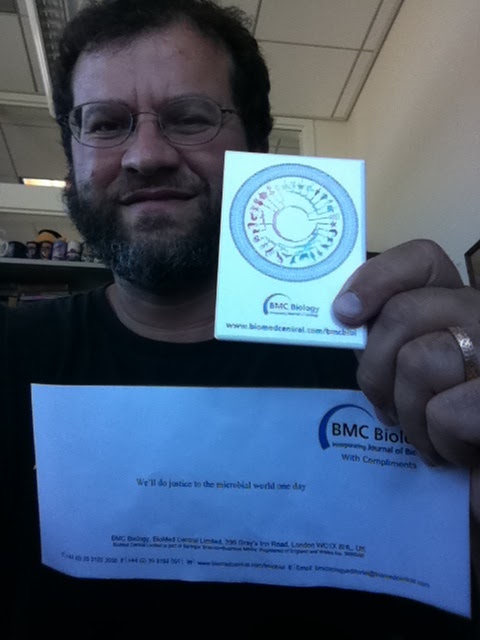
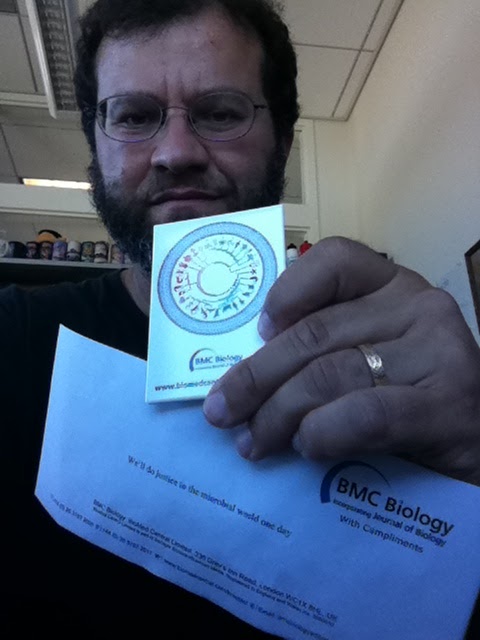
The note reads “”We’ll do justice to the microbial world one day”.

Indeed.

I note, even without their responses, I truly love Biomed Central.  I published my first open access paper was published in a Biomed Central Journal, Genome Biology: http://genomebiology.com/2000/1/6/research/0011 and I have published quite a few articles in their journals including:

Biomed Central was THE pioneer for truly open access publications in biology and they are still doing great things.  I note in addition, they do a very good job covering microbiology not only in their general journals but also with specific microbiology focused journals including:

So it seems – you are already doing some justice to the microbial world.

Fun with Pubmed central – first paper describing #HeLa cells – Note @rebeccaskloot

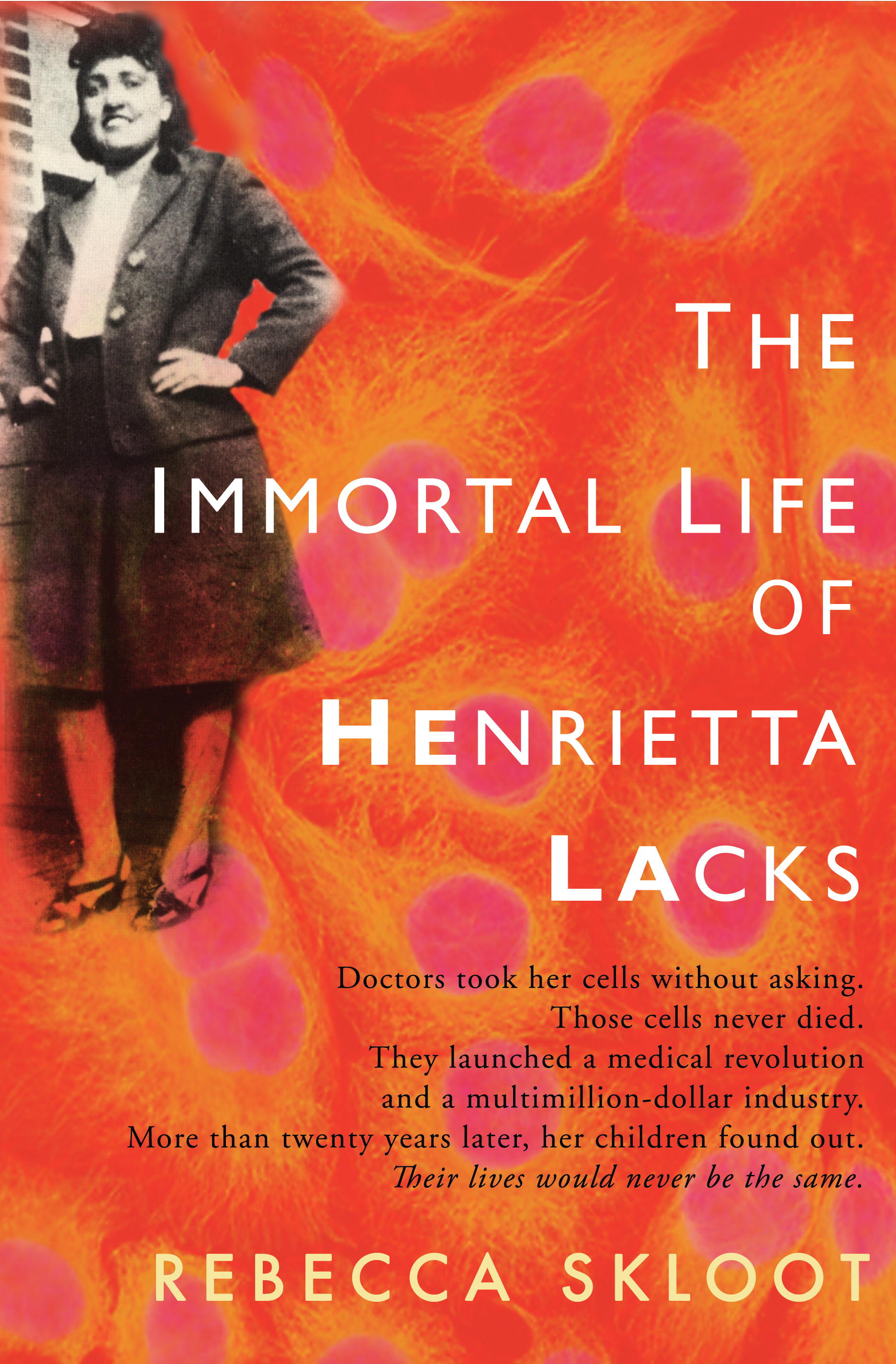
Last year, Rebecca Skloot came to Davis to talk about her book “The Immortal Life of Henrietta Lacks“.  Note – if you have not read the book – what f*$ing rock have you been hiding under?  It is in my opinion the best non fiction book I have ever read.  Seriously.  Not the best science book. The best non fiction book of any kind.  And I am not alone in this feeling as it has won a bazillion positive reviews and awards.   In summary – it tells three stories – the story of the isolation of HeLa cells, the story of the woman from whom those cells came, and the story of Skloot learning the other two stories.

Anyway – I somehow managed to get her to come to UC Davis to give a talk last year just as the book was going viral.  In preparation for Skloot’s visit I decided to do some sort of “open access” schtick and looked into how many papers about HeLa cells were in Pubmed Central.  Pubmed Central is a database of papers for which the full text is available at no charge.  After this mini-research and after interacting with Rebecca over the last year and seeing the well deserved recognition of her book, I have been a bit fascinated about how much of the literature surrounding studies of HeLa cells is openly and/or freely available.

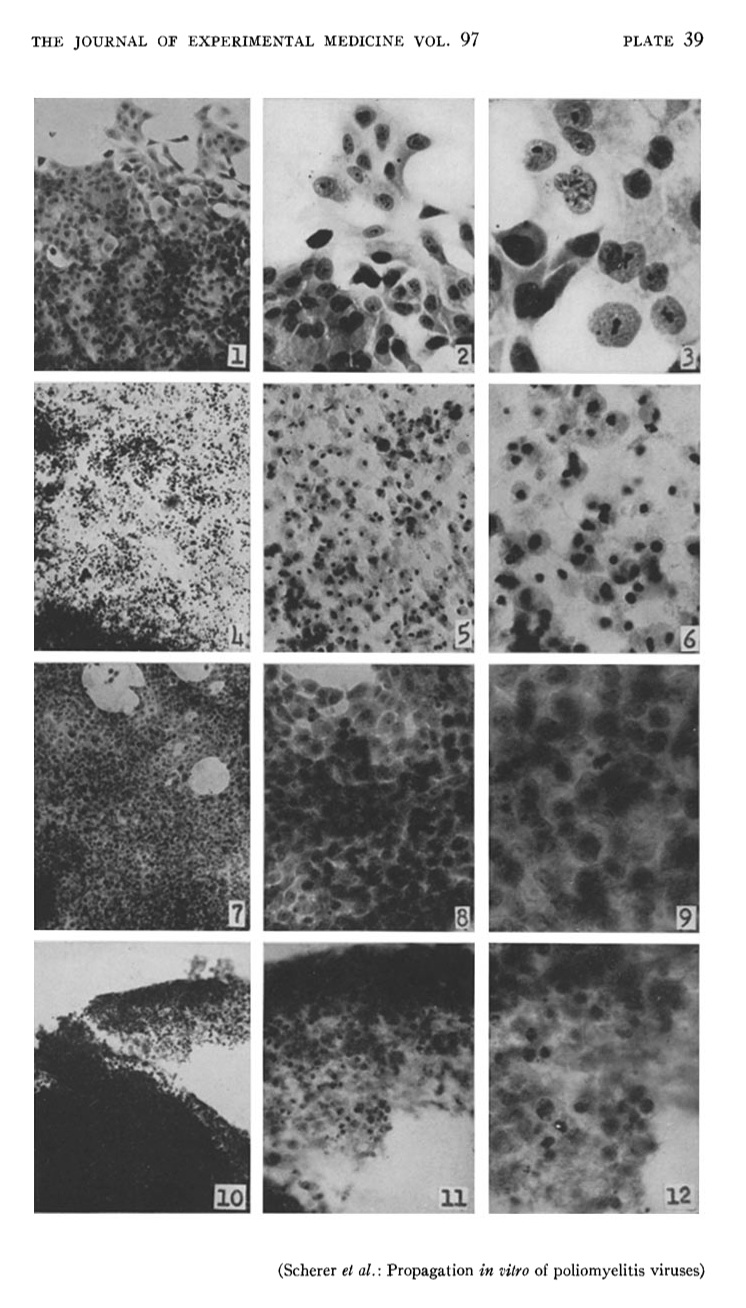
So today I decided to see what was the earliest HeLa paper that was freely available on PubMed Central.  And I managed to find a good one: Studies on the propagation in vitro of poliomyelitis viruses. IV. viral multiplication in a stable strain of human malignant epithelial cells (strain hela) derived from an epidermoid carcinoma of the cervix. William F. Scherer, Jerome T. Syverton, and George O. Gey.  J Exp Med. 1953 May 1; 97(5): 695–710.

I believe this was the first full paper published discussing HeLa cells.  Nice short title by the way. Anyway – good to see it in Pubmed Central.

I note  – I could not find in Pubmed Central the meeting abstract about HeLa cells which was published in 1952 but I did find it from Cancer Research’s online archive here.  I have copied the abstract below, for you HeLa history buffs out there:

TISSUE CULTURE STUDIES OF THE PRO-
LIFERATIVE CAPACITY OF CERVICAL
CARCINOMA AND NORMAL EPITHE-
LIUM. George O. Gey,Ward D. Coffman*
and Mary T. Kubicek *(Departments of
Surgery and Gynecology, Johns Hopkins
Hospital and University, Baltimore 5, Md.

This is a report of an evaluation in vitro of the
growth potential of normal, early intra-epithelial,
and invasive carcinoma from a series of cases of
cervical carcinoma. Comparable cytological and
tissue culture studies were actually carried out on
selected biopsies of normal and neoplastic areas of
the same cervix. Thus far, only one strain of epi-
dermoid carcinoma has been established and
grown in continuous roller tube cultures for al-
most a year. It grows well in a composite medium
of chicken plasma, bovine embryo extract, and
human placenta! cord serum. The autologous nor-
mal prototype is most difficult to maintain under
comparable cultural conditions. Most of the tissue
from other cases showed rapid keratinization of
the cells grown in cultures whether from normal
or neoplastic areas. Some of the hormonal aspects
of the problem will be discussed.

Anyway – if you are interested in HeLa and/or The Immortal Life of Henrietta Lacks, you may find it interesting to check out these early papers on the topic such as the ones described above.  Here are a few more that are from the early era and are freely available:

Pubmed Central is a rich resource not just for accessing scientific papers but for learning about science history too.  It is a good thing that articles in Pubmed Central are available at no charge and here’s hoping that sometime soon that past and present and future science papers will be more readily available to all.

UPDATE ———-
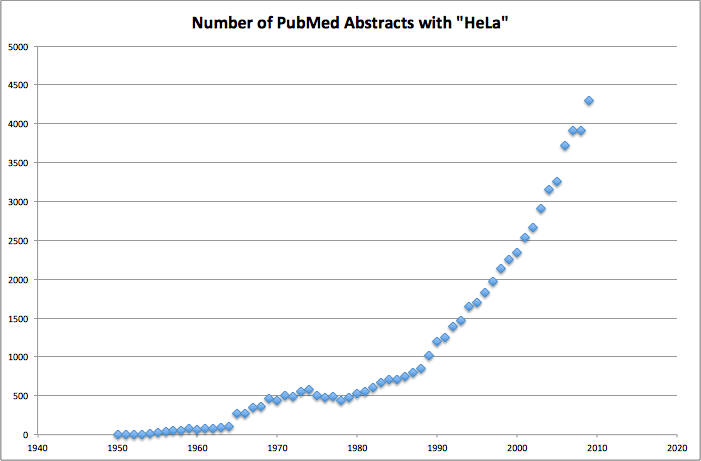
John Hogenesch from U. Penn made a nice figure of relevance and agreed to let me post it:

And he comments “You can see several things, Nixon’s “war on cancer” in the early 70s and the dawn of the cell/molecular biology age in the 80s and expansion in the 90s.”

Thanks John …

Open Parkinson’s – Parkinson’s UK pushing (and funding) openness #brilliant

Just a quick post here on my new theme of Openness in Parkinson’s research in honor of my father in law Carlos Benito who is, unfortunately, dying from this disease.  I did a google search for open access and Parkinson’s to see whether any organizations out there were pushing for more openness.  And the good news is that there are a few.  One I highlight today Parkinson’s UK.  I highlight them because of their position on Open Access publishing: Parkinson’s UK – Open access publishing – (formerly Parkinson’s Disease Society)

From their site:

“We expect authors of research papers to maximise the opportunities to make their results available for free.”

But that is not all – they do offer to help support OA publishing fees on top of the research money they dole out.  Truly putting one’s money where one’s mouth is.


Their full policy can be found here and they summarize the policy in the five following bullet points:

  • We expect authors of research papers to maximise the opportunities to make their results available for free.
  • We require electronic copies of any research papers that have been accepted for publication in a peer-reviewed journal, and are supported in whole or in part by Parkinson’s UK funding, to be made available through PubMed Central (PMC) and UK PubMed Central (UKPMC). This must be as soon as possible and in any event within 6 months of the journal publisher’s official date of final publication.
  • We’ll provide grantholders with additional funding to cover open access charges, where appropriate, (up to 2 years after the end of the grant) in order to meet our requirements.
  • We encourage (and where we pays an open access fee, require) authors and publishers to license research papers such that they may be freely copied and re-used (for example for text and data-mining purposes), provided that such uses are fully attributed.
  • We affirm the principle that it is the intrinsic merit of the work, and not the title of the journal in which an author’s work is published, that should be considered in making funding decisions.

It is really quite awesome actually – they even focus on openness and not just on “no cost” access which many organizations do not seem to understand.  Any and all medical funding organizations that do not have a policy on open access should check out theirs.  Way to go Parkinson’s UK.

Also see:

Ahh … Pubmed Central. I love you. In many ways. But alas, not today. #openaccess

Been having some challenges with Pubmed Central recently.  What is Pubmed Central?  If you don’t know, and you have anything to do with the life sciences in any way, you should learn.  A good place to learn is on their info page here.   Here is the summary:

PubMed Central (PMC) is a free archive of biomedical and life sciences journal literature at the U.S. National Institutes of Health’s National Library of Medicine (NIH/NLM). In keeping with NLM’s legislative mandate to collect and preserve the biomedical literature, PMC serves as a digital counterpart to NLM’s extensive print journal collection. Launched in February 2000, PMC was developed and is managed by NLM’s National Center for Biotechnology Information (NCBI).

It is a fantastic resource.  Alas, there is one major limitation.  Mostly it is an archive of papers submitted by publishers.  Some publishers do not submit their material there.  Fortunately, there is now a way around this.  Author’s can submit their own papers to PMC.  However, there is some caveats to this — there are severe restrictions on what one can submit.  In the past I was aware of one of these caveats – the work in the manuscript has to have been at least partially supported by NIH funds (well, there is a way to submit if supported by the Wellcome Trust to).  To submit NIH supported work, you have to use the NIH manuscript submission system.  Why they won’t take papers supported by other funding agencies I do not know.  Imagine if Genbank only took sequences inferred with NIH funds?  Imagine if libraries only took books supported by rich Europeans.  I am sure Pubmed does this because other agencies don’t pay for the archive but still — I think this is shortsighted.

And today I discovered a new caveat.  A few days ago I used the NIH manuscript submission form to submit author versions of a few of my past papers supported by NIH funds.  And one of them was rejected today because

Your submission to the NIHMS system cannot be processed because the NIH Public Access Policy does not apply to this material. The NIH Public Access Policy does not apply to book chapters, editorials, letters, or conference proceedings. As such, we are sorry that we cannot process your submission.

And though my paper was not one of these things, it is marked in such a way that it seems to be an editorial.  And thus apparently they won’t take it.  I find this a bit surprising since PMC is actually filled with things like editorials including ones by me like PLoS Biology 2.0 and Genomics of Emerging Infectious Disease: A PLoS Collection and meeting reports like Meeting Report: The Terabase Metagenomics Workshop and the Vision of an Earth Microbiome Project. 
and letters (none of mine but I found many of others including even responses to letters to the editor). I have run this through my brain over and over and I cannot figure out why (or in fact how) they would exclude these types of materials.   I am going to ask around and see if anyone knows more detail about this but I am not convinced there will be a simple explanation.  Most likely it will have something to do with trying to cover “research” but not opinion.  But in my opinion, research and opinion are not always distinct.

Anyway – I am a bit annoyed by all of this because really, all I want to do is find these best way to share all of my past publications and this seemed like a useful addition to posting them on my website and/or in Mendeley as well as in UC sponsored archives.  And it would be great to have all my papers in PMC.  I note – the vast vast majority of my recent work is in PMC because I basically only publish in Open Access journals that deposit their material there.  But a lot of my old work is not in PMC.  And that is too bad.  Someone, somewhere might find it useful …

New #openaccess journals welcome; competition good; not sure how they know it is "top tier" though

Great news from HHMI, The Wellcome Trust and the Max Planck: http://www.hhmi.org/news/20110627.html

Leading Research Organizations Announce Top-Tier, Open Access Journal for Biomedical and Life Sciences


The Howard Hughes Medical Institute, the Max Planck Society and the Wellcome Trust announced today that they are to support a new, top-tier, open access journal for biomedical and life sciences research.

The three organizations aim to establish a new journal that will attract and define the very best research publications from across these fields. All research published in the journal will make highly significant contributions that will extend the boundaries of scientific knowledge.

A team of highly regarded, experienced and actively practicing scientists will ensure fair, swift and transparent editorial decisions followed by rapid online publication. The first issue of the journal, whose name has yet to be decided, is expected to be published in the summer of 2012.

The three research organizations developed their plans following a workshop in 2010 at HHMI’s Janelia Farm Research Campus attended by a number of leading scientists. The participants concluded that there was a need for a model of academic publishing that better suits the needs of the research community.

Dr. Robert Tjian, President of the Howard Hughes Medical Institute, says: “The message from the research community was clear: we are fortunate to have many excellent journals, but there is need for a different, more appropriate and efficient publishing model.”

Professor Herbert Jäckle, Vice President of the Max Planck Society, says: “A journal which aims to represent and publish the very best research outcomes needs an editorial team of experienced – and, crucially, actively practicing – scientists. It must also be editorially independent of those who provide the financial support.”

Sir Mark Walport, Director of the Wellcome Trust, says: “We will attract the most outstanding science for publication by establishing a journal in which researchers have confidence in robust editorial decisions taken by their scientific peers. This will be a journal for scientists edited by scientists. The ethos of the journal will be to avoid asking authors to make extensive modifications or perform endless additional experiments before a paper can be published.”

Recruitment is under way for an Editor-in-Chief who – together with the journal’s editorial team – will be an experienced, active scientist. The editorial team will be editorially independent of the funders. They will rely on their scientific expertise and active research experience to identify the best papers, make scientifically-based judgments and exercise leadership in steering these papers through peer review.

The journal will employ an open and transparent peer review process in which papers will be accepted or rejected as rapidly as possible, generally with only one round of revisions, and with limited need for modifications or additional experiments. For transparency, reviewers’ comments will be published anonymously.

As the journal will only exist online, it offers an opportunity to create a journal and article format that will exploit the potential of new technologies to allow for improved data presentation. The journal will be an open access journal, i.e. the entire content will be freely available for all to read, to reproduce and for unrestricted use. This open access system will also enhance opportunities to share content and to more directly engage the reader.

The three organizations have made a commitment to cover costs of launching the journal to ensure its success. The long-term business model will be developed by the incoming Editor-in-Chief and the team they build.

This is great news.  The more #openaccess journals we have the better.  Clearly some of the text here is a dig at existing journals, including PLoS Biology.  PLoS Biology definitely needs to work on some things – like transparency (e.g., if your article is rejected, the Academic Editor who advised the professional editors is not names).  PLoS Biology is also run by professional editors.  Thus it is not run by “active scientists” which is another one of the comments in this press release.  Personally I think it would be better if PLoS Biology was run by active scientists.  But that is not the system there.  I have a strange role at PLoS Biology – “Academic Editor in Chief” for a journal not run by academics.  In essence I am a senior advisor to the professionals who run the journal.  I personally would prefer it if academics ran the journal, probably for the same reasons that HHMI, Wellcome, and Max Planck make such a big deal out of it here.  But the professionals do run PLoS Biology.  And overall, they do a good job.  I think the journal could certainly be better – and thus this new competition should be good.  We will have to wait and see just how much competition it is.  It seems a bit weird for them to call this a “top tier” journal before it exists.  Maybe they should have said “aiming to be a top tier journal” or something like that.  But I think it probably will become one if HHMI and Wellcome and MaxPlanck scientists start publishing their good papers there.  I hope this helps catalyze some beneficial changes at PLoS Biology, but we will have to wait and see.

It is a good time for #OpenAccess when major organizations start to compete to create the best “top tier” open access journal.  In the end, this can only be good for science and scientists. 

Yes, I am a #RedSox & #PLoS fan; & this video sort of is proof #BenFranklinAward #OpenScience

Just saw this posted on Youtube.  Did not know it was coming … but am happy they recorded it

And here are the slides I used.  Will try to synch

For more on this award see

Freeing my father’s publications part 5: near completion of PDF collection at Mendeley (h/t @David_Dobbs)

Well, the story continues.  Yesterday marked a major achievement in my goal to free up the scientific publications of my father Howard J. Eisen, who passed away in 1987 when I was in college.  I have been working for the last 3+ years or so on collecting and sharing as much of his scientific work as possible.  I have documented this effort on a page on this blog: Freeing dads pubs.  That page contains links to various details about my effort here.

I have been doing this for many reasons.  And I could detail them all here.  But instead I point you to the amazing story written by David Dobbs that relates to this effort: Free Science, One Paper at a Time | Wired Science | Wired.com.  David is a science writer/blogger/scientist/journalist and about a year ago he was interviewing me for a story that he was working on about Mendeley.  It was good timing as right around then I was trying all sorts of different tools for sharing his publications, from Academia.Edu to web pages and so on.  And I had been looking at Mendeley too.  When Academia.Edu did not pan out, Mr. Gunn suggested in a comment on one of my posts that this might work in Mendeley.  So I set up a Mendeley page for my father which I diddled around with for a bit.  But inspired by the discussions with David I tried to beef up the Mendeley page and try to learn how to use the system.  And I managed to post many of my dad’s papers there and on my blog.  And I ended up telling David about the whole saga of trying to free up my dad’s papers.  David, being an insightful journalist, realized that this saga was a good story and he asked a lot of questions about it.

But then I got caught up in life and the effort to free my dad’s publications slowed down.  That was, until David’s blog post came out: Free Science, One Paper at a Time | Wired Science | Wired.com.  The piece moved me.  It scared me a bit at first, since there are some really personal details in there, but I realized when reading it why he had focused in on this story.  So, with his post out there – for all to read.  I realized, I had to get my shit together and redouble my efforts to free up my father’s publications.  So over the last week or so I have been scavenging around (with some help from people around the web) trying to dig up PDFs of as many of my father’s papers as possible.  Note – I generally would like to obtain these papers without having to pay for them but I am trying to not break any laws either.

I am writing today because I have nearly completed the task of getting PDFs of all of his papers.  And I have discovered that Mendeley is really a great way to share them.  So now on the Howard Eisen Mendeley page almost all of his papers are there for anyone to obtain.  And thanks to the social features of Mendeley, more and more people will see and have access to those papers, thus ensuring that they do not wallow in never never land but continue to have some potential impact on science and society.  Anyway – thanks David, for a wonderful article and for inspiring me to get moving on the “Freeing My Father’s Publications” effort.  And thanks to all the people who have supported me along the way including Linda Avey, Mr. Gunn, David Williams, and more.  It has been a slog but we are getting there.

Afterthought: some additional discussions of David’s story include:

Wanted – OpenAccess figures on introductory molecular and cellular biology topics

Quick post here.  I am looking for OpenAccess figures on introductory topics in molecular and cellular biology like DNA, RNA, proteins, transcription, translation, etc.  I want these for multiple purposes including teaching, blog posts, etc.  Anyone out there know of a database of such things?

UPDATE
Some suggestions from Twitter

I know – Ego Blogging is so 2010 – But I won. I won. I won. (The Ben Franklin Award …)

OK so the title is a bit much. But I am really happy that I won this years Benjamin Franklin Award, given out by the Bioinformatics Organization. For more on this see …
I found out a few days ago and am rearranging some things to go to Boston April 13 for the award ceremony at the Bio-IT World Conference and Expo.  
From the Bioinformatics Organization web site:

Benjamin Franklin (1706-1790) was one of the most remarkable men of his time. Scientist, inventor, statesman, he freely and openly shared his ideas and refused to patent his inventions. It is the opinion of the founders of the Bioinformatics Organization, Inc. that he embodied the best traits of a scientist, and we seek to honor those who share these virtues

The Benjamin Franklin Award for Open Access in the Life Sciences is a humanitarian/bioethics award presented annually by this organization to an individual who has, in his or her practice, promoted free and open access to the materials and methods used in the life sciences.

I like the general sentiment very much.  And perhaps more important – the list of prior winners is an impressive crew.  Again, from the Bioinformatics Organization web site:

Note – my brother won the first one.

Anyway – am thinking about what to say in the awards ceremony.  Probably going to say something about how openness is more than about being at no charge.  Also I might discuss how it would be good to have a female winner one of these days.  Speaking of which – maybe people can give suggestions for women to nominate for next year …

UPDATE 9/25/12: See this Friendfeed discussion for some more comments about possible female candidates. I have copied the text below in case Friendfeed disappears: “maybe people can give suggestions for women to nominate for next year …”. OK, I’ll start: how about Rosie Redfield? If it weren’t for the Life Sciences focus I’d also suggest Heather Joseph. Speaking of Heathers, one H. Piwowar springs to mind whenever Open Foo is mentioned. – Bill Hooker heh, that would be cool someday 🙂 For now, how about Helen M. Berman, Judith A. Blake, Maryann E. Martone, Catherine Ball, or other pioneers in open databases? – Heather Piwowar Janet Thornton. – Heather Piwowar Agreed! – Egon Willighagen In an award speech at ISMB 2005, Janet Thornton expressed gratitude she was able to take years out-with-family and then pick up again. Inspirational. Not relevant for the Ben Franklin award, but wanted to mention it because it made such an impact. – Heather Piwowar

Calling for Nature Publishing Group to return all money charged for articles that were supposed to be free #OpenAccess

Well, in case you did not see, yesterday I got really pissed off at Nature Publishing Group.  Short summary – many articles of mine that were supposed to be freely available on their journal sites were not.  For more information see

People from Nature Publishing Group have responded quite quickly saying they will look into this and try to fix it and indeed they have fixed many if not all of the mistakes in accessibility I found yesterday.  Glad they responded so quickly.  However, their response raises quite a few questions.  Like “what happened?” – as in – why did access get closed off?  And why were they charging to for article use when they should not have been?
It would be good for Nature to publish / post a full description of what went wrong.  And perhaps they will.  Apparently, it was just a glitch in the system.  Whatever the cause however, almost certainly some people paid for access for articles that were supposed to be freely available.  I am calling on Nature here to audit their systems and return all money that was paid for such access.