Fermentation microbiomes part 2 from #UCDavis: American coolship ale microbiome

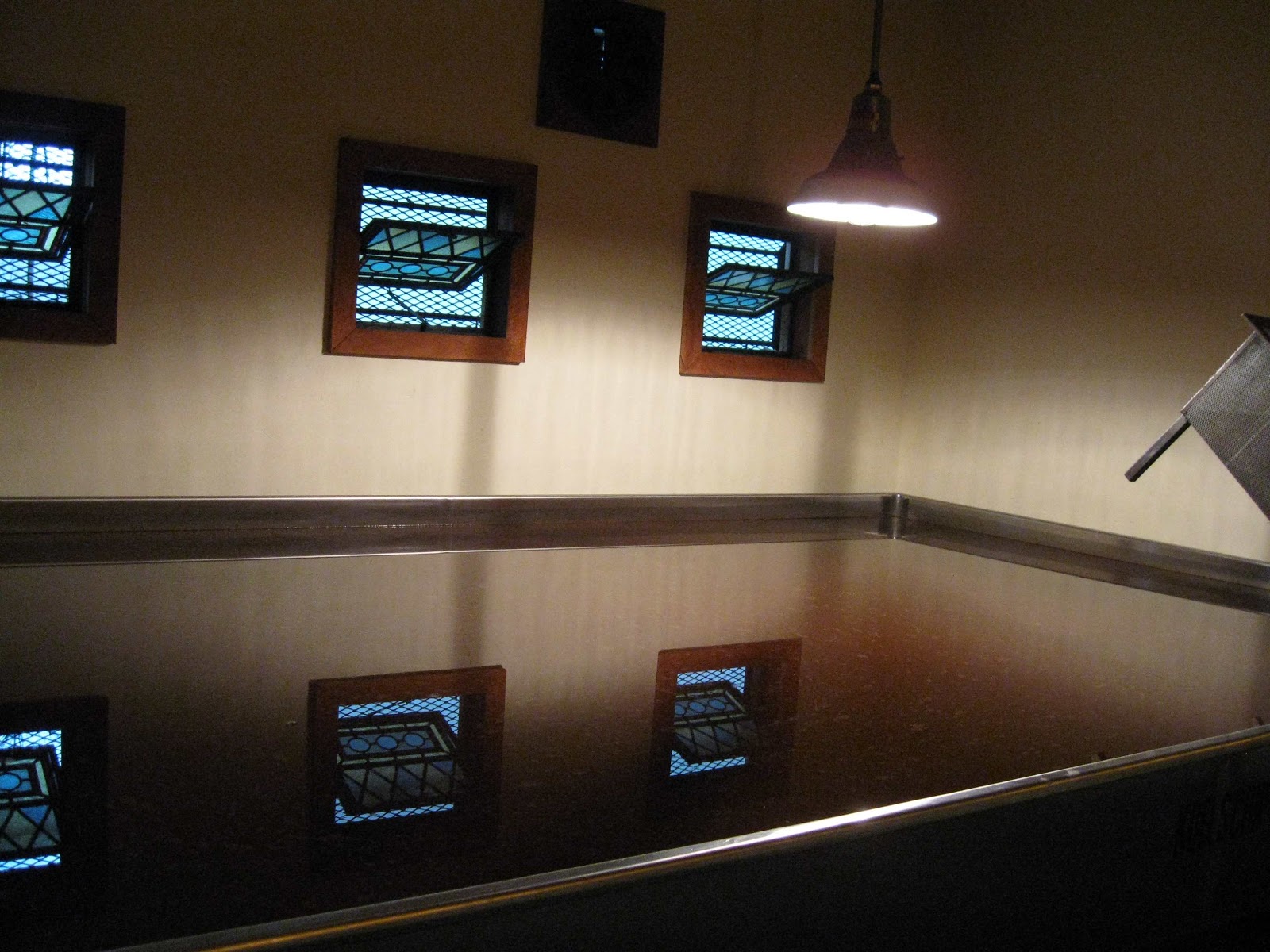
 From Nick Bokulich: This is an image of the “coolship” where the cooling wort
(pre-fermented beer) is left overnight and presumably where wild
microbes are introduced to kick off the fermentation. This is the
morning after, still full of wort.

Just a quick follow up to my recent post on How did I miss this? The botrytized wine microbiome … from #UCDavis colleague David Mills.  There is a similar paper from the same group also in PLoS One from about the same time: PLOS ONE: Brewhouse-Resident Microbiota Are Responsible for Multi-Stage Fermentation of American Coolship Ale.  What a job — microbes, ales and wines, and sequencing.  One of the few times when reading a paper where I have said “I wish that was me doing that work.” … must look into getting involved in such studies …

How did I miss this? The botrytized wine microbiome … from #UCDavis colleague David Mills

From here.

Fun use of next generation sequencing in this paper: PLOS ONE: Next-Generation Sequencing Reveals Significant Bacterial Diversity of Botrytized Wine.  They used sequencing to characterize the diversity of microbes associated with botrytized wine (wine produced from grapes infected with the mold Botrytis cinerea.  They focused in particular on Dolce wine (not 100% sure what this is but I think it is wine from the Dolce winery …).  And they focused in particular on the bacteria associated with this wine as it was being produced.  Anyway … I am no food/drink microbiologist .. but this seems cool.

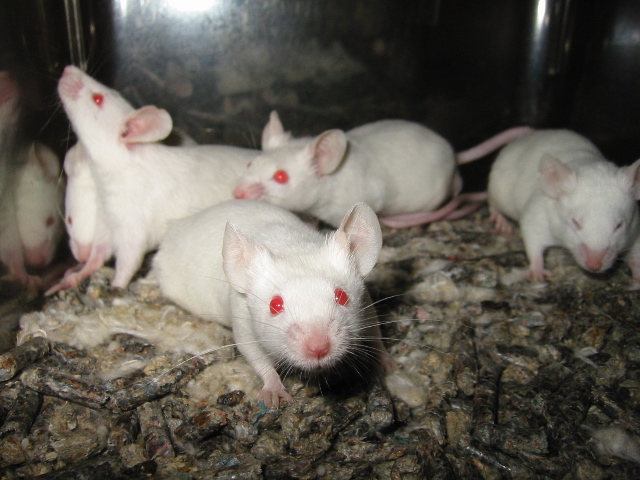
Important & neglected aspect of lab studies of animals : effect of habitat change on microbiome

By Aaron Logan via Wikipedia 

Very very interesting paper came out recent from some colleagues at UC Davis: PLOS ONE: Routine Habitat Change: A Source of Unrecognized Transient Alteration of Intestinal Microbiota in Laboratory Mice

Abstract: The mammalian intestine harbors a vast, complex and dynamic microbial population, which has profound effects on host nutrition, intestinal function and immune response, as well as influence on physiology outside of the alimentary tract. Imbalance in the composition of the dense colonizing bacterial population can increase susceptibility to various acute and chronic diseases. Valuable insights on the association of the microbiota with disease critically depend on investigation of mouse models. Like in humans, the microbial community in the mouse intestine is relatively stable and resilient, yet can be influenced by environmental factors. An often-overlooked variable in research is basic animal husbandry, which can potentially alter mouse physiology and experimental outcomes. This study examined the effects of common husbandry practices, including food and bedding alterations, as well as facility and cage changes, on the gut microbiota over a short time course of five days using three culture-independent techniques, quantitative PCR, terminal restriction fragment length polymorphism (TRFLP) and next generation sequencing (NGS). This study detected a substantial transient alteration in microbiota after the common practice of a short cross-campus facility transfer, but found no comparable alterations in microbiota within 5 days of switches in common laboratory food or bedding, or following an isolated cage change in mice acclimated to their housing facility. Our results highlight the importance of an acclimation period following even simple transfer of mice between campus facilities, and highlights that occult changes in microbiota should be considered when imposing husbandry variables on laboratory animals.

I personally think that we as a community are going to have to come to grips with the fact that the microbial communities in / on research organisms (of all kinds) may have a profound effect on experimental results.  This may explain many of the differences seen in experiments between facilities or over time within a facility.  In general, I think either controlling the microbes more carefully in lab experiments (e.g., using defined flora) or at least monitoring them is going to be very important to best interpret studies of plants and animals in the lab (or for that matter – in the field too).  Anyway -this paper is a tiny window into one of the ways that controlling for microbiomes may be important in lab studies.

Citation: Ma BW, Bokulich NA, Castillo PA, Kananurak A, Underwood MA, et al. (2012) Routine Habitat Change: A Source of Unrecognized Transient Alteration of Intestinal Microbiota in Laboratory Mice. PLoS ONE 7(10): e47416. doi:10.1371/journal.pone.0047416

Hmm .. apparently I am not supposed to be posting about #UCDavis in "social media" (SEE UPDATE AT BOTTOM)

At the suggestion of a colleague I have been browsing through the UC Davis Policy and Procedure Manual – Chapter 310, Communications and Technology Section 40, University Communications: Publications, Graphic Standards, Marketing, and Media Relations.

Much of it is straightforward but much of it seems to basically be discouraging any direct social media posts or interaction with the press. See for example:

The News Service unit in University Communications is the exclusive source for developing and disseminating news about UC Davis to the general public via newspapers, radio, television, magazines, and the World Wide Web, including social media and related channels. The News Service unit determines the newsworthiness of significant developments and activities in academic research; administrative programs; accomplishments of faculty, staff, or students; events; and other campus matters. It conducts or coordinates direct contact with news media representatives, and assures that media relations are timely, accurate, comprehensive, and of broad public interest.

and

Generally, the news media will contact the News Service to find a source for a story. If a reporter contacts a source directly, that faculty member, staff member, or student shall notify the News Service

Hmm … so ..  when I was contacted by multiple reporters about the pepper spray incident and for my comments on it and on the handling of it by UC Davis I was supposed to notify the UC Davis News Service.  I suppose I could have done that.  But how about this – I communicate with dozens if not 100s of reporters on Twitter about all sorts of things.  Should I notify the news service about each contact?  That would actually be kind of fun.  They would block my emails very soon thereafter I am sure.
I am also wondering about the role of the News Service as the “exclusive source for developing and disseminating news” “via newspapers, radio, television, magazines, and the World Wide Web, including social media and related channels.”  So is this saying I am no longer supposed to write about UC Davis on social media?   No more blogging?  No more Twitter?  How does this jibe with all the retweets and reposts I get by official UC Davis groups/people?  
In the end I can imagine that the UC Davis administration would say this wording is not quite what they mean.  But it is there.  And technically, I am supposed to follow it.  Oh well, off to kill all my social media accounts.  Yeah, right.

UPDATE: Barry Shiller – UC Davis Communications Chief Guru has responded with clarifications that this policy is NOT intended to suppress any communications but is about coordination with the News Service

I’m replying directly and publicly as an expression of transparency, and professional respect for you.

You indeed misinterpret the policy. It was, and is, intended to optimize coordination with the media – not, as is inferred by your post, to inhibit anyone. Coordination, by the way, is as beneficial to the media as anyone. They appreciate knowing their go-to points of contact. That said, reporters contact faculty, staff and students without interference or inhibition. All the time. 

It may be that this policy fails to clarify or contemporize the distinction between “reporters” and social media content creators, including bloggers. If so, we will take a look at it; I’d welcome your input. 

But let me be clear: as you well know, many university constituents actively blog, tweet, post, opine. (I’m among them.) In this age, it is an important ingredient in telling our story. The policy is not intended to discourage that

Profile of Michael Turelli in the Sacramento Bee

Pretty good profile of Michael Turelli in the Sacramento Bee: UCD professor Michael Turelli finds biomathematics work ‘ridiculously satisfying’ – Living Here – The Sacramento Bee.  It discusses his career from PhD work to early research to his new work on Wolbachia.  Note of lack of objectivity on my part – Turelli was the first person to recruit me to UC Davis and, well, I love him.  He simply is great …

The Ballad of #UCDavis from Aaron Heuckroth

The Ballad of UC Davis from the brilliant and talented Aaron Heuckroth.


Hat tip to the Davis Patch.

Courtesy employee notice regarding annual systemwide payroll disclosure

Just received this … seemed to be something that should be shared publicly.

#UCDavis Prof. Dawn Sumner video interview on being involved in Mars Curiosity Rover landing

I am getting really excited about the upcoming Curiosity landing on Mars. So cool that Dawn Sumner – Geology Prof. from UC Davis is going to be involved …
 

Also check out:

#UCDavis neurosurgeons conducted experimental surgery w/o IRB approval

Not really sure what to say about this other than that this story should be read by many/all who are interested in medical research and/or UC Davis: 2 UC Davis neurosurgeons accused of experimental surgery are banned from human research – Investigations – The Sacramento Bee.

UPDATE 7/23.  Added a summary: Two UC Davis neurosurgeons were treating terminally ill brain cancer patients with an unapproved, experimental treatment that is referred to as “Probiotic Intracranial Therapy for Malignant Glioma”.  The treatment involved purposefully infecting patients brains with a bacterium Enterobacter aerogenes apparently because of prior anecdotes and case reports that suggested that patients with these brain cancers who also had brain infections might live longer than those with the cancer but without the infection.  According to the article, there was an investigation at UC Davis into the practices of the surgeons.  It was determined by UC Davis that they did not have IRB approval to carry out the treatments and that there were some other issues with the practice going on.  At the conclusion of the investigation UC Davis wrote a letter to the FDA detailing the case and has banned the two neurosurgeons from performing medical research on humans.  Read the article for much more detail and see the link below.

Many interconnected issues in here involving IRB approval, human experimental treatments and informed consent, UC Davis, and even “probiotics”.  Still taking it all in …  Uggh …

Other stories posted in the SacBee at the same time:

See also

UPDATE 7/22/12. Some tidbits to consider
  • The doctors used the bacterium Enterobacter aerogenes for the treatment.  It wear obtained from ATCC and grown by a graduate student at UC Davis.
  • The use of the bacterium for human treatments violated the ATCC MTA.
  • It is unclear from the details here why this bacterial strain/species was selected.  But I assume it is related to the referenced Neurosurgery article (see more below).
  • The hypothesis that purposefully causing an infection may help glioblastoma patients seems to come from the observation that patients with glioblastoma w/ postoperative infections have better survival than those who do not get infections.  This could be due to many many factors jumping to purposefully causing infections with E. aerogenes seems a big big jump.
  • It would be nice to know more about the statement “Early this year, as required by University policy Drs. Muizelaar and Schrot submitted a Record of ~Invention for the bacterial intervention to UCD’s technology transfer office.” in the letter from UCD to the FDA.  Was this just a formality or were the surgeons looking to patent/protect the bacterial treatment method?
  • The Neurosurgery article discussing infection and glioblastoma may be “Long-term Remission of Malignant Brain Tumors after Intracranial Infection: A Report of Four Cases” Neurosurgery: March 1999 – Volume 44 – Issue 3 – pp 636-642.  This reported that some of the patients with infections that seemed to have a longer survival with glioblastoma were infected with E. aerogenes.
    • “In three of the cases described above, Enterobacter aerogenes was recovered from microbial cultures. Whether the presence of Enterobacter aerogenes was coincidental or whether this organism plays an important role in tumor defense is not known and cannot be proven from the cases reported. “
  • See also
UPDATE 2
UPDATE 3 – some papers on bacterial infections and glioblastoma and other cancers
  • Biocrime or a Passion to Save a Life?.  This pointed me to the article below:
  • A key article of interest: Post-operative infection may influence survival in patients with glioblastoma: simply a myth?: Glioblastoma, infection and survival from 2011. The article casts some doubt on the basis for the treatment used here
    • Citation: De Bonis P, M D AA, M D GL, de Waure C, Mangiola A, Pettorini BL, Pompucci A, Balducci M, Fiorentino A, Lauriola L, Anile C, Maira G. 2011. Post-operative infection may influence survival in patients with glioblastoma: simply a myth?: Glioblastoma, infection and survival. Neurosurgery. 2011 Oct;69(4):864-8; discussion 868-9.
    • “One of the myths that continues to be perpetrated in neurosurgery relates to the observation that a postoperative infection may actually confer a survival advantage in patients with malignant glial tumors”
    • The take-home message of this study, which can be applied to any aspect of neurosurgery, is to do everything possible to prevent a postoperative wound or cavity infection. The association between infection and prolonged survival is not definitive; we acknowledge the considerable difficulties in undertaking this type of study in a retrospective manner in view of the numerous clinical variables. A prospective randomized study on this subject is clearly not possible. Nevertheless, we believe the results of this study are important and can be used as a stimulus for further multicentric studies (to increase the number of patients) or for experimental studies using genetically modified bacteria for the treatment of GBM.
  • Also see The survival impact of postoperative infection in patients with glioblastoma multiform from 2009.
    • In this single-center study, postoperative infection did not confer any survival advantage in patients with glioblastoma multiforme”
    • Available free online here
    • “This study did not show a causal relationship between postoperative infection and prolonged survival in patients with GBM. Although targeted immunotherapy may provide antitumoral effects, simple infection does not appear to do so. Modern aseptic and antiseptic surgical techniques continue to be integral to the care of patients with gliomas.
  • Also see  Cancer J. 2012 Jan-Feb;18(1):59-68. Immunotherapy for the treatment of glioblastoma. Thomas AA, Ernstoff MS, Fadul CE. (though I cannot seem to be able to get a copy ..)

    UPDATE 6: 7/23 10 AM – some info. on UC Davis IRB, Med School, etc

      UPDATE 9: SacBee Editorial calling for Muizelear to step down as Chair
      • The Sac Bee has an editorial today calling for the doctor involved in this issue to step down as chair of the Neurosurgery department.  Some quotes below
      • Experimentation on terminal patients requires a specific set of protections for good reason. People who are, quite literally, on death’s doorstep are extremely vulnerable, and therefore not always able to give informed consent.
      • University officials conceded that “systemic issues” within the medical center may have contributed to errors made and that “additional measures designed to avoid future confusion” have been put in place.”
      • “Curiously, even after it was imposed last fall, the university named Muizelaar to fill its new Julian R. Youmans endowed chair in neurological surgery. The donor specified, university officials explained, that the chair be filled with the head of the department, a fact that begs the question: Why is Muizelaar still chairman of the department?”
      UPDATE 9: some new stories
      UPDATE 11: Muizelaar steps down as chair of department, at least temporarily
      • UC Davis neurosurgeon department chair steps down pending …
        • “One advocate for ethical human subjects research questioned the university’s decision to keep the matter in-house instead of seeking outside review. “The time is long gone for another internal investigation,” said Elizabeth Woeckner, founder and director of Citizens for Responsible Care and Research, or CIRCARE. The nonprofit group works to improve protections for human subjects in research. Woeckner called the doctors’ work on the patients – intentionally infecting them with bacteria restricted to use in lab rats only – as “the worst thing I’ve seen in my 12 years with CIRCARE.””
      UPDATE 12 – September 7, 2012 – some new news stories on Federal investigations
      UPDATE 13: December 11, 2012 – Federal investigation at UC Davis, Resignation of UC Davis Dean of Medicine, more
      UPDATE 16: August 15, 2015
      Well, many things have happened since 2012 – here are some stories to look at

      Updates on the #UCDavis Academic Freedom situation

      A few days ago I wrote a post: Report on “Egregious Academic Freedom Violation” at #UCDavis.  The post provides some detail on an investigation carried out by the UC Davis Academic Senate into a case of apparent retribution at the UC Davis medical school.  In the case the Dean of the Medical School (Claire Pomeroy), the Executive Associate Dean Fred Meyers and the Health System Counsel appear to have carried out a retribution of sorts against a member of the faculty at the medical school (NOTE – I have a half appointment at the medical school).  The faculty member – Michael Wilkes had the gall to write an editorial (with Jerome Hoffman) for the SF Chronicle expressing opinions about a medical issue and actions of some people at the UC Davis Medical School.  Apparently, some people at the medical school did not like being criticized.  The result?  A threat to take away his space, to remove him as instructor of a medical school course, and other incites including a threatening email/letter from the medical school counsel.  Lovely.

      Fortunately, the UC Davis Academic Senate was brought into the case by Wilkes and a committee of the academic senate responded VERY strongly with a report (see my previous post with more detail).  Meanwhile – news of the report spread and was covered in Inside Higher Ed.  It was then that I heard about it and felt the need to blog about it.  And news has spread a bit more (thank you PZ Myers and others).  On Friday, the UC Davis Academic Senate met (and though I am not a member of the Senate, I went to the meeting).  And the Senate passed three resolutions coming out strongly in support of Prof. Wilkes and critiquing the behavior of the Dean, Asst. Dean and Counsel from the Med. School.  Just after the resolution was passed the faculty received an email from the Provost Ralph Hexter that was very strongly saying he supported academic freedom on campus.

      So that is where we stand now.  I am very pleased with the Provost’s statement.  At the same time I am still dismayed at the reported behavior of the Medical School administration.  And I think this issue needs to still get some air until there are repercussions for the Medical School actions …

      Here are some related links and updates that I collected as the story has unfolded.


      UPDATE: Some links of relevance

      UPDATE 2: Some new links (6/8)

      • UC removes “In the media” page which linked to the Inside Higher Ed. story.
      • UC Davis Academic Senate passes three resolutions in relation to this case.  See here for full text.

      UPDATE 7: 6/14

      Well – finally some news.  Not sure what I think about it but at least something is moving forward.  A report was issued yesterday from a panel investigating this case.  
      I have received a detailed email from Prof. Gregory Pasternack of UC Davis about the new “findings” from the report.  Pasternack was on the committee that issues the original report about this case.  He has this response to the new report:

      1) Compared to the thorough 14-page analysis from the faculty investigation, the 2-page administrative review presents virtually no new information, contradicts the testimony of the Executive Associate Dean who said he was in fact responding to complaints against Dr. Wilkes, and completely ignores the totality of the threats all occurring peculiarly at the same time, creating a strong sense of retaliating when viewed as a whole. The faculty saw through thin excuses, while this review merely parrots and accepts them with no scrutiny or common sense. 

      2) The administrative review claims a factual mistake in the timeline suggesting that the Executive Associate Dean wrote a key email before he was aware of Dr. Wilkes’ activities.  This is factually incorrect.  There is uncertainty about the timing of various emails (UC Davis does not keep historical emails, so a request for those went unfilled), but our report is very clear that Dr. Wilkes first raised his allegations to the Dean on September 16, 2010, well before the dates discussed by the administrative review.  Dr. Wilkes, other faculty, and the Dean were already well into the dispute when the Dean began retaliatory measures. Those measures continued over a period of time. The administrative review committee ignored this information. 

      3) The administrative review appears to inappropriately downplay the seriousness of lawyers threatening faculty and fails to account for the fact that the lawyer was ordered by the administrators to send the threat to Dr. Wilkes.  Why are those administrators not held accountable for those orders?  According to the logic in the administrative review, if a person writes that they are not trying to interfere with a person’s academic freedom, then that grants free license to say and do anything, especially to violate faculty academic freedom. 

      4) The fact that almost all administrative and legal personnel involved in the case have had adjustments to their University status since the Senate acted speaks louder than this poorly conducted and written review about what is going on. 

      5) It is very disappointing that the administration will not apologize and move forward in a positive direction.

      Just got this in email.  

      Dear Academic Senate Members,
      This message is being sent on behalf of Academic Senate Secretary, Abigail Thompson.  Please see the following link (http://academicsenate.ucdavis.edu/ra/RA-Meeting-Call-2013-02-28.pdf) to access the Representative Assembly Meeting Call forThursday’s (2-28-13) meeting.  You can also access RA information, meeting calls, and meeting summaries on the RA website (http://academicsenate.ucdavis.edu/repassembly.cfm).

      On p9 of the document this is written:
      Report to the Representative Assembly by CAFR – January 19, 2013
      Last spring the Representative Assembly passed a series of resolutions related to academic freedom and the Provost sent a letter to the Senate in response. This report summarizes our analysis.

      1. In June 2012 the Representative Assembly unanimously condemned the use of letters from legal counsel to intimidate faculty: The provost has indicated that steps have been taken to prevent this, but stated that the actions of the administration cannot legally be described.
      2. In response to a thorough analysis by last year’s CAFR that found that the Medical School administration had impinged on the academic freedom of Michael Wilkes, the Representative Assembly unanimously requested in June 2012 that none of the actions threatened to punish Wilkes be carried out. To date, none of the actions have been carried out although none have been explicitly ruled out.
      3. In addition, the Representative Assembly unanimously passed a resolution calling for additional actions: an apology to Wilkes, training for medical school personnel on academic freedom and a report to the Representative Assembly with six months on the training program. The administration has elected not to do any of these things. The Provost has proposed a “town hall meeting” on academic freedom.
      4. The administration appointed a three person committee to examine the Wilkes case on their behalf. The committee’s report was provided with the letter from the Provost. There was only one new contention in the report; it called into question one piece of data in the CAFR report: the timing of one email threatening actions to be taken against Wilkes. Although put forward as a key issue, this is a secondary issue. Even assuming a revised timing of this email, the preponderance of evidence still supports the conclusions of the study conducted by CAFR last year and provided to the Representative Assembly, namely that the Medical School administration had impinged on the academic freedom of Michael Wilkes.