At @ucdavis 2/21: Mary E. Power “Floods, Drought, and River Food Webs”

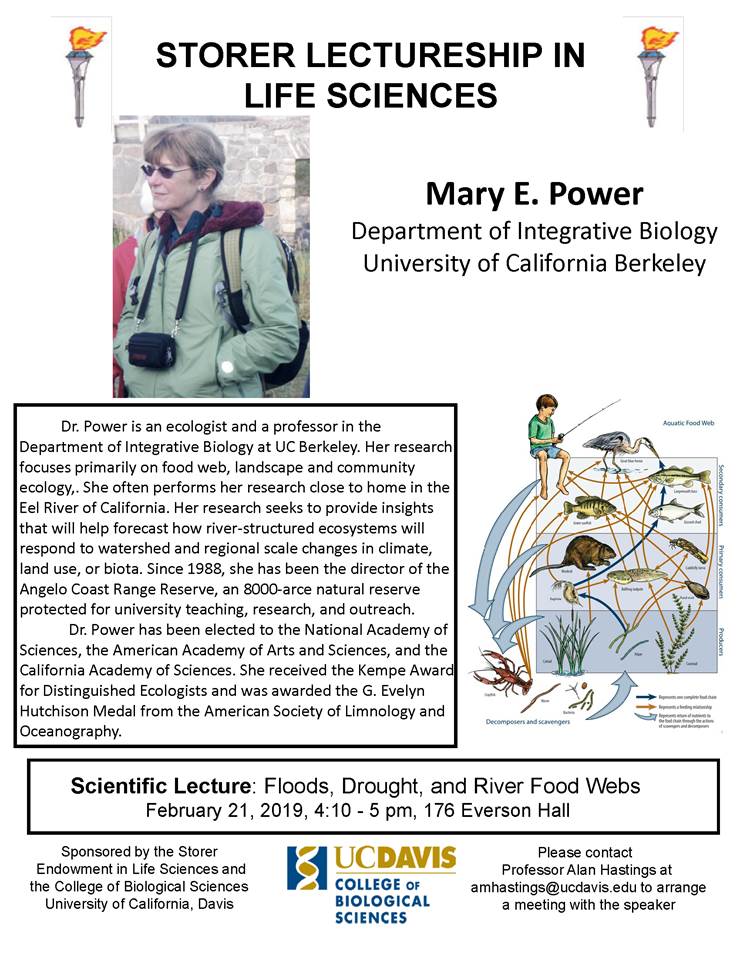
STORER LECTURESHIP IN LIFE SCIENCES

Mary E. Power

Department of Integrative Biology University of California Berkeley

Dr. Power is an ecologist and a professor in the Department of Integrative Biology at UC Berkeley. Her research focuses primarily on food web, landscape and community ecology,. She often performs her research close to home in the Eel River of California. Her research seeks to provide insights that will help forecast how river-structured ecosystems will respond to watershed and regional scale changes in climate, land use, or biota. Since 1988, she has been the director of the Angelo Coast Range Reserve, an 8000-arce natural reserve protected for university teaching, research, and outreach.

Dr. Power has been elected to the National Academy of Sciences, the American Academy of Arts and Sciences, and the California Academy of Sciences. She received the Kempe Award for Distinguished Ecologists and was awarded the G. Evelyn Hutchison Medal from the American Society of Limnology and Oceanography.

Scientific Lecture: Floods, Drought, and River Food Webs

February 21, 2019, 4:10 – 5 pm, 176 Everson Hall

We look forward to seeing you!

Please share and distribute widely.

https://imgssl.constantcontact.com/letters/images/sys/S.gif
FacebookTwitterInstagramLinkedIn

Power_flyer_v3.pdf

Interview w/ Raquel Peixoto on Coral Bleaching and Marine Probiotics

See: Coral Bleaching and Marine Probiotics: Raquel Peixoto, Ph.D. | Microbiome Special Research Program

It is an interview with Raquel Peixoto by Jose Franco as part of our Microbiome Special Research Program activities.

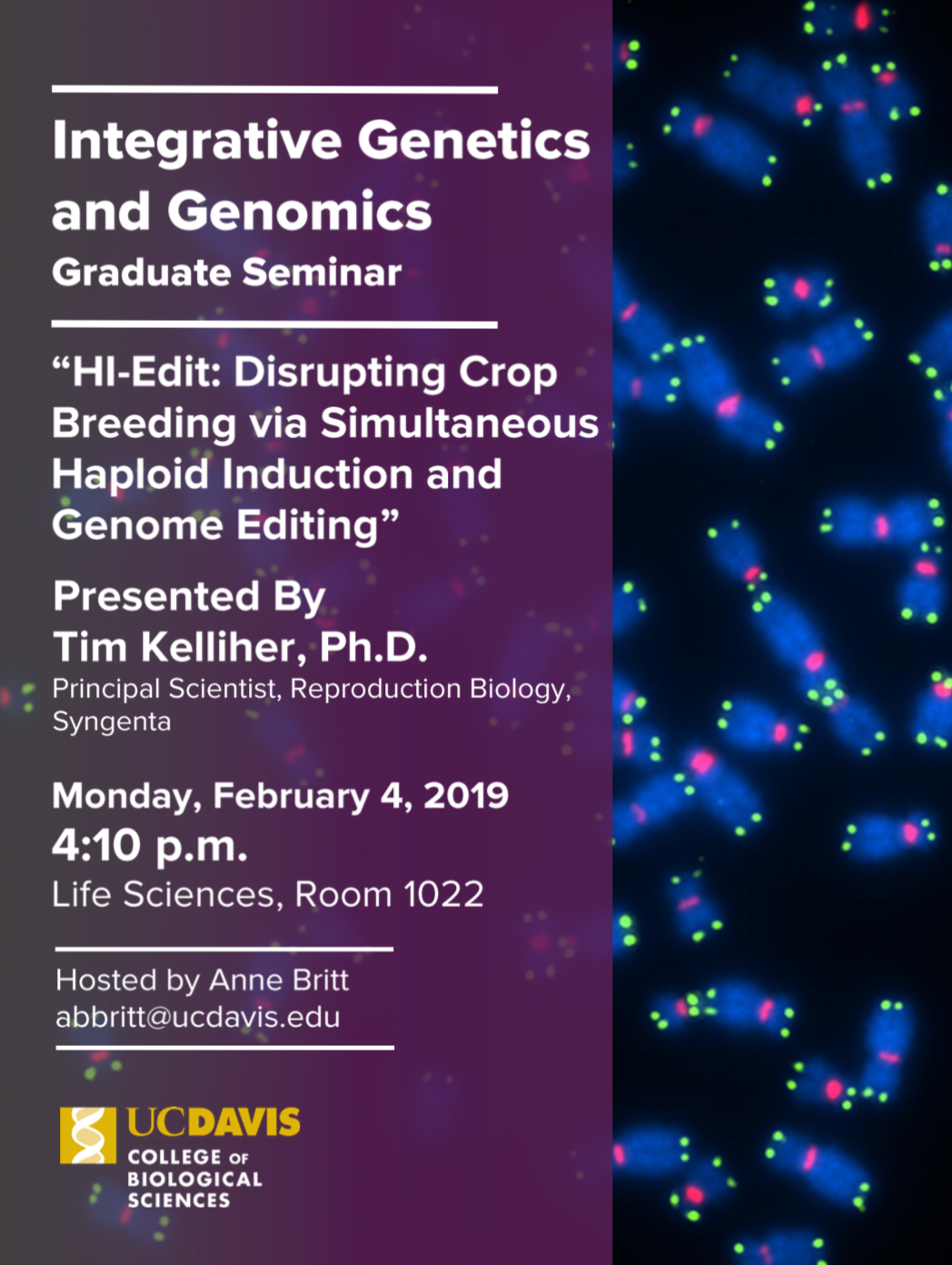
Today 2/4/19 at @ucdavis: Tim Kellier, Syngenta, “HI-Edit: Disrupting Crop Breeding via Simultaneous Haploid Induction & Genome Editing”

TKelliher Flyer.pdf

New preprint from the lab on “Network analysis to evaluate the impact of research funding on research community consolidation”

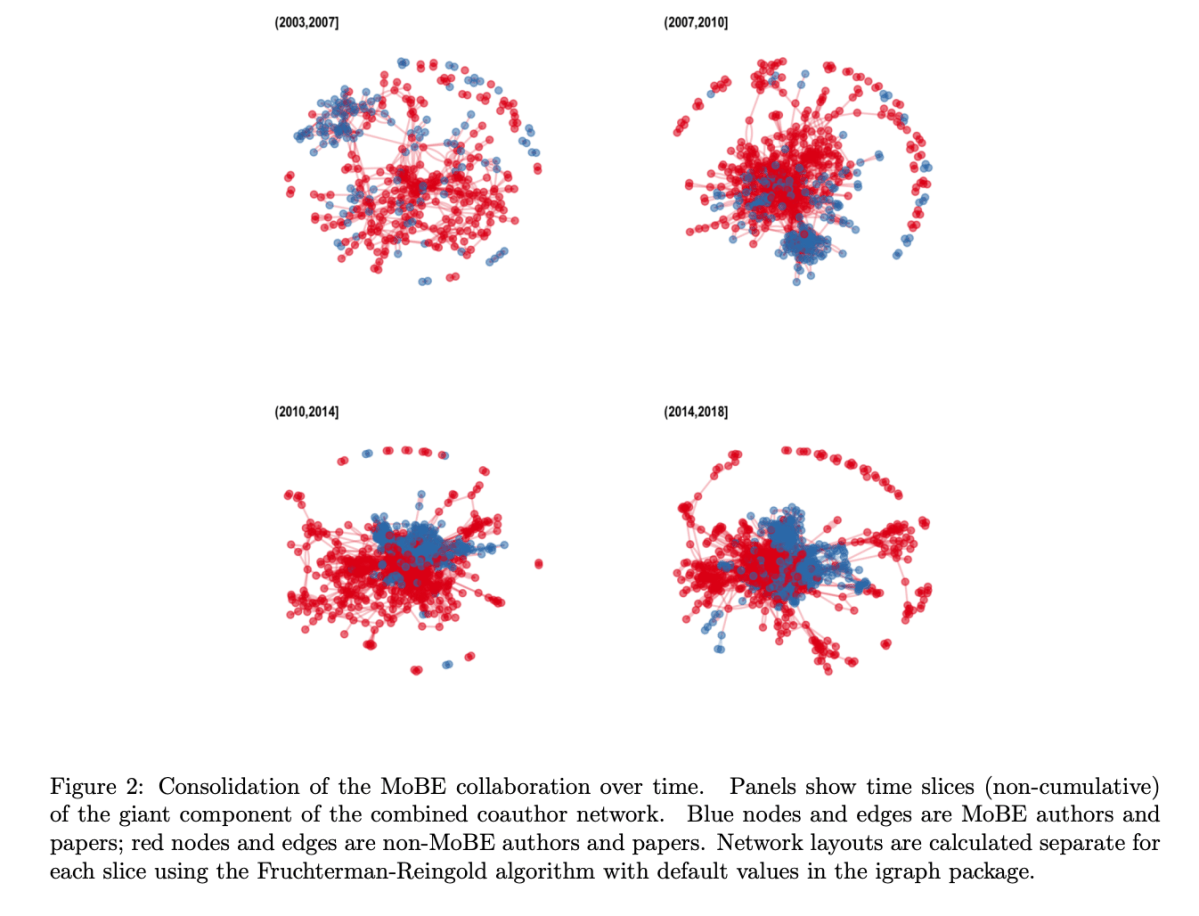
We (me and David Coil) have a new preprint out on analysis we did in collaboration with Daniel Hicks and Carl Stahmer also from UC Davis. The paper is an analysis of the Microbiology of the Built Environment program funded by the Alfred P. Sloan Foundation via analysis of publications from within and outside the program. We would love feedback …

Citation:

Network analysis to evaluate the impact of research funding on research community consolidation. Daniel J Hicks, David A Coil, Carl G Stahmer, Jonathan A. Eisen.

Abstract:

In 2004, the Alfred P. Sloan Foundation launched a new program focused on incubating a new field, “Microbiology of the Built Environment” (MoBE). By the end of 2017, the program had supported the publication of hundreds of scholarly works, but it was unclear to what extent it had stimulated the development of a new research community. We identified 307 works funded by the MoBE program, as well as a comparison set of 698 authors who published in the same journals during the same period of time but were not part of the Sloan Foundation-funded collaboration. Our analysis of collaboration networks for both groups of authors suggests that the Sloan Foundation’s program resulted in a more consolidated community of researchers, specifically in terms of number of components, diameter, density, and transitivity of the coauthor networks. In addition to highlighting the success of this particular program, our method could be applied to other fields to examine the impact of funding programs and other large-scale initiatives on the formation of research communities.

New preprint from the lab: Bacterial communities associated with cell phones and shoes 

We have a new preprint out in BioRXiv.  Would love comments and feedback

Bacterial communities associated with cell phones and shoes [PeerJ Preprints]

Full citation:

Coil DA, Neches RY, Lang JM, Jospin G, Brown WE, Cavalier D, Hampton-Marcell J, Gilbert JA, Eisen JA. 2019. Bacterial communities associated with cell phones and shoes. PeerJ Preprints 7:e27514v1 https://doi.org/10.7287/peerj.preprints.27514v1