Computational Biologist job posting at 10X technologies

Interesting job posting I just got sent by 10X technologies:

Computational Biologist

10X is looking for an outstanding individual to join its Computational Biology group. This person will: (1) lead the development of algorithms that form the core of 10X software and (2) define custom analyses to guide product development. This position is a unique opportunity to work on an exciting and novel form of Next Generation Sequencing (NGS) data that enables a wide array of previously unachievable applications. The ideal candidate will have an extremely strong background in algorithms and statistics and will be highly proficient in both generating novel algorithms and combining them with existing tools.

The right candidate must also have strong programming skills, and a keen interest in biology and working with real-world data. Strong interpersonal skills, a desire to understand customer needs and the ability to communicate results clearly are a must. This position will interact closely with colleagues in biochemistry, microfluidics and chemistry.

Key Responsibilities

  • Develop algorithms for novel NGS data across a number of novel applications
  • Develop custom analyses to asses and guide development of the core technology
  • Work with software team to commercialize algorithms products
  • Work with early customers to understand applications and requirements
  • Analyze internally generated sequencing data

    Desired Skills and Background

  • PhD in computer science, mathematics, computational/systems biology or related field
  • Extremely strong background in algorithms and statistics
  • Strong programming ability in Python (experience with C/C++ a significant plus)
  • Hands on experience with NGS data tools (e.g. bwa, samtools, GATK)
  • Creative problem solver who obsesses over novel applications of data
  • A deep intuition for the processes utilized by current NGS technologies
  • A combination of mathematical depth with a healthy respect for the imperfections

    inherent in real-world data

  • Highly independent
  • Ability to work in a fast-paced and quickly changing environment

    For more information, please contact jobs

10XCompBioJobDescription.pdf

Great use of metagenomic data: community wide adaptation signatures

OK I have been dreaming about doing something like this for many years.  One of the potentially most useful aspects of shotgun metagenomic data is that you get a sample of many/all members of a microbial community at once.  And then in theory one could look across different species and taxa and ask – do they all have similar adaptations in response to some sort of environmental pressure.  There have been a few papers on this over the last few years (e.g. check out this one from Muegge et al on Diet Driving Convergence in Gut Microbes).  But this new paper is really the type of thing I have been hoping to see: Environmental shaping of codon usage and functional adaptation across microbial communities.  Basically they looked at codon usage in organisms in different metagenomic samples and found major metagenome specific signatures, suggesting that different taxa were in essence converging on common codon usage.

The paper is definitely worth a look.

Ewan Birney visiting Davis, speaking at the Genome Center next Wednesday (14th August)

Forwarding this announcement i just received

Ewan Birney, the Associate Directory of the European Bioinformatics Institute, is visiting UC Davis next Wednesday and will be giving a talk at 2:00 in the GBSF Auditorium: ‘Using outbred genetics to understand basic biological processes’.
He will also talk about the need for a data infrastructure in the life sciences and how the European Bioinformatics Institute contributes to it.

Ewan is the creator/co-creator of many popular bioinformatics tools (e.g. GeneWise, CRAM, Velvet, Pecan), and has had an enthusiastic involvement in many other genomics/bioinformatics projects (e.g. Pfam, BioPerl, Ensembl), not to mention taking a leading role in the human ENCODE project.

News coverage of SpaceMicrobes event

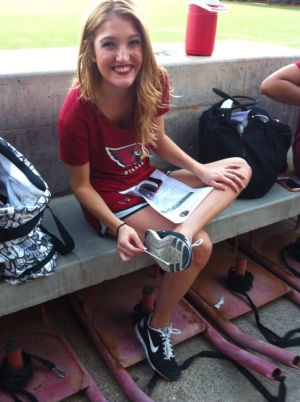
Quick post here.  Our Project MERCCURI got some press coverage relating to an event July 20th with the Arizona Cardinals: Gilbert, Tempe participate in national microbe-swabbing project – East Valley Tribune: Gilbert.

From the article:

“The event — held at the Arizona Cardinals’ training facility on July 20 — featured members of the Cardinals’ cheerleading squad swabbing their shoes and cell phones to collect microbe samples later sent to a lab at the University of California Davis for analysis. Microbes are microscopic single-cell organisms that have existed for millions of years and are found just about everywhere on the planet.”

Also some mention of out sampling the Space Station and other parts of the project.

See more about the project here.

Perhaps this meeting should be renamed "Of Microbiomes and Men" ….

Well, just got an email inviting me to participate in a meeting on microbiomes. The full invite is at the bottom of this posting.  Alas, at first glances it seems this meeting, has, well, some gender issues.

Confirmed Keynote Speakers: both male.

  • Mark Adams, Ph.D., Scientific Director, J. Craig Venter Institute, San Diego
  • Sarkis K. Mazmanian, Professor of Biology, California Institute of Technology

Confirmed other speakers: all seven male

  • Pierre Belichard, Co-founder and CEO, Enterome
  • Adam Godzik, Ph.D., Bioinformatics and Systems Biology, Professor & Program Director, Sanford-Burnham Research Institute
  • JunHua Li, Team Leader of Reference Metagenomics, BGI Research
  • Victor Nizet, MD, Professor & Division Chief, Department of Pediatrics, UCSD School of Medicine, San Diego
  • Steve Orndorff, NuMe Health
  • Andrei Osterman, Ph.D., Professor, Bioinformatics & Systems Biology, Infectious and Inflammatory Disease Center, Sanford-Burnham Medical Research Institute
  • Bernd Schnabl, MD, Assistant Professor, Division of Gastroenterology, UCSD School of Medicine, TSRI California Campus

I suppose one could say “Well, they are still working on their agenda … maybe they will have some female speakers.”  So I decided to dig around a little bit more. They provide a link to the outline agenda here. Alas that is even worse.  There we find out who some invited speakers are who have not yet accepted

  • David Odelson, R&D Program Director, Life Technologies
  • Peter B. DiLaura, President & CEO, Second Genome
  • Chris Christofferson, Morganthaler Ventures 
  • Lou Tartaglia, Third Rock Ventures
  • Mike Grey, Pappas Ventures
  • Justin L. Sonnenburg, Assistant Professor, Microbiology & Immunology, Stanford School of Medicine, Palo Alto, CA

So that is 9 confirmed speakers and six invited speakers – all of whom are male.  Great.  Here is a suggestion.  DO NOT GO TO THIS MEETING.

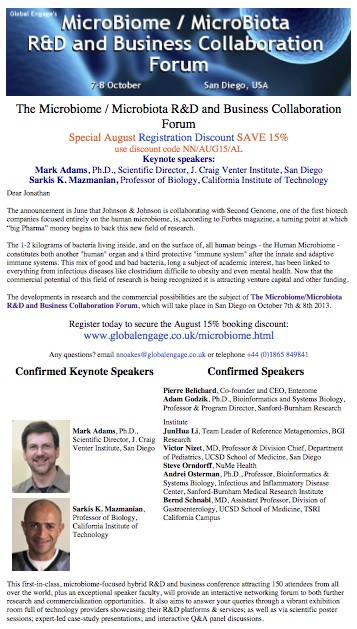
Microbiome Masthead
The Microbiome / Microbiota R&D and Business Collaboration Forum
Special August Registration Discount SAVE 15%

use discount code NN/AUG15/AL
Keynote speakers:
Mark Adams, Ph.D., Scientific Director, J. Craig Venter Institute, San Diego
Sarkis K. Mazmanian, Professor of Biology, California Institute of Technology
Dear Jonathan

The announcement in June that Johnson & Johnson is collaborating with Second Genome, one of the first biotech companies focused entirely on the human microbiome, is, according to Forbes magazine, a turning point at which “big Pharma” money begins to back this new field of research.

The 1-2 kilograms of bacteria living inside, and on the surface of, all human beings – the Human Microbiome – constitutes both another “human” organ and a third protective “immune system” after the innate and adaptive immune systems. This mix of good and bad bacteria, long a subject of academic interest, has been linked to everything from infectious diseases like clostridium difficile to obesity and even mental health. Now that the commercial potential of this field of research is being recognized it is attracting venture capital and other funding.

The developments in research and the commercial possibilities are the subject of The Microbiome/Microbiota R&D and Business Collaboration Forum, which will take place in San Diego onOctober 7th & 8th 2013.

Register today to secure the August 15% booking discount:
www.globalengage.co.uk/microbiome.html

Any questions? email nnoakes@globalengage.co.uk or telephone +44 (0)1865 849841

Confirmed Keynote Speakers


Mark Adams
Mark Adams, Ph.D., Scientific Director, J. Craig Venter Institute, San Diego

Sarkis Mazmanian
Sarkis K. Mazmanian, Professor of Biology, California Institute of Technology

Confirmed Speakers


Pierre Belichard, Co-founder and CEO, Enterome
Adam Godzik, Ph.D., Bioinformatics and Systems Biology, Professor & Program Director, Sanford-Burnham Research Institute
JunHua Li, Team Leader of Reference Metagenomics, BGI Research
Victor Nizet, MD, Professor & Division Chief, Department of Pediatrics, UCSD School of Medicine, San Diego
Steve Orndorff, NuMe Health
Andrei Osterman, Ph.D., Professor, Bioinformatics & Systems Biology, Infectious and Inflammatory Disease Center, Sanford-Burnham Medical Research Institute
Bernd Schnabl, MD, Assistant Professor, Division of Gastroenterology, UCSD School of Medicine, TSRI California Campus

This first-in-class, microbiome-focused hybrid R&D and business conference attracting 150 attendees from all over the world, plus an exceptional speaker faculty, will provide an interactive networking forum to both further research and commercialization opportunities.  It also aims to answer your queries through a vibrant exhibition room full of technology providers showcasing their R&D platforms & services; as well as via scientific poster sessions; expert-led case-study presentations; and interactive Q&A panel discussions.
The Outline Agenda


Sequencing/Bioinformatics of the Microbiome

  • An overview of the human microbiome project
  • Contributions to Metagenomics and Data Analysis
  • Advances in sequencing technologies
  • The role of chip technologies (the Phylo chip) as a rapid readout vs. sequencing
  • The $1000 genome may cost $100Ms to interpret!

Venture Capital + Technology Transfer

  • Commercializing Microbiome Technologies from Government & Academic Entities
  • International Small Company Showcase

The microbiome of the GI tract

  • The role of commensal bacteria in regulating the immune system
  • Metabolic exchange in gut microbial communities: who needs vitamins?
  • Contemplating novel antibiotic therapies that do not destroy the healthy microbiome
  • Metagenomic profiling in IBD

Clinical Applications

  • The contribution of the gut microbiome to liver disease
  • Treatment of C. Difficile infections with fecal transplants

Connections to the Food World

  • The role of diet in regulating the microbiome mix
  • Prebiotics vs. probiotics vs. pharmaceuticals
  • Opportunities to treat diabetes and obesity via the microbiome
  • Panel Discussion – Pharma/Biotech/Food Industry Partnering
  • Small Company Showcases
www.globalengage.co.uk/microbiome.html
Not interested in the Microbiome/Microbiota?
Unsubscribe here

Nick Noakesnnoakes@globalengage.co.uk Tel +44 (0) 1865 849841
Global Engage, The Kidlington Centre, Kidlington, Oxfordshire, OX5 2DL, UK.

You might think that at some point some of the people organizing meetings

Search for Executive Director, UCSD Center for Bioinformatics Analysis

Just got this by email. Seems like an interesting job —

———- Forwarded message ———-

Date: Tue, Jul 30, 2013 at 6:49 PM
Subject: Search for Executive Director, UCSD Center for Bioinformatics Analysis
To: jaeisen@ucdavis.edu
Dear Jonathan Eisen,

I am writing to seek your assistance in identying a director of a new center being established at UC San Diego, the Center for Bioinformatic Analysis. This center will establish a world-class program of bioinformatics research, collaboration and service. Its mission is to develop and apply technology for integrating diverse ‘omics data sets and to establish the means by which this information can be translated to the clinic to promote human health and prevent disease. To lead the Center for Bioinformatic Analysis we are looking for an Executive Director who has a PhD in Bioinformatics or related discipline with substantial team management experience in industry or academia. S/he will be responsible for the overall planning, function and long-term support of the Center. Key responsibilities involve interacting with UC San Diego life sciences faculty and engaging them in collaborative research projects; management of Center staff dedicated to collaboration or software development; reporting to UC San Diego faculty leadership and advisory boards; establishing the Center business model and lead in outreach and fundraising efforts. Under the leadership of the Director, the Center will be staffed by several dozen bioinformatics personnel that carry out the key functions of the center. I would greatly appreciate it if you could forward this notice and alert any candidates who might be interested. The job application is online at the UCSD web portal: http://jobs.ucsd.edu/bulletin/job.aspx?cat=search&sortby=rank&jobnum_in=67358&search=bioinformatics Thanks for your help!


Misleading microbial headline of the month: Bacteria in Brains Suggest Alzheimer’s-Gum Disease Link

Wow.  Check out this story from Bloomberg: Bacteria in Brains Suggest Alzheimer’s-Gum Disease Link – Bloomberg.  The title suggests that there is some connection between Alzheimer’s and Gum Disease.  And so does the story.  Plus check out these other stories:

All based on the same work.  Sounds like a real connection was made in this new work showing a link between bad dental hygiene and Alzheimer’s, and also between the bacterium Porphyromonas gingivalis and Alzheimer’s.  These would both be a big big deal.  After all – tooth decay is something you can do something about.  And if tooth decay causes Alzheimer’s – then – well – we could probably prevent Alzheimer’s.

Sounds awesome.  Was going to go invest in companies that are working on this topic.  Then I made a dreadful mistake.  I decided to look at the paper that all of this is based on: Determining the Presence of Periodontopathic Virulence Factors in Short-Term Postmortem Alzheimer’s Disease Brain Tissue.

Hmm .. that is weird.  The paper does not seem to have anything in it really closely tied to all the claims in the news stories. Here is the Abstract:

The aim of this study was to establish a link between periodontal disease and Alzheimer’s disease (AD) with a view to identifying the major periodontal disease bacteria (Treponema denticola, Tannerella forsythia, and Porphyromonas gingivalis) and/or bacterial components in brain tissue from 12 h postmortem delay. Our request matched 10 AD cases for tissue from Brains for Dementia Research alongside 10 non-AD age-related controls with similar or greater postmortem interval. We exposed SVGp12, an astrocyte cell line, to culture supernatant containing lipopolysaccharide (LPS) from the putative periodontal bacteria P. gingivalis. The challenged SVGp12 cells and cryosections from AD and control brains were immunolabeled and immunoblotted using a battery of antibodies including the anti-P. gingivalis-specific monoclonal antibody. Immunofluorescence labeling demonstrated the SVGp12 cell line was able to adsorb LPS from culture supernatant on its surface membrane; similar labeling was observed in four out of 10 AD cases. Immunoblotting demonstrated bands corresponding to LPS from P. gingivalis in the SVGp12 cell lysate and in the same four AD brain specimens which were positive when screened by immunofluorescence. All controls remained negative throughout while the same four cases were consistently positive for P. gingivalis LPS (p = 0.029). This study confirms that LPS from periodontal bacteria can access the AD brain during life as labeling in the corresponding controls, with equivalent/longer postmortem interval, was absent. Demonstration of a known chronic oral-pathogen-related virulence factor reaching the human brains suggests an inflammatory role in the existing AD pathology.

Alas, even via UC Davis Libraries I do not have access to the full article.  So my inferences will have to be based on the abstract (note to authors, if you want people to judge your full papers not just your abstracts, well, it would be good to have your paper be available).  From what I can tell – what they showed in this paper is that antibodies that are known to find to lipopolysaccharide (LPS) from P. gingivalis showed positive binding to brain material from a few patients who had Alzheimer’s and did not show binding to brain material from controls.  So let’s ask and try to answer a few questions about this:

  • Does LPS from a specific organism in the brain mean that the organism was in the brain: I don’t think so – LPS could move around?
  • Does binding by the antibody they used mean that there is LPS from P. gingivalis there?  Definitely no – there could be cross reactivity with other LPSs or even other molecules?
  • Did they do any more specific tests (e.g., DNA)? Doesn’t seem like it.

But let us just assume that they really did detect P. gingivalis in the brains of Alzheimer’s patients.  Would this mean PG causes Alzheimer’s? Obviously it does not mean that. Let us even assume (ridiculously) that PG causes Alzheimer’s.  Would this mean the periodontal disease leads to Alzheimer’s? No – PG could come into brains in other ways.

I could go on and on.  There are so so so so so so so many jumps that are needed to go from the limited results presented in this paper to getting anywhere near supporting a hypothesis that periodontal disease causes Alzheimer’s that it makes we want to scream.  The news reporting here is awful.  The scientists involved seem to be overhyping their work to extremes with risky, dangerous possible consequences (e.g., – oh – so you have Alzheimer’s – it’s your fault for not taking care of your teeth … we need more money for dental care to prevent Alzheimer’s; everyone should take prophylactic antibiotics to prevent Alzheimer’s and so on).

Summer microbial ecology course 2014 in Sydney, Australia

Center for Marine Bio-Innovation is accepting applications for its Summer Course in Microbial Ecology for 2014 in Sydney, Australia.

February 17-28, 2014

For more information see http://www.cmb.unsw.edu.au

CMB Summer Course Feb. 2014.pdf

Another genomics meeting featuring men men men and men: International Forum on "Genomics, Innovation and economic growth"

Well this is just peachy.  Saw this tweet

And my first thought was – please – please – please let this meeting have a decent gender ratio. I am so so sick of genome meetings that have gender ratio issues. Alas, then I went to their site: International Forum “Genomics, Innovation and economic growth”

11 plenary speakers. All of them men.  See here.
Forum president: 1 man
Advisory Board: 5 men

Crap crap crap. What is WRONG WITH PEOPLE?

Nothing else to say really.  But I will not be going I guess I can say that.

Cool open science project: rOpenSci just got 180K funding boost

Just a quick post here.  Just found out from Carl Boettiger that this cool project “rOpenSci” in which he is involved just got a boost in funding with a grant from the Alfred P. Sloan Foundation – see rOpenSci – What we hope to accomplish with the new funding.  The goals of the project are summarized on their site

“At rOpenSci we are creating packages that allow access to data repositories through the R statistical programming environment that is already a familiar part of the workflow of many scientists. We hope that our tools will not only facilitate drawing data into an environment where it can readily be manipulated, but also one in which those analyses and methods can be easily shared, replicated, and extended by other researchers. While all the pieces for connecting researchers with these data sources exist as disparate entities, our efforts will provide a unified framework that will be quickly connect researchers to open data.”