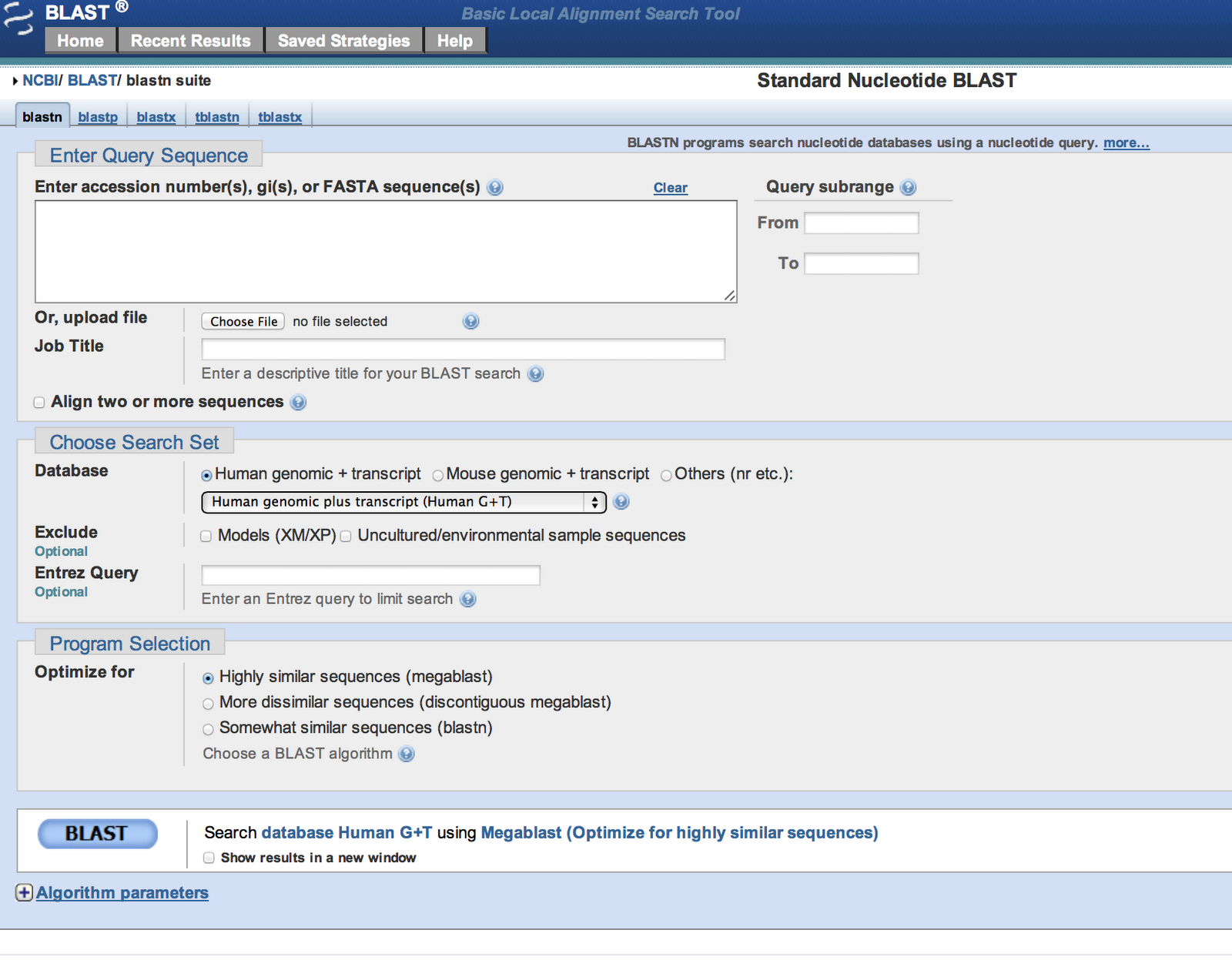
Now – I am extremely grateful for many – if not most – of the things NCBI does. Pubmed is great. Pubmed Central rocks. Sequence databases galore. And all sorts of widgets and tools associated with sequence analysis. Including a free blast server. Which I use a lot. But why? why is human G+T the default database for blastn searches? Why? I never only want to search this Db. Why not have the non redundant Db of everything be the default? Are there really that many people who only want to search human G+T? Or is this some ploy to force people to do such searches? This tiny little thing. This setting. This glitch. Whatever it is. It drives me batty …
Author: Jonathan Eisen
Winner of the "genome conference speakers should be male" award …
Presenters at the World Genome Data Analysis Summit. Women highlighted in yellow.
- Richard LeDuc, Manager, National Center for Genome Analysis Support, Indiana University
- Gholson Lyon, Assistant Professor, Cold Spring Harbour Laboratory
- Christopher Mason, Assistant Professor, Cornell University
- Liz Worthey, Assistant Professor, Medical College of Wisconsin
- Garry Nolan, Professor of Genetics, Stanford University
- David Dooling, Assistant Director, Genome Institute, Washington University
- Peter Robinson, Senior Technical Marketing Manager, DataDirect Networks
- Thomas Keane, Senior Scientific Manager, Sequencing Informatics, Wellcome Trust Sanger Institute
- Eric Fauman, Associate Research Fellow, Pfizer
- Geetha Vasudevan, Assistant Director and Bioinformatics Scientist, Bristol-Myers Squibb
- Shanrong Zhao, Senior Scientist, Johnson & Johnson
- Bill Barnett, Director, National Center for Genome Analysis Support, Indiana University
- Zemin Zhang, Senior Scientist, Bioinformatics, Computational Biology, Genentech
- Christopher Mason, Assistant Professor, Cornell University
- James Cai, Head, Disease & Translational Informatics, Roche
- Eric Zheng, Fellow of Bioinformatics Science, Regeneron
- Monica Wang, Associate Director, Knowledge Engineering, Millennium
- Joachim Theilhaber, Lead Bioinformatics Research Investigator, Sanofi
- Francisco De La Vega, Visiting Scholar, Stanford University
- Don Jennings, Manager of Data Integration, Enterprise Information Management, Eli Lilly
- Deepak Rajpal, Senior Scientific Investigator, Computational Biology, GSK
- Mark Schreiber, Associate Director, Knowledge Engineering, Novartis
So that is a ratio of 19:3 for a whopping 13.6% women. Please – I beg of you – if you are organizing a conference give some thought to the diversity of speakers. In my experience the best conferences have always ended up being ones with highly diverse speakers. These conferences were good probably because the organizers put a lot of thought into who to invite to speak, rather than just inviting either big names or people that one knew in some way.
UPDATE: It has been pointed out that I listed one person (Chris Mason) twice — so it is only an 18:3 ratio. Phew. Much better.
For other posts on this topic see
- women in science
- The Tree of Life: Diversity (of speakers, participants) at meetings: do …
- The Tree of Life: A conference where the speakers are all women?
- A conference where the speakers are all women? (with tweets – Storify
- “Genomics: the Power and the Promise” meeting – could be called “Men Studying Genomics” instead
Bad words: Nebraska declares many words and names to be off limits when spelled/written
For immediate release
From the Nebraska State Government Headquarters
——————————————
In response to criticisms of our handling of the sign language based signing of a child’s name we have decided that it would only be rationale to also apply the same standard to written and spoken words. Therefore, be it declared that any words or names that are one letter substitution away from anything bad should be banned.
For example, due to the danger associated with the word G-U-N (which we note – we are just spelling here but not actually writing the word) the following names have been banned: GUS, GUY and the following words are not allowed either GUM, GUY, BUN, RUN, SUN, FUN, GIN, PUN, GUT
For similar reasons it has been deemed that the following names and words to be banned:
- Names: Ash, Bart, Buck, Butch, Cam, Coco, Dick, Dirk, Fitch, Huck, Luck, Mitch, Nick, Santorum, Tito
- Words: abs, ads, ash, ask, asp, batch, bits, buck, bum, bunt, butch, can’t, cart, cent, chit, cub, cud, cup, cut, dart, deck, dice, dink, disk, diss, ditch, dock, dock, duck, fare, farm, fits, fort, funk, hiss, hitch, hits, hum, hunt, itch, jock, kick, kiss, kits, lick, lock, luck, miss, mock, muck, mum, nits, part, pick, pitch, pits, puck, punt, rock, rum, runt, santorum, shin, ship, shot, sick, sits, skit, slit, snit, sock, spit, such, sum, tart, tats, tick, tins, tips, tots, tuck, wart, witch, wits, yuck, yum
To help everyone out we have organized the names into clusters based on the banned word (which we would rather not spell out here).
Group 1:
- Names: Butch, Fitch, Mitch
- Words: batch, butch, witch, ditch, hitch, pitch, itch
Group 2:
- Names: Coco
- Words: dock, jock, lock, mock, rock, sock
Group 3:
- Names: Tito
- Words: tots, tats, bits, fits, hits, kits, nits, pits, sits, wits, tins, tips,
Group 4:
- Names: Ash
- Words: ash, abs, ads, ask, asp,
Group 5:
- Names: Bart
- Words: farm, fare, fort, cart, dart, part, tart, wart
Group 6:
- Names: Santorum
- Words: santorum
Group 7:
- Names:
- Words: spit, slit, skit, snit, chit, shot, shin, ship
Group 8:
- Names: Huck, Luck, Buck
- Words: funk, buck, duck, luck, muck, puck, tuck, yuck, such
Group 9:
- Names:
- Words: can’t, cent, bunt, hunt, punt, runt
Group 11:
- Names:
- Words: miss, diss, hiss, kiss,
Group 12:
- Names: Nick, Dirk,
- Words: kick, lick, pick, sick, tick, deck, dock, disk, dink, dice
Group 13:
- Names: Cam
- Words: gum, bum, rum, hum, mum, sum, yum, cut, cud, cub, cup, cut
More groups / banned words coming
Germs germs germs. They are everywhere. Get rid of them w/ hexochlorophene.
Now that many people consider germs to be a blessing, not a curse, it is useful to remind ourselves where we were a few years ago. Today’s episode of “bad germs” is brought to you by Tact soap. Hat top to Liza Gross.
Or see this newspaper ad:
So what if Tact soap from that era had hexachlorophene (the active ingredient in phisohex and something that probably is not so good for you). It killed microbes. And that has to be a good thing right? Right?
Velasquez-Manoff opinion piece in the NY Times on autism, parasites & inflammation; nice ideas; not enough caveats
There is a very interesting “Opinion” piece in the New York Times today: Immune Disorders and Autism – NYTimes.com. By Moises Velasquez-Manoff is details some recent work that the author believes relates to autism and a variety of other human ailments with an autoimmune connection.
The general logic/key points seem to be as follows:
- Some autism cases look like a form of inflammatory diseases with the immune system overactive (inflammation on high, anti-inflammation on low, or some combination thereof)
- Infection of a mother during pregnancy increases the risk of having a child with autism.
- In animal models, inducing inflammation in the mother (even without an infection) leads to an increased risk of behavioral “problems” in her offspring
- Inflammatory and/or autoimmune diseases (e.g., asthma) have increased in incidence along with autism.
- If a mother has automimmune or inflammatory diseases such as rheumatoid arthritis celiac disease she has a higher risk of having a child with autism. Similarly if a mother has allergies or asthma during the second trimester, there is a higher risk of having children with autism.
- Many automimmune and inflammatory disorders and autism are all more prevalent is the developed world.
- The developed world is generally cleaner that the developing world.
- There are many fewer parasites in people in the developed world.
- Parasites are known to suppress inflammation.
- Therefore, we may be able to stop/limit autism, asthma, and other inflammatory diseases by purposefully infecting people with parasites from our evolutionary past.
Now, personally, I like the general hypothesis here. It makes complete sense. But alas, it is suffers from this issue that is spreading almost as fast as these diseases – a lack of a discussion of the distinction between correlation and causation. I have been obsessing about this a bit recently with studies of the microbiome. Overall, I do like this current article. It mixes human epidemiological studies with controlled animal studies with discussion of conceptual models. But alas there is really no discussion of the challenges if disentangling correlations vs. causation. And I think it is a bit dangerous in the latter parts with the jump to potentially curing these various ailments by purposeful infection with parasites. Again, I like the idea. But a few caveats would have been nice. I am glad it was marked as an opinion piece but even when one states an opinion about a medical issue, one can still say “there are reasons why this might not be true .. such as …”. Too bad that wasn’t done here.
UPDATE – Emily Willingham has written a VERY detailed critique of the article that I think everyone interested in anything related to this topic should read: Emily Willingham: Autism, immunity, inflammation, and the New York Timeswww.emilywillinghamphd.com.
Spammy journal of the day: Journal of Proteomics and Genomics …
Just got this email posted below. Certain aspects of it make me a little skeptical of the editorial quality of the journals from this publisher … (highlighting a few parts done by me).
——————————–
Dear Dr.jonathan a. eisen,
Call for papers – to be published in the month of September and there on
Journal of Proteomics and Genomics
The scientific research is on its wheels now a day more than it has ever been. All the research and results are being accumulated enormously and in this race, you can come into lime light, only if you are noticeable enough. Are you sure the resource you have chosen provides you with such a benefit?
If you are not sure go through this list and make sure if you are at the right place, learn few facts to choose wisely when publishing your valuable research work:
- Is it an open access online journal: Being online enhances the reachability of the journal worldwide and being open access means removing barriers for all the researchers, without any discrimination of dissipating the knowledge. (Subscription based is available only for who can afford.)
- Does it provide xml files: Xml files are important for deposition into the repositories. Generally high prices are obtained for providing these files by publishing companies. (We provide free of cost.)
- Proper communication and support during publication: The most important and the actual tyranny lies in publishing the research paper which is the sweat and time of your hardship. But it would be more hardship if you have to publish with a poorly communicating and non-supportive journal. (Our advanced online system enhances communication effectively.)
- Through peer review of original and revised manuscripts: Value of your research paper is enhanced only if it is peer reviewed. (Peer review is one of the main quality element provided by us.)
- Revision made easy: And the revision part out there is so terrific. (But with us it is easy due to the detailed comments of our reviewers.)
- High profile experts with lot of experience: Editors with specialized expertize are an asset when dealing with scientific manuscripts. They can provide very accurate suggestions with experience and help improving the quality of the paper in-depth. (We are rich with them.)
- Support for enhanced citations even after publishing : Paper has been published, everything is done, now what? Have you ever wondered what is happening with your paper? Is it reaching the required? Not only social media but there are hundred other ways to get you to the right place. (The secret is only with us.)
- Appropriate Fee : Open Access journals now a days cost nothing less than $1000. (We charge only $ 540)
Note – I have not included the link so as to not in any way contribute to their Google Ranking. But wow – journal spam is pooping up so often it is hard to keep up with it.
Notes from some recent meetings about microbiology of the built environment
Quick post here. At the microBEnet site that I run we have posted some notes, slides, videos and other information from a few recent meetings on the topic of “microbiology of the built environment” that may be of interest so I am posting links here
- Put a microbe on it: “The Great Indoors” session at the Ecological Society of America’s annual meeting
- Videos and slides from GSC13 meeting session on “microbiology of the Built Environment” | microBEnet: The microbiology of the Built Environment network.
- GSC13: From Genomes to Interactions to Communities to Models blog post by Holly Bik
- Guest Post: Metadata for the Built Environment – MIxS-BE package blog post by Lynn Schriml
- Report of 13th Genomic Standards Consortium Meeting including microbiology of the built environment session
- “Challenges in Microbial Sampling in Indoor Environments” – Workshop Report Summary
- Summary: Healthy Buildings 2012
- An outdoor microbiologist indoors: Thoughts and ramblings from ASM2012 post by Lizzy
- Guest Post by David Thaler: Thoughts on the Inaugural Conference on the Microbiology of the Built Environment guest post by David Thaler
- ASM Live video on bacteria in hotel rooms
"Genomics: the Power and the Promise" meeting – could be called "Men Studying Genomics" instead
Just got another email advertising this meeting: Genomics: the Power and the Promise.  Organized by Genome Canada and the Gairdner Foundation. And, well, though I love some of the things Genome Canada has done, this conference really stick in my craw in the wrong way. Why? It has a serious male speaker overabundance. Here is the list of speakers:
Day 1 
- Pierre Muelien
- John Dirks
- Gary Goodyear
- Eric Lander
- Craig Venter
- Philip Sharp
- Svante Paabo
- Tom Hudson
- Peter Jones
- Stephen Scherer
- Michael Hayden
- Bertha Maria Knoppers
Day 2
- Stephen Mayfield
- Elizabeth Edwards
- Curtis Suttle
- Peter Langridge
- Michel Georges
- William Davidson
- Klaus Ammann
That is 17:2 male: female ratio. That is one female speaker per day. Not impressive.
On Day 2 there are two panels (which generally I do not count as “speakers” but at least there are a few more women on these):
- Panel 1: Sally Aitken, Vincent Martin, Elizabeth Edwards, Curtis Suttle, Gerrit Voordouw, Steve Yearley
- Panel 2: William Davidson, Martine Dubuc, Isobel Parkin, Graham Plastow, Curtis Pozniak, Peter Phillips 
So if you count these that then comes to a ratio of presenters of 25: 6. Do I want quotes for meetings? No, but given that the ratio of men: women in biology is close to 1:1 this suggests to me some sort of bias. Where does this bias come from? I don’t know. Could be at the level of who gets invited. Could be at the level of who accepts. Could be some non obvious criterion for selecting speakers that leads to a bias towards men. I don’t know. But I personally think they could do better. And I note – they could probably do better in terms of other aspects of diversity of speakers, but I am focusing here just on the male vs. female ratio. Again, I am not suggesting one should have quotas for all meetings but at the same time, a 17:2 male to female speaker ratio suggests something could use some working on.
As a side story I decided to look at some past conferences sponsored by Genome Canada. I worked my way down the list … see below:
- 2008 Joint IUFRO-CTIA International conference. Speakers: 8:2 male: female
- 6th Canadian Plant Genomics Workshop Plenary Speakers 8:2
- 8th Annual International Conference of the Canadian Proteomics Initiative. See below. 32:2 male to female. I have no idea what the ratio is in the field of proteomics but this is a very big skew in the ratio. 94% male.
- Leigh Anderson (Plasma Proteome Institute)
- Ron Beavis (UBC)
- John Bergeron (McGill)
- Christoph Borchers (UVic)
- Jens Coorssen (U Calgary)
- Al Edwards (U Toronto)
- Andrew Emili (U Toronto)
- Leonard Foster (UBC)
- Jack Greenblatt (U Toronto)
- Juergen Kast (UBC)
- Gilles Lajoie (U Western Ontario)
- Liang Li (U Alberta)
- John Marshall (Ryerson)
- Susan Murch (UBC Okanagan)
- Richard Oleschuk (Queens)
- Dev Pinto (NRC)
- Guy Poirier (Laval)
- Don Riddle (UBC)
- David Schreimer (University of Calgary)
- Christoph Sensen (University of Calgary)
- Michael Siu (York)
- John Wilkins (University of Manitoba)
- David Wishart (University of Alberta)
- Rober McMaster (Universiyt of British Columbia)
- Peter Liu (University of Toronto)
- Christopher Overall (Universiyt of British Columbia)
- John Kelly (NRC, Ottawa)
- Joshua N. Adkins (Pacific Northwest National Laboratory, USA)
- Dustin N.D. Lippert (University of British Columbia)
- David Juncker (McGill University)
- Jenya Petrotchenko (University of Victoria)
- Detlev Suckau (Bruker Daltonik GmbH)
- Peipei Ping (University of California)
- Robert McMaster (University of British Columbia)
Got poo?: Clinical trial on fecal transplants (aka fecal bacteriotherapy) to treat C. difficile infections
Normally I avoid covering press releases here on my blog but this one is actually worth noting: Groundbreaking Clinical Trial Looks at Fecal Transplant as Treatment for C. Difficile | Women’s Medicine Collaborative. It details the funding of a clinical trial to study the effectiveness of fecal transplants in treating Clostridium difficile infections.
Fecal transplants have gotten a growing amount of publicity over the last few years. And they certainly seem to have potential. But though they have been shown to be safe, they have not yet been shown in a clinical trial to be effective in treating anything. So it is good to see a funded clinical trial on such transplants (though I note, transplant is probably the wrong word to use – maybe fecal bacteriotherapy is more appropriate.
For some background on fecal transplants see
Referring to 16S surveys as "metagenomics" is misleading and annoying #badomics #OmicMimicry
Aargh. I am a big fan if of ribosomal RNA based surveys of microbial diversity. Been doing them for 20+ years and still continue to – even though I have moved on to more genomic/metagenomic based studies. But it drives me crazy to see rRNA surveys now being called “metagenomics”.
Here are some examples of cases where rRNA surveys are referred to as metagenomics:
- Deep 16S rRNA metagenomics and quantitative PCR analyses of the premature infant fecal microbiota … – Wow — rRNA as metagenomics even made it into the title here
- Paper: 16S rRNA metagenomics-based survey of oral biofilms in obese children… Poster Abstract
- Gastroenterology & Endoscopy News – Studies Link Composition of … News Story
- Metagenomic study of the oral microbiota by Illumina high-throughput sequencing – paper is only about rRNA sequencing, not metagenomics
- Dr. Dag Harmsen publishes first 16S metagenomic study on the Ion PGM Sequencing … a Youtube video highlighting a PLoS One paper
- Bacterial Community Shift in Treated Periodontitis Patients Revealed by Ion Torrent 16S rRNA Gene Amplicon Sequencing – PLOS One paper from the video above
- EUREKA GENOMICS | 16S metagenomic analysis service – a company pushing their services
- A Metagenomic Approach to Characterization of the Vaginal Microbiome Signature in Pregnancy … PLoS One paper
Well, this software might be useful for
#metagenomics but drives me crazy when people refer to 16S PCR as#metagenomics plosone.org/article/info:d…
— Jonathan Eisen (@phylogenomics) August 22, 2012
//platform.twitter.com/widgets.js
@phylogenomics why such a strong sentiment? Do you have a good definition of the field of metagenomics that “excludes” the 16S work?
— Rob Hooft (@rwwh) August 22, 2012
//platform.twitter.com/widgets.js
@phylogenomics Yes, that would cut out all my favourite microbes.
— Sarah Watkinson (@philonotis) August 22, 2012
//platform.twitter.com/widgets.js
@rwwh metagenomics = sampling/analysis/study of the genomes from community/sample; rRNA PCR (which I love) is not about genomics
— Jonathan Eisen (@phylogenomics) August 22, 2012
//platform.twitter.com/widgets.js
@xquickfixx actually it is sadly getting more and more common …
— Jonathan Eisen (@phylogenomics) August 22, 2012