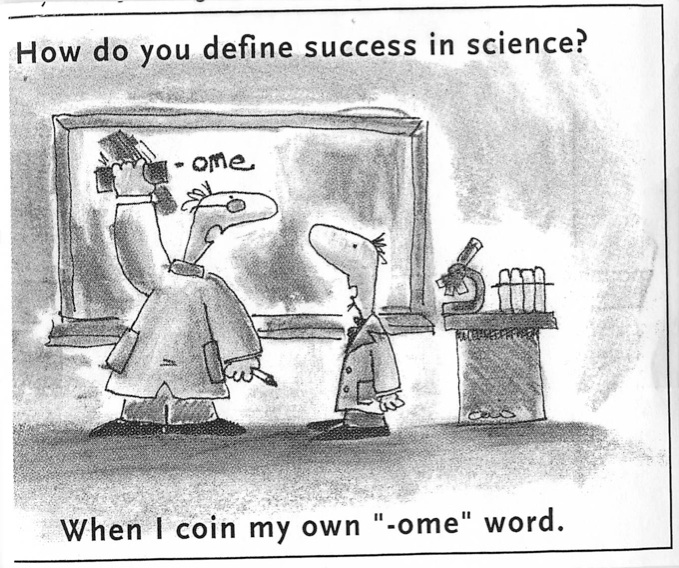
Trying to track down source of cartoon about coining "ome" words #badomics

I have this cartoon of direct relevance to my crusade to end the use of badomics words.  I have been trying to track where it came from for – like – ever.  And though I did not want to post it without getting permission I have decided to do so to try and track it’s source.  Here it is

I note – I tried using Google Image search (see a discussion of how to do this here) and it finds some other versions of this cartoon online but none of them have a source for it either.  

So – does anyone out there know where this came from?

Scifoo Notes via Storify

http://storify.com/phylogenomics/scifoo-2012.js?template=slideshow[View the story “scifoo 2012” on Storify]

#PLoSOne paper on the "horse #microbiome" and colitis; wonder if they will study ‘poo tea’

There is a new paper on the horse microbiome: PLoS ONE: Comparison of the Fecal Microbiota of Healthy Horses and Horses with Colitis by High Throughput Sequencing of the V3-V5 Region of the 16S rRNA Gene

They discuss the microbial community in the feces of healthy horses and those with colitis.  In the conclusions, they also discuss the possibility of “fecal transplants” to treat problems in the gut microbiome.

Bacterial species richness and diversity are thought to be important components of a ‘healthy’ intestinal microbiome. Decreases in richness and diversity have been associated with conditions such as chronic diarrhea and recurrent C. difficile infection (CDI) in humans [24], [40]. Restoration of bacterial diversity and richness is the principle behind fecal microbiota transplantation, an approach that has received much attention recently for successful treatment of recurrent CDI [41], [42]. Surprisingly, equine colitis was not associated with loss of diversity and richness, but further studies using more uniform groups of horses with specific etiologies are required. Microbiota transplantation might potentially be an effective treatment to restore this complex environment towards is considered more ‘normal’.”

I find it very surprising that they do not discussion “transfaunation” which is basically fecal transplantation in animals.  For more on transfaunation see:

And I think they should have / could have mentioned “poo tea” which some old school horse caretakers make for horses with colitis.  For more on that I suppose you can watch my Tedmed/Ted talk where I talk about this issue briefly

http://video.ted.com/assets/player/swf/EmbedPlayer.swf

A centralized journal commenting system? Who would comment there? Volunteers?

Well, just got off the phone with someone who is working on an open, centralized, system to comment on/rate all journal articles.  If all scientists used such a system that could be quite useful though I told the person, as I have said many times before, I am skeptical that people will use such a system when they can (and do) comment on papers in their social networks.  Anyway, this person asked if I could come up with a list of people who might be interested in being Beta testers of such a system.  So I am asking here – any volunteers?  Any recommended people who you know do a lot of commenting already in other places?

Thanks

What #Scifoo did to me in 2006, 2007

In 2006 and 2007 I went to this amazing meeting called Science Foo camp, or “SciFoo.”  More about my previous experiences with it are here:Holy s$&# – I am going back to #SciFoo

Right now I want to note something that for me is pretty unusual.  In 2006 I gave a mini presentation on microbial diversity at SciFoo.  I just posted my slides to Slideshare here:

The next year I was not sure if I was going to try to present anything and then, while at SciFoo someone (can’t remember whom) asked me if I could do a presentation on “The Human Microbiome.”  Silly me – I said – sure.  Alas – it meant staying up very very late in the Wild Palms hotel because, well, I had never given a presentation on the Human Microbiome before that.  My slides from that are below:

Why am I writing this?  Well, doing that presentation is largely what moved me into being interested in the human microbiome and the microbiomes of various plants and animals.  Prior to that I had done very little work on communities of microbes associated with animals or plants.  I had done a lot of genomics, and studies of microbial diversity and even metagenomics.  But most of work on plant or animal associated microbes was one cases where there were a small number of symbionts living in or on a host – simple systems.  The complexity of the “microbiome” of plants and animals kind of scared me off.  I was thinking about doing more work on microbes associated with Drosophila but not yet convinced it was the right thing to do.  And that presentation – as well as the response from the people at SciFoo (e.g., Freeman Dyson said he found it fascinating) helped spur me on to do much more work on plant and animal associated microbial communities.

I wonder what will happen this year … SciFoo starts tonight …

Mars Curiosity discussion on Colbert

The Colbert Report Mon – Thurs 11:30pm / 10:30c
John Grunsfeld
www.colbertnation.com
http://media.mtvnservices.com/mgid:cms:item:comedycentral.com:417293
Colbert Report Full Episodes Political Humor & Satire Blog Video Archive

#UCDavis Prof. Dawn Sumner video interview on being involved in Mars Curiosity Rover landing

I am getting really excited about the upcoming Curiosity landing on Mars. So cool that Dawn Sumner – Geology Prof. from UC Davis is going to be involved …
 

Also check out:

Holy s$&# – I am going back to #SciFoo

Well, I cannot wait until Friday.  I am going back to SciFoo.  Best.  Meeting.  Ever.  Went in 2006 & 2007.  Changed my life.  Here are some posts – back when I was a very newbie blogger:

2006

2007

Nice new memory efficient metagenome assembly method from C. Titus Brown –

Interesting new #OpenAccess PNAS paper from C. Titus Brown: Scaling metagenome sequence assembly with probabilistic de Bruijn graphs.  Of course, if you follow Titus on Twitter or his blog you would know about this already because not only has he posted about it but he posted a preprint of the paper on arXiv in December.

Check out the press release from Michigan State.  Some good lines there like “Analyzing DNA data using traditional computing methods is like trying to eat a large pizza in a single bite.”

A key point in the paper: “The graph representation is based on a probabilistic data structure, a Bloom filter, that allows us to efficiently store assembly graphs in as little as 4 bits per k-mer, albeit inexactly. We show that this data structure accurately represents DNA assembly graphs in low memory.” This is important because right now most assemblers for genome data use a ton of memory.

Anyway the software behind the paper is available on GitHub here.  Assemble away.

Uggh – Robert Krulwich blogs about butterflies as hybrids resurrecting BS from Williamson

Oh for the love of …

Was browsing Twitter when I saw this:

So I had to check it out.  First I clicked on the link to my blog since I didi not know what post this was referencing.  Uh oh.  It was a post entitled “Just grand -Donald Williamson published more crap on larval “evolution” – this time in one of the #OMICS journals

Then with dread I clicked on the link to NPR and found a blog post from none other than Robert Krulwich: Are Butterflies Two Different Animals in One? The Death And Resurrection Theory : Krulwich Wonders… : NPR.  In it Krulwich references some book by Bernd Heinrich which itself discusses the theory (if you can call it that) that butterfly and moth metamorphosis represents the death of one organism and the “resurrection” of another.  And furthermore that this is due to a past hybridization event between two species where somehow the genomes merged and the organisms maintained distinct lives linked by the metamorphosis stage.

The problem with this?  Well, a lot of it comes from the ridiculous papers of Donald Williamson, which have been shown quite clearly to be bogus.  Yes, as Krulwich notes, this theory of two species in one “startles” but so does the theory that humans closest relatives are dolphins because they are smarter than chimps.  As does the theory that bacteria are in fact little planets of their own orbiting around animals attracted to them by microgravity.  A theory being startling is a good thing only if the theory is not complete unadulterated crap. http://storify.com/phylogenomics/robert-krulwich-at-nprscience-botches-discussion-o.js?template=slideshow[View the story “Robert Krulwich at NPRScience botches discussion of bogus hybridization story” on Storify]