Just got this in email and thought it would be good to share
Author: Jonathan Eisen
Support good science writing – pay for it
A quick one here since I think there is not much complication to this issue. As many know – I am a big big advocate of “open access” to the scientific literature. I think if the taxpayers / government pay for research (and pays for salaries/indirect costs/etc that go into publishing) then the results of that research (data, papers, software) should be available freely and openly. I think it is also better if ANY scientific writing could be freely and openly available (e.g., research paid by private funds).
However, this does not mean that one should not pay for writing about science. I think we as a society need to support good science writing and reporting. I subscribe to the New York Times – party partly for access to the science writing (not all of which I like but some of which is phenomenal). I subscribe to Wired. I donate (occasionally) to blogs. I subscribe to Scientific American. I buy good science books (sometimes many copies and then give them out – like I did with Rebecca Skloot’s HeLa book which).
So I call on people out there – whether you support Open Access to government funded work or not – pay for some good science writing. Buy a book. Subscribe to a magazine. Donate to a blog. Do something to support those who enrich our lives. Science writers need to earn a living after all …
Real science vs. fake science in advertising
UCDavis IT and GMail think this "Open Journal of Genetics" journal announcement is SPAM, I do too #EndScienceSpam
Just got this email which both Gmail and UC Davis systems think is SPAM (see below). It is from yet another new journal and the journal certainly seems a bit, well, off to me. I am posting such emails from journals like this in the hope that in Google search results people at least see some comments on the web at least asking questions about the quality of these journals. I do not know any details about this journal but I note I could not find any actual description of their licensing/copyright policies and all the papers list the copyright as belonging to the journal. This seems to me to be unlikely to fit the standard definition of “open access” though it is very hard to tell from their website.
Please circulate this CFP among your colleagues and students.
**********************************************************************************************
**********************************************************************************************
Dear Jonathan A Eisen
Open Journal of Genetics (OJGEN) is an international journal (Open Access) dedicated to the latest advancement of Genetics. The goal of this journal is to provide a platform for scientists and academicians all over the world to promote, share, and discuss various new issues and developments in different areas of Genetics.
——————-
Topics:
www.scirp.org/Journal/AimScope.aspx?JournalID=613
——————-
+ Behavioural genetics
+ Classical genetics
+ Developmental genetics
+ Conservation genetics
+ Ecological genetics
+ Evolutionary genetics
+ Genetic engineering
+ Genetics of intelligence
+ Genomics
+ Human genetics
+ Medical genetics
+ Microbial genetics
+ Molecular genetics
+ Population genetics
+ Psychiatric genetics
+ Quantitative genetics
——————-
Editorial Board:
www.scirp.org/Journal/EditorialBoard.aspx?JournalID=613
——————-
Editor in Chief
Prof. Benoît Chénais, Université du Maine, France
Editorial Board
Prof. Jinsong Bao, Zhejiang University, China
DR. Gonzalo Blanco, University of York, UK
Prof. Yurov Yuri Boris, Russian Academy of Medical Sciences, Russia
Prof. Hassen Chaabani, University of Monastir, Tunisia
DR. Craig E. Coleman, Brigham Young University, USA
DR. Ming-Shun Chen, Kansas State University, USA
DR. Philip D. Cotter, American College of Medical Genetics, USA
DR. Clark Ford, Iowa State University, USA
DR. Andreas Futschik, University of Vienna, Austria
DR. Cenci Giovanni, University of L’Aquila, Italy
DR. Tomonobu Hasegawa, Keio University School of Medicine, Japan
DR. Karen Elise Heath, Hospital Universitario La Paz, Spain
Prof. Gregg E. Homanics, University of Pittsburgh, USA
DR. Nilüfer Karadeniz, Ankara Training and Research Hospital, Germany
Prof. Presa Martínez, Universidad de Vigo, Spain
DR. James Michael Mason, National Institute of Environmental Health Sciences, USA
Prof. Pratibha Nallari, Osmania University, India
DR. Georges Nemer, American University of Beirut, Lebanon
Prof. Ettore Olmo, Università Politecnica delle Marche, Italy
DR. Drewell A. Robert, Harvey Mudd College, Canada
DR. Surasak Sangkhathat, Prince of Songkla University, Thailand
Prof. Bernd Schierwater, Yale University, USA
Prof. Genlou Sun, Saint Mary’s University, Canada
DR. Reshma Taneja, National University of Singapore, Singapore
——————-
Authors’ Guidelines:
www.scirp.org/Journal/ForAuthors.aspx?JournalID=613
——————-
+ All manuscripts must be prepared in English.
+ Review paper is warmly welcome.
+ Submit your paper via online submission system papersubmission.
www.papersubmission.scirp.org/admin/initLoginAction.action?journalID=107
+ To expedite the review process, please format your reference as the guideline,
+ Please visit journal homepage for more information.
Best Regards,
Joyce Y.
Editorial Office of OJGEN
Scientific Research Publishing, USA
Email:ojgen@scirp.org
Scientists have …. (impressions from #scio12)
![]() |
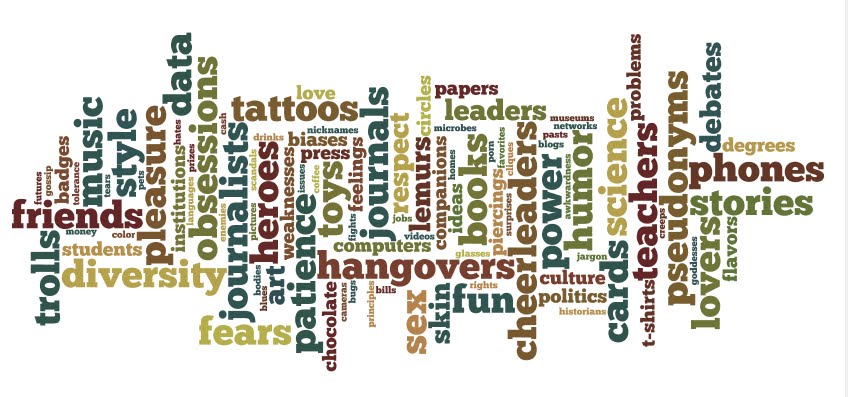
And for reasons I am not entirely clear on, the essence kept coming up as single words. So I tried to write them down but it was a bit too vague … so then I thought – what about giving those words some friends …
So I decided to try to come up with 100 words to complete the phrase “Scientists have …” I made a list and then gave each word a “weight” and used Wordle.Net to make a word cloud with them.
This word cloud, in the context of “Scientists have …” captures a lot of meeting for me.
Would be great to see other people come up with their 100 words for this …
My full list with scores is below:
| art | 15 |
| awkwardness | 5 |
| badges | 10 |
| biases | 10 |
| bills | 5 |
| blogs | 5 |
| blues | 5 |
| bodies | 5 |
| books | 20 |
| bugs | 5 |
| cameras | 5 |
| cards | 20 |
| cash | 5 |
| cheerleaders | 20 |
| chocolate | 10 |
| circles | 10 |
| cliques | 5 |
| coffee | 5 |
| color | 5 |
| companions | 10 |
| computers | 10 |
| creeps | 5 |
| culture | 10 |
| data | 20 |
| debates | 15 |
| degrees | 10 |
| diversity | 20 |
| drinks | 5 |
| enemies | 5 |
| favorites | 5 |
| fears | 20 |
| feelings | 10 |
| fights | 5 |
| flavors | 10 |
| friends | 20 |
| fun | 20 |
| futures | 5 |
| glasses | 5 |
| goddesses | 5 |
| gossip | 5 |
| hangovers | 20 |
| hates | 5 |
| heroes | 20 |
| historians | 5 |
| homes | 5 |
| humor | 20 |
| ideas | 10 |
| institutions | 10 |
| issues | 5 |
| jargon | 5 |
| jobs | 5 |
| journalists | 20 |
| journals | 20 |
| languages | 5 |
| leaders | 15 |
| lemurs | 15 |
| love | 10 |
| lovers | 20 |
| microbes | 5 |
| money | 5 |
| museums | 5 |
| music | 20 |
| networks | 5 |
| nicknames | 5 |
| obsessions | 20 |
| papers | 10 |
| pasts | 5 |
| patience | 20 |
| pets | 5 |
| phones | 20 |
| pictures | 5 |
| piercings | 10 |
| pleasure | 20 |
| politics | 10 |
| porn | 5 |
| power | 20 |
| press | 10 |
| principles | 5 |
| prizes | 5 |
| problems | 10 |
| pseudonyms | 20 |
| respect | 15 |
| rights | 5 |
| scandals | 5 |
| science | 20 |
| sex | 20 |
| skin | 15 |
| stories | 20 |
| students | 10 |
| style | 20 |
| surprises | 5 |
| t-shirts | 10 |
| tattoos | 20 |
| teachers | 20 |
| tears | 5 |
| tolerance | 5 |
| toys | 20 |
| trolls | 20 |
| videos | 5 |
| weaknesses | 10 |