Panel from Science Online London (SOLO11): Linking with the Literature – the Arsenic Story

Video from the panel that I skyped in to last week from my garage at 2:30 AM is now available. The detail is found at River Valley TV: Panel #1 : Linking with the Literature – the Arsenic Story | River Valley TV

Or see it here:

Fortunately for all I did not do skype video chat – just audio – since I was in my garage in my pajamas: Garage science: why skyping in to a meeting at 2:30 AM can be, well, interesting #SOLO11

Sharing what I have been learning about sharing audio synched to slides for talks #Slideshare #Youtube #SciVee

As many of you must know, I like to share. Sort of an open science thing. Sort of an ego thing. But I like to share my papers, and data and even my talks. Going about sharing ones talks is not completely straightforward alas. A few years ago I started using a really nice tool called Slideshare which is one of many site/systems out there for sharing slides from talks. I have I posted many presentations on slideshare over the years and continue to do so. It has some nice embed functions for example and thus I can put a little flash version of my talk from a few days ago right here in my post

And they have some social features there which are also really nice. But slides are, well, just slides. Much better would be to include audio along with slides.


So recently I have been trying to record audio from talks and post it with my slides. Slideshare has a way to link the audio to the slides so I can then embed a flash presentation with the audio like below:

Of course, some might complain about the focus on Flash for the embedding (which means many apple phones and computers cannot view them but it is still nice to have the embed functions there. But alas, there is one major limitation. The method for synching audio to slides in Slideshare is really painful. It takes forever to do and is cumbersome. Hopefully they will add other options for doing the synching that are less painful. So what I have been doing recently has been to give my presentations using the Keynote software on my Macbook and to use the “Record Slideshow” option which records the audio as well as the slide transition timing. So I did that for my latest talk and then uploaded the video of the slideshow (with audio) to Youtube which allows me to embed it here too:

 I also uploaded it to SciVee.tv here:

  http://www.scivee.tv/flash/embedCast.swf

Not sure which is going to be a better option for slideshows with audio but am experimenting here. Any suggestions for other ways to record audio in synch with slides and to share that with people would be welcome.

Storification of my notes/tweets from #UCDavis CLIMB Symposium "The infant gut microbiome: prebiotics, probiotics and establishment"

I made a Storify posting for the CLIMB Symposium I participated in yesterday. First I am reposting my summary of what the symposium was about which I posted the day before the meeting:

There is a symposium tomorrow at UC Davis organized by a undergraduates in the CLIMB program.  CLIMB stands for “Collaborative Learning at the Interface of Mathematics and Biology (CLIMB)” and is a program that emphasizes hands-on training using mathematics and computation to answer state-of-the-art questions in biology.  A select group of undergraduates participate in the program and this summer the students had to do some sort of modelling project.  Somehow I managed to convince them to do work on human gut microbes.  And they have done a remarkable job.  

As part of their summer work, they organized a symposium on the topic and their symposium takes place tomorrow.  Details are below. 

The Infant Gut Microbiome: Prebiotics, Probiotics, & Establishment 

  • Jonathan Eisen, UC Davis “DNA and the hidden world of microbes”
  • Mark Underwood, UC Davis “Dysbiosis and necrotizing enterocolitis”
  • Ruth Ley, Cornell University “Host-microbial interactions and metabolic syndrome” 
  • CLIMB 2010 cohort “Breast milk metabolism and bacterial coexistence in the infant microbiome”
  • David Relman, Stanford University “Early days: assembly of the human gut microbiome during childhood” 
  • Bruce German, UC Davis

The only major issue for me is I am losing my voice.  So we will see how this goes.  Though I note I have gotten some very sage advice on how to treat my voice problem via the magic of twitter.  If I do not collapse I will also be tweeting/posting about the other talks during the day. 


Anyway – here is the storification:

http://storify.com/phylogenomics/climb-symposium-at-uc-davis.js<a href=”http://storify.com/phylogenomics/climb-symposium-at-uc-davis” target=”_blank”>View “CLIMB Symposium at UC Davis” on Storify</a>

More on the Bioweathermap project #NotAboutWeather #ItsAboutMicrobes #AndMoney #CitizenMicrobiology

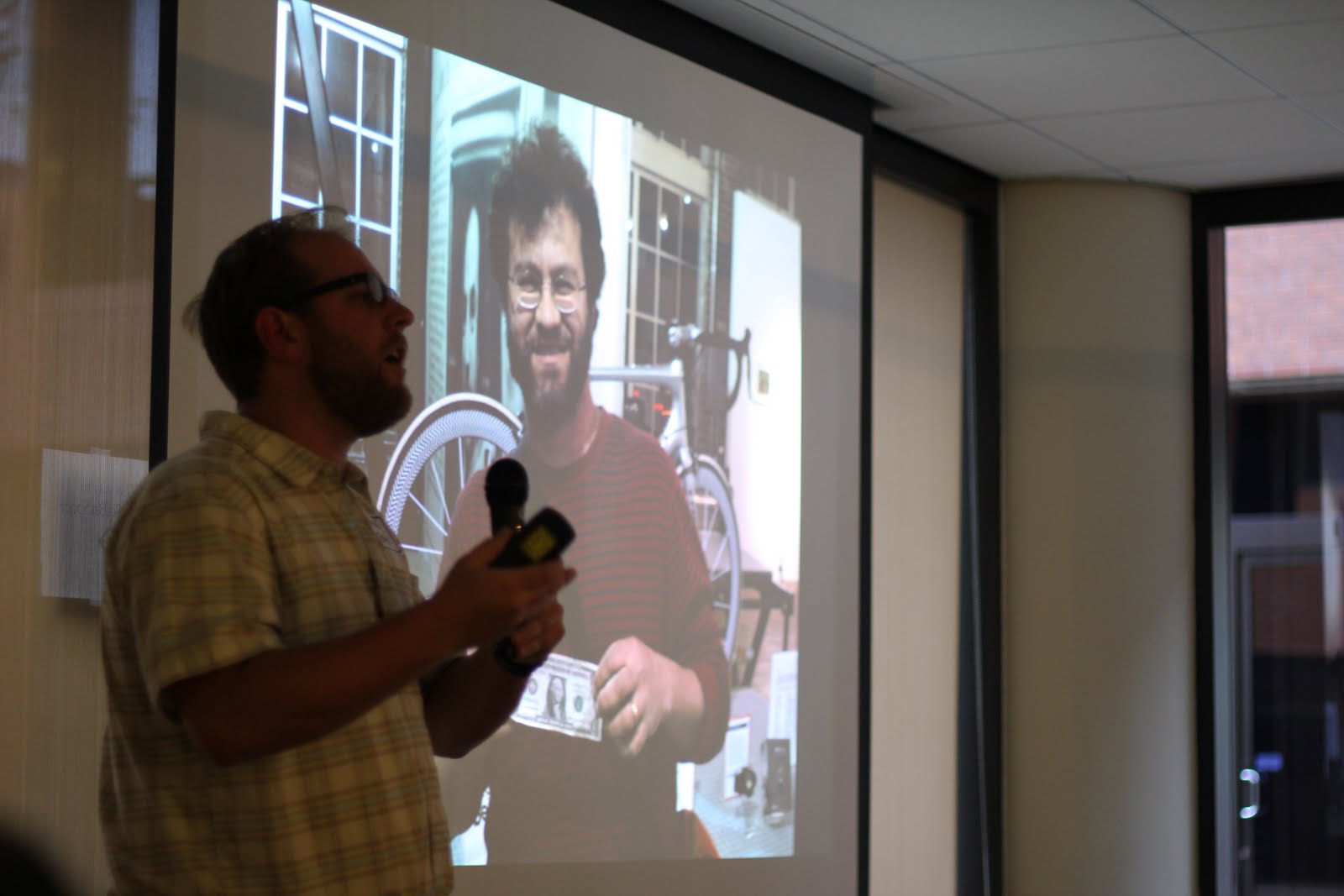
Just a mini post here about Bioweathermap.  I had posted a mini post about this project in July: Desperate to know what microbes are on your money? This project is for you (with some cool side science benefits).  I got reminded about this by this PLoS Blog: DIY Science at #SciBarSpace 2 | The Official PLoS Blog.  The PLoS blog discusses a talk by Jason Bobe about Bioweathermap.

Bioweathermap is not the most accurately named project but it is pretty cool.  From their site:

The BioWeatherMap initiative is a global, grassroots, distributed environmental sensing effort aimed at answering some very basic questions about the geographic and temporal distribution patterns of microbial life. Utilizing the power of high-throughput, low cost DNA sequencing and harnessing the drive of an enlightened public we propose a new collaborative research approach aimed at generating a steady stream of environmental samples from many geographic locations to produce high quality data for ongoing discovery and surveillance. Our approach will provide a unique opportunity to engage the public in the scientific research process while we address fundamental questions such as “How diverse is the microbial life around us?” and “How do microbial communities in different habitats change over time?” and “How can advanced sequencing technologies best be utilized to address issues in biodiversity, public health, and biosurveillance?”

In other words, it is about microbes (suggestion to them – it might be good to have something about microbes in the title of the project – maybe “microbioweathermap” or something like that).  Anyway, to do the project they have been collecting dollar bills from various people:

From PLoS Blog.

And then characterizing the microbes on those bills.  I note – Jason collected the bill from me when we met at the book launch party for Thomas Goetz’s “The Decision Tree“.  Anyway – in essence this is a citizen microbiology project and it is worth checking out.  For more on it see:

Seems to me there are more and more Citizen Microbiology projects out there.  For some other posts of mine about CM projects (got to give them an abbreviation) see:

No award to give out but here are some lessons in using Google’s image search to find an image source

Was going to blog about the distorted tree of life that BMC Biology used for an ad in the Scientist (note – I am a big fan of both BMC Biology and the Scientist, but the ad still irked me).  But I was not really sure where the image came from since the ad does not say much of anything about the source.  So I used a new trick I learned last week.  I scanned the ad:

As all of you should be able to see, this tree does not do such a good job with microbial diversity.  And as an official Guardian of Microbial Diversity, I was offended.  So the question now was – from where exactly did this tree come?  And could I find BMC Biology saying something important about the figure so that then I could snark about them in my blog and give them a Twisted Tree of Life Award.

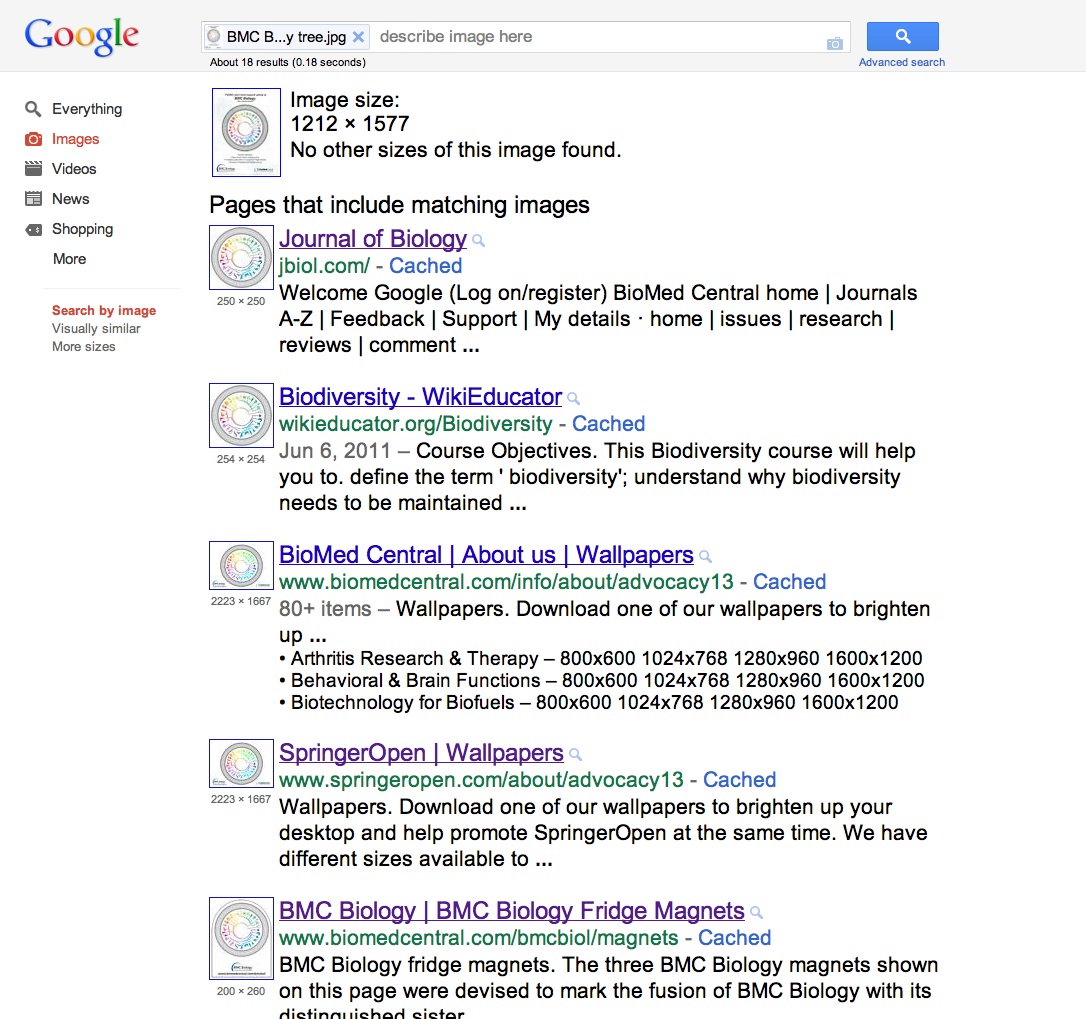
Last week in response to an email from some folks at ASM about tracking down the source of an image, I discovered a cool new trick which I used here.  I went to Google’s image search page:


And instead of typing anything in, I clicked on the little camera icon inside the search box

And that gave me a new window:

And I uploaded the scanded ad and presto, this window came up:

With all sorts of pages with similar images.  Pretty cool.  And after browsing a few of them I found that the page on BMC Biol. fridge magnets which they give away at conferences.  And for the one with the offending tree they say

The problem of representing all of biology is encapsulated in the image we have devised as an emblem for the fusion of BMC Biology and Journal of Biology. Our protocellular lipid bilayer surrounding a circular representation of a rootless phylogenetic tree omits explicit reference to much that is fundamental, critical and topical in biology, and outrageously distorts the phylogenetic tree. You will have to love the image for itself.

Well well well.  Kind of awkward to give someone an award for bad evolution mojo when they know full well that their evolution mojo is bad.  So alas, no Twisted Tree of Life Award for BMC Biology.  Kudos to them for knowing / acknowledging that the tree might have some issues.  Now what I really want is to get me one of them magnets.  Issues aside, the tree is pretty …

UPDATE 9/3/2012
BMC Biology has an editorial about this here: What is wrong with this picture?

Coming Monday at #UCDavis "The Infant Gut Microbiome: Prebiotics, Probiotics, & Establishment"

Just a little announcement here.  There is a symposium tomorrow at UC Davis organized by a undergraduates in the CLIMB program.  CLIMB stands for “Collaborative Learning at the Interface of Mathematics and Biology (CLIMB)” and is a program that emphasizes hands-on training using mathematics and computation to answer state-of-the-art questions in biology.  A select group of undergraduates participate in the program and this summer the students had to do some sort of modelling project.  Somehow I managed to convince them to do work on human gut microbes.  And they have done a remarkable job.

As part of their summer work, they organized a symposium on the topic and their symposium takes place tomorrow.  Details are below.

The Infant Gut Microbiome: Prebiotics, Probiotics, & Establishment

Monday, 12 September 2011, 9am-4pm

Life Sciences 1022

UC Davis

9:00-9:10 Introduction

9:10-9:40 Jonathan Eisen, UC Davis

“DNA and the hidden world of microbes”

9:40-10:40 Mark Underwood, UC Davis

“Dysbiosis and necrotizing enterocolitis”

10:40-10:50 break

10:50-11:50 Ruth Ley, Cornell University

“Host-microbial interactions and metabolic syndrome”

11:50-12:00 general discussion

12:00-1:00 lunch

1:00-2:00 CLIMB 2010 cohort

“Breast milk metabolism and bacterial coexistence in the infant microbiome”

2:00-2:10 break

2:10-3:10 David Relman, Stanford University

“Early days: assembly of the human gut microbiome during childhood”

3:10-3:40 Bruce German, UC Davis

3:40-4:00 next steps

The only major issue for me is I am losing my voice.  So we will see how this goes.  Though I note I have gotten some very sage advice on how to treat my voice problem via the magic of twitter.  If I do not collapse I will also be tweeting/posting about the other talks during the day.


Email phishing – does anyone still fall for these? #SPAM

Got this email this AM

from Western Union st104624@ait.ac.th
reply-to westernunion.organization@yahoo.com.hk
to date Sun, Sep 11, 2011 at 4:02 AM
subject Dear Customer.
mailed-by ait.ac.th
hide details 4:02 AM (2 hours ago)

Dear Esteemed Customer,
You have been awarded with the sum of $50,000.00 US Dollars
by our office, as one of our customers who use Western
Union in their daily business transaction.
This award was been selected through the internet, where
your e-mail address was indicated and notified. Please
provide Mr. David Palmer with the following details
listed below so that your fund will be remitted to you
through Western Union immediately.
* Full Name:
* Sex: Age:
* Martial Status:
* Nationality:
* Country:
* Direct Address:
* Mobile Number:
* Office Number:
* Occupation:

Just wondering – does anyone still fall for this type of phishing.  I mean, some phishing attempts out there are subtle and tricky.   This one, however, is not.  Anyone know – do these really obvious ones ever work?  Or are they just part of the “chatter” that eventually will disappear by natural selection of phishing strategies?

Biomed Central web sites do such weird things when viewed in Safari …

Bmc

Germophobia: wanna get people in the mood for "Contagion" movie about killer virus – grow harmless microbes in public #microbialart

Well, this story is pretty cool in many ways. David Coil, who works on my “microBEnet” project posted an entry on our blog: Microbial art in the built environment: bacterial billboard goes viral which called my attention to the story.

Seems that the folks promoting the microbe-focused movie “Contagion” came up with a fun marketing idea. They created a living billboard with microbes on it

It is pretty cool. Just watch how the letters come out and the billboard becomes 3D. It would be fun to do this with some event at UC Davis .. will have to think about it. But overall, I think this idea is really cool and very very well executed.

However, I do want to note some of the reporting on it has gotten a few details a bit off. For example, in the Washington Post: ‘Contagion’ bacteria billboard is exactly what it sounds like (Video) – Celebritology 2.0 – The Washington Post they write

“A YouTube video shows the process in which “two large Petri dishes were inoculated with live bacteria including penicillin, mold and pigmented bacteria.” The result is the most amazing, creepy and literal viral marketing campaign in recent history”


Well, not exactly. Penicillin and mold are not live bacteria. Penicillin is alas, not even alive but I think they are referring to organisms that make the antibiotic, not the antibiotic itself. And this is certainly a great viral marketing campaign, but it is not “literally” viral marketing as these are not viruses in the billboard.
The Montreal Gazette has a better story on the campaign: Bacterial billboard brings ‘culture’ to Hollywood marketing. In the article they describe in more detail the ideas and some of the challenges behind the living billboard. Most interesting to me:
“We wanted to create an organic execution that people could fall in love with,” said Anthony Ganjou, founder of U.K.-based CURB media, an agency specializing in natural and sustainable media whose previous creations include billboards made out of grass plants and light installations made out of glow-in-the-dark bacteria.
Using 35 different strains of bacteria and fungi — including penicillin, mould and pigmented bacteria — CURB’s team of 25 microbiologists and immunologists tested different strains of bacteria to see which would work best at creating a message that would slowly grow into letters making up the film’s name.
So I guess they too called the mold penicillin not Penicillium … may be more common than I thought. But also worth noting is this is a agency that specializes in living billboards and this is not the first time they have done something with microbes. In fact they have done some pretty cool living/outdoor ads including using compost, crop circles, mowing patterns, and even, yes, bioluminescence: Bioluminescence – CURB, sustainable advertising, natural media
Going back to the accuracy of the reporting issue. I note there are others out there who have flagged the story and the concept due to the fact that the movie is about a killer virus and the billboard is of course using bacteria and fungi. For example see Katherine Hobson’s post at the Wall Street Journal Blog: Studio Promotes Killer-Virus Movie … With Bacterial Billboard. In it she says
We at the Health Blog are very sensitive to mixing up viruses and bacteria, probably because we’ve made that error ourselves before.
So on one hand, we think the promotion Warner Bros. Canada dreamed up for Steven Soderbergh’s “Contagion,” which opens today, is clever …..
But then she goes on to critique it

On the other hand, the movie is about a virus — the fictional MEV-1. People are already confused about the differences between viral and bacterial ailments, to the point where they will demand antibiotics for problems that likely have a viral cause, like upper respiratory infections.

Personally I think this may be a bit too curmudgeony. The campaign clearly had the desired effect by showing, well, that microbes can grow fast. So the microbes they used were not viruses. And so the ones they used were not harmful. It still is creepy in a way. It is a fine balance of course. We (the royal we here) want to promote microbes as being fun. And we also want to promote them as not always being dangerous. But microbes also do kill a lot of people. And this billboard will probably do more to get people talking and thinking about bacteria and mold than any other movie promotion in recent memory.
In the end microbes I guess creep people out much of the time. And we microbe fans just need to work on that to find ways such that microbes are not always viewed as icky.  So – sure this is capitalizing on a general feeling of germophobia.  But hey – that is pervasive and not the fault of the movie marketers (NOTE – ORIGINAL VERSION OF POST LEFT OUT THE “NOT” HERE – OOPS).
Just a last little note here – though some of the reporting has implied otherwise, there are lots of examples of microbes being used in art or related enterprises. See for example Microbial Art as well as the “Growing Impressions” work of Baldwin and Gulden and the work of Hunter Cole.  Lots of other living art out there including microbes – if anyone knows other examples please post.

O Na Na; Chemistry fun from the Women’s Leadership Program at GWU; oh, and my mom

You go mom … and her students …