
I was reading a paper recently which had an awkward acknowledgements sections and I thought it might be fun to make a collection of papers with unusual such sections. So I am putting out a call here – do people know any good examples of strange or funny or exceptionally long or otherwise interesting acknowledgement sections from papers? Please post them here or on twitter/friendfeed and I will eventually post a list
Author: Jonathan Eisen
I am an evolutionary biologist and a Professor at U. C. Davis. (see my lab site here). My research focuses on the origin of novelty (how new processes and functions originate). To study this I focus on sequencing and analyzing genomes of organisms, especially microbes and using phylogenomic analysis

Amazon’s $23,698,655.93 book about flies
OK I realize I am not objective here since this is from my brother, Michael Eisen, but his post about a book on Drosophila that is for sale for > $23 million is fascinating. See
Amazon’s $23,698,655.93 book about flies.
Share this:
Microbes do some strange things: splitting and permuting tRNAs
 |
|
Figure 1 – Predicted secondary structures of trans-spliced and permuted precursor tRNAs
(a) Mature tRNAAsp(GUC) in A. pernix and T. aggregans are formed by joining the 5′ half and the 3′ half at position 37/38 after splicing at the bulge-helix-bulge (BHB) motif. (b) The 5′ half and the 3′ half of trans-spliced tRNALys(CUU) in S. hellenicus and S. marinus join at position 30/31, same as the previously identified split tRNALys(CUU) in N. equitans [5]. (c) Circularized permuted tRNAiMet(CAU) and tRNATyr(GUA) in T. pendens have the 3′ half located upstream of the 5′ half separated by intervening sequences represented in green. The two fragments join at position 59/60, same as the T-Ψ-C loop permuted tRNAs in the red alga C. merolae [9]. Pre-tRNAAla(UGC) in C. merolae is shown for comparison. 5′ half of tRNA transcripts are represented in blue, the 3′ halves in orange. Black arrows indicate positions of splicing. Anticodons are boxed in light blue.
|
I was woefully unaware of some of the tRNA shenanigans going on in microbes until reading this paper: Genome Biology | Abstract | Discovery of permuted and recently split transfer RNAs in Archaea from Patricia Chan, Aaron Cozen and Todd Lowe. Life is pretty weird and wacky sometimes, even in components of cells that are considered “core” parts of the machinery of life. Go figure. It is worth a read …
Share this:

Hospital acquired infections – NY Times raising level of attention w/ editorial
Just a quick one here. The New York Times had an editorial Sunday on hospital acquired infections: Hospitals Shouldn’t Make You Sicker. I couldn’t agree more. The Times discussed some recent studies published in the New England Journal of Medicine as well as plans by the Obama Administration to fund some work in this area. It would be good I note if some of the funding focused not on infections per se but on the microbial ecology of hospitals, which we know very little about. Focusing just on hand washing and transmission of nasty pathogens is not enough.
Share this:
Boston, Bioinformatics & Ben Franklin Award wrap up from #BioIT11
 |
| Photo by Mark Gabrenya |
Well, just got back from Boston where I went to the BioIT World convention to pick up the “Benjamin Franklin Award” for contributions to Open Science from Bioinformatics.Org. A quick round up of the trip:
Flew to Boston early Tuesday AM. Only thing of note – during Layover in Chicago I saw a bookstore selling autographed versions of “The Immortal Life of Henrietta Lacks” by Rebecca Skloot.


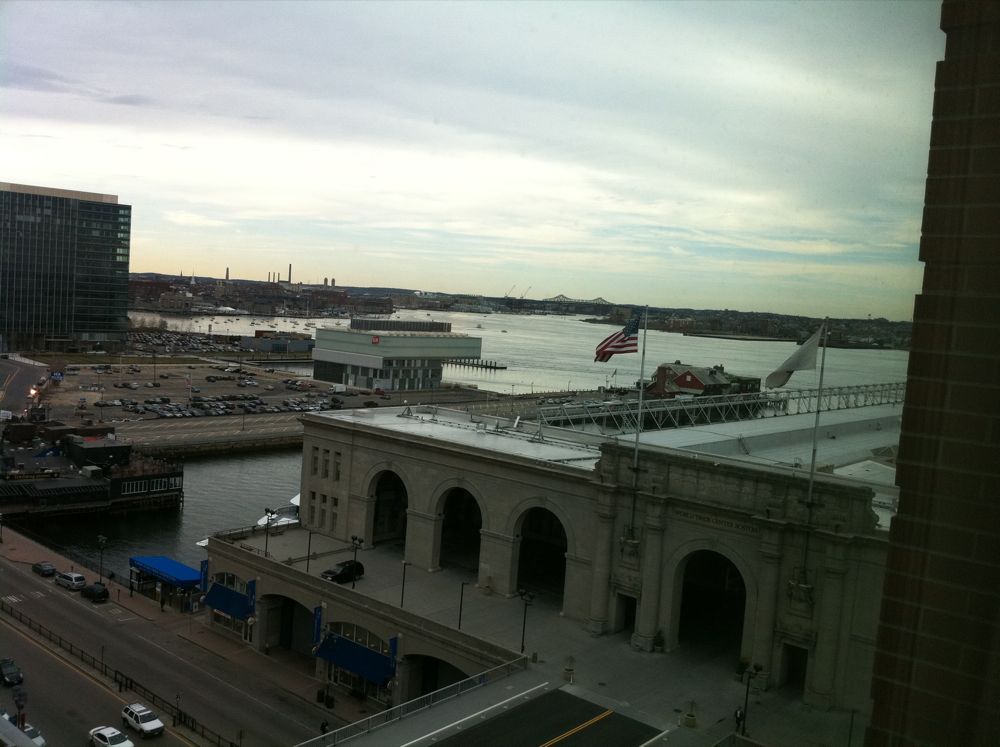
Dropped off my stuff at the Seaport Hotel – had a nice view from my room.
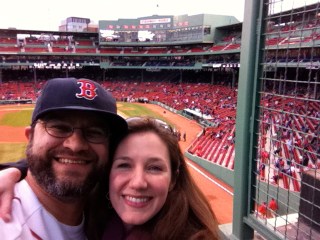
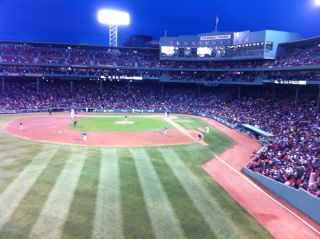
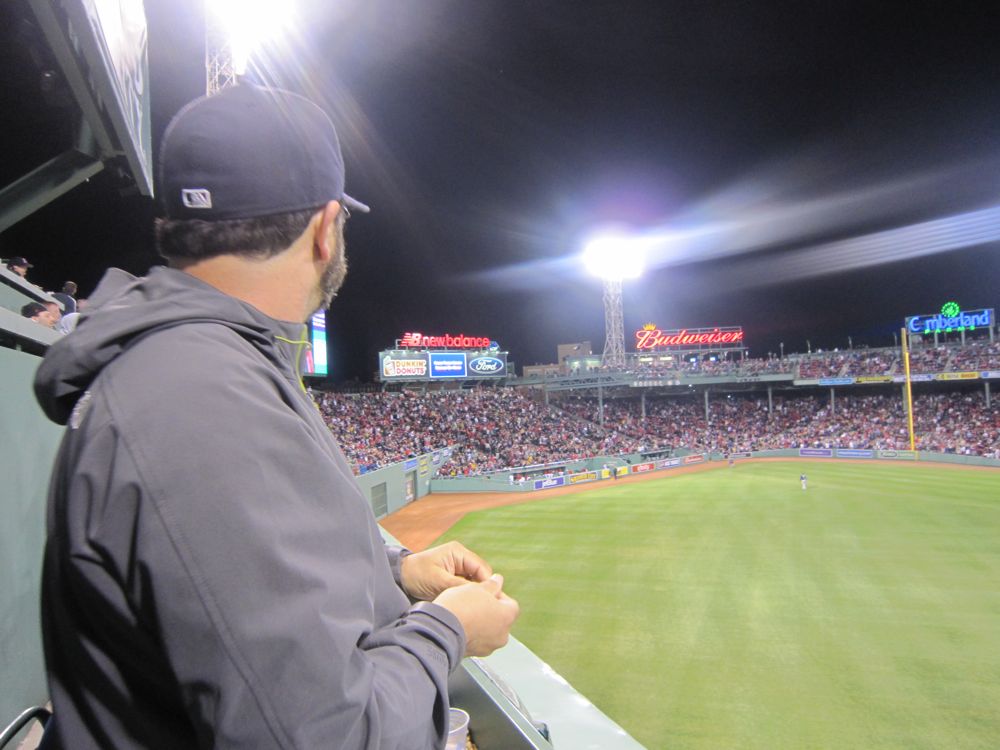
Called up my friend Ashlee Earl who currently works at the Broad and arranged to meet her at Kenmore Square in an hour. I collaborated with Ashlee many years ago on analyzing her expression studies of the Deinococcus radiodurans genome and have been friends ever since. Took the T to Kenmore Square and met Ashlee and then went into this “Fenway Park” place to see a baseball game. (I was born in Boston and am a Redsox fan …) Had the best baseball seats ever – front row Green Monster Seats – which I had bought from Stubhub.com. Watched the Sox lose while Ashlee and I discussed Genome Centers. I note – to those in the Broad Public Affairs office, Ashlee makes the Broad sound like a great place to work. I tried to get some dirt out of her but she did not provide much.




 |
| Photo by Ashlee Earl |
 |
| Photo by Ashlee Earl |
Took the T back to the hotel after the game. And went to sleep. Got up very early to think about my “acceptance speech” for when I was to pick up my Ben Franklin Award. I made some quick slides on my Ipad (this was the first time I have gone to a meeting w/o my laptop) and during the talk before the award ceremony I emailed them to one of the organizers and we got things set up.
Then I was Introduced and Jeff Bizzaro read a mini statement about why I won the award. Something like what they put on the Bioinformatics.org web site:
Jonathan uses his high visibility in social media to advocate for open access by sharing links to discussions, mentioning open access articles and initiatives, and pushing for the opening up of popular closed access articles. This culture is shared with his students, who advocate for “open access” peer reviewing and created a peer-to-peer service for sharing bioinformatics material (articles, software and datasets). He is the academic editor in chief of PLoS Biology [1] and voices his opinions and support for open access publication and open data sharing on his “Tree of Life” blog [2]. In addition to just voicing his opinion, he also practices what he preaches, by refusing to publish in non-open access journals. With respect to bioinformatics, he has been involved with many software packages that are freely available, such as the recent AMPHORA [3] and PhyloOTU [4]. Lastly, Jonathan helped release a new open data sharing tool for scientists called BioTorrents [5]. This is just another step in encouraging all scientists to share their data and results more openly.
References:
4. http://www.ploscompbiol.org/article/info%3Adoi%2F10.1371%2Fjournal.pcbi.1001061
5. http://www.plosone.org/article/info:doi/10.1371/journal.pone.0010071
Note – am proud to get this award. It is given for contributions to Open Science and previous winners are an esteemed crew: Michael Eisen (my brother), Alex Bateman, Michael Ashburner, Jim Kent, Robert Gentleman, Phil Bourne, Lincoln Stein, Ewan Birney, and Sean Eddy (see full details here).
Then I gave my mini talk focusing on a brief history of how I got into Open Science. Here are my slides
Ben Franklin Award Slides
View more presentations from Jonathan Eisen
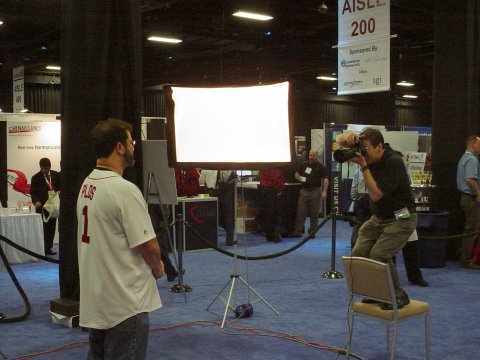
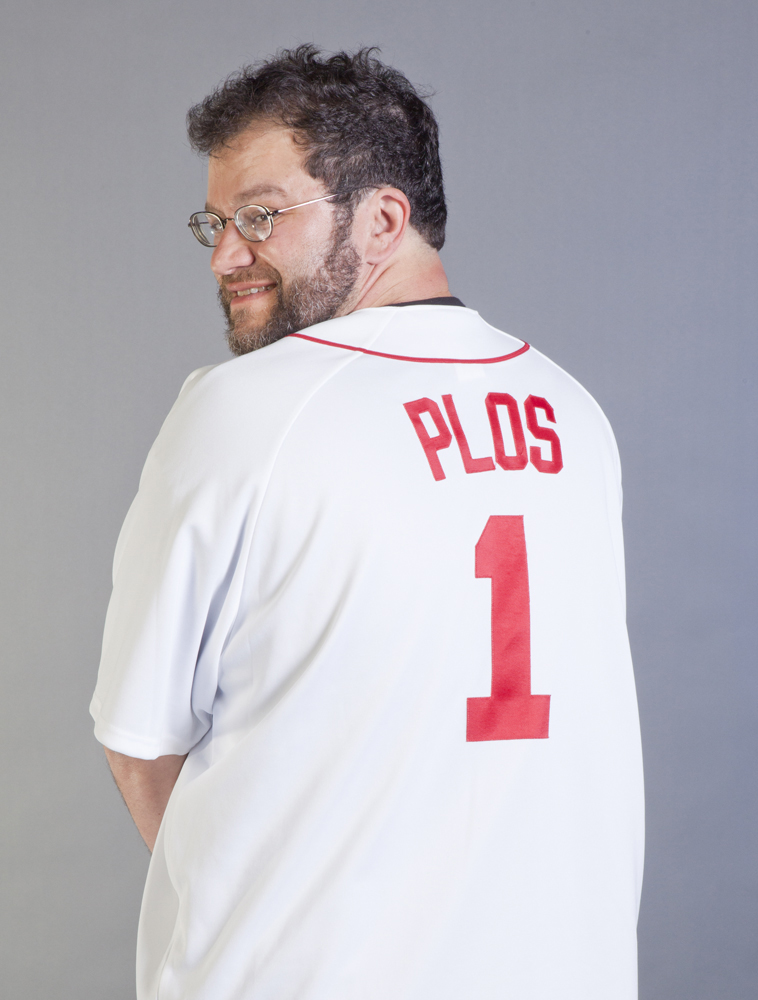
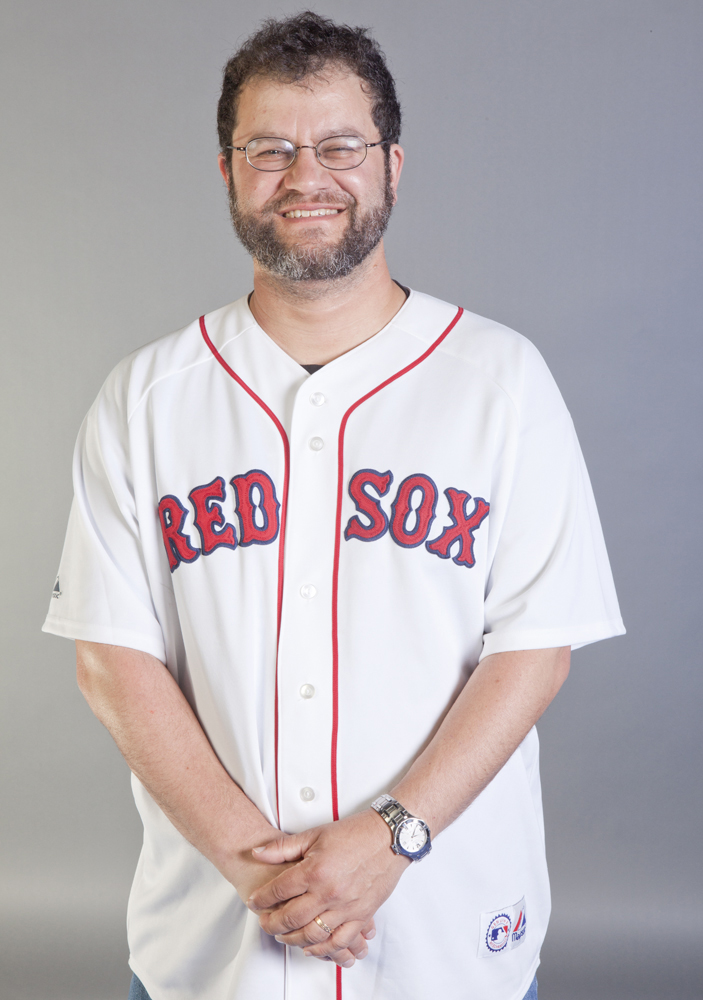
Note the awkward typo where I introduced the “Public Library of Science”. Oops. Anyway – talked for a few minutes. While wearing my RedSox PLoS 1 shirt I note.
 |
| Photo by Jeff Bizarro |
 |
| Photo by Mark Gabrenya |
|
| Photo by Mark Gabrenya |
And then there was a break. They took some pictures during the break and eventually I wandered around to the booths.

 |
| Photo by Mark Gabrenya |
 |
| Photo by Mark Gabrenya |
 |
| Photo by Mark Gabrenya |
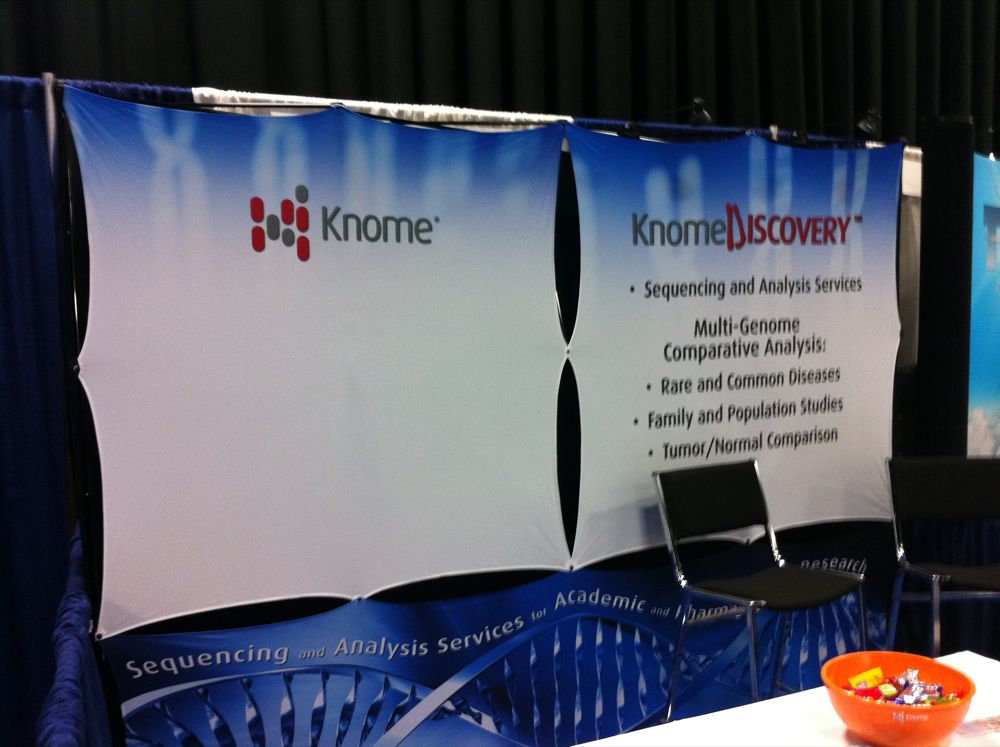
I saw Nat Pearson who now works for Knome and I went to lunch with him to discuss my “Exome” which Knome has sequenced. I note, Nat was a student in a class I TAd at Stanford — good to see how far he has come.
And then back to the meeting where I wandered around again for a while. Saw an old friend from TIGR Xiaoying Lin who now works at Life Technologies and discussed the Ion Torrent with him.

Was pleased to see a booth giving away free RedSox tickets as a prize.

Then I headed out to Brookline for dinner with my Aunt and Uncle and cousin and eventually made my way back to the hotel where I had a few drinks.
The next day I got up a bit late, and eventually made my way to Logan Airport where the trip home was a disaster. My outbound flight was late. Missed my connection. Then the flight I was on was held up for others to make their connection. Though I did get a few hours in Denver Airport to wander around. Got home after 1 AM … And finally made it home.
Share this:

Interesting PLoS One paper on local assembly from short reads by "tagging" DNA via restriction enzymes
Quick one here. Interesting paper from Paul Etter et al. from Eric Johnson’s lab at U. Oregon in PLoS ONE: PLoS ONE: Local De Novo Assembly of RAD Paired-End Contigs Using Short Sequencing Reads
Here is the abstract:
“Despite the power of massively parallel sequencing platforms, a drawback is the short length of the sequence reads produced. We demonstrate that short reads can be locally assembled into longer contigs using paired-end sequencing of restriction-site associatedDNA (RAD-PE) fragments. We use this RAD-PE contig approach to identify single nucleotide polymorphisms (SNPs) and determine haplotype structure in threespine stickleback and to sequence E. coli and stickleback genomic DNA with overlapping contigs of several hundred nucleotides. We also demonstrate that adding a circularization step allows the local assembly of contigs up to 5 kilobases (kb) in length. The ease of assembly and accuracy of the individual contigs produced from each RAD site sequence suggests RAD-PE sequencing is a useful way to convert genome-wide short reads into individually-assembled sequences hundreds or thousands of nucleotides long.”
Note as they note in the paper “Competing interests: E.A.J. has patents filed on the RAD marker, and partial interest in a company commercializing the system. This does not alter the authors’ adherence to all the PLoS ONE policies on sharing data and material” This seems like it would have potential in metagenomic applications. I note, we are working on a similar approach – and kind of got scooped here in a way. Hope their patent does not limit what we can do.
Share this:
Hmm – How did I miss this paper discussing RFAM, Wikipedia & community annotation #cool
 |
| Edits for Wikipedia articles on RNA families. The cumulative number of edits since 1st January 2007 for the 733 Wikipedia articles that are associated with Rfam entries is shown in black. The total number of edits that were reverted or labeled as vandalism is shown in red. To mid-2010, there were just 106 of these. However, some reverted edits may have been well-intentioned but were deemed inappropriate for Wikipedia. From http://nar.oxfordjournals.org/content/39/suppl_1/D141.long |
Very interesting discussion in this paper on Rfam about community annotation: Rfam: Wikipedia, clans and the “decimal” release. In the paper the authors (inlcuding Alex Bateman, Sean Eddy, Paul Gardner and others) discuss the use of Wikipedia for Community Annotation of biological databases. They report:
Given our positive experiences, we can highly recommend other curation efforts turning to Wikipedia for their annotation
I am not sure how I missed this paper when it came out recently. But it is definitely worth a look. The last line hints at future developments
We look forward to working with the wider community to develop these new tools and techniques.
It seems that they have bought into the Wikipedia based annotation system as having enormous potential. I generally agree though I am not sure how this is best done.
Share this:

Nice review/commentary on challenges in phylogenomic analysis in PLoS Bio by Philippe et al. #fb
This one is definitely worth a read for phylogeneticists and phylogenomicists (is that a word?) out there: PLoS Biology: Resolving Difficult Phylogenetic Questions: Why More Sequences Are Not Enough. Philippe et al. discuss some important issues in using genomes to infer phylogenies of species in this commentary/review paper. They discuss in particular some recent studies of animal evolution but they cover a lot of useful ground here and include a good review of terminology and some of the basic issues at play. I am personally going to have to read it in more detail to help deal with some of the issues in our recent study of novel sequences in metagenomic data.
Share this:
Richard Branson getting into microbial diversity (a little bit)
Just a quick one here. For those interested in the deep-sea and microbial diversity you might want to check out this article: Richard Branson launches Virgin Oceanic: deep-sea exploring submarines – Boing Boing. It discusses how Branson will be working with Katrina Edwards, Doug Bartlett and others to study microbial diversity in the deep sea as a component of his project to make dives in his personal submarine.
Share this:
Request for #UCDavis affiliates to help Japan from Chancellor Katehi
Just got this email from the Chancellor of UC Davis Linda Katehi and thought I would share
To the UC Davis Community,
The crisis and devastation in Japan following the March 11 earthquake and tsunami continue, and as with any natural disaster of this magnitude, healing will be neither simple nor immediate. Our thoughts and hearts are with the Japanese people and with their many loved ones who are teaching and learning on our campus and in our community.
Inevitably, the disaster will fall from the headlines, but the UC Davis community will not look away. We will continue to reach out in comfort and with assistance to honor those who are hurting and in respect for our deep connection to Japan. Nearly 200 Japanese residents are currently studying at UC Davis, and this year, we have more than 50 Japanese faculty members visiting our campus. Our students were also at five universities in Japan at the time of the disaster, including in areas with heavy damage, and we are grateful that all are safe.
There is still much to do, and you can help, too. Please see this link for a variety of charities aiding the Japanese people:
http://www.charitynavigator.org/index.cfm?bay=content.view&cpid=1221
UC Davis has a compassionate spirit, and I thank you for proving that once again.
Linda P.B. Katehi
Chancellor
– Posted using BlogPress from my iPad

