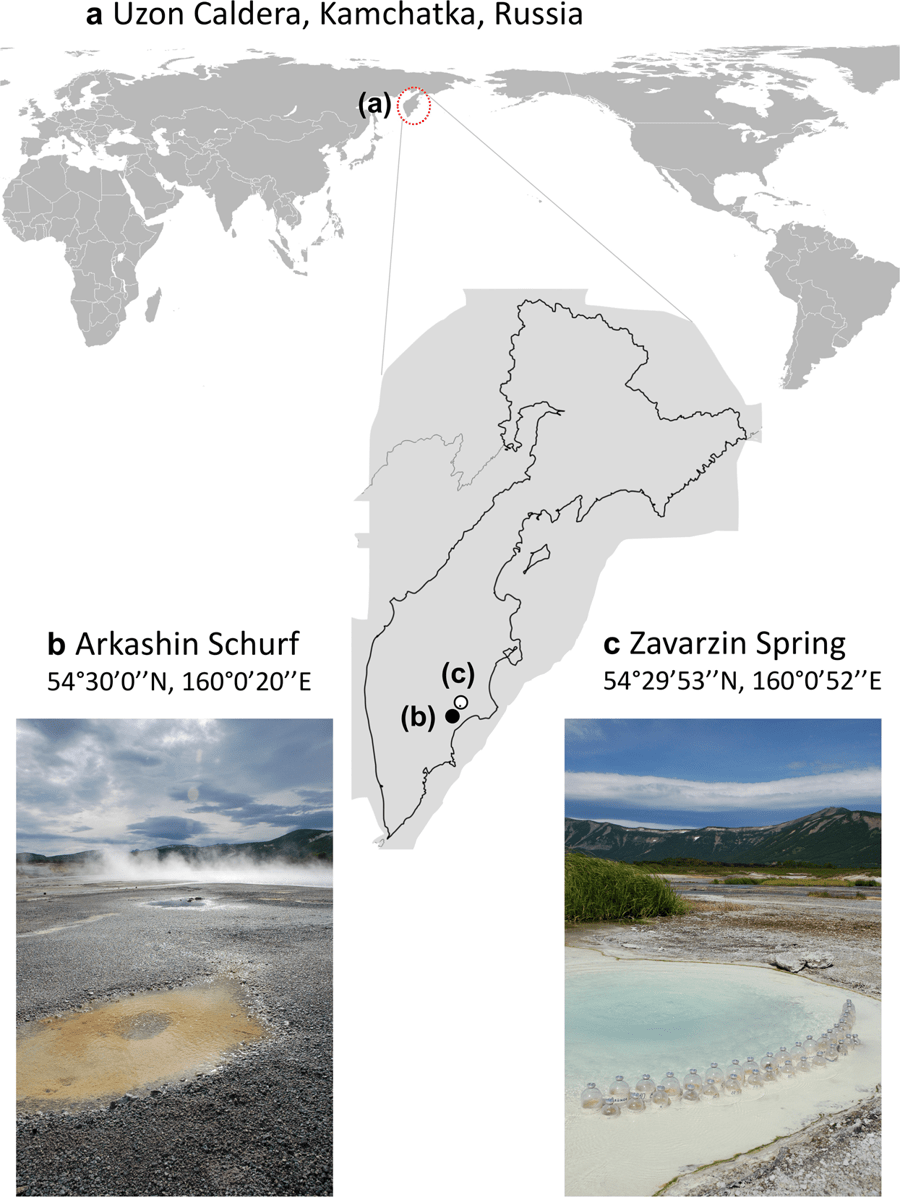
New paper from the Eisen lab on MAGs from two thermal pools in Kamchatka (great work led by Laetitia Wilkins @M_helvetiae and Cassie Ettinger @casettron) 

A new paper just out from the lab:

Laetitia G. E. Wilkins & Cassandra L. Ettinger (co-1st authors), Guillaume Jospin & Jonathan A. Eisen. Metagenome-assembled genomes provide new insight into the microbial diversity of two thermal pools in Kamchatka, Russia. Scientific Reports. volume 9, Article number: 3059

This was truly a remarkable piece of work led by Laetitia G. E. Wilkins & Cassandra L. Ettinger who are co-first authors on the paper.  Also contributing to the work was Guillaume Jospin, the lab bioinformatics guru. I will write a much longer “story behind the paper” about this in the next week or two but wanted to give a brief summary here.

This paper had its beginnings just after September 11, 2001.  Yes. that September 11.  We had a meeting planned in September in Yellowstone National Park that had to be delayed due to 9/11.  The meeting then happened in October.  The meeting was between a group of US researchers and a group of Russian researchers to plan an NSF proposal on comparing the microbes living in hot springs in Yellowstone with those living in hot springs in Kamchatka.  The meeting went well and eventually we got a grant from NSF’s Biocomplexity program for this work.

At the time I was at TIGR (The Institute for Genomic Research) and I had a minor role in the grant – I was supposed to do coordinate some metagenomic sequencing of samples from Kamchatka.  We got some samples from Juergen Wiegel from U. Georgia and did a small amount of Sanger sequencing of them but this was right around the time I moved to UC Davis and right around the time that TIGR kind of dissolved.  We did not end up writing a paper on that small amount of Sanger sequencing.  Years later, Russell Neches in my lab got interested in this project and went to Kamchatka with Frank Robb and others on a collecting trip. See some details about this trip and plans back then in this blog post.  Russell then coordinated some Illumina sequencing of the same DNA samples we had done Sanger sequencing for at TIGR.  And Russell did some preliminary analysis of the samples but did not end up writing up a paper on it.

Fast forward again to a few years ago and we decided in my lab to try and rescue orphan data and try to at least get the data into the public domain and, if it was of interest to someone, write a paper on the data.  We thus created some “Reboot” channels within the lab Slack site and Laetitia Wilkins and Cassie Ettinger decided to try and do something with the Kamchatka data.  And they did.  This is what led to this paper.

A few other notes I would like to make here.  This paper certainly is a testament to the remarkable work of Cassie Ettinger and Laetitia Wilkins as well as Guillaume Jospin who helped them with some of the informatics.  I am really proud to have them all in my lab.  In addition, this paper is a culmination of contributions of all sorts of people.  We tried to acknowledge many of them in the Acknowledgement section of the paper and I am posting that below for the record here.

We would like to thank Russell Neches (ORCID: 0000-0002-2055-8381) for the use of photographs taken on a trip to Kamchatka, Russia in 2012. We also would like to thank Elizabeth A. Burgess and Juergen Wiegel for providing JAE with the DNA used here. We are also grateful to Christopher Brown (ORCID: 0000-0002-7758-6447) and Laura Hug (ORCID: 0000-0001-5974-9428) for their help getting access to the genomes used in Figure 2. A special thank you goes to Alexandros Stamatakis (ORCID: 0000-0003-0353-0691), Wayne Pfeiffer and Mark Miller for offering their help with getting the CIPRES Science Gateway server to run RAxML-HPC2 v.8 on XSEDE. We also thank two anonymous reviewers for comments on earlier versions of this manuscript. A. Murat Eren (ORCID: 0000-0001-9013-4827) provided constructive feedback on the publicly available preprint version of this article. LGEW was supported by a fellowship of the Swiss National Science Foundation P2LAP3_164915. Funding for the sequencing at TIGR was provided by a a subcontract to JAE for a grant from the National Science Foundation (MCB-MO 0238407). Funding for some of the work on this project was also provided by grant from the Gordon and Betty Moore Foundation (GBMF5603) to JAE.

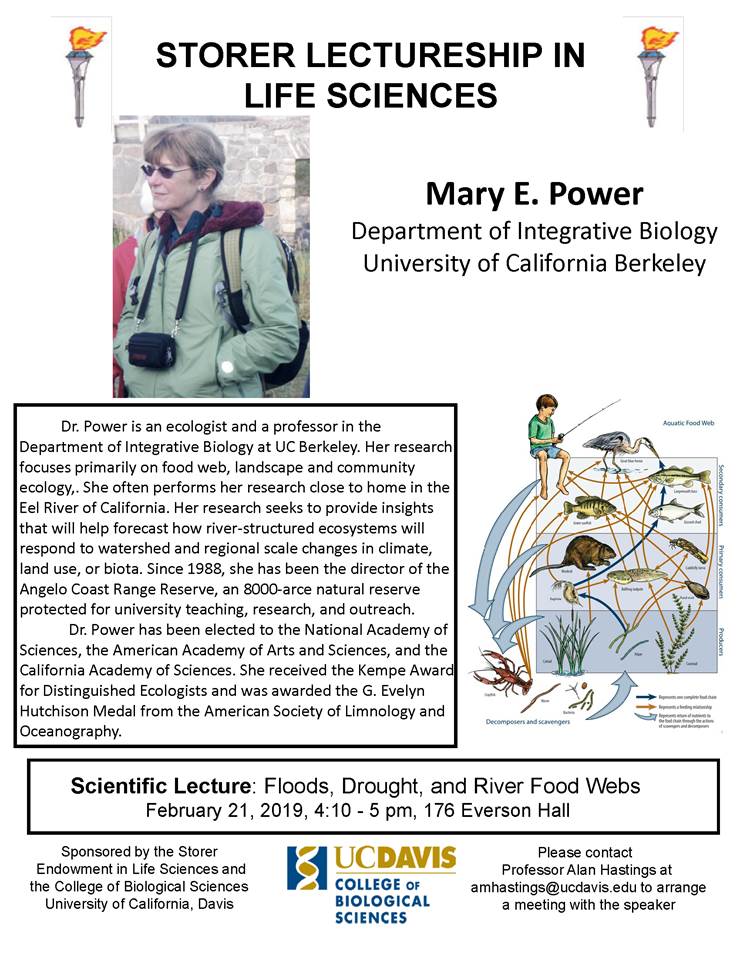
At @ucdavis 2/21: Mary E. Power “Floods, Drought, and River Food Webs”

STORER LECTURESHIP IN LIFE SCIENCES

Mary E. Power

Department of Integrative Biology University of California Berkeley

Dr. Power is an ecologist and a professor in the Department of Integrative Biology at UC Berkeley. Her research focuses primarily on food web, landscape and community ecology,. She often performs her research close to home in the Eel River of California. Her research seeks to provide insights that will help forecast how river-structured ecosystems will respond to watershed and regional scale changes in climate, land use, or biota. Since 1988, she has been the director of the Angelo Coast Range Reserve, an 8000-arce natural reserve protected for university teaching, research, and outreach.

Dr. Power has been elected to the National Academy of Sciences, the American Academy of Arts and Sciences, and the California Academy of Sciences. She received the Kempe Award for Distinguished Ecologists and was awarded the G. Evelyn Hutchison Medal from the American Society of Limnology and Oceanography.

Scientific Lecture: Floods, Drought, and River Food Webs

February 21, 2019, 4:10 – 5 pm, 176 Everson Hall

We look forward to seeing you!

Please share and distribute widely.

https://imgssl.constantcontact.com/letters/images/sys/S.gif
FacebookTwitterInstagramLinkedIn

Power_flyer_v3.pdf

Interview w/ Raquel Peixoto on Coral Bleaching and Marine Probiotics

See: Coral Bleaching and Marine Probiotics: Raquel Peixoto, Ph.D. | Microbiome Special Research Program

It is an interview with Raquel Peixoto by Jose Franco as part of our Microbiome Special Research Program activities.

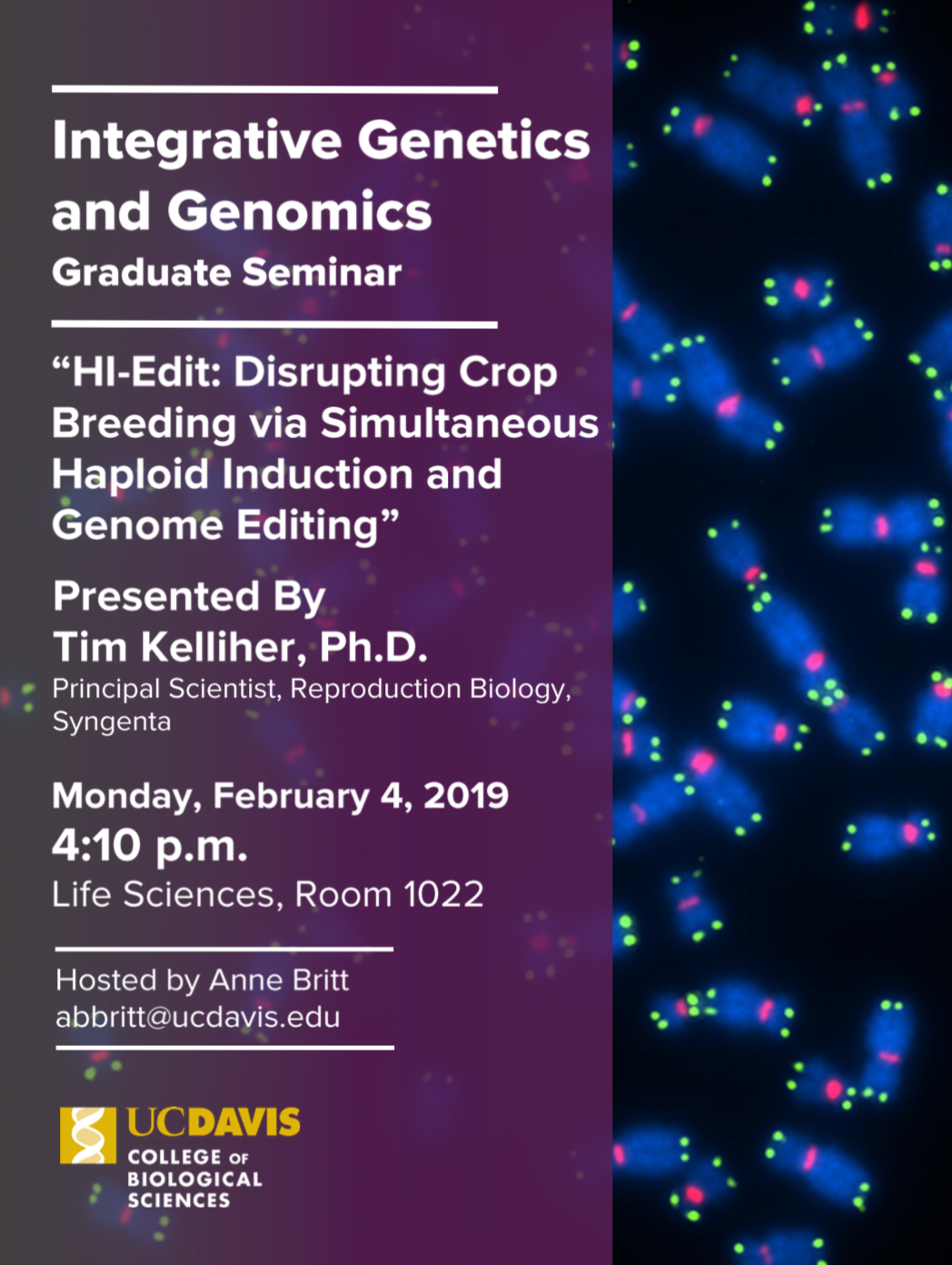
Today 2/4/19 at @ucdavis: Tim Kellier, Syngenta, “HI-Edit: Disrupting Crop Breeding via Simultaneous Haploid Induction & Genome Editing”

TKelliher Flyer.pdf

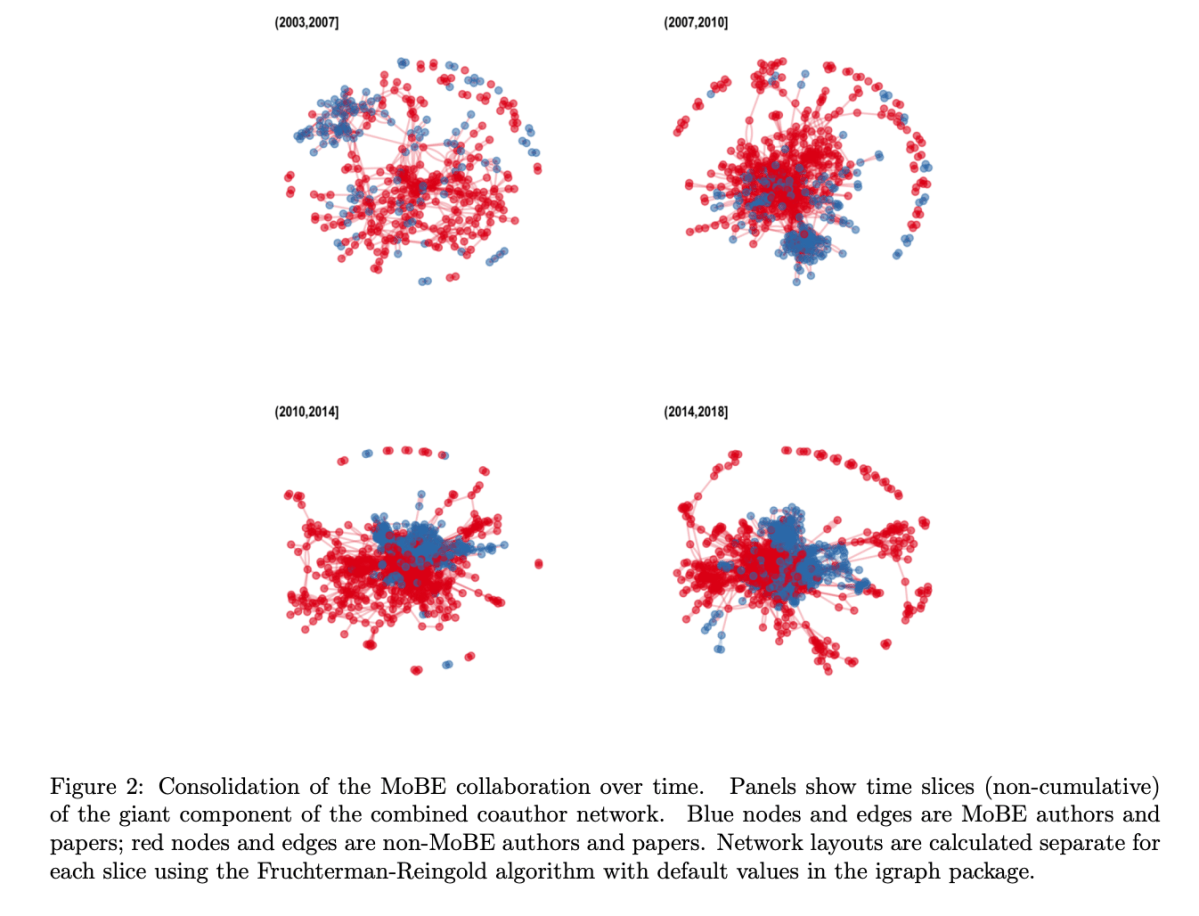
New preprint from the lab on “Network analysis to evaluate the impact of research funding on research community consolidation”

We (me and David Coil) have a new preprint out on analysis we did in collaboration with Daniel Hicks and Carl Stahmer also from UC Davis. The paper is an analysis of the Microbiology of the Built Environment program funded by the Alfred P. Sloan Foundation via analysis of publications from within and outside the program. We would love feedback …

Citation:

Network analysis to evaluate the impact of research funding on research community consolidation. Daniel J Hicks, David A Coil, Carl G Stahmer, Jonathan A. Eisen.

Abstract:

In 2004, the Alfred P. Sloan Foundation launched a new program focused on incubating a new field, “Microbiology of the Built Environment” (MoBE). By the end of 2017, the program had supported the publication of hundreds of scholarly works, but it was unclear to what extent it had stimulated the development of a new research community. We identified 307 works funded by the MoBE program, as well as a comparison set of 698 authors who published in the same journals during the same period of time but were not part of the Sloan Foundation-funded collaboration. Our analysis of collaboration networks for both groups of authors suggests that the Sloan Foundation’s program resulted in a more consolidated community of researchers, specifically in terms of number of components, diameter, density, and transitivity of the coauthor networks. In addition to highlighting the success of this particular program, our method could be applied to other fields to examine the impact of funding programs and other large-scale initiatives on the formation of research communities.

New preprint from the lab: Bacterial communities associated with cell phones and shoes 

We have a new preprint out in BioRXiv.  Would love comments and feedback

Bacterial communities associated with cell phones and shoes [PeerJ Preprints]

Full citation:

Coil DA, Neches RY, Lang JM, Jospin G, Brown WE, Cavalier D, Hampton-Marcell J, Gilbert JA, Eisen JA. 2019. Bacterial communities associated with cell phones and shoes. PeerJ Preprints 7:e27514v1 https://doi.org/10.7287/peerj.preprints.27514v1


At @ucdavis 2/1 Dog diversity as a natural experiment in cognitive and behavioral evolution

Got this by email and am posting it.

*See the attached flier for the entire quarter’s seminar schedule.

This week’s Animal Behavior Graduate Group seminar:

Dog diversity as a natural experiment in cognitive and behavioral evolution

Dr. Kevin MacLean
University of Arizona

Friday, February 1st at 12:10 pm in 1150 Hart Hall

Coffee and cookies will be available.

“Dr. Evan MacLean is a biological anthropologist and comparative psychologist with interests in cognitive evolution and the study of animal minds. He received his Ph.D. from Duke University in 2012, and served as Co-Director of the Duke Canine Cognition Center from 2012-2016. Dr. MacLean conducts research with diverse species ranging from chimpanzees and bonobos to lemurs and domestic dogs. His work is motivated by questions about what makes the human mind unique, as well as how and why cognition evolves.”

For more information about Dr. MacLean’s research: https://dogs.arizona.edu/people/dr-evan-maclean

ABGGSeminarFlyerWinter2019FINAL_1_15_19.pdf

Today at @ucdavis: John Ioannidis – Reproducible and Useful Research: Building Trust in our Science

TODAY Dr. John Ioannidis, C. F. Rehnborg Chair in Disease Prevention at the School of Medicine, Stanford University, will be giving a lecture as part of The UC Davis Forums series. He will be speaking on the topic of "Reproducible and Useful Research: Building Trust in our Science."

The lecture will take place in Ballroom B of the Activities and Recreation Center (ARC) from 3 to 4:30 p.m, with a reception and light refreshments to follow. This event is free and open to the public.

Please see the attached flyer below for more information, and feel free to contact us with any questions.

John Ioannidis Flyer.pdf

At @ucdavis today – Evolution and Ecology Seminar Mathew Leibold

Mathew Leibold from the University of Florida will be giving the Ecology and Evolution seminar “Rethinking Metacommunity Ecology” today, Jan 24th, at 4:10PM in 176 Everson Hall.

More detail on new @UCDavis faculty diversity initiative

More detail on the UC Davis “Advancing Faculty Diversity Grant” has been posted. See  Advancing Faculty Diversity | Academic Affairs. 

Some key details:

  • UC Davis received a grant from the UC Office of the president to run a pilot project involving faculty searches in each of eight campus entities.
  • The searches are very broad.  From the site “The searches will be college or school-wide, without specification of a specific discipline or department, provided that an applicant’s area of expertise falls within a discipline embodied in the academic unit. The goal of these broad searches is to attract the widest possible pool of candidates.”
  • The searches are trying a new approach to screening faculty candidates where the first screening will focus on “Contributions to Diversity” statements from the candidates.
  • From the site “In addition to a strong record of research and teaching excellence, successful candidates will also have an accomplished track record (calibrated to their career stage) of teaching, research or service activities addressing the needs of African-American, Latino(a)/Chicano(a)/Hispanic, and Native American students or communities. Successful candidates will have a clearly articulated vision of how their work at UC Davis will continue to contribute to the University’s mission of serving the needs of our diverse state and student population and an understanding of the barriers preventing full participation of underrepresented minorities in higher education. Applicants’ track record of engagement and activity related to diversity, equal opportunity, and inclusion as well as their plans for future engagement will be a significant part of the overall evaluation of the candidate’s qualifications for a faculty appointment.”
  • The site provides some guidance for “What Should a Statement of Contributions to Diversity Accomplish?”
  • The site has some additional Q&As that may be helpful for applicants

Direct links to the job ads are below: