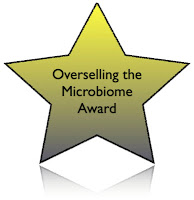
Overselling the microbiome award: Time Magazine & Martin Blaser for "antibiotics are extinguishing our microbiome"

Well, alas, Time magazine turned what could have been a story about the spread of antibiotic resistance into what appears to be a promotion for Martin Blaser’s new book: Antibiotic-Resistant Bacteria Are Now In Every Part of the World | TIME.com.

The article starts of OK – reporting on the new WHO report on antibiotic resistance.  But then it gets into the microbiome and what antibiotics supposedly do to it.  Some quotes:

“But even more concerning, say experts like Dr. Martin Blaser, director of the human microbiome program at the New York University Langone Medical Center and author of Missing Microbes, is how these antibiotics are affecting the makeup of both good and bad bacteria that live within us – our microbiome. The first big cost of antibiotics is resistance,” he says. “But the other side of the coin is [the fact that] antibiotics are extinguishing our microbiome and changing human development.

Extinguishing our microbiome?  Really?  The evidence simply does not support such a claim.  I personally think antibiotics may be contributing to messing up the microbiome in many people and that this in turn might be contributing to the increase in a variety of human ailments (e.g., I mentioned this issue in my TED talk and many many times here and elsewhere).  But “extinguishing”?  Not even close.  In fact, many of the published sutdies done so far suggest that the human microbiome is pretty resilient in response to antibiotics.  Really serious overselling of the impact of antiobitcs by Blaser.

And “changing human development?”  Not sure what the evidence for that is either.  Most likely this refers to the role the microbiome plays in immune system development but I am not aware of strong evidence that antibiotics lead to changes in human devleopment.

They then quote Blaser again:

If I prescribe a heart medicine for a patient, that heart medicine is going to affect that patient,” says Blaser. “But if I prescribe an antibiotic, that antibiotic will affect the entire community to some degree. And the effect is cumulative.

Yes antibiotics can affect more than one person because microbes (and resistance) can spread.  But “the effect is cumulative”?  I do not think that has been shown.

Finally, Time (well, Alice Park, the author) states (in relation to limiting overuse of antibiotics)

That may also help to protect our microbiomes, which in turn could slow the appearance of chronic diseases such as obesity, cancer and allergies.

What?  Now antibiotics cause obesity?  And allergies?  And cancer? Sure – there is good reason to think that antibiotic usage plays a role in obesity and allergies.  The evidence is not yet completely overwhelming but it is certainly a reasonable notion.  But how did cancer get thrown in here?

I note – as I assume many know – I think the microbiome is critical to many human functions and phenotypes.  And screwing with it via excessive use of antibiotics seems like a very very bad idea.  The precautionary principle says to me we should avoid any antimicrobials unless absolutely necessary.  But do we really need to overstate what we know in order to effect change?  Do we need to say things like “antibiotics are extinguishing our microbiome” which is simply untrue?  I don’t think we do.  I think we can be more careful, not mislead people, and still have an impact.  And thus, I am giving out today’s “Overselling the microbiome” award to Time magazine and Martin Blaser.


UPDATE 5/1 – some links of interest

Other Overselling the Microbome Awards:

Some papers of relevance on antibioics and the microbiome

Ancestral human microbiome

UPDATE 5/3/4

Some papers that offer a more tempered view of the role of the microbiome in causing various disease:

  • Disturbed gut colonisation patterns have been associated with allergic disease, but whether microbial variation is the cause or effect of these diseases is still under investigation. We are far from understanding what constitutes a “healthy gut microbiome” that promotes tolerance. This remains a major limitation and might explain some of the inconsistency in human intervention studies with prebiotics and probiotics. Multidisciplinary integrative approaches with researchers working in networks, using harmonised outcomes and methodologies are needed to advance our understanding in this field.
  • Such data suggest that bona fide associations may exist between microbiota and obesity in humans, although causality remains to be addressed. Whether these associations will hold up to large-scale replication has yet to be determined. This situation is reminiscent of genetic association studies done in the pre-genome-wide association scan era, during which many candidate associations were found using sample sizes which at the time were considered large, but were rather small in retrospect [54]. Very few of these earlier associations have held up to replication in the modern era, where the threshold for association is more stringent and requires sample sizes orders of magnitude larger [55]. It seems reasonable to postulate that causal contributions from the gut microbiome to the development of human obesity have effect sizes on the order of common genetic variations implicated in complex diseases. If this is the case, much larger studies will be necessary before we have clear evidence of association.  
  • This review considers the nature of the evidence supporting a relationship between the microbiota and the predisposition to disease as associative, correlative, or causal. Altogether, indirect or associative support currently dominates the evidence base, which now suggests that the intestinal microbiome can be linked to a growing number of over 25 diseases or syndromes. While only a handful of cause-and-effect studies have been performed, this form of evidence is increasing. 
  • Talk by Rob Knight on “From Correlation to Causation in Human Microbiome Studies”

Update 5/4 #2.  I would also recommend people check out the Helicobacter foundation web site. which has some useful background information on the organism and the diseases it causes.


Update 5/4 #3.  Some recent papers by Martin Blaser worth looking at


UPDATE 5/4/#4. Martin Blaser on Dr. Oz show where Dr. Oz and Blaser both make some statements that are a seriously over the top.

History of studies of the affect of antibiotics on human health


Oh – and Barry Marshall – winner of the Nobel Prize for discovering how H. pylori causes ulcers and cancer – chimed in on Twitter:

//platform.twitter.com/widgets.js Other Tweets of relevance

//platform.twitter.com/widgets.js

//platform.twitter.com/widgets.js

//platform.twitter.com/widgets.js

//platform.twitter.com/widgets.js

//platform.twitter.com/widgets.js


UPDATE 5/4 – Caesarian Section Risk notes

A related question I have been thinking about involves Caesarian sections and whether they lead to an increased risk of any ailments that might have a microbial connection (e.g., obesity, allergy, autoimmune diseases). I started digging into the literature on this for my TED talk and then again when I posted something from the Smithsonian Genomics Exhibit that suggested there were no risks associated with C-sections.

Some papers on the topic suggest there may be some risks from C-sections related to these topics but that they are very very small:


UPDATE 5/5 Diabetes

Increase in type 1 and type 2 diabetes rates in children reported – is this connected to antibiotic usage or microbiomes?

Grant review: Eisen may not be able to help much due to time spent on blog; Eisen’s response – blog about it

Wrote a draft of this post in 2012.  Decided to post it now since I included some information about it in a talk and it has gotten some reaction on the intertubes (e.g., Blog about science? Kiss your grant proposal goodbye).  This is what I wrote after getting the reviews back and decided, for various reasons, to never post.  In retrospect, I think I should have posted then …


Got this back in a grant review for a project that I have a minor role in:

Outstanding group of individuals, and the organizational and management structure appears sound with clear roles and responsibilities of theme faculty. There is a large focus on developing this for microbiome research, but Eisen seems to be the only team member with this expertise, and may not have the bandwidth to coordinate this on such a large project alone, especially given his high time commitment to his blog

I started drafting a letter to the reviewer – partly about how great I think I am and partly to vent some anger … here is the beginning:

Dear Reviewer 

  1. Fuck you.
  2. Apparently getting elected to the American Academy of Microbiology this year was due to my blogging.
  3. I have 31907 citations in Google Scholar.  What the fuck do you have?
  4. My blog is in fact about EXACTLY what we were talking about in the proposal, you fucking piece of fucking shit.
  5. Fuck you.
  6. You are right in a way – I have little time to spare.  Did I somehow not do something you wanted me to do?  Fine.  Say that.  But focusing on my blog just shows you are a …

But then I realized this was a bit too much.  I should not let this comment lead me to get defensive about my career, my blog, etc.  Plus, I was spending too much time on this.  (The above took 2 minutes and 12 seconds to write and then another 1 minute and 11 seconds to highlight and link up and ponder).  So I decided to be more concise

Dear Reviewer 

Fuck you. 

Love,
Jonathan Eisen

But then I realized,  cursing was not the solution.  Maybe love would be better?

Dear Reviewer 

Thank you for your insight.  I will do my best to spend less time blogging in the future.

Love,
Jonathan Eisen

But this still did not seem right.  So I decided that the best option was to do nothing.  So that is what I am doing.  Nothing.  No response.  No blog post.  Nothing.  There.  I feel better already.


NOTE – I HAVE SENT A MESSAGE OF CONCERN/COMPLAINT TO THE PROGRAM OFFICER WHO RESPONDED INSTANTLY AND APOLOGIZED AND ACCEPTS THAT THIS WAS UNACCEPTABLE. PO SAYS THIS HAD NO IMPACT ON FINAL DECISION. PO PROBABLY RIGHT.

NOTE 2 – I HAVE BEEN ON MANY GRANT PANELS WHERE REVIEWERS OR EVEN PANELISTS MAKE INAPPROPRIATE SNARKY COMMENTS. IN MOST CASES PEOPLE / PROGRAM OFFICERS TRY TO REMOVE THESE.

NOTE 3 – SNARKY COMMENTS ARE MADE FOR MANY PAPER REVIEWS TOO. WHEN I AM HANDLING A PAPER AS AN EDITOR I DO NOT REMOVE SUCH COMMENTS BECAUSE I THINK THE AUTHORS DESERVE TO SEE ALL OF THE REVIEW. I DO SAY THAT REVIEWERS COMMENTS WERE DISCOUNTED BECAUSE OF INAPPROPRIATE BEHAVIOR BUT THAT I FELT THAT AUTHOR DESERVED TO SEE REVIEW.

NOTE 4 – IT REALLY IS TOUGH TO RUN A GRANT REVIEW PANEL. YOU CAN DO EVERYTHING RIGHT – HAVE AS FAIR A REVIEW AS POSSIBLE AND THEN SHIT LIKE THIS HAPPENS. I SYMPATHIZE WITH THE PO HERE. I STILL POSTED THIS BECAUSE, WELL, IT IS WHAT I DO.

NOTE 5 – I DO SPEND A LOT OF TIME ON ONLINE COMMUNICATION. BUT MY BLOG IS ONLY ONE PART OF THAT. I LIKE SCIENCE ONLINE STUFF. I REALLY DO. SO SHOOT ME. THOUGH I NOTE – I THINK THIS ONLY HELPS THE RESEARCH/PROJECTS I WORK ON.


UPDATE 5/4 – some Tweets about this

//platform.twitter.com/widgets.js

//platform.twitter.com/widgets.js

//platform.twitter.com/widgets.js

//platform.twitter.com/widgets.js

//platform.twitter.com/widgets.js

NSF asks for comments on "genomes-phenomes" program; here’s a comment – phenome is a silly #badomics term

Hmm.  Just got this in the emails.

BIO seeks community input on Genomes-Phenomes research frontiersJohn Wingfield, Assistant Director of the National Science Foundation Directorate for Biological Sciences (BIO), is pleased to announce the posting of a Wiki to seek community input on the grand challenge of understanding the complex relationship between genomes and phenomes.  The Wiki is intended to facilitate discussion among researchers in diverse disciplines that intersect with biology, such as computation, mathematics, engineering, physics, and chemistry.The Wiki format encourages open communication, captures new viewpoints, and promotes free exchange of ideas about the bottlenecks that impede progress on the genomes-phenomes grand challenge and approaches or strategies to overcome these challenges. Information provided through the Wiki will help inform BIO’s future research investments and activities relevant to understanding genomes-phenomes relationships.To provide comments, ask questions and view input from and interact with other community members, first-time users should sign up for an account via this link:Sign-up.  Once registered, users will be directed to the main page of the NSF Wiki to accept the terms and conditions before proceeding.  Additional guidance and subsequent visits can be accessed via this link: Genomes-Phenomes Wiki.Community members should feel free to forward notice of this to anyone they think might be interested in contributing to the discussion. Questions regarding the Wiki should be sent to bio-gen-phen@nsf.gov.
########################################################################


Nice that they are seeking input. But really – does NSF have to adopt “phenome” as a term? How exactly is this different from “phenotype”? This seems to be a case of exactly what I was criticizing in my Badomics article in Gigascience and in all my posts here (eg bad omics words of the day, Worst New Omics Word Award, badomics, etc). Blech. Genomics is really interesting. I have worked on it for many years. But there is no need to contaminate the literature by using new, uninformative, oversold terms like “phenome”.

New “data paper” from the lab on the draft genome of Tatumella sp. isolated from Drosophila suzukii larvae

See: Draft Genome Sequence of Tatumella sp. Strain UCD-D_suzukii (Phylum Proteobacteria) Isolated from Drosophila suzukii Larvae.

Congrats to all involved: Madison Dunitz, Pamela James, Guillaume Jospin, David Coil and Angus Chandler.  Getting data out there to the community and writing up a description of how the data was generated is an important part of open science.

Talk 5/7 Daryl Smith “Diversity’s Promise for Excellence in a Pluralistic Society: The Public University and the Common Good”

Email I received:

Dear UC Davis Faculty, Staff, Students and Community Members,

We would like to remind you that the next event in the Provost’s Forums on the Public University and the Social Good will be held next Wednesday, May 7, 2014.

Daryl Smith, Senior Research Fellow and Professor Emerita of Education and Psychology at Claremont Graduate University will be speaking on the topic of “Diversity’s Promise for Excellence in a Pluralistic Society: The Public University and the Common Good”.

Before assuming her current faculty position at CGU, Professor Smith served as a college administrator in planning and evaluation, institutional research, and student affairs. Her research, teaching, and publications have been in the area of organizational implications of diversity, assessment and evaluation, leadership, and change, governance, diversity in STEM fields, and faculty diversity. She is the author or co-author of several books, including Diversity’s Promise for Higher Education: Making it Work, The Challenge of Diversity: Alienation of Involvement in the Academy, and Achieving Faculty Diversity: Debunking the Myths.

Professor Smith will be joined by two UC Davis panelists for this event. Kevin Johnson, Dean of the UC Davis School of Law,
Mabie-Apallas Professor of Public Interest Law, and Professor of Chicana/o Studies, and Maureen Stanton, Vice Provost for Academic Affairs and Professor of Evolution and Ecology.

The event will begin at 3 p.m. in the Multipurpose Room of the Student Community Center and will go until 5:30 p.m. It is free and open to the general public. There will be an hour long reception with light refreshments directly following the end of the lecture.

If you are unable to attend this event, videos of all Provost’s Forums lectures are available to the public and can be found on the official Provost’s Forums website. Our most recent lecture, “Universities and Regional Growth: Insights from the University of California” will soon be available for viewing along with all of the 2013-2014 season lectures.

For more details and information on this event, please see the attached flyer, visit our website: The Provost’s Forum on the Public University and the Social Good, or contact Casey Castaldi. In addition, please forward this information to any interested parties, as all events are open to the public.

We hope to see you at this important event!
Smith Flyer 5.7.14.pdf

#UCDavis seminar Monday Beth Shapiro “The genetic consequences of climate change: lessons from the Pleistocene ice ages”

Forwarding this:

Monday’s Genetics seminar speaker is Beth Shapiro from UCSC. Her title is “The genetic consequences of climate change: lessons from the Pleistocene ice ages”

The seminar is at 4:10pm in LS 1022

Beth uses ancient DNA (paleogenomics) to study the evolution of species and populations.

Beth writes on her website http://pgl.soe.ucsc.edu/index.html : “In the Shapiro lab, a common theme to our research is that it tends to involve some aspect of time. The temporal signal comes from historical information, radiocarbon dates, sampling times (for rapidly evolving viruses), or information from depositional environments. We combine temporal and genetic data to identify periods of growth, decline, dispersal, and replacement in populations. When possible, we integrate these data with climate and environmental records to try to identify the causative factors behind changes in genetic diversity. We have recently been transitioning from single-locus analyses to working with multi-locus, or even complete genome, data… even for our oldest samples!”

Overselling the microbiome award: Mercola/Perlmutter on fecal transplants for severe neurological dysfunction

Well, this is pretty scary.

An automated Google Search I have picked up a hit to an article by Mercola about an interview he did with David Perlmutter: Key Dietary Strategies to Protect Yourself from Alzheimer’s : Natural Wellness Review

And the article covers many topics but one is pretty over the top.  There is a section on recommendations by Dr. Perlmutter to promote brain health.  And one of them is quoted below:

Fecal transplantation, in cases of severe neurological dysfunction where poor gut flora appears to be a contributing factor. Your microbiome is critical for multiple reasons, including regulating the set point of inflammation, producing neurotransmitters like serotonin, and modulating systems associated with brain function and brain health. This form of therapy is now the standard of care for life-threatening C. difficile infections.

Yup.  He is recommending fecla transplants to treat severe neurological dysfunction.  Not the first person to suggest a connection between microbes and neurology.  Not the first person to say that maybe trying to change the microbiome might be an interesting thing to test as a treatment for some issues.  But with no caveats here they just jump right in to using this to treat neurological dysfunction.  This is just grossly over the top and will likely mislead many many people with neurological dysfunctions into thinking fecal transplants are a known effective treatment.  I wonder if Dr. Perlmutter will start offerring home fecal transplant kits for sale on his web site (which I will not link to here).

Now, I think microbes are important.  And I think there is potential here for fecal transplants for a lot of issues.  But potential is different than proven.  By a long show.  And people like Mercola and Dr. Perlmutter should be ashamed for misleading people like this.  And thus they are today’s winners of an “Overselling the Microbiome” award.

Storify roundup of links & pics about evolution, microbes, open science, etc

So I just don’t have time to do a compilation of links with extra detail about them like some people do regarding interesting information and stories they have seen over the last week or so. Instead I am trying to compile such information via Twitter posts of mine and then converting the more relevnt ones into a Storify. So here is one such storification for the last month or so.

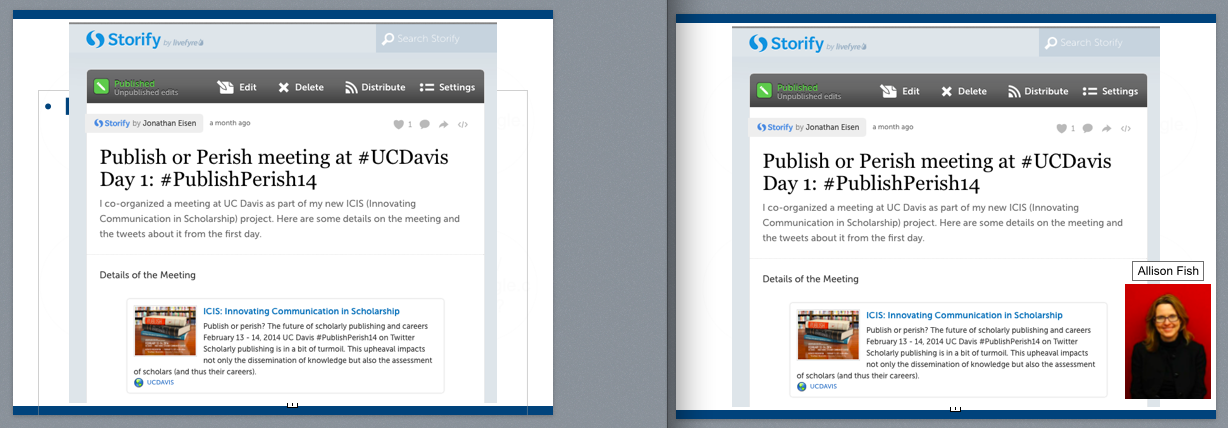
Storify summary of Tweets from Publication Mismatches meeting at #UCDavis

I made a brief Storification of some of the Tweets from the meeting. I ended up doing this a bit late and now the Twitter API makes it hard to find some of the Tweets but I think I captured much of the original posts (though miss out on some of the discussion).


Today’s wondering – why are so few of the speakers at "UC Drought Summit" women?

Got pointed to YAMWASGR (yet another meeting with a skewed gender ratio) this AM via Twitter.

//platform.twitter.com/widgets.js

This was in reference to a meeting in Sacramento:  Apr. 25: UC Drought Summit, free and open to public | Center for Watershed Sciences and alas the gender ratio is definitely skewed on the speaker list.  Men in Blue, Women in Yellow.

  • UC activities to reduce water use on and off campus
    • • Barbara Allen-Diaz, UC Division of Agriculture and Natural Resources 
    • • Matthew St.Clair, University Office of the President
  • Current drought: causes, how bad is it, and will we see more like it?
    • • Amir AghaKouchak, UC Irvine
    • • Michael Anderson, State Climatologist
    • • Daniel Cayan, UC San Diego
    • • William Collins, UC Berkeley; Intergovernmental Panel on Climate Change
    • • Glen MacDonald, UCLA
    • • Daniel Swain, Stanford University
  • Drought-proofing California?
    • • Michael Stenstrom, UCLA 
    • • Jay Lund, UC Davis
  • Kenneth Baerenklau, UC Riverside
    • Roger Bales, UC Merced
    • • Charles Burt, Cal Poly San Luis Obispo
    • • Frank Loge, UC Davis
    • • Stephanie Pincetl,UCLA
    • • Scott Stephens, UC Berkeley
  • Remarks by Chancellor Linda P.B. Katehi, UC Davis
  • Economic consequences of the drought: agriculture, energy, forests, industry and water
    • • Katrina Jessoe, UC Davis
    • • Anthony Madrigal, Twenty-Nine Palms Band of Mission Indians 
    • • Josué Medellín-Azuara, UC Davis
    • • Daniel Sumner, UC Agricultural Issues Center
    • • David Sunding, UC Berkeley
  • Endangered species and drought: science, management and policies
    • • Richard Frank, UC Davis
    • • Ellen Hanak, Public Policy Institute of California
    • • David Hayes, Stanford University; former deputy Interior secretary
    •  • Peter Moyle, UC Davis
    • • David Sedlak, UC Berkeley
    • • Joshua Viers, UC Merced
  • State policy for future droughts: groundwater, storage, marketing and conservation
    • • Jay Famiglietti, UC Irvine
    • • Thomas Harter, UC Davis
    • • Ruth Langridge, UC Santa Cruz
    • • Steve Macaulay, consultant
    • • Samuel Sandoval Solis, UC Davis 
    • • Kurt Schwabe, UC Riversidepage2image9504     page2image9928

That comes out to 26:6 in my count or 18.8% female, 81.2% male.  Now, I note – I have no idea what the “pool” looks like in this area, but such a % certainly does not look good from an outside (to the field, even though I am an insider in that this was organized by some people at UC Davis).   Once again, I would like to point out to meeting organizers, that having a diverse pool of speakers for a meeting is important for many reasons and sometimes it takes extra work to pull it off, but in my experience it is definitely worth it.