#UCDavis Provost’s Forum 10/9 – Michael Teitelbaum – Does the US have enough STEM workers?

Got this in an email …

Dear UC Davis Faculty, Staff, Students and Community Members,

We are delighted to announce that the 2014-2015 season of the Provost’s Forums on the Public University and the Social Good will begin on Thursday, October 9, 2014.

The first lecture of the season features Michael S. Teitelbaum, Senior Research Associate at the Labor and Worklife Program at Harvard University. Dr. Teitelbaum will discuss how the demand for and supply of STEM workers and scholars has been shaped and reshaped by public policies since World War II.

Among his previous roles, Dr. Teitelbaum has served as Vice President and Program Director at the Alfred P. Sloan Foundation, as a faculty member at Princeton University and the University of Oxford; and as Vice Chair and Acting Chair of the U.S. Commission on International Migration. He was educated at Reed College and at Oxford, where he was a Rhodes Scholar. He is a demographer, with research interests that include the causes and consequences of very low fertility rates; the processes and implications of international migration; and patterns and trends in science and engineering labor markets in the U.S. and elsewhere.

The event will begin at 4 p.m. in the Kalmonovitz Appellate Courtroom of King Hall and will go until 5:30 p.m. It is free and open to the general public. There will be an hour-long reception with light refreshments directly following the end of the lecture.

If you are unable to attend this event, videos of all Provost’s Forums lectures are available to the public and can be found on the official Provost’s Forums website. All of the lectures from the previous two years are now available for viewing.

For more details and information on this event, please see the attached flyer, visit our website: The Provost’s Forum on the Public University and the Social Good, or contact Casey Castaldi. In addition, please forward this information to any interested parties, as all events are open to the public.

We hope to see you at this exciting event!

Teitelbaum- 10.9.pdf

#UCDavis New Biology Postdoctoral Fellowship

New BiologyPostdoctoral Fellowship

College of Biological Sciences

UC Davis

The College of Biological Science at UC Davis invites applications for the New Biology Postdoctoral Fellowship program that brings outstanding young researchers to campus to conduct highly integrative research addressing major societal challenges. Fellows will have a home in a sponsoring CBS laboratory and will conduct research that leverages the tools and approaches represented by at least one additional laboratory at UC Davis.

A 2011 report by the National Research Council champions the power of deep integration of traditionally distinct research approaches and methods. The essence of the New Biology, as defined by this report, is integration – re-integration of the many sub-disciplines of biology, and the integration into biology of physicists, chemists, computer scientists, engineers, and mathematicians to create a research community with the capacity to tackle a broad range of scientific and societal problems.

Application: Interested early career individuals should establish communications with at least one host laboratory in the UC Davis College of Biological Sciences (http://biosci3.ucdavis.edu/Faculty/) and a second bridge laboratory from throughout the UC Davis community that can be from CBS or any other campus department. Eligibility is restricted to individuals who have the Ph.D. degree and will have completed no more than three years of postdoctoral training at the time of this appointment. Applicants should submit a cover letter that includes names and addresses of three letter writers, with their CV, statement of research accomplishments (1-2 pages) and a project summary of not more than 4 pages describing the research goals, the proposed integration of approaches, and explains how the work will lead to progress on a major societal challenge in nutrition, energy, health or the environment. Applications must be made electronically at: https://recruit.ucdavis.edu/apply/JPF00328.

Duration: Fellows are awarded a two year appointment.

Duties of the Fellow: In addition to conducting new research, the fellow would engage the community at UCD on three levels throughout the term of the fellowship:

  1. The fellow would give a research seminar near the inception of their tenure as an introduction of themselves and their research to the life sciences community at UCD.
  2. During the course of their tenure the fellow would offer a workshop or discussion series aimed at graduate students and others involving the transferal of new methods, tools, techniques or concepts to the UCD community. This might take the form of a focused workshop to demonstrate the utility of new analytical techniques or a more distributed discussion group that stretched over the course of fellow’s tenure. This activity will be defined in collaboration with the primary host PI and normally will take place during the second year of the postdoc.
  3. The fellow would engage the non-academic community in some form of public outreach activity. This could be a lecture aimed at the general public, an outreach event at local schools, picnic day, etc.

Together with the development of a fellow’s research program these three activities will help prepare the fellow for the multiple demands of academic life: research, teaching, and outreach.

Salary and Research Support: Awardees will be paid a salary of $50,000 per year ($34K from CBS, $8K from the hosting department, and $4K from each of the two sponsoring faculty members plus 17.45% for benefits and GAEL). While some research infrastructure will be supported by the host labs, to allow the scholar to pursue his or her research independent of grant funding from the host labs, a $10,000 per year research and travel budget will be provided by the college.

Selection Criteria:

  1. Ph.D. in biological sciences or related field at the time of appointment (but not necessarily at the time of nomination, as we would want to consider very recent PhDs.)
  2. Publication and prior research record that shows strong evidence of independent thinking and “superstar” potential
  3. Proposed research agenda / project that capitalizes on different research strengths of the two sponsoring faculty at UC Davis.
  4. Eligibility is restricted to individuals who have the Ph.D. degree and will have completed no more than three years of postdoctoral training at the time of this appointment.

EFFECTIVE: August 5, 2014

APPLICATION DEADLINE: December 1, 2014

NEW BIOLOGY POSTDOCTORAL FELLOWSHIP Ad 2014.pdf

installing STAMP on a Mac

Since this was such a huge pain in the ass for so many of us, I figured I’d share what finally worked for me.

First this:
pip install STAMP

then I got an error about matplotlib, so then this:
pip install matplotlib

Now, I type STAMP and it launches.

Of course, I did a hundred other things before I tried this, any number of which may or may not have contributed to the ease of this solution. But, if you’re still trying to get STAMP installed, give this a try.

“pip install STAMP” was a suggestion by Tracy Teal, btw. Can’t wait for her and Titus to get to Davis!

9/25 4PM GBSF1005: Lizzy WIlbanks “”Metagenomics and ecophysiology of macroscopic marine microbial aggregates: the ‘pink berries’ of the Sippewissett salt marsh””

Thursday, September 25, 2014

Lizzy Wilbanks

PhD Student in the Eisen and Facciotti Labs

“Metagenomics and ecophysiology of macroscopic marine microbial aggregates: the ‘pink berries’ of the Sippewissett salt marsh"

PhD exit seminar

1005 GBSF, 4:00 PM

exitSem.pdf

Story Behind the Paper: Comparative Analysis of Functional Metagenomic Annotation and the Mappability of Short Reads (by Rogan Carr and Elhanan Borenstein)

Here is another post in my “Story Behind the Paper” series where I ask authors of open access papers to tell the story behind their paper.  This one comes from Rogan Carr and Elhanan Borenstein.  Note – this was crossposted at microBEnet.  If anyone out there has an open access paper for which you want to tell the story — let me know.


We’d like to first thank Jon for the opportunity to discuss our work in this forum. We recently published a study investigating direct functional annotation of short metagenomic reads that stemmed from protocol development for our lab. Jon invited us to write a blog post on the subject, and we thought it would be a great venue to discuss some practical applications of our work and to share with the research community the motivation for our study and how it came about.

Our lab, the Borenstein Lab at the University of Washington, is broadly interested in metabolic modeling of the human microbiome (see, for example our Metagenomic Systems Biology approach) and in the development of novel computational methods for analyzing functional metagenomic data (see, for example, Metagenomic Deconvolution). In this capacity, we often perform large-scale analysis of publicly available metagenomic datasets as well as collaborate with experimental labs to analyze new metagenomic datasets, and accordingly we have developed extensive expertise in performing functional, community-level annotation of metagenomic samples. We focused primarily on protocols that derive functional profiles directly from short sequencing reads (e.g., by mapping the short reads to a collection of annotated genes), as such protocols provide gene abundance profiles that are relatively unbiased by species abundance in the sample or by the availability of closely-related reference genomes. Such functional annotation protocols are extremely common in the literature and are essential when approaching metagenomics from a gene-centric point of view, where the goal is to describe the community as a whole.

However, when we began to design our in-house annotation pipeline, we pored over the literature and realized that each research group and each metagenomic study applied a slightly different approach to functional annotation. When we implemented and evaluated these methods in the lab, we also discovered that the functional profiles obtained by the various methods often differ significantly. Discussing these findings with colleagues, some further expressed doubt that that such short sequencing reads even contained enough information to map back unambiguously to the correct function. Perhaps the whole approach was wrong!

We therefore set out to develop a set of ‘best practices’ for our lab for metagenomic sequence annotation and to prove (or disprove) quantitatively that such direct functional annotation of short reads provides a valid functional representation of the sample. We specifically decided to pursue a large-scale study, performed as rigorously as possible, taking into account both the phylogeny of the microbes in the sample and the phylogenetic coverage of the database, as well as several technical aspects of sequencing like base-calling error and read length. We have found this evaluation approach and the results we obtained quite useful for designing our lab protocols, and thought it would be helpful to share them with the wider metagenomics and microbiome research community. The result is our recent paper in PLoS One, Comparative Analysis of Functional Metagenomic Annotation and the Mappability of Short Reads.

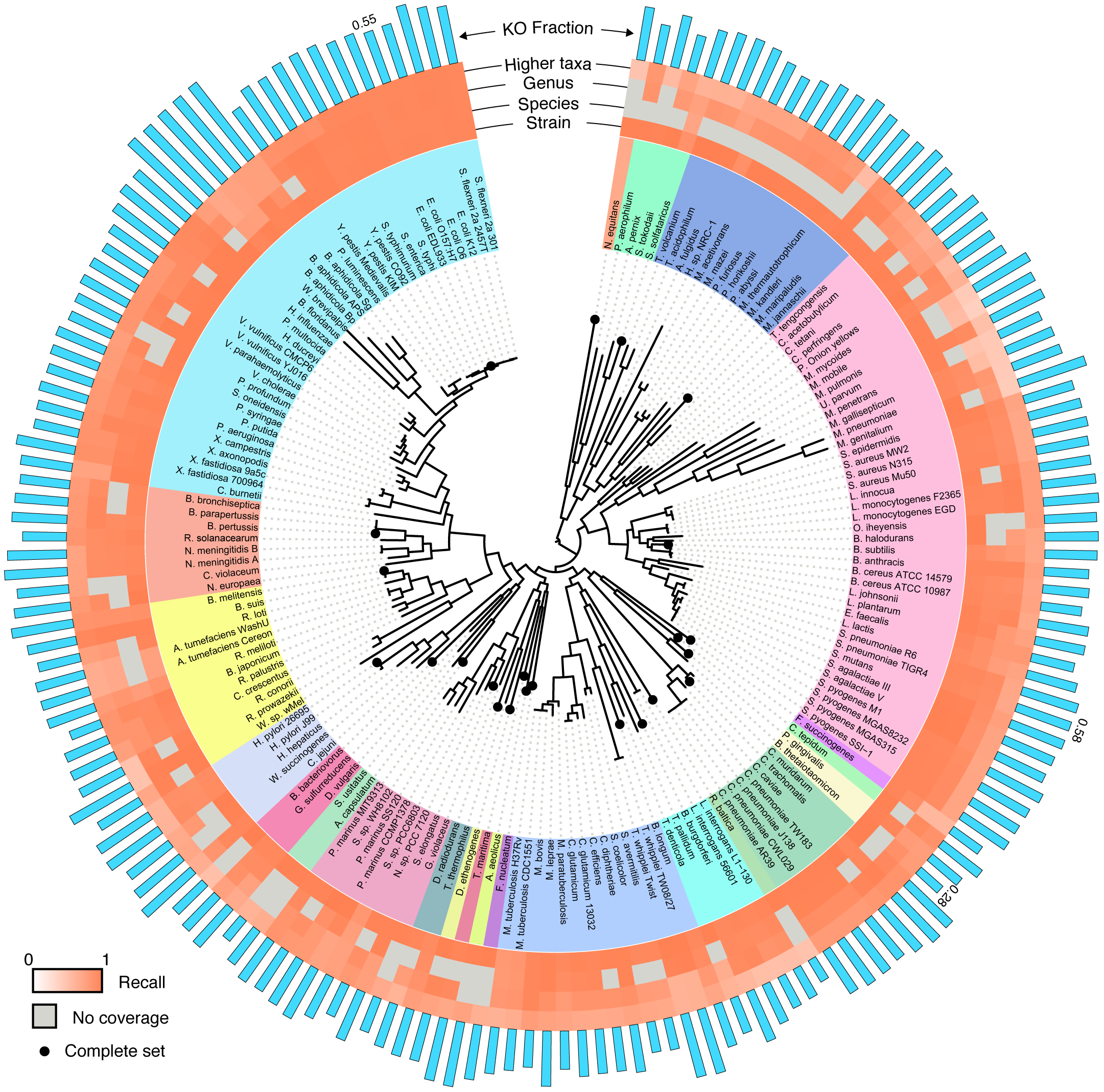
The performance of BLAST-based annotation of short reads across the bacterial and archaeal tree of life. The phylogenetic tree was obtained from Ciccarelli et al. Colored rings represent the recall for identifying reads originating from a KO gene using the top gene protocol. The 4 rings correspond to varying levels of database coverage. Specifically, the innermost ring illustrates the recall obtained when the strain from which the reads originated is included in the database, while the other 3 rings, respectively, correspond to cases where only genomes from the same species, genus, or more remote taxonomic relationships are present in the database. Entries where no data were available (for example, when the strain from which the reads originated was the only member of its species) are shaded gray. For one genome in each phylum, denoted by a black dot at the branch tip, every possible 101-bp read was generated for this analysis. For the remaining genomes, every 10th possible read was used. Blue bars represent the fraction of the genome's peptide genes associated with a KO; for reference, the values are shown for E. coli, B. thetaiotaomicron, and S. Pneumoniae. Figure and text adapted from: Carr R, Borenstein E (2014) Comparative Analysis of Functional Metagenomic Annotation and the Mappability of Short Reads. PLoS ONE 9(8): e105776. doi:10.1371/journal.pone.0105776. See the manuscript for full details.
The performance of BLAST-based annotation of short reads across the bacterial and archaeal tree of life using the ‘top gene’ protocol. See the manuscript for full details. Figure and text adapted from: Carr R, Borenstein E (2014) Comparative Analysis of Functional Metagenomic Annotation and the Mappability of Short Reads. PLoS ONE 9(8): e105776 

To perform a rigorous study of functional annotation, we needed a set of reads whose true annotations were known (a “ground truth”). In other words, we had to know the exact locus and the exact genome from which each sequencing read originated and the functional classification associated with this locus. We further wanted to have complete control over technical sources of error. To accomplish this, we chose to implement a simulation scheme, deriving a huge collection of sequence reads from fully sequenced, well annotated, and curated genomes. This schemed allowed us to have complete information about the origin of each read and allowed us to simulate various technical factors we were interested in. Moreover, simulating sequencing reads allowed us to systematically eliminate variations in annotation performance due to technological or biological effects that would typically be convoluted in an experimental setup. For a set of curated genomes, we settled on the KEGG database, as it contained a large collection of consistently functionally curated microbial genomes and it has been widely used in metagenomics for sample annotation. The KEGG hierarchy of KEGG Orthology groups (KOs), Modules, and Pathways could then serve as a common basis for comparative analysis. To control for phylogenetic bias in our results, we sampled broadly across 23 phyla and 89 genera in the bacterial and archaeal tree of life, using a randomly selected strain in KEGG for each tip of the tree from Ciccarelli et al. From each of the selected 170 strains, we generated either *every* possible contiguous sequence of a given length or (in some cases) every 10th contiguous sequence, using a sliding window approach. We additionally introduced various models to simulate sequencing errors. This large collection of reads (totaling ~16Gb) were then aligned to the KEGG genes database using a translated BLAST mapping. To control for phylogenetic coverage of the database (the phylogenetic relationship of the database to the sequence being aligned) we also simulated mapping to many partial collections of genomes. We further used four common protocols from the literature to convert the obtained BLAST alignments to functional annotations. Comparing the resulting annotation of each read to the annotation of the gene from which it originated allowed us to systematically evaluate the accuracy of this annotation approach and to examine the effect of various factors, including read length, sequencing error, and phylogeny.

First and foremost, we confirmed that direct annotation of short reads indeed provides an overall accurate functional description of both individual reads and the sample as a whole. In other words, short reads appear to contain enough information to identify the functional annotation of the gene they originated from (although, not necessarily the specific taxa of origin). Functions of individual reads were identified with high precision and recall, yet the recall was found to be clade dependent. As expected, recall and precision decreased with increasing phylogenetic distance to the reference database, but generally, having a representative of the genus in the reference database was sufficient to achieve a relatively high accuracy. We also found variability in the accuracy of identifying individual KOs, with KOs that are more variable in length or in copy number having lower recall. Our paper includes abundance of data on these results, a detailed characterization of the mapping accuracy across different clades, and a description of the impact of additional properties (e.g., read length, sequencing error, etc.).

A principal component analysis of the pathway abundance profiles obtained for 15 HMP samples and by four different annotation protocols. HMP samples are numbered from 1 to 15 according to the list that appears in the Methods section of the manuscript. The different protocols are represented by color and shape. Note that two outlier protocols for sample 14 are not shown but were included in the PCA calculation. Figure and text adapted from: Carr R, Borenstein E (2014) Comparative Analysis of Functional Metagenomic Annotation and the Mappability of Short Reads. PLoS ONE 9(8): e105776. doi:10.1371/journal.pone.0105776. See the manuscript for full details.
A principal component analysis of the pathway abundance profiles obtained for 15 HMP samples and by four different annotation protocols.The different protocols are represented by color and shape. See the manuscript for full details. Figure and text adapted from: Carr R, Borenstein E (2014) Comparative Analysis of Functional Metagenomic Annotation and the Mappability of Short Reads. PLoS ONE 9(8): e105776 

Importantly, while the obtained functional annotations are in general representative of the true content of the sample, the exact protocol used to analyze the BLAST alignments and to assign functional annotation to each read could still dramatically affect the obtained profile. For example, in analyzing stool samples from the Human Microbiome Project, we found that each protocol left a consistent “fingerprint” on the resulting profile and that the variation introduced by the different protocols was on the same order of magnitude as biological variation across samples. Differences in annotation protocols are thus analogous to batch effects from variation in experimental procedures and should be carefully taken into consideration when designing the bioinformatic pipeline for a study.

Generally, however, we found that assigning each read with the annotation of the top E-value hit (the ‘top gene’ protocol) had the highest precision for identifying the function from a sequencing read, and only slightly lower recall than methods enriching for known annotations (such as the commonly used ‘top 20 KOs’ protocol). Given our lab interests, this finding led us to adopt the ‘top gene’ protocol for functionally annotating metagenomic samples. Specifically, our work often requires high precision for annotating individual reads for model reconstruction (e.g., utilizing the presence and absence of individual genes) and the most accurate functional abundance profile for statistical method development. If your lab has similar interests, we would recommend this approach for your annotation pipelines. If however, you have different or more specific needs, we encourage you to make use of the datasets we have published along with our paper to help you design your own solution. We would also be very happy to discuss such issues further with labs that are considering various approaches for functional annotation, to assess some of the factors that can impact downstream analyses, or to assist in such functional annotation efforts.

A distasteful & disgraceful "Are there limits to evolution?" meeting at the University of Cambridge #YAMMM

Well, I saw this Tweet the other day

//platform.twitter.com/widgets.js And though there was a bit of a discussion on Twitter I felt I had to follow up with a blog post. When I saw the post I was at a conference (Lake Arrowhead Microbial Genomes) where I could get Twitter access but for some reason very little web access. So I could not dig around until now (I am home). 

This meeting is a complete disgrace and an embarassment for the field of evolutionary biology, for the University of Cambridge which is hosting the meeting, and for the Templeton Foundation which is sponsoring it.

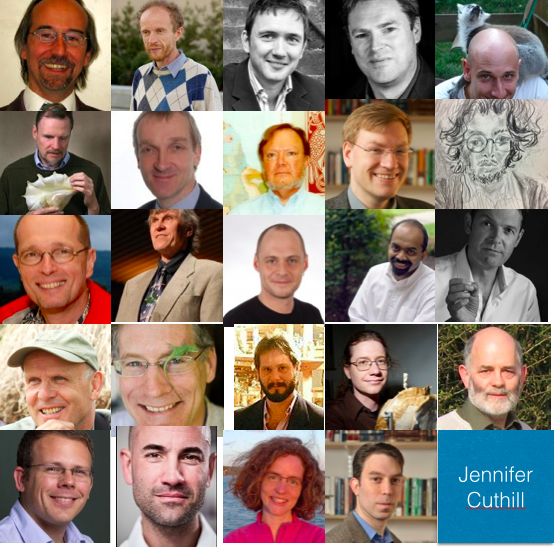
Why do I say this? Well, pretty simple actually. The meeting site lists the Invited Keynote speakers for the meeting.  Notice anything?  How about I help you by bringing all the pictures together.

Notice anything now?  How about I help you some more by masking out the men and not the women.

Impressive no?  25 speakers – 23 of them male.  I guess that means there are no qualified female speakers who coudl discuss something about evolution right?  It would be worth reading “Fewer invited talks bu women in evolutionary biology symposia” to get some context.  What an incredible, disgusting, distasteful and disgraceful meeting.  
I recommend to everyone who was considering going to this meeting – skip it.  Also consider writing to the University of Cambirdge and the Templeton Foundation to express your thoughts about the meeting.  This certainly is a fine example of Yet Another Mostly Male Meeting (YAMMM).  Well, maybe I should word that differently – this is a disgusting example of a YAMMM.  


For more on this and related issues

  • Posts on Women in STEM

  • Also see

    //platform.twitter.com/widgets.js

    Fun read of the day: On whimsy, jokes, and beauty: can scientific writing be enjoyed?

    This is such a fun paper: On whimsy, jokes, and beauty: can scientific writing be enjoyed? by Stephen Heard in Ideas in Ecology and Evolution 7: 64–72, 2014  I found out about it in an email from Heard, who sent it to me because he had earlier commented on a blog post I had written: The best writing in science papers part 1: Vladimir Nabokov in Notes on Neotropical Plebejinae (Lycaenidae, Lepidoptera).

    Anyway – enough about me – what about this paper?  It has so many nuggets of interest I am not sure which to highlight so I will just go through some of it.  Oh – and it is published with a Creative Commons Attribution license (yay).

    Abstract: While scientists are often exhorted to write better, it isn’t entirely obvious what “better” means. It’s uncontroversial that good scientific writing is clear, with the reader’s understanding as effortless as possible. Unsettled, and largely undiscussed, is the question of whether our goal of clarity precludes us from making our writing enjoyable by incorporating touches of whimsy, humanity, humour, and beauty. I offer examples of scientific writing that offers pleasure, drawing from ecology and evolution and from other natural sciences, and I argue that enjoyable writing can help recruit readers to a paper and retain them as they read. I document resistance to this idea in the scientific community, and consider the objections (well grounded and not) that may lie behind this resistance. I close by recommending that we include touches of whimsy and beauty in our own writing, and also that we work to encourage such touches in the writing of others.

    OK – the title would have drawn me in anyway but the abstract definitely had me.

    If scientific writers aren’t sure how to write better, it isn’t for lack of advice. Dozens of guidebooks discuss form, style, and goals in scientific writing (e.g., Montgomery 2003, Davis 2005, Day and Gastel 2006, Katz 2006, Matthews and Matthews 2007, Rogers 2007, Harmon and Gross 2010, Hofmann 2010, Pechenik 2010, Greene 2013, Heard unpubl.).

    OK – I am going to have to look at some of these.

    Heard documents a bit of a spat between Sprat and Boyle from the 1660s regarding scientific writing.  I especially like the Boyle quote:

    To affect needless rhetorical ornaments in setting down an experiment…were little less improper than…to paint the eyeglasses of a telescope…in which even the most delightful colours cannot so much please the eye as they would hinder the sight…And yet I approve not that dull and insipid way of writing, which is practiced by many…for though a philosopher need not be solicitous that his style should delight his reader with his floridness, yet I think he may very well be allowed to take a care that it disgust not his reader by its flatness…Though it were foolish to colour…the glasses of telescopes, yet to gild…the tubes of them may render them most acceptable to the users (Boyle 1661:11-12, spelling and punctuation modern- ized).

    Heard then goes through some different aspects of good scientific writing

    • Sightings (1): Playfulness in the scientific literature
    • Sightings (2): Beauty

    Also – he then doscusses pushback against the “notion that whimsy, jokes, and beauty can have a place in our scientific literature.” which I have also seen in many contexts.

    He ends with suggestions and I quote the whole section with some highlights:

    If you write papers that are crystal clear and thus effortless to read, you’ll have achieved the primary goal of scientific writing and your work will be among the best of our literature. But if you want to reach for even more, if you agree with me that we can also offer our readers some pleasure in reading, what can you do? To begin, you can try to write with small touches of whimsy, humanity, humour, and beauty—without, of course, compromising clarity; and even knowing that sometimes, reviewers will make you take them out. I am not suggesting writing in which art shares the stage equally with content (as can be true in the lay literature). Rather, the goal that’s within our reach is clear, functional writing punctuated with occasional nuggets of playfulness or glints of beauty—to extend Boyle’s metaphor, not a telescope of solid gold but one lightly gilded. 

    You can also work to encourage pleasure in what your colleagues write, in two complementary ways. First, when you review manuscripts, you can suppress the reflex telling you to question any touches of whimsy, humour, or beauty that you find; you can even (gently) suggest some be put in. Second, you can announce your admiration of writing that has given you pleasure. Announce your admiration to the writers who crafted the passage, to editors who might be considering its fate, and to students or colleagues who might read it. If we choose to, we can change our culture to deliver, and value, pleasure along with function in our writing.

    This is a must read paper.  And I really wish more people would endorse the idea that scientific writing can include more than just science.  Of course, there are many who already endorse this notion but for those who do not – give it a try.

    Cornell University-MBG job posting

    Posting this:

    Dear Dr. Eisen,

    We are writing to enlist your assistance in identifying talented candidates for a tenure-track Assistant or Associate Professor position in the Department of Molecular Biology and Genetics at Cornell University in Ithaca, NY. We are seeking to fill this position with a creative individual in the area of Computational Genomics.

    Our hope is that this individual will interact synergistically with existing department strengths as well as those in other departments at Cornell including Biological Statistics and Computational Biology (BSCB). We envision that the ideal candidate will develop innovative computational genomics methods to solve novel problems in genome biology. An advertisement, which is attached, will appear in the September 19, 2014 issue of Science and more information is available at http://mbg.cornell.edu/jobs

    This is a very exciting time at Cornell as the University has specifically targeted computational biology for expansion, and is making a concerted investment in interdisciplinary studies that bridge existing strengths in the University.

    The Department of Molecular Biology and Genetics (www.mbg.cornell.edu ) includes a highly interactive faculty with research programs in genetics, molecular biology, comparative and population genomics, cell biology, developmental biology, biochemistry and structural biology. Excellent students are attracted to graduate programs in Biochemistry, Molecular and Cell Biology (BMCB), Genetics, Genomics and Development (GG&D), Computational Biology (CB), and Biophysics.

    Please bring this great opportunity to the attention of outstanding junior scientists in your department. It would help us enormously if you could post the attached advertisement. If you have any questions, please do not hesitate to contact me at barbash.

    Sincerely yours,

    Daniel Barbash, Ph.D.

    Associate Professor

    Chair, Computational Genomics Search Committee

    Computational Genomics Ad September 2014.pdf

    Grant opportunities from the Bill & Melinda Gates Foundation

    Received this email:

    Dear Colleagues,

    The Bill & Melinda Gates Foundation is now inviting applications to Grand Challenges Explorations, which has awarded over 1070 grants in over 58 countries to date.

    Grand Challenges Explorations seeks innovative global health and development solutions. Applicants can be at any experience level; in any discipline; and from any organization, including universities, government laboratories, research institutions, non-profit organizations as well as for-profit companies.

    Two-page proposals are being accepted online from September 4, 2014 until November 12, 2014 on the following topics:

    – Surveillance Tools, Diagnostics and an Artificial Diet to Support New Approaches to Vector Control.
    – New Approaches for Addressing Outdoor/Residual Malaria Transmission
    – New Ways to Reduce Pneumonia Fatalities through Timely, Effective Treatment of Children
    – Enable Universal Acceptance of Mobile Money Payments to Create an Economic Ecosystem that Will Help Lift the Poorest Out of Poverty
    – Explore New Ways to Measure Brain Development and Gestational Age
    – New Ways of Working Together: Integrating Community-Based Interventions

    Initial grants will be US $100,000 each, and projects showing promise will have the opportunity to receive additional funding of up to US $1 million. Full descriptions of the new topics and application instructions are available at: www.grandchallenges.org/explorations.

    We look forward to receiving innovative ideas from around the world and from all disciplines. If you have a great idea, please apply. If you know someone who may have a great idea, please forward this message.

    Please also note our Global Health Innovation Group on LinkedIn. Developed in collaboration with Grand Challenges Canada, this group offers a platform to connect and communicate with innovators from around the world. Anyone with a LinkedIn account can join and make use of this forum.

    Thank you for your commitment to solving the world’s greatest health and development challenges.

    The Grand Challenges Team

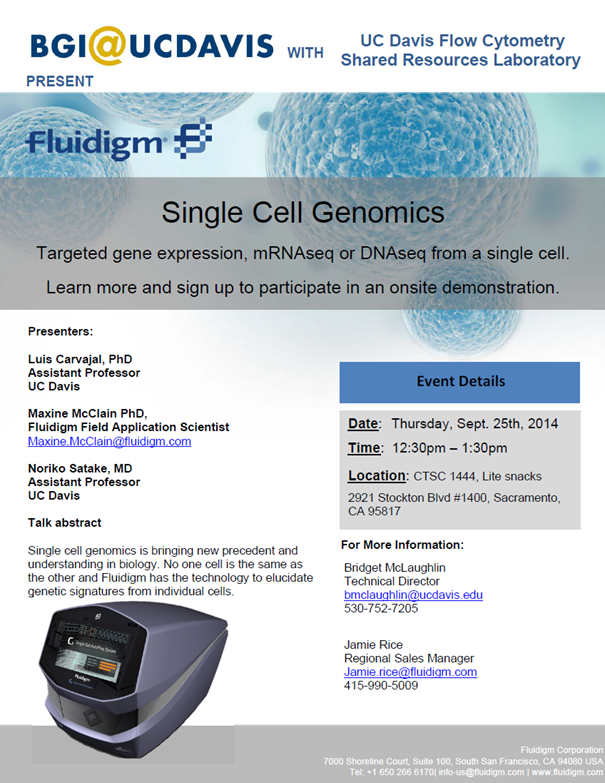
    Single cell genomics at #UCDavis …

    z

    UCDMCroadshow2014-BGImod.pdf